Evidence
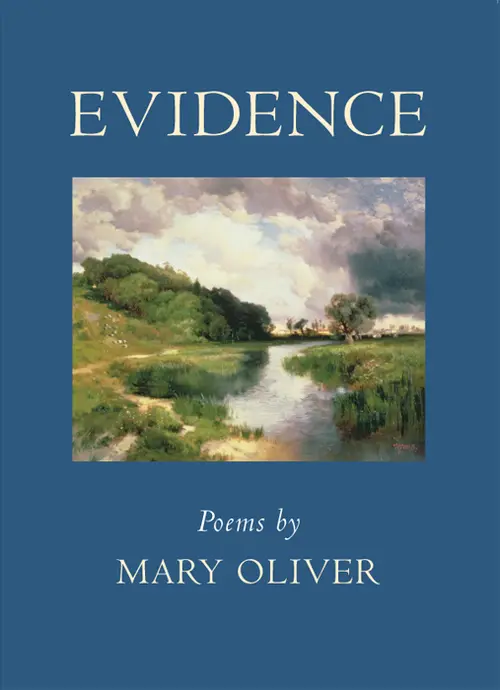
Cover
Title Page
OTHER BOOKS BY MARY OLIVER
POETRY
No Voyage and Other Poems
The River Styx, Ohio, and Other Poems
Twelve Moons
American Primitive
Dream Work
House of Light
New and Selected Poems Volume One
White Pine
West Wind
The Leaf and the Cloud
What Do We Know
Owls and Other Fantasies
Why I Wake Early
Blue Iris
New and Selected Poems Volume Two
Thirst
Red Bird
The Truro Bear and Other Adventures
CHAPBOOKS AND SPECIAL EDITIONS
The Night Traveler
Sleeping in the Forest
Provincetown
Wild Geese (UK Edition)
PROSE
A Poetry Handbook
Blue Pastures
Rules for the Dance
Winter Hours
Long Life
Our World (with photographs by Molly Malone Cook)
Dedication
For Anne Taylor
We create ourselves by our choices.
—Kierkegaard
Yellow
There is the heaven we enter
through institutional grace
and there are the yellow finches bathing and singing
in the lowly puddle.
Swans
They appeared
over the dunes,
they skimmed the trees
and hurried on
to the sea
or some lonely pond
or wherever it is
that swans go,
urgent, immaculate,
the heat of their eyes
staring down
and then away,
the thick spans
of their wings
as bright as snow,
their shoulder-power
echoing
inside my own body.
How could I help but adore them?
How could I help but wish
that one of them might drop
a white feather
that I should have
something in my hand
to tell me
that they were real?
Of course
this was foolish.
What we love, shapely and pure,
is not to be held,
but to be believed in.
And then they vanished, into the unreachable distance.
Heart Poem
My heart, that used to pump along so pleasantly, has come now to a different sort of music.
There is someone inside those red walls, irritated and even, occasionally, irrational.
Years ago I was part of an orchestra; our conductor was a wild man. He was forever rapping the music- stand for silence. Then he would call out some correction and we would begin again.
Now again it is the wild man.
I remember the music shattering, and our desperate attentiveness.
Once he flung the baton over our heads and into the midst of the players. It flew over the violins and landed next to a bass fiddle. It flopped to the floor. What silence! Then someone picked it up and it was passed forward back to him. He rapped the stand and raised his arms. Then we all breathed again, and the music restarted.
Prince Buzzard
Prince Buzzard,
I took you, so high in the air,
for a narrow boat and two black sails.
You were drifting
in the depths of the air
wherever you wanted to go,
and when you came down
with your spoony mouth
and your red head
and your creaking wings
to the lamb
dead, dead, dead
in the fields of spring
I knew it was hunger
that brought you—
yet you went about it
so slowly,
settling with hunched wings
and silent
as the grass itself
over the lamb’s white body—
it seemed
a ceremony,
a pause
as though something
in the quick of your own body
had come out
to give thanks
for the dark work
that was yours,
which wasn’t to be done easily or quickly,
but thoroughly—
and indeed by time summer
opened its green harbors
the field was nothing but flowers, flowers, flowers,
from shore to shore
Li Po and the Moon
There is the story of the old Chinese poet:
at night in his boat he went drinking and dreaming
and singing
then drowned as he reached for the moon’s reflection.
Well, probably each of us, at some time, has been
as desperate.
Not the moon, though.
Thinking of Swirler
One day I went out
into a wonderful
ongoing afternoon,
it was fall,
the pine trees were brushing themselves
against the sky
as though they were painting it,
and Swirler,
who was alive then,
was walking slowly
through the green bog,
his neck
as thick as an ox,
his antlers
brushing against the trees,
his three good feet tapping
the softness beneath him
and the fourth, from an old wound,
swirling.
I know he saw me
for he gave me a long look
which was as precious as a few
good words,
since his eyes
were without terror.
What do the creatures know?
What in this world can we be certain about?
How did he know I was nothing
but a harmless mumbler of words,
some of which would be about him
and this wind-whipped day?
In a week he would be dead,
arrowed down by a young man I like,
though with some difficulty.
In my house there are a hundred half-done poems.
Each of us leaves an unfinished life.
Snowy Egret
A late summer night and the snowy egret
has come again to the shallows in front of my house
as he has for forty years.
Don’t think he is a casual part of my life,
that white stroke in the dark.
Violets
Down by the rumbling creek and the tall trees—
where I went truant from school three days a week
and therefore broke the record—
there were violets as easy in their lives
as anything you have ever seen
or leaned down to intake the sweet breath of.
Later, when the necessary houses were built
they were gone, and who would give significance
to their absence.
Oh, violets, you did signify, and what shall take
your place?
Then Bluebird Sang
Bluebird
slipped a little tremble
out of the triangle
of his mouth
and it hung in the air
until it reached my ear
like a froth or a frill
that Schumann
might have written in a dream.
Dear morning
you come
with so many angels of mercy
so wondrously disguised
in feathers, in leaves,
in the tongues of stones,
in the restless waters,
in the creep and the click
and the rustle
that greet me wherever I go
with their joyful cry: I’m still here, alive!
We Shake with Joy
We shake with joy, we shake with grief.
What a time they have, these two
housed as they are in the same body.
Spring
Faith
is the instructor.
We need no other.
Guess what I am,
he says in his
incomparably lovely
young-man voice.
Because I love the world
I think of grass,
I think of leaves
and the bold sun,
I think of the rushes
in the black marshes
just coming back
from under the pure white
and now finally melting
stubs of snow.
Whatever we know or don’t know
leads us to say:
Teacher, what do you mean?
But faith is still there, and silent.
Then he who owns
the incomparable voice
suddenly flows upward
and out of the room
and I follow,
obedient and happy.
Of course I am thinking
the Lord was once young
and will never in fact be old.
And who else could this be, who goes off
down the green path,
carrying his sandals, and singing?
The Poet Always Carries a Notebook
What is he scribbling on the page?
Is there snow in it, or fire?
Is it the beginning of a poem?
Is it a love note?
More Honey Locust
Any day now
the branches
of the honey locust
will be filled
with white fountains;
in my hands
I will see
the holy seeds
and a sweetness
will rise up
from those petal-bundles
so heavy
I must close my eyes
to take it in,
to bear
such generosity.
I hope that you too
know the honey locust,
the fragrance
of those fountains;
and I hope that you too will pause
to admire the slender trunk,
the leaves, the holy seeds,
the ground they grow from
year after year
with striving and patience;
and I hope that you too
will say a word of thanks
for such creation
out of the wholesome earth,
which would be, and dearly is it needed,
a prayer for all of us.
Halleluiah
Everyone should be born into this world happy
and loving everything.
But in truth it rarely works that way.
For myself, I have spent my life clamoring toward it.
Halleluiah, anyway I’m not where I started!
And have you too been trudging like that, sometimes
almost forgetting how wondrous the world is
and how miraculously kind some people can be?
And have you too decided that probably nothing important
is ever easy?
Not, say, for the first sixty years.
Halleluiah, I’m sixty now, and even a little more,
and some days I feel I have wings.
It Was Early
It was early,
which has always been my hour
to begin looking
at the world
and of course,
even in the darkness,
to begin
listening into it,
especially
under the pines
where the owl lives
and sometimes calls out
as I walk by,
as he did
on this morning.
So many gifts!
What do they mean?
In the marshes
where the pink light
was just arriving
the mink
with his bristle tail
was stalking
the soft-eared mice,
and in the pines
the cones were heavy,
each one
ordained to open.
Sometimes I need
only to stand
wherever I am
to be blessed.
Little mink, let me watch you.
Little mice, run and run.
Dear pine cone, let me hold you
as you open.
Water
What is the vitality and necessity
of clean water?
Ask the man who is ill, who is lifting
his lips to the cup.
Ask the forest.
If You Say It Right, It Helps the Heart to Bear It
The comforts
of language
are true
and deep;
in a cemetery,
in the South,
so many stones
and so many
so small.
Sometimes
three or four
in a row.
In this instance:
Eliza May,
Oceola,
Joseph.
Can you imagine
the condition
of the heart
of a mother
or a father
watching these plantings?
I cannot.
But I try.
“God taketh
his young lambs home”
is carved there.
A few words
like water
on a stone.
Cool and beautiful
like water on a stone.
Empty Branch in the Orchard
To have loved
is everything.
I loved, once,
a hummingbird
who came every afternoon—
the freedom-loving male—
who flew by himself
to sample
the sweets of the garden,
to sit
on a high, leafless branch
with his red throat gleaming.
And then, he came no more.
And I’m still waiting for him,
ten years later,
to come back,
and he will, or he will not.
There is a certain commitment
that each of us is given,
that has to do
with another world,
if there is one.
I remember you, hummingbird.
I think of you every day
even as I am still here,
soaked in color, waiting
year after honey-rich year.
A Lesson from James Wright
If James Wright
could put in his book of poems
a blank page
dedicated to “the Horse David
Who Ate One of My Poems,” I am ready
to follow him along
the sweet path he cut
through the dryness
and suggest that you sit now
very quietly
in some lovely wild place, and listen
to the silence.
And I say that this, too,
is a poem.
Deep Summer
The mockingbird
opens his throat
among the thorns
for his own reasons
but doesn’t mind
if we pause
to listen
and learn something
for ourselves;
he doesn’t stop,
he nods
his gray head
with the frightfully bright eyes,
he flirts
his supple tail,
he says:
listen, if you would listen.
There’s no end
to good talk,
to passion songs,
to the melodies
that say
this branch,
this tree is mine,
to the wholesome
happiness
of being alive
on a patch
of this green earth
in the deep
pleasures of summer.
What a bird!
Your clocks, he says plainly,
which are always ticking,
do not have to be listened to.
The spirit of his every word.
Almost a Conversation
I have not really, not yet, talked with otter
about his life.
He has so many teeth, he has trouble
with vowels.
Wherefore our understanding
is all body expression—
he swims like the sleekest fish,
he dives and exhales and lifts a trail of bubbles.
Little by little he trusts my eyes
and my curious body sitting on the shore.
Sometimes he comes close.
I admire his whiskers
and his dark fur which I would rather die than wear.
He has no words, still what he tells about his life
is clear.
He does not own a computer.
He imagines the river will last forever.
He does not envy the dry house I live in.
He does not wonder who or what it is that I worship.
He wonders, morning after morning, that the river
is so cold and fresh and alive, and still
I don’t jump in.
There Are a Lot of Mockingbirds in This Book
Yes, there are many
of those wondrous creatures
who live in the thorns
and are musical all day
and the Lord knows
when they sleep, for they sing
in the dark as well,
as they stare at the moon,
as they flutter a little
into the air
then back to the branch,
back to the thorns—
but this isn’t nature
in which such birds
want, each pair,
their own few acres—
this isn’t nature
where the sweetest things,
being hidden in leaves
and thorn-thick bushes
reveal themselves rarely—
this is a book
of the heart’s rapture,
of hearing and praising
and never forgetting
so that the world
is what the world is
in a long lifetime:
singer after singer
bursts from the thorn bush,
now, and again, and again,
their songs in the mind forever.
Prayer
May I never not be frisky,
May I never not be risqué.
May my ashes, when you have them, friend,
and give them to the ocean,
leap in the froth of the waves,
still loving movement,
still ready, beyond all else,
to dance for the world.
At the Pond
One summer
I went every morning
to the edge of a pond where
a huddle of just-hatched geese
would paddle to me
and clamber
up the marshy slope
and over my body,
peeping and staring—
such sweetness every day
which the grown ones watched,
for whatever reason,
serenely.
Not there, however, but here
is where the story begins.
Nature has many mysteries,
some of them severe.
Five of the young geese grew
heavy of chest and
bold of wing
while the sixth waited and waited
in its gauze-feathers, its body
that would not grow.
And then it was fall.
And this is what I think
everything is about:
the way
I was glad
for those five and two
that flew away,
and the way I hold in my heart the wingless one
that had to stay.
To Begin With, the Sweet Grass
1.
Will the hungry ox stand in the field and not eat
of the sweet grass?
Will the owl bite off its own wings?
Will the lark forget to lift its body in the air or
forget to sing?
Will the rivers run upstream?
Behold, I say—behold
the reliability and the finery and the teachings
of this gritty earth gift.
2.
Eat bread and understand comfort.
Drink water, and understand delight.
Visit the garden where the scarlet trumpets
are opening their bodies for the hummingbirds
who are drinking the sweetness, who are
thrillingly gluttonous.
For one thing leads to another.
Soon you will notice how stones shine underfoot.
Eventually tides will be the only calendar you believe in.
And someone’s face, whom you love, will be as a star
both intimate and ultimate,
and you will be both heart-shaken and respectful.
And you will hear the air itself, like a beloved, whisper:
oh, let me, for a while longer, enter the two
beautiful bodies of your lungs.
3.
The witchery of living
is my whole conversation
with you, my darlings.
All I can tell you is what I know.
Look, and look again.
This world is not just a little thrill for the eyes.
It’s more than bones.
It’s more than the delicate wrist with its personal pulse.
It’s more than the beating of the single heart.
It’s praising.
It’s giving until the giving feels like receiving.
You have a life—just imagine that!
You have this day, and maybe another, and maybe
still another.
4.
Someday I am going to ask my friend Paulus,
the dancer, the potter,
to make me a begging bowl
which I believe
my soul needs.
And if I come to you,
to the door of your comfortable house
with unwashed clothes and unclean fingernails,
will you put something into it?
I would like to take this chance.
I would like to give you this chance.
5.
We do one thing or another; we stay the same, or we
change.
Congratulations, if
you have changed.
6.
Let me ask you this.
Do you also think that beauty exists for some
fabulous reason?
And, if you have not been enchanted by this adventure—
your life—
what would do for you?
7.
What I loved in the beginning, I think, was mostly myself.
Never mind that I had to, since somebody had to.
That was many years ago.
Since then I have gone out from my confinements,
though with difficulty.
I mean the ones that thought to rule my heart.
I cast them out, I put them on the mush pile.
They will be nourishment somehow (everything is nourishment
somehow or another).
And I have become the child of the clouds, and of hope.
I have become the friend of the enemy, whoever that is.
I have become older and, cherishing what I have learned,
I have become younger.
And what do I risk to tell you this, which is all I know?
Love yourself. Then forget it. Then, love the world.
With Thanks to the Field Sparrow, Whose Voice Is So Delicate and Humble
I do not live happily or comfortably
with the cleverness of our times.
The talk is all about computers,
the news is all about bombs and blood.
This morning, in the fresh field,
I came upon a hidden nest.
It held four warm, speckled eggs.
I touched them.
Then went away softly,
having felt something more wonderful
than all the electricity of New York City.
Landscape in Winter
Upon the snow that says nothing,
that is endlessly brilliant,
there is something
heaped, dark and motionless.
Then come the many wings, strong and bold.
“Death has happened,” shout the carrion crows.
I Want to Write Something So Simply
“And this is good for us.”
I want to write something
so simply
about love
or about pain
that even
as you are reading
you feel it
and as you read
you keep feeling it
and though it be my story
it will be common,
though it be singular
it will be known to you
so that by the end
you will think—
no, you will realize—
that it was all the while
yourself arranging the words,
that it was all the time
words that you yourself,
out of your own heart
had been saying.
Evidence
1.
Where do I live? If I had no address, as many people
do not, I could nevertheless say that I lived in the
same town as the lilies of the field, and the still
waters.
Spring, and all through the neighborhood now there are
strong men tending flowers.
Beauty without purpose is beauty without virtue. But
all beautiful things, inherently, have this function—
to excite the viewers toward sublime thought. Glory
to the world, that good teacher.
Among the swans there is none called the least, or
the greatest.
I believe in kindness. Also in mischief. Also in
singing, especially when singing is not necessarily
prescribed.
As for the body, it is solid and strong and curious
and full of detail; it wants to polish itself; it
wants to love another body; it is the only vessel in
the world that can hold, in a mix of power and
sweetness: words, song, gesture, passion, ideas,
ingenuity, devotion, merriment, vanity, and virtue.
Keep some room in your heart for the unimaginable.
2.
There are many ways to perish, or to flourish.
How old pain, for example, can stall us at the
threshold of function.
Memory: a golden bowl, or a basement without light.
For which reason the nightmare comes with its
painful story and says: you need to know this.
Some memories I would give anything to forget.
Others I would not give up upon the point of
death, they are the bright hawks of my life.
Still, friends, consider stone, that is without
the fret of gravity, and water that is without
anxiety.
And the pine trees that never forget their
recipe for renewal.
And the female wood duck who is looking this way
and that way for her children. And the snapping
turtle who is looking this way and that way also.
This is the world.
And consider, always, every day, the determination
of the grass to grow despite the unending obstacles.
3.
I ask you again: if you have not been enchanted by
this adventure—your life—what would do for
you?
And, where are you, with your ears bagged down
as if with packets of sand? Listen. We all
have much more listening to do. Tear the sand
away. And listen. The river is singing.
What blackboard could ever be invented that
could hold all the zeros of eternity?
Let me put it this way—if you disdain the
cobbler may I assume you walk barefoot?
Last week I met the so-called deranged man
who lives in the woods. He was walking with
great care, so as not to step on any small,
living thing.
For myself, I have walked in these woods for
more than forty years, and I am the only
thing, it seems, that is about to be used up.
Or, to be less extravagant, will, in the
foreseeable future, be used up.
First, though, I want to step out into some
fresh morning and look around and hear myself
crying out: “The house of money is falling!
The house of money is falling! The weeds are
rising! The weeds are rising!”
I Am Standing
I am standing
on the dunes
in the heat of summer
and I am listening
to mockingbird again
who is tonguing
his embellishments
and, in the distance,
the shy
weed loving sparrow
who has but one
soft song
which he sings
again and again
and something
somewhere inside
my own unmusical self
begins humming:
thanks for the beauty of the world.
Thanks for my life.
Schubert
He takes such small steps
to express our longings.
Thank you, Schubert.
How many hours
do I sit here
aching to do
what I do not do
when, suddenly,
he throws a single note
higher than the others
so that I feel
the green field of hope,
and then, descending,
all this world’s sorrow,
so deadly, so beautiful.
Moon and Water
I wake and spend
the last hours
of darkness
with no one
but the moon.
She listens
to my complaints
like the good
companion she is
and comforts me surely
with her light.
But she, like everyone,
has her own life.
So finally I understand
that she has turned away,
is no longer listening.
She wants me
to refold myself
into my own life.
And, bending close,
as we all dream of doing,
she rows with her white arms
through the dark water
which she adores.
When I Was Young and Poor
When I was young and poor,
when little was much,
when I was nimble and never tired,
and the hours of the day were deep and long,
where was the end that was already committed?
Where was the flesh that thinned and stiffened?
Nowhere, nowhere!
Just the gift of forgetfulness gracious and kind
while I ran up hills and drank the wind—
time out of mind.
At the River Clarion
1.
I don’t know who God is exactly.
But I’ll tell you this.
I was sitting in the river named Clarion, on a
water splashed stone
and all afternoon I listened to the voices
of the river talking.
Whenever the water struck the stone it had
something to say,
and the water itself, and even the mosses trailing
under the water.
And slowly, very slowly, it became clear to me
what they were saying.
Said the river: I am part of holiness.
And I too, said the stone. And I too, whispered
the moss beneath the water.
The Story Continues on BooksBarbecue!
Enjoyed this preview? ❤️ Do not stop here!
Read the complete book free online → 🔗
Continue reading now on BooksBarbecue and discover every page!
Love reading? Bookmark BooksBarbecue.com for more amazing books!
Happy Reading!