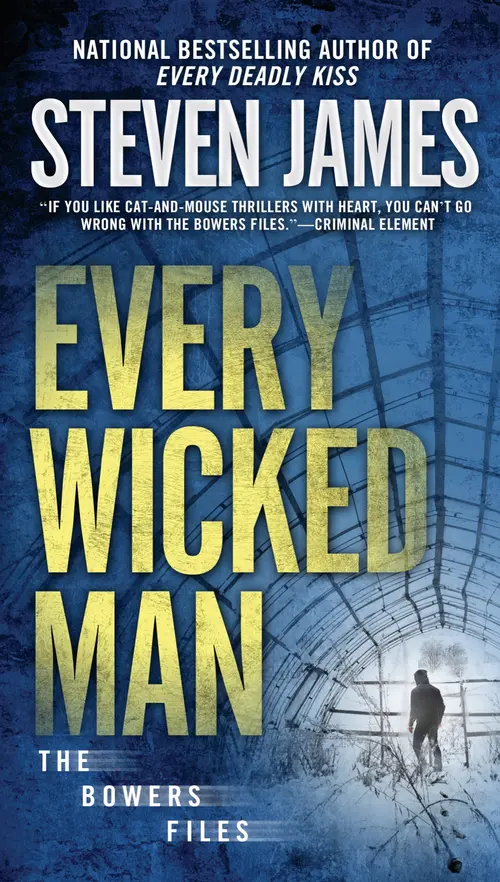
Every Wicked Man
Cover
Praise for the novels of Steven James
“James delivers first-rate characters [and] dazzling plot twists, and powers it all with nonstop action.”
—Emmy Award–winning screenplay writer John Tinker
PRAISE FOR THE NOVELS OF STEVEN JAMES
Every Deadly Kiss
“James brings complexity and intrigue to his latest Patrick Bowers thriller, layering plotlines and unfolding characters in a way that keeps readers on the edge through the very end . . . Fans of the Bowers Files will not be disappointed.”
—RT Book Reviews
“As always, James’s writing is top drawer, suspenseful, and unnerving.”
—Mystery Scene
Every Crooked Path
“Steven James is right up there with the likes of James Patterson . . . I can’t wait for more.”
—Fresh Fiction
Checkmate
“High tension all the way . . . Fast, sharp, and believable. Put it at the top of your list.”
—John Lutz, Edgar® Award–winning author of
Single White Female and Slaughter
The King
“His tightly woven, adrenaline-laced plots leave readers breathless.”
—The Suspense Zone
“Steven James offers yet another slam dunk in the Bowers Files series!”
—Suspense Magazine
Opening Moves
“A mesmerizing read . . . My conclusion: I need to read more of Steven James.”
—Michael Connelly, New York Times bestselling author of
The Wrong Side of Goodbye
“Steven James has created a fast-moving thriller with psychological depth and gripping action. Opening Moves is a smart, taut, intense novel of suspense that reads like a cross between Michael Connelly and Thomas Harris . . . a blisteringly fast and riveting read.”
—Mark Greaney, New York Times bestselling author of
Gunmetal Gray
“[A] fast-moving, intense thriller that has as many demented twists and turns as the crimes themselves.”
—Examiner.com
The Pawn
“Riveting.”
—Publishers Weekly
“[An] exceptional psychological thriller.”
—Armchair Reviews
THE BOWERS FILES
Opening Moves
The Pawn
The Rook
The Knight
The Bishop
The Queen
The King
Checkmate
Every Crooked Path
Every Deadly Kiss
Every Wicked Man
Dedication
For Ashley
Epigraph
“We are, I know not how, double in ourselves, so that what we believe we disbelieve, and cannot rid ourselves of what we condemn.”
—PHILOSOPHER AND WRITER MICHEL DE MONTAIGNE (1533–1592)
“If we could see each other’s thoughts, no one would be considered good.”
—FROM MAXIMS BY ST. STEPHEN OF MURET (1045–1124)
STAGE I
Denial
Camera angles. The observer.
There’s a number for everyone.
1
“Have the nightmares been getting worse?”
Timothy Sabian didn’t like being here at his psychiatrist’s office, didn’t like what it implied. “No. I mean, they’re about the same.”
“Well, that’s good, then. I’m glad to hear that, Timothy—that they’re not escalating in severity.”
Sometimes they happen when I’m awake, Timothy thought, but kept that to himself.
Dr. Percival looked maybe fifty or so, and even though he was about the age Timothy’s father would be, Timothy had never seen him as a father figure. This was a different kind of relationship.
“And the bugs?” the doctor asked.
“They’re not real.”
But even as he said the words, Timothy could feel the insects crawling across his abdomen.
In the literature, the feeling was described as “disturbing cutaneous sensations” rather than just saying that it felt like bugs crawling on you day and night. Then you had the constant itching, which doctors tried to make sound more scientific by naming it pruritus.
He didn’t want to show Dr. Percival the scars on his arms from the scratching and from trying to use the tweezers and the razor blade to dig out the bugs that burrowed into his skin. The bandage wrapped around his left arm was keeping the fresh blood hidden today. That, and the dark knit, long-sleeved sweater.
Yet still, Timothy felt the urge to scratch at them, to swat at them, to make them somehow, somehow go away.
Somehow. Go.
Away.
But he did not. He just sat still instead and nodded knowingly to his psychiatrist. “No bugs. That’s just delusional parasitosis.”
“That’s right,” Dr. Percival said. “They’re delusions.”
But Timothy caught a hint of condescension, that subtle shift in tone that meant the doctor had moved from believing the patient to trying to understand what the patient believed.
He’d been through this before.
He’d seen how these things end.
It meant that empathy was on its way out and a diagnosis was on its way in. And at that point, it was just too hard to go back. Once doubt crept in there, the more you claimed you weren’t mad, the more convinced they became that you were.
“We both know there aren’t any bugs,” Dr. Percival went on, “but I’m more curious if they’re still bothering you.”
“All gone,” Timothy said. “I’m not here today about the nightmares or the bugs.”
“Okay. Tell me why you’re here today.”
“How do you turn it off?”
“Turn what off?”
“The noise, the voices. Is it this way for everyone?”
“What do you mean?”
Since he didn’t want his doctor to think he was crazy, Timothy hadn’t brought this up before, but today, for some reason, he felt like he needed to talk about it, just to make sure, just to be certain that there wasn’t anything seriously wrong with him.
“All the chatter, chatter, chatter,” he said. “The words and the spiderweb connections, back and forth, all the time, touching each other. Intertwining, overlapping. Threading between things, around them. Is there a way to turn it off?”
“Tell me more about this chatter. About what it’s like.”
“I see a leaf on the ground and wonder about the tree that dropped it there, when it was planted, how long it’s been growing, how many other trees its roots touch down there, deep underground. A server at a restaurant hands me a pen to sign my credit card receipt, and I think of all the other people who’ve ever held that pen—the dates they were on, the argument or lovemaking or chilled silence that might have followed later that evening after one of them signed the receipt and handed back the pen. I pass a girl on the street and see her smile after reading a text message, and I fill in what it was she might have read.”
“That simply shows you have a vivid imagination.”
“So you don’t hear them?”
“I imagine different scenarios. Yes, of course. Different ways things might play out. Everyone does.”
“There’s something wrong with me.”
Dr. Percival glanced at the clock on the wall, something they should teach psychiatrists never to do, for all that it communicates to their clients.
Still twenty minutes left in their session.
“I think it’s natural to see connections between things,” the doctor said, “to wonder about something’s past, its origins, its future. I think it’s a skill you’ve honed over time. Being a novelist, you’ve taught yourself to be observant and inquisitive. Your livelihood depends on it. Don’t mistake creativity for mental illness. Your imagination is—”
“Overactive. That’s what my fifth-grade teacher used to tell me: ‘You have an overactive imagination.’ Is that possible?”
“It’s just a saying.”
“How can an imagination be overactive? Isn’t there something wrong with it, then? I mean, if it’s more active than it should be?”
“Timothy, most people’s imaginations have been blunted by years of sensible thinking and—”
“Beveled dreams.”
“Beveled dreams?”
“Dreams that have been chisel-wedge sharpened by the futility of slamming against an uncompromising reality.”
Timothy caught himself scratching at his arm, at the bugs crawling out of the open sores he’d been so careful to bandage over, the bugs Dr. Percival assured him weren’t real.
The doctor watched him carefully, then jotted something in his notebook—another therapist habit that silently spoke volumes.
Sometimes Timothy wondered if Dr. Percival was really writing things related to his case. Maybe he was scribbling out a shopping list. Maybe he was drawing farm animals. Maybe he was writing a letter to his daughter and he was going to mail it to her as soon as Timothy left for the—
Kill him.
“It’s happening,” Timothy whispered.
“What’s happening?”
You see that letter opener on his desk? Pick it up.
“No.” Timothy shook his head, tried to quiet the voice. “Make it stop, make it stop.”
Pick up the letter opener.
Dr. Percival was watching him carefully. “Tell me what it’s like right now, Timothy. What you’re hearing.”
“No. I can’t.”
Do it.
He had to make it stop. He had to had to had to had to.
And there was only one way.
Timothy picked up the letter opener.
“What are you doing?”
Now drive it into his neck.
“No,” Timothy yelled. “I won’t!”
“You won’t what?”
Lean across the desk, grab him by the collar to hold him in place, and then push it up into his throat. Just like the others.
No, no. There haven’t been others. You’re lying to me!
I’m not lying, Timothy. You know that—
“No!”
But yet he stood.
The psychiatrist eased back and reached for the button under his desk, the one he’d pressed eight months ago and Timothy knew was still there. He wasn’t stupid, after all. He wasn’t dangerous anymore. Not like he was back then.
He wasn’t—no, of course he wasn’t—or else he wouldn’t be here today; he would be back at the White Shirts Place with all those people who needed to be locked away, the ones who were a danger to themselves or others.
The crazy ones.
The unstable ones.
You’re unstable, Timothy. You’re crazy.
“No, I’m not!”
“You need to put that down, Timothy.”
But Timothy walked around the desk to where Dr. Percival was standing, and the doctor backed up even farther, until he was almost to the window.
Timothy felt his hands trembling. “You have to help me.”
“Timothy, get back.” The psychiatrist’s voice caught with fear. “Now!”
You have a vivid imagination. Overactive. There’s something wrong.
Beveled dreams.
Oh, beveled dreams.
Just like the others.
And then, Timothy Sabian shoved his psychiatrist fiercely against the wall and drove the letter opener into his own neck.
++++
You’re not supposed to survive something like that. Some people said he was lucky; others, that it was a miracle. Timothy just knew that he was in the hospital for a long time afterward. They kept his wrists and ankles strapped down so he couldn’t move, so he couldn’t hurt himself, and despite all the drugs they gave him and all the therapy they tried, the voices didn’t go away.
And neither did the bugs.
He knew that too.
2
Friday, November 2
New York City
Dusk
“C’mon,” my stepdaughter begged me. “Just once more around the pumpkins. Seriously. I’ve got this.”
It was our fourth visit to this parking lot since she’d turned sixteen a week and a half ago. Teaching a daughter to drive. A rite of passage for dads, and in this case, I was the closest thing she had to that.
“I need to get back, Tessa. I have to work tonight.”
“It’s that suicide, isn’t it?”
“I can’t tell you about the case.”
“Thought so.”
She shouldn’t have known anything about what I was working on, but because of who was dead and what I do for a living, it hadn’t been hard for her to deduce how I might be spending my evening.
But as bright as she was, she wasn’t exactly a prodigy at driving a car.
Not having any traffic cones, I’d opted for the pumpkins, a good seasonal choice—and now deeply discounted after Halloween. The day after the holiday, the price dropped in half. Stores only decorate for upcoming holidays, never the ones in the rearview mirror. They build up to a holiday for months and then, the moment it’s over, start advertising for the next one.
People were already looking ahead to Thanksgiving. Always looking ahead. Frantically scrambling forward.
“I promise to be quick and not to squish any more of ’em,” Tessa vowed with one hand raised in an earnest salute. There she sat in the driver’s seat. Inquisitive yet sad eyes. Light on the makeup—apart from the blood-dipped color of her fingernail polish. Dark, night-washed hair.
“You do know what those pumpkins represent, don’t you?”
“Traffic cones.”
“People.”
“If they were people, they’d get outta my way.”
We lived in New York City—not the ideal place to teach a teenager that it’s not supposed to be the job of pedestrians to avoid getting run over.
“We don’t want you smack-whamming the car into anything,” I said, “let alone running over pedestrians.”
She stared at me coolly.
“What?”
“Did you really just say ‘smack-whamming’? Was that you trying to be hip?”
“It’s just what came out. Why? Was it hip?”
“Um. No.”
She’d flattened two of the eight pumpkins so far, and I wasn’t holding my breath about the other six, especially if we went with the figure-eight pattern again rather than just practicing stopping in time without nudging the fruit, which she was a lot better at.
Earlier, I’d made the mistake of referring to the pumpkins as vegetables, but she was quick to correct me, informing me that, of course, they’re fruit, that everybody knows that.
With her off-the-charts IQ, she would undoubtedly ace the written portion of the test, but the behind-the-wheel part was clearly going to be a challenge.
“Alright, let’s see it.” I pointed to her hands. “Remember, ten o’clock and two o’clock.”
“I still can’t believe you’re stuck on analog,” she complained wearily, but she did move her hands to the places I’d shown her earlier on the steering wheel. “It’s so twentieth-century of you. You’re showing your age.”
“I’m thirty-five years old, Tessa.”
“Uh-huh. And your point is?”
I indicated the line of pumpkins. “Let’s see you do it this time all the way through. And watch out for pedestrians.”
“Right.”
“And remember, if you start to skid for whatever reason, it won’t seem to make sense, but steer into the skid.”
“Steer where you veer.”
“Exactly.”
She rounded the first pumpkin, then the second, and was confidently on her way to cruising past the third when she overcompensated the turn, cranking the wheel too far to the left. The bang and bump made it clear what’d just happened.
She cringed.
“Another fruitality,” I sighed.
She eyed me.
“Come on, now,” I said. “That was funny, right?”
“You’re starting to scare me.” Then she shook her head. “I wasn’t gonna hit that pumpkin. I swear. Maybe it rolled in front of us because of the Coriolis effect.”
“C’mon, let’s pick them up and head home.”
++++
Lots of people in the city choose to go without personal vehicles—and I understood why. If it hadn’t been necessary for my job at the Bureau, I might not have kept mine.
I aimed the car toward the parkway. From here, at this time of day, I expected we should be back to our apartment within the hour.
“So,” she said. “I watched the video.”
“The video?”
“The one with the senator’s son.”
“Tessa, I told you not—”
“I know, but it’s in the news and . . . It was . . . I didn’t like it. I didn’t like seeing it.”
“Of course you didn’t.” It’s not something anyone should like seeing, I thought.
Our Cyber division was taking down the video wherever it popped up online, but that hadn’t seemed to be doing a whole lot of good. It was out there. And once something’s on the Internet, you’re fighting a losing battle trying to contain it, even with the resources the Bureau has.
“How much did you watch?” I asked her.
“Enough.” Then she added, “But if it’s a suicide, why are you involved? I still don’t get that.”
I didn’t mention my observation that someone else had been present when Jon Murray died. Only a few people knew, including Assistant Director DeYoung and the senator, who’d invited me to his estate tonight so I could have a look around. Otherwise, we hadn’t released the information—I didn’t want the media reporting it. Right now, we had an edge, however slight that might be, and I needed additional information before we released any more details to the public.
“I never said I was involved,” I told Tessa evasively.
“Gotcha.” She’d started chewing a glob of vegan-friendly gum—which I hadn’t even known existed until I met her. “So what’s your plan?”
“I can’t discuss specifics of an investigation.”
“But if you could?”
“Sorry.”
“Broad strokes.”
“My plan . . . Hmm . . . I’d have to say I have a plan so secret that even I don’t know what it is.”
She stopped chewing. “How long have you been waiting to use that line?”
“It is possible I’ve been saving it up for a while.”
“Huh,” she said in a tone that was hard to read.
Oh, this was going brilliantly.
Christie, my wife of less than two months, had told me not to try so hard to connect with Tessa—to just be myself—but I was still trying to figure out what that self looked like in the role of a stepfather. I’d never been a dad before, and I certainly didn’t know the right things to say to a teenage girl.
Tessa was quiet, and I wasn’t sure if I should try to find something to talk about or not. In the end, I said nothing.
Empathy has never been my strong suit, but I’d been doing my best to remain understanding with her. It’d been a tumultuous couple of weeks for this girl.
She’d had a foster sister for a few months, but now that was over, and her mood swings had been more pronounced than usual as she processed being an only child again.
Azaliya Saleem was a fourteen-year-old girl who’d been staying with us through a special arrangement with social services. As it turned out, she was with us nine weeks, and then a relative of hers from her extended family in Kazakhstan agreed to care for her.
Azaliya’s departure from our lives had happened abruptly and took Tessa by surprise. Honestly, it was affecting her more than I thought it would. I hadn’t realized how much having a sister, even if it was only a foster sister, had meant to her.
“Can I ask you something, Patrick?” she said, drawing me out of my thoughts.
“Sure.”
“Do you know why Mom’s pissed at me?”
“What makes you think your mom is mad at you?”
A shrug.
Tessa and Christie were extremely close, and the girl could read my wife even better than I could. But then again, I’d only met Christie in the spring and, after a bit of a whirlwind romance, proposed—and, since we couldn’t come up with any good reason to put off the wedding, had promptly tied the knot.
Neither of them spoke much about Tessa’s biological father, but from what I’d gathered, he hadn’t even stuck around long enough to be present for her birth.
“She just needed some time to herself this weekend,” I explained.
“You mean time away from me.”
From us, I thought.
“From everyone,” I said.
“Yeah, but at a monastery?”
“They have a retreat center there. It’s really not as weird as it sounds.”
“Uh-huh. Well, it sounds pretty weird. I think she’s upset about something, and I want to know what it is.”
Christie, who somewhat enigmatically attended a fundamentalist Baptist church and was also a fan of the Catholic mystics and contemplatives, had taken the weekend to attend a silent retreat at the Abbey of Gethsemani in rural Kentucky. One of her favorite authors, Thomas Merton, had lived there as a hermit before his death in 1968.
Over the years, his books had sold hundreds of thousands—maybe millions—of copies, and since he’d taken a vow of poverty, the money from the royalties went back to the monastery. Using the funds, they’d built a retreat center beside their church. It was open to the public and, as long as you made a reservation, you could come and participate in a silent, unguided three- or four-day spiritual retreat.
Christie had been there once a few years ago and decided, somewhat on the spur of the moment on Tuesday night, that she wanted to return. As it turned out, they had a room available for this weekend, and she’d flown to Lexington this morning.
Getting back to Tessa’s concern, I said, “Don’t worry about your mom. I’m sure she’s fine. It’s good to give people a little space sometimes.”
“Ha.”
“Ha?”
“I see what you did there—first you said she needed time, then that we need to give people space. Time and space. This from Mr. Geospatial Investigator himself.”
I hadn’t even noticed. “Glad you caught that.”
“You didn’t even realize you said that, did you?”
“Don’t be ridiculous.”
She blew a bubble. “That’s what I thought.”
Time and space. She was right about that much.
I leave means, motive, and opportunity to my associates. I’m looking instead at context, timing, and location since they provide a much more reliable set of indicators on which to base an investigation. Searching for motives is simply a guessing game that we’re not nearly as good at as television crime shows make us out to be.
People love to go motive hunting. They want to know why someone could do such and such a thing, the reason behind it all, and even what initiated the behavior in the first place. A clean-cut and forensic answer, something understandable and definable that they can put their finger on:
“Did you always like lighting fires?”
“No.”
“When did you start?”
“After my mom died. Then everything changed.”
Ah. Yes. So that was it. The loss of his mother. That explains things—that’s the stressor, the psychological trigger we were looking for. Case closed.
It’s somehow comforting to find that single event, that precipitating one, that explains the subsequent choices someone makes, to play pin the motive on the crime. A way to make sense of it all.
The Story Continues on BooksBarbecue!
Enjoyed this preview? ❤️ Do not stop here!
Read the complete book free online → 🔗
Continue reading now on BooksBarbecue and discover every page!
Love reading? Bookmark BooksBarbecue.com for more amazing books!
Happy Reading!