Enemies at Home
Table of Contents
Also by Lindsey Davis
Title Page
Copyright
Map
The Cast
Rome, the Esquiline Hill: June AD89
Chapter 1
Chapter 2
Chapter 3
Chapter 4
Chapter 5
Chapter 6
Chapter 7
Chapter 8
Chapter 9
Chapter 10
Chapter 11
Chapter 12
Chapter 13
Chapter 14
Chapter 15
Chapter 16
Chapter 17
Chapter 18
Chapter 19
Chapter 20
Chapter 21
Chapter 22
Chapter 23
Chapter 24
Chapter 25
Chapter 26
Chapter 27
Chapter 28
Chapter 29
Chapter 30
Chapter 31
Chapter 32
Chapter 33
Chapter 34
Chapter 35
Chapter 36
Chapter 37
Chapter 38
Chapter 39
Chapter 40
Chapter 41
Chapter 42
Chapter 43
Chapter 44
Chapter 45
Chapter 46
Chapter 47
Chapter 48
Chapter 49
Chapter 50
Chapter 51
Chapter 52
Chapter 53
Chapter 54
Chapter 55
Chapter 56
Chapter 57
Chapter 58
Chapter 59
Also by Lindsey Davis
The Course of Honour
Rebels and Traitors
Master and God
A Cruel Fate
The Falco Series
The Silver Pigs
Shadows in Bronze
Venus in Copper
The Iron Hand of Mars
Poseidon’s Gold
Last Act in Palmyra
Time to Depart
A Dying Light in Corduba
Three Hands in the Fountain
Two for the Lions
One Virgin too Many
Ode to a Banker
A Body in the Bath House
The Jupiter Myth
The Accusers
Scandal Takes a Holiday
See Delphi and Die
Saturnalia
Alexandria
Nemesis
The Flavia Albia Series
The Ides of April
Enemies at Home
ENEMIES AT HOME
Lindsey Davis

Copyright
First published in Great Britain in 2014 by Hodder & Stoughton
An Hachette UK company
Copyright © Lindsey Davis 2014
The right of Lindsey Davis to be identified as the Author of the Work has been asserted by her in accordance with the Copyright, Designs and Patents Act 1988.
All rights reserved.
No part of this publication may be reproduced, stored in a retrieval system, or transmitted, in any form or by any means without the prior written permission of the publisher, nor be otherwise circulated in any form of binding or cover other than that in which it is published and without a similar condition being imposed on the subsequent purchaser.
All characters in this publication are fictitious and any resemblance to real persons, living or dead, is purely coincidental.
A CIP catalogue record for this title is available from the British Library.
ISBN 978 1 444 76662 2
Hodder & Stoughton Ltd
338 Euston Road
London NW1 3BH
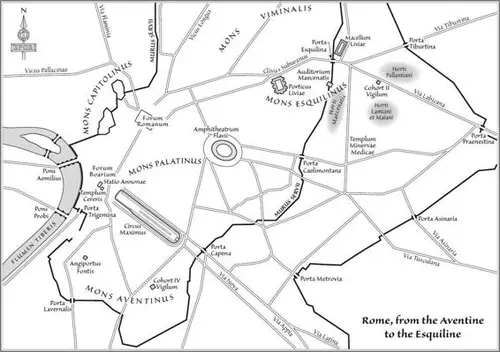
Map
THE CAST
Friends and Acquaintances
The Dead and their Associates
Crime and Punishment
Slaves, various
Dromo, Gratus, Libycus, Amethystus, Diomedes, Daphnus, Phaedrus, Nicostratus (not for long), Chrysodorus, Melander, Amaranta, Olympe, Myla (and a baby), Gratus, Onesimus (off the scene), Cosmus
Pets
ROME, the Esquiline Hill:
June AD89
1
Even before I started, I knew I should say no.
There are rules for private informers accepting a new case. Never take on clients who cannot pay you. Never do favours for friends. Don’t work with relatives. Think carefully about legal work. If, like me, you are a woman, keep clear of men you find attractive.
The Aviola inquiry broke every one of those rules, not least because the clients had no money, yet I took it on. Will I never learn?
One warm, starry June night in the city of Rome, burglars invaded a ground-floor apartment on the Esquiline Hill. A large quantity of fine domestic silverware was taken, which people assumed was the primary target. The middle-aged couple who rented the fashionable suite had married only recently, which made what happened to them more poignant. After the robbers left, their bodies were found on the marital bed, amid signs of violent struggle. Both had been strangled.
The dead couple were wealthy enough to merit an investigation, a privilege that was generally thought too good for the poor, though it was normally available to victims who had left behind influential friends, as was the case here. Enquiries were first assigned to a vigiles officer, Titianus of the Second Cohort. In fairness, Titianus was no more inept than most vigiles. He knew that two plus two made four – unless he happened to be preoccupied with watching a good cockfight, when he might inadvertently say five. But he had a decent record of arresting pickpockets in the Market of Livia. For about two hours he even thought that trying to solve a double murder was exciting. Then reality set in.
Titianus found it impossible to identify the thief or thieves. After asking around a bit, he turned his attention to the household, declaring that this must be an inside job. Inevitably his gaze fell on the owners’ freedmen and slaves. The freedmen were mature, articulate and well organised; that was how they had managed to gain their liberty and how they now bamboozled Titianus. The slaves were more vulnerable: younger and naive, or else older and plain dim. Nobody ever said any of them had threatened their master and mistress, but to a law officer in Rome any culprits were better than none and with slaves no real proof was necessary. They could be accused, tortured, prosecuted and executed on simple probability. Titianus put on a clean tunic to look good, then went and announced to his cohort tribune that he had the answer. The slaves did it.
The slaves got wind of their plight. They knew the notorious Roman law when a head of household was murdered at home. By instinct the authorities went after the wife, but that was no use if she was dead too. So unless the dead man had another obvious enemy, his slaves fell under suspicion. Whether guilty or not, they were put to death. All of them.
The good thing about such systematic capital punishment, occurring in public of course, was that it helped make other slaves, of whom there were hundreds of thousands in Rome, more well behaved. The proportion of masters to slaves was very small so nobody wanted this big slave population to get the idea of staging a rebellion. In our city it had been decided not to dress slaves in any distinguishing way, because then they might realise the power of their own numbers.
Many owners lived in constant fear of slaves turning against them. You cannot batter loyalty into a sullen, captive foreigner and neither can you even guarantee that kindly treatment will gain their gratitude. In Rome, executing slaves who betrayed their masters was extremely popular therefore. At least it was among the slave-owning classes.
Terrified, and with good reason, some of the accused slaves bolted from the elegant Esquiline house and took refuge a distance away at the Temple of Ceres. By tradition, this monument on the Aventine Hill offered a haven for refugees. They could claim sanctuary, be kept safe and even hope to be fed.
In theory, the authorities fostered the great temple’s famous role as a focus of liberty and protector of the desperate. However, nobody wants to take fine ideals too far.
In a swift, panic-stricken meeting just after dawn, the issue of how to get rid of the fugitives was handed to a magistrate whose duties gave him close connections to the temple. His name was Manlius Faustus, one of that year’s plebeian aediles, and I knew him. I liked his methods. He always stayed calm.
Charged with solving the problem, Faustus solemnly agreed with the Temple of Ceres authorities that it was important to take the correct action. This situation could easily turn ugly. They wanted to avoid censure. The public were shouting for a solution, preferably bloody. The Daily Gazette had already asked for a quotable comment and was about to feature the story in its scandal section; publication would fire lurid Forum gossip. The unseen eye of the emperor was probably on the Temple. Faustus had been handed a rather hot platter here.
As this dutiful man tried to come up with ideas, he walked to a bar called the Stargazer. There, while he pondered the meagre choice for breakfast, he ran into me.
2
I had seen the aedile coming − always a good idea with magistrates who can impose large fines. Anyone who runs a market stall, anyone with a pavement outside their premises, anyone whose profession is heavily regulated (any prostitute, for instance), loathes aediles. Informers like me avoid them. My relatives who ran the Stargazer would not thank him for eating there, given that part of his job was the regulation of bars. They would not thank me either. They would think he had chosen it because he knew it was my local.
I had first met Faustus a few weeks before, working jointly on an investigation and sometimes putting our heads together in this very caupona. I had known him to go about in disguise, though not today. He was a solid man in his mid-thirties, who came down the drab street with a steady tread. He had no flashy train of attendants, relying on his purple-striped tunic to deter trouble-makers. Aediles were not given bodyguards. They were sacrosanct, protected by religious laws. Besides, he was obviously tough; even when he was preoccupied, Faustus looked as if he punched his weight. That was assuming people even noticed him; he was not the kind of official who made a lot of noise wherever he went.
He cannot have expected to see me sitting at a table. He thought I was with my family at our villa on the coast, though I had recently come back to Rome because I was tired of sun, sand and fishing expeditions. Before anyone wonders, I was not hankering for Faustus. I might be a fancy-free widow, but a magistrate was way out of my league.
‘Flavia Albia!’
‘Manlius Faustus.’
Formal name terms. After he ordered a bread roll with Lucanian sausage, the Stargazer’s only deal that morning (or any morning), he took a seat at my table, though he asked permission first.
‘Mind if I join you?’
‘Always a pleasure.’
‘Good to see you.’
‘You too, aedile.’
Play acting. We were both unsure. The last time we met, I made embarrassing advances, which Faustus sensibly rejected. Despite my gaffe, the aedile had expressed a hope we might work together again. Being polite, I thought. Still, here he was in my aunt’s horrible bar.
Manlius Faustus had responsibilities for neighbourhood law and order – fair trading, clean streets, quiet baths and decorous brothels. I knew he was currently advising magistrates in other districts too, as they tackled a rash of random street killings that were happening throughout Rome. We lived in troubled times. The Vesuvius calamity, a decade ago but still vivid in the memory, had shaken people. We now had a paranoid emperor, who at just short of forty was still young enough to inflict many years of dread upon us. Our empire’s borders regularly came under attack from barbarians, so there was constant unsettling military talk. The city was also full of bitter satirists, outlawed philosophers and pouting poets who had failed to win prizes. In this climate all kinds of madness flourished.
As for me, I was a private investigator. Don’t point out it’s an unusual job for a woman; after twelve years, I had heard that enough times. I was hired by clients who wanted help when life went wrong – or sometimes before it happened: parents checking out gold-diggers their silly daughters had fallen for; small traders whose rivals were stealing business; litigants searching for witnesses to back them up in court; executors of wills who feared they were inheriting large debts. Many of my enquiries led to divorce. Most clients were sad people: either hopeless idiots who had caused their own predicament or well-meaning innocents who had been targeted by fraudsters.
Faustus glumly tapped his bread roll, which was definitely yesterday’s. He looked around. The Stargazer stood on a corner, with the usual arrangement of crazy-patterned marble counters at right angles where, come lunchtime, big pots of unappetising broths would attract more flies than customers. Inside, a wonky shelf had been nailed to a wall, using too-short nails. Beakers in various sizes were perched on it, ready to crash off when the fixings gave way. A faded sign on one wall offered varieties of wine, with illegible notes of their prices. Falernian was permanently listed, though always ‘sold out’ if you asked for it. Mostly the bar was visited by local labourers in search of cheap scoff. They would stand in the street, snatching a bite and a drink. Sit-down diners were rare.
Old Apollonius, who called himself the head waiter, leaned on one counter and stared into space. My aunt or my cousin would come in later; Aunt Junia was an abrasive character who should never have been running a bar, but her son, Junillus, made the best of this sad place.
A stray dog snuck in for a sniff around; she didn’t like it and left quickly. The second table indoors was empty, which was all too normal.
Making conversation, I described to Faustus my boredom with sun and seaside stuff. He patiently listened, then told me about the double murder on the Esquiline and needing to remove the fugitive slaves from the temple. He never gave much away, but I could tell he felt despondent.
He was sturdy, in the way of plebeian Romans, though taller than many and not bandy-legged. He had that way of implying he thought himself affable, while in fact remaining reticent. His eyes were grey, which does happen; mine were too, though his had no blue tint but were entirely pale, like the mist that comes off the Tiber at dawn. His dark hair was not yet tinged with grey, though gave the impression it might be soon. When he bothered to shave and spruce up, he was a fine-looking man. He had bothered today.
Faustus speared his sausage slice on the point of his own pocket-knife then gingerly tasted it. Even the Stargazer could do little damage to a bought-in Lucanian, so he cheered up. I reached over and pinched a gherkin that Apollonius had plonked on as a garnish. Faustus let me do it but quickly nipped up the other gherkin himself. We were easy together, for some reason that I never troubled to analyse.
He started complaining that the Esquiline, where the Aviola couple were murdered, was not his patch. When a group of new aediles began their year in office, they divided up Rome, each hoping to get areas that produced high revenues. They couldn’t take the income home (well, not legally), but public service is all about ‘my record is shinier than yours’. Each wanted to win the fines challenge. Success would attract votes if ever they stood for election again, or at least they might be rewarded with some minor priesthood.
Faustus had managed to get jurisdiction of the Aventine, home ground for both of us and a busy hive of wrongdoers. The Esquiline was one of the other Seven Hills, lying beyond the Circus Maximus and the Forum. It was not an area I knew well and Faustus seemed to think little of it.
‘I need to find out what really happened in the apartment that night, Albia. If the slaves are exonerated, they can go home. We are stuck with them until then.’
‘You’re even stuck with them if they are guilty – they have sought asylum.’
‘Don’t I know it! I have to prove somebody else is guilty.’ As Faustus leaned back in his seat and considered me, I saw where he was heading: ‘I don’t have the time; I need an agent.’
‘What about the vigiles?’
Succinctly, Faustus described Titianus of the Second Cohort.
‘Well, I can’t help you,’ I warned, getting in first. ‘I welcome new work, but not an exhausting trek over there every day.’
Faustus smiled sweetly. I was too experienced to fall for that. ‘I could organise some accommodation nearby,’ he offered. ‘And for assisting the Temple of Ceres, your fee would be worth having.’ I was tempted. I was short of work after my holiday. The temple could afford to pay well, since it benefited directly from all the fines the aediles slapped on people. ‘Go on,’ he urged. ‘It’s fascinating, Albiola. You know you want it.’ It always disturbed me when he used that diminutive, which he had invented.
I outlined for him why no informer would do this: the impossibility of tracking down the burglars now Titianus had muddied the trail, the difficulties of making slaves give reliable answers, the need for speed, the risks of any inquiry that was conducted in the public eye …
‘You are exactly the woman. Discreet, shrewd and no-nonsense,’ Faustus flattered me.
‘Damn you, Tiberius.’ I was not being over-familiar; he used his first name when working incognito, as he had been when I first met him.
‘I am delighted you accept. Do you need a written contract?’
‘I believe I do,’ I answered coldly. ‘Let me draft it; then I can specify draconian terms.’
Faustus grinned as he ordered up more breakfast. He could afford to be cheerful. His troubles were over. Mine were just beginning.
At least he told Apollonius to bring Lucanian sausage for me too. ‘Make that with big Colymbadian olives on the side and double gherkins!’ I growled, exploiting my new employer, who agreed it with a look of resignation.
To be honest, I fancied working with him. He was an interesting character.
I was already planning where to start. I told Faustus that the first thing the Temple of Ceres must pay for was decent legal advice. I happened to know two lawyers who were no more devious than normal and who, for the kind of money a religious body paid, would certainly oblige.
My uncles. Yes, I know what I said about never working with relatives, but the Camillus brothers were always so skint they would welcome this.
3
I sent a message to warn them. The aedile provided an errand boy. Even though Faustus was nominally alone, any man of affairs has an attendant, who tags along then sits on the kerb outside, waiting for orders. They squat there unnoticed among all the other slaves who are kicking their heels while their masters lurk in bars. At night, some streets are lined with rows of cute little boys asleep on their lanterns; in the day, pavements are clogged with liveried flunkeys, playing board games in the dust. High numbers make their owners look swanky. Faustus genuinely did not care about that, but had a lad with him for convenience.
Later that morning I took the aedile to meet my mother’s younger brothers. They occupied a pair of houses at the Capena Gate, which sits in the old Servian Wall, just past the end of the Circus Maximus. Faustus and I walked down from the Aventine together in silence, but as we ducked under the dripping arches of the notoriously leaky Claudian Aqueduct, trying to cover our heads, I briefed him.
‘They are Aulus Camillus Aelianus, senior of the two, and Quintus Camillus Justinus. We’ll go in first to see Justinus then we’ll probably adjourn to Aelianus’ house.’ Faustus failed to ask why I preferred to start with Justinus. That saved me having to tell him. ‘Justinus is very much a family man; no one gets much quiet thinking done where he lives. His brother’s house is the opposite, as dead as an old tomb in a necropolis. He is on his third wife, but the marriage is failing.’
‘That’s sad,’ Faustus observed conventionally, steering me around some of the beggars who lurked under the aqueduct. ‘Children?’
‘Fortunately no.’ Aelianus, an awkward character, would probably have been a high-handed father. ‘Both my uncles are in the Senate, although it was a big financial struggle. I don’t know all the details, except that my father contributed.’
‘Generous.’
‘He had worked with both. Still does. You know how Roman families operate.’
Faustus nodded. He himself lived with an uncle; they shared business interests and perhaps other sins. ‘The Camilli are now a partnership?’
‘Yes, but on sometimes spiky terms.’ The pair had matured slightly when they hit their late twenties and came good as court prosecutors, which is almost a respectable career. But they were temperamentally different and Justinus had once eloped with Claudia Rufina, a Baetican heiress who had really come to Rome to marry his brother. Years later, it still rankled. The brothers were thirty-nine and forty now. Old enough to be consuls, though for them it would never happen. They lacked the right political friends. My father reckoned that was what made them decent and likeable.
‘Are they good, or just your uncles?’
‘They are good.’ They really were. He gave me a look. ‘Honestly, Faustus.’
‘And you work with them?’
‘Sometimes a case benefits from a woman’s touch.’
Yes, and sometimes those two casual lads were just too lazy to do the legwork themselves.
Camillus Justinus’ house looked half-painted; I could not remember any maintenance being done since my grandparents’ time. We were admitted by an age-old Janus who had rudely forgotten my name even though I had cursed him a hundred times before. A desultory housekeeper showed us to a salon where a sleepy serving boy just stared at us. Faustus and I exchanged glances; we were both thinking about slaves and their habits today.
The Story Continues on BooksBarbecue!
Enjoyed this preview? ❤️ Do not stop here!
Read the complete book free online → 🔗
Continue reading now on BooksBarbecue and discover every page!
Love reading? Bookmark BooksBarbecue.com for more amazing books!
Happy Reading!