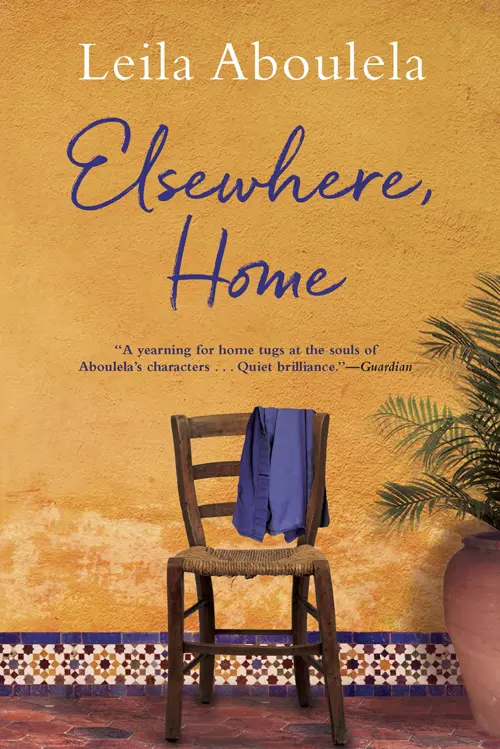
Elsewhere, Home
Cover
Also by Leila Aboulela
ALSO BY LEILA ABOULELA
The Translator
Coloured Lights
Minaret
Lyrics Alley
The Kindness of Enemies
Leila Aboulela
Elsewhere,
Home

Copyright
Copyright © 2018 by Leila Aboulela
Cover design by Rose Cooper
Cover photo collage: chair © Giovanni Meregheti/Alamy
All rights reserved. No part of this book may be reproduced in any form or by any electronic or mechanical means, including information storage and retrieval systems, without permission in writing from the publisher, except by a reviewer, who may quote brief passages in a review. Scanning, uploading, and electronic distribution of this book or the facilitation of such without the permission of the publisher is prohibited. Please purchase only authorized electronic editions, and do not participate in or encourage electronic piracy of copyrighted materials. Your support of the author’s rights is appreciated. Any member of educational institutions wishing to photocopy part or all of the work for classroom use, or anthology, should send inquiries to Grove Atlantic, 154 West 14th Street, New York, NY 10011 or [email protected].
First published in Great Britain in 2018 by Telegram Books
Published simultaneously in Canada
Printed in the United States of America
First Grove Atlantic edition: February 2019
ISBN 978-0-8021-2913-0
eISBN 978-0-8021-4694-6
Library of Congress Cataloging-in-Publication data is available for this title.
Black Cat
an imprint of Grove Atlantic
154 West 14th Street
New York, NY 10011
Distributed by Publishers Group West
groveatlantic.com
18 19 20 21 10 9 8 7 6 5 4 3 2 1
Summer Maze
It was not her first time boarding the Egypt Air flight from Heathrow to Cairo. Nadia’s life was a zigzag of these annual visits that sometimes stretched into every single day of the holidays and made the September return to school feel abrupt and unfocused. She had made sure to pack the PlayStation but it might not be enough. Her mother’s bulky arm pressed against her. Lateefa was in her best clothes but Nadia wasn’t. They had argued about this.
The airplane was going to be full and there was a mix up over the seating arrangements. Nadia watched the steward struggle in his broken English to remove a couple from seats which their boarding cards indicated to be rightly theirs. He pronounced every ‘p’ as a ‘b’ so that it was, ‘Blease this is seat 3D’. Just like my mother, Nadia thought. The next challenge taken up by the crew was to find enough storage space for the hand baggage of the Egyptian passengers. Big, bulging plastic bags testified to suitcases that were unable to hold any more, filled to the brim with the results of shopping. Like my mother, Nadia thought.
For weeks Lateefa had walked up and down Oxford Street, searching for the best bargains, tightly clutching her receipts in fear that she would lose them. She would buy, exchange and agonise over every purchase. Wearing her Dr Scholl exercise slippers (because her feet always got swollen from too much walking) she would stand in the queue of Marks and Spencer’s Customers Services, tense, never quite believing that they would refund her money. She would hand in her receipt, crumpled from the sweat of her palms, and nervously explain her reasons to the bored sales assistant. And Nadia, if she was with her, would feel ashamed, not only from the slippers but from the furtive look in her mother’s eyes.
It was happening again, and it was one of Nadia’s anxieties about the summer. The air hostess was addressing her in Arabic and she could not answer. She turned to her mother and Lateefa not only translated but answered the stewardess, ‘No, we won’t give up either of our seats; we are together.’ There was a time when Nadia had spoken Arabic, her baby chatter, her first fumbling words. But then with starting nursery school, the language had started to evade her. Not overnight of course. There was a time when she understood but would only answer in English, slyly, eager to hurt her mother. And then finally came the time when she could understand a little but could not speak fluently. Yet there remained within her a faint memory of a complete closeness with Lateefa, a time of unqualified approval that was somehow lost with her ability to speak her mother’s tongue.
In Cairo she was a stranger, but a stranger who went unnoticed, who was not tricked into paying extra for taxi rides and souvenirs. The effect was like a disguise, a role she was playing in an overworld which did not demand from her much skill or strategy. She could not really think of herself as Egyptian, nor did she want to. The city’s traffic overwhelmed her, the cars weaving in and out of the lanes, the pedestrians crossing in the middle of the road, the overflowing buses. She would stare unnerved at the sight of a woman riding on the back seat of a motorcycle with a child balanced on her lap. On every trip she would long for London and promise herself she would not come again. She would tell herself that she was not a child any more, some of her friends no longer went with their families on holiday – she could do the same. But perhaps it was her mother’s anger that she feared, the hot reckless words like sandpaper on skin. Or perhaps she was bewitched by the welcome that she received from her aunt and cousins.
In England her friends’ lives were a smooth continuation of their parents’ or so it seemed to her. When they made Valentine’s cards at school, their mothers understood; when they dressed up for Halloween, their mothers helped. But Lateefa would not understand, ‘You wasted good time at school making cards!’ ‘Those silly beoble telling their children the bresents came from Santa Claus. How will they learn to be grateful that their fathers and mothers get them nice things?’ Lateefa’s words would stay in Nadia’s mind, echoing, though she tried hard to push them away. She could see things in the ‘normal’ way, the same way that her friends did, untainted by Lateefa’s judgments. But she could also change the lens and see what her mother saw. It was as if Lateefa’s values were a subtle, throttled part of her. She had sucked them down with her mother’s milk.
Her cousin, Khalid, was waiting to meet them, leaning against the iron railing that separated the emerging passengers from the car park. The Khalid of each and every summer, old enough to be intriguing, young enough to be her only Cairo friend. She aimed her trolley at him and began to walk faster. ‘It’s so hot,’ she said to her mother but Lateefa, surging ahead, didn’t hear.
Although it was midnight, the airport was as busy as ever. Large tourist buses were parked in the open-air car park amidst the taxis that worked with meters and the posh ‘limousines’ which charged higher rates. The drivers had spilled out of their vehicles and were shouting, ‘Taxee! Taxee!’ into the dense crowd of tourists. They were aggressive and persistent, a few of them reaching to grab Nadia’s trolley. She kept shaking her head. She kept saying, ‘Thanks, but no we don’t need a taxi.’
‘Just ignore them,’ Lateefa yelled back as if this was the easiest thing in the world. She was the one who reached Khalid first, beaming and hugging him, pulling his neck down to kiss his forehead and cheeks. ‘You still haven’t shaved your beard?’ she scolded. ‘One of these days you’ll be arrested for a terrorist!’
He laughed and turned to shake Nadia’s hand. When she was younger she had sat on his lap in cars and cinemas; in swimming pools she had wrapped slippery legs around his waist and squealed, ‘Again! Again!’ when he lifted her up from under her arms and threw her in the water. But that was a long time ago when he was a schoolboy and she was a child and the age gap between them had seemed large. For the past few years though, she had felt shy in his presence, especially in the first few days of the visit.
Khalid had prepared for the assault of their suitcases on the carrying capacity of his Lada. He had attached a metal frame to its roof and Nadia imagined him doing that after finishing work in the pharmacy, in the midst of moving out of his room, packing some clothes and climbing the three flights of stairs to share a room with his sister’s children. His sister, her husband and their three children lived in a two-bedroom flat in the same building. It would be his home for the coming months while Nadia and Lateefa occupied his room downstairs. Khalid’s room and sleeping in his bed were part of the rituals of the summer. Lateefa on a mattress on the floor which she rolled up in the morning and put on top of the bed. Then Nadia waking late to the din from the street below and the smell of cooking, making her way through the crowded, elaborate furniture, towards her aunt’s voice. Her aunt Salwa absorbed everyone’s news and concerns; she was like an octopus reaching out for all her relations. Especially to Khalid’s sister and her life in that more modern upstairs flat; her children’s ailments, even her husband’s problems at work seeped and overflowed down the three flights of stairs and into Aunt Salwa’s home.
‘What took you so long? You were almost the last passengers to come out.’ Khalid fastened a rope on top of the suitcases so they would not fall off.
They were late because of a scene that had taken place in the customs hall. Fingering their green Egyptian passports, lifting their suitcases off the trolley to test their weight, a lanky custom’s official told them to stand aside and open the suitcases for inspection. The weight of their bags had filled him with the suspicion that they were bringing in goods to sell in Egypt without paying custom duties. After keeping them waiting for half an hour, he demanded that every item be taken out, examined, priced and eventually taxed. Lateefa explained that all the things in the bags were gifts. The man listened unmoved as if he had heard all this before. He turned instead to wave through a group of tourists, bestowing upon them deferential smiles.
Whisking out their two British passports from her handbag, Lateefa waved them under the official’s nose. ‘If we had come into the country with these,’ she shouted, ‘you would not have treated us in this way! For a whole year I have not come home and this is the treatment I get. You treat foreigners better!’ There were reasons, other than Lateefa’s patriotic sentiments, why they left London on their British passport and entered Egypt with their Egyptian ones. It saved them £20 each, the cost of the visa, and it saved them the inconvenience, in Cairo, of registering themselves at the nearest police station as all foreigners had to do. The burgundy booklets worked liked magic. The custom official cleared his throat, ‘Calm down Madam, we don’t want you to come into Cairo so upset, have a nice stay.’
Lateefa narrated this to Khalid, with embellishments and a few gentle additions from Nadia. At a traffic light, cars bumper to bumper, a hand scraped Nadia’s window. A man with no legs, on what she could only think of as a skateboard, was meandering through the cars. She gasped and cringed back from the face, just the ravaged face, suddenly appearing at the window. Lateefa glanced back at her and smiled, ‘The spoilt young lady from Europe.’ The nails scratched on to Khalid’s window. Unperturbed he dropped a note without even turning to look at the man who clattered away to another car. Khalid and Lateefa continued their conversation, ‘The sons of donkeys,’ he chuckled. ‘They probably wanted you to bribe your way out of customs.’ In the back seat, Nadia fought back nausea and tears. That roaming, wanting man, half-human, half-skateboard, would feature in her nightmares.
On the next day, when Khalid came home from work, he took Nadia aside and said, ‘You and I are going on a special outing. Tonight you’re going to meet my fiancée!’ He laughed when Nadia squealed in surprise. ‘Believe me,’ he said. ‘This summer is going to be completely different!’
Nadia had met other Egyptian girls before, distant relatives, family friends. She would find herself thrown in their company, hardly understanding what they were saying, shy and out of place. They would be polite to her but friendships never developed and she would always feel weary after such encounters, resentful of another of Lateefa’s attempts to find companions for her. But Reem was different. And what was pivotal about her was that she spoke English. From the very first words, Nadia was drawn in. ‘I’ve heard so much about you. Khalid told me about the time he visited you in London.’ Everything was out in the open and clear. Nadia could talk back; she did not need to grapple with mouthfuls of Arabic words or run translations through her head.
Reem spoke English even with Khalid for she had been born in Oklahoma and lived there until she was twelve. When she came to Cairo, she went to the American School in Maadi, the CAC, and the AUC, the American University in Cairo, where she was now studying Islamic Architecture. It became the custom during that summer that whenever Khalid visited Reem or took her out – which was nearly every evening – Nadia would be with him. It was Reem who insisted on Nadia’s presence, wanting to please her, to show her more of Cairo. So Nadia would sit in the back seat of the Lada, Reem in the front next to Khalid, sitting twisted on her seat so that she could talk to them both at the same time.
In a faintly Southern accent intersected here and there with Arabic words, Reem talked about how cool Khalid was, what a drag a few of her lectures were, and how awesome some of Cairo’s mosques were. While scarves and long sleeves looked drab and old-fashioned on Lateefa, on Reem they looked fashionable. Loose fishermen trousers, colourful embroidered shirts, a gypsy-like scarf tied around her head, another rectangular transparent one on top with its two ends falling to her waist, and long sparkling earrings framing her face. Lateefa didn’t seem to warm to Reem but when she wore skinny jeans and an oversized ‘I Live to Shop’ t-shirt, Nadia smiled, thinking about how much that logo suited her mother.
Reem did take Nadia shopping, in all the new air-conditioned stores that Cairo had to offer – Benetton, Mobacco, Stefanel – and Nadia was pleased that she could buy things so much cheaper than they were in London. This was not Lateefa’s Cairo; this was a Cairo which offered spin classes, McDonalds, and a Pizza Hut where Nadia could order the ‘Suber Subreme’ because the pepperoni was beef.
Reem gave her a street map, unusual in that it was in English with cartoon-like drawings of the landmarks and the Nile. So Nadia would sit in the back seat of the Lada, the map spread out in front of her, feeling as if she were in a video adventure, navigating and lurching through a virtual maze, bit by bit unlocking the access to new areas of the game world. ‘You’re going the wrong way Khalid, this is a one-way street’, she would shout. And when it didn’t matter, she learnt to laugh too.
They went one afternoon together to the pyramids. ‘Let’s climb up,’ Reem said when they arrived and she managed a few of the blocks of the largest pyramid before sitting down. Khalid climbed and sat next to her, while Nadia remained on the bottom block, making patterns in the desert sand with her feet. It was the best time of day to visit the pyramids, the sun no longer blinding but a giant orange button slipping on the horizon. A few camels carrying tourists bobbed across the desert, small boys pulled donkeys and offered rides. A family was picnicking, with a large watermelon, and kofta sandwiches wrapped in newspaper. A little girl with torn shoes and scruffy hair sold them roasted watermelon seeds and peanuts.
‘Khalid, get us some peanuts, please,’ said Reem. But he did not have to move for the girl, sensing the opportunity to sell, clambered up the stones to where they were sitting.
‘Here Nadia, for you,’ and Reem tossed her a wrap of peanuts before Nadia had time to say that she didn’t want any.
Nadia saw an elderly couple, obviously tourists, walk towards the Sphinx. The woman reminded Nadia of her primary school dinner lady. The couple’s advance was interrupted by a young boy selling small leather camels. His faded t-shirt hovered above his navel and his left foot dragged a torn pair of sandals. He twisted himself around them, trying to get them to notice his wares though the couple showed no interest. But he persisted as if he had been taught that this was what he must do to sell.
‘Look dear,’ Nadia heard the woman say to her husband, ‘He’s selling them for a pound each and in the hotel they’re five pounds!’
The accent made Nadia homesick for London. She moved towards the couple, drawn to their familiar tones, eager for a flicker of recognition, an encouragement to say hello. But when they looked up at her they saw someone different from them, an Egyptian girl at the foot of that large pyramid in Giza. Nadia forced herself to speak out because she needed this encounter now, needed to make this link. She said, ‘If you haggle with him, you can even get two camels for a pound. He’ll sell them to you for that price, if you stand your ground.’ She illustrated by using her rudimentary Arabic on the boy. He immediately dropped his price to a local rate. The couple were delighted. ‘And you speak such good English too!’
Nadia explained that she was from North London and chatted for a few minutes with Dan and Sheila from Tunbridge Wells. They were seasoned travellers having been to Greece, Israel and Jordan, but Cairo had more to offer, they said.
She walked back to Reem and Khalid feeling refreshed. The English couple were Londoners like her; she could speak their language and warm to their moods. But she was not a tourist and for her Egypt could never be a holiday destination like Jordan or Greece. Desert, pyramids and Sphinx were embedded in her DNA. They were her heritage whether she wanted it or not. In a few weeks’ time she would go back to school and this time she would have something to say about what she did on her holidays. She would not be ashamed like every year before.
In this particular summer, though, Lateefa was quick to complain. Watching Nadia get dressed to go out to dinner, she said, ‘Don’t you think you’re spending too much time with Khalid and Reem?’
‘They’ve asked me to go along.’
‘They’re just being bolite.’
‘No. Reem is not like that. She would be honest with me. If she wanted to be alone with Khalid she would tell me so.’ But Nadia remembered a previous summer’s conversation with her mother, when she had asked, ‘Why do people in Egypt lie all the time? When Tante Salwa has visitors why does she always tell them to stay longer when they get up to leave? She goes on and on and she doesn’t mean it, she wants them to go and she’s relieved when they go.’
‘It’s bolite,’ Lateefa had answered, ‘and the visitors know that and they leave just the same.’ This was Egyptian etiquette; these were the Egyptian complexities Nadia would never appreciate.
Now, she slipped her shoes on and refused to meet her mother’s eyes. ‘I want to go out with them. Today we’re going to TGI Fridays and it’s on a boat on the Nile!’
‘Make sure you pay for your own meal,’ grumbled Lateefa. ‘I don’t want you to be unwanted and I certainly don’t want you taking favours. I’d rather you didn’t go at all.’
‘Why are you doing this?’ Nadia’s voice rose. ‘You are so annoying. You drag me here every summer against my will and when I finally start to enjoy myself you want to spoil everything!’
Later that evening, in order to make amends, Nadia joined her mother in front of the television. She asked her about the film, knowing that watching Arabic films together, while Lateefa translated, was a pastime her mother enjoyed. ‘It’s not really one of the best,’ Lateefa now said. ‘But it is bringing back memories. Your father and I watched it at the Cinema Normandy when we were engaged. Khalid came with us as a chaperone.’ She laughed. ‘He was seven years old. And every time we went out we had to take him with us! Your father struggled to amuse him and keep him occupied so that we could be together longer.’
The Story Continues on BooksBarbecue!
Enjoyed this preview? ❤️ Do not stop here!
Read the complete book free online → 🔗
Continue reading now on BooksBarbecue and discover every page!
Love reading? Bookmark BooksBarbecue.com for more amazing books!
Happy Reading!