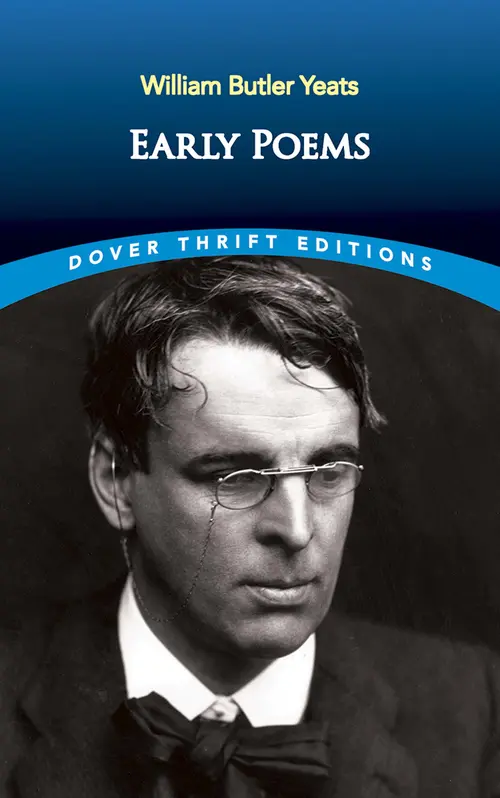
Early Poems
Title Page

At Dover Publications we’re committed to producing books in an earth-friendly manner and to helping our customers make greener choices.
Manufacturing books in the United States ensures compliance with strict environmental laws and eliminates the need for international freight shipping, a major contributor to global air pollution. And printing on recycled paper helps minimize our consumption of trees, water and fossil fuels.
The text of this book was printed on paper made with 10% post-consumer waste and the cover was printed on paper made with 10% post-consumer waste. At Dover, we use Environmental Defense’s Paper Calculator to measure the benefits of these choices, including: the number of trees saved, gallons of water conserved, as well as air emissions and solid waste eliminated.
Courier Corporation, the manufacturer of this book, owns the Green Edition Trademark.
Please visit the product page for Early Poems at www.doverpublications.com to see a detailed account of the environmental savings we’ve achieved over the life of this book.
Copyright Page
DOVER THRIFT EDITIONS
GENERAL EDITOR: STANLEY APPELBAUM
EDITOR OF THIS VOLUME: SHANE WELLER
Copyright
Bibliographical Note
This Dover edition, first published in 1993, contains all the lyric poems from the following W B. Yeats volumes: The Wind Among the Reeds (second edition), Elkin Mathews, London, 1899; In the Seven Woods: Being Poems Chiefly of the Irish Heroic Age, The Dun Emer Press, Dundrum, 1903; The Green Helmet and Other Poems, The Cuala Press, Churchtown, Dundrum, 1910; Poems, T. Fisher Unwin, London, 1912; and Responsibilities: Poems and a Play, The Cuala Press, Churchtown, Dundrum, 1914.
The Note, the footnotes and the alphabetical lists of titles and first lines were prepared specially for the present edition.
Library of Congress Cataloging-in-Publication Data
Yeats, W B. (William Butler), 1865—1939.
Early poems / William Butler Yeats.
p. cm.—(Dover thrift editions)
9780486159454
I. Title. II. Series.
PR5902.A3 1993
821’.8—dc20
93-21798
CIP
Note
THE NOBEL LAUREATE William Butler Yeats (1865—1939) is perhaps the greatest modern English-language poet, whose verse demonstrates both technical virtuosity and an extraordinary range (from love songs and ballads to meditations on time, history and the spiritual). Besides the lyric and narrative poems, he also wrote plays, essays, stories, autobiographies and philosophy. For his subject matter and vocabulary he drew heavily on Irish mythology, contemporary Irish history and mystical philosophy.
The present edition contains all the lyric poetry from Yeats’s first six collections of verse: Crossways (1889), The Rose (1893),1 The Wind Among the Reeds (1899), In the Seven Woods (1903), The Green Helmet and Other Poems (1910) and Responsibilities (1914). Yeats devoted considerable energy throughout his career to revising poems; thus, the versions and the poem titles found here sometimes differ quite markedly from both earlier and later ones. (The editions reprinted are identified on the copyright page.) In addition, a few poems included under the above headings in The Collected Poems (1933) do not appear here in any form.
CROSSWAYS
“The stars are threshed, and the souls are threshed from their husks.”
WILLIAM BLAKE.
To A. E.
The Song of the Happy Shepherd
The woods of Arcady are dead,
And over is their antique joy;
Of old the world on dreaming fed;
Gray Truth is now her painted toy;
Yet still she turns her restless head:
But O, sick children of the world,
Of all the many changing things
In dreary dancing past us whirled,
To the cracked tune that Chronos sings,
Words alone are certain good.
Where are now the warring kings,
Word be-mockers?—By the Rood
Where are now the warring kings?
An idle word is now their glory,
By the stammering schoolboy said,
Reading some entangled story:
The kings of the old time are fled.
The wandering earth herself may be
Only a sudden flaming word,
In clanging space a moment heard,
Troubling the endless reverie.
Then nowise worship dusty deeds,
Nor seek; for this is also sooth;
To hunger fiercely after truth,
Lest all thy toiling only breeds
New dreams, new dreams; there is no truth
Saving in thine own heart. Seek, then,
No learning from the starry men,
Who follow with the optic glass
The whirling ways of stars that pass—
Seek, then, for this is also sooth,
No word of theirs—the cold star-bane
Has cloven and rent their hearts in twain,
And dead is all their human truth.
Go gather by the humming-sea
Some twisted, echo-harbouring shell,
And to its lips thy story tell,
And they thy comforters will be,
Rewarding in melodious guile,
Thy fretful words a little while,
Till they shall singing fade in ruth,
And die a pearly brotherhood;
For words alone are certain good:
Sing, then, for this is also sooth.
I must be gone: there is a grave
Where daffodil and lily wave,
And I would please the hapless faun,
Buried under the sleepy ground,
With mirthful songs before the dawn.
His shouting days with mirth were crowned;
And still I dream he treads the lawn,
Walking ghostly in the dew,
Pierced by my glad singing through,
My songs of old earth’s dreamy youth:
But ah! she dreams not now; dream thou!
For fair are poppies on the brow:
Dream, dream, for this is also sooth.
The Sad Shepherd
There was a man whom Sorrow named his friend,
And he, of his high comrade Sorrow dreaming,
Went walking with slow steps along the gleaming
And humming sands, where windy surges wend:
And he called loudly to the stars to bend
From their pale thrones and comfort him, but they
Among themselves laugh on and sing alway:
And then the man whom Sorrow named his friend
Cried out, Dim sea, hear my most piteous story!
The sea swept on and cried her old cry still,
Rolling along in dreams from hill to hill;
He fled the persecution of her glory
And, in a far-off, gentle valley stopping,
Cried all his story to the dewdrops glistening,
But naught they heard, for they are always listening,
The dewdrops, for the sound of their own dropping.
And then the man whom Sorrow named his friend,
Sought once again the shore, and found a shell,
And thought, I will my heavy story tell
Till my own words, re-echoing, shall send
Their sadness through a hollow, pearly heart;
And my own tale again for me shall sing,
And my own whispering words be comforting,
And lo! my ancient burden may depart.
Then he sang softly nigh the pearly rim;
But the sad dweller by the sea-ways lone
Changed all he sang to inarticulate moan
Among her wildering whirls, forgetting him.
The Cloak, the Boat, and the Shoes
“What do you make so fair and bright?”
“I make the cloak of Sorrow:
”O, lovely to see in all men’s sight
“Shall be the cloak of Sorrow,
”In all men’s sight.”
“What do you build with sails for flight?”
“I build a boat for Sorrow,
”O, swift on the seas all day and night
“Saileth the rover Sorrow,
”All day and night.”
“What do you weave with wool so white?”
“I weave the shoes of Sorrow,
”Soundless shall be the footfall light
“In all men’s ears of Sorrow,
”Sudden and light.”
Anashuya and Vijaya
A little Indian temple in the Golden Age. Around it a garden; around that the forest. ANASHUYA, the young priestess, kneeling within the temple.
ANASHUYA
Send peace on all the lands and flickering corn.—
O, may tranquillity walk by his elbow
When wandering in the forest, if he love
No other.—Hear, and may the indolent flocks
Be plentiful.—And if he love another,
May panthers end him.—Hear, and load our king
With wisdom hour by hour.—May we two stand,
When we are dead, beyond the setting suns,
A little from the other shades apart,
With mingling hair, and play upon one lute.
VIJAYA [entering and throwing a lily at her]
Hail! hail, my Anashuya.
ANASHUYA
No: be still.
I, priestess of this temple, offer up
Prayers for the land.
VIJAYA
I will wait here, Amrita.
ANASHUYA
By mighty Brahma’s ever rustling robe,
Who is Amrita? Sorrow of all sorrows!
Another fills your mind.
VIJAYA
My mother’s name.
ANASHUYA [sings, coming out of the temple]
A sad, sad thought went by me slowly:
Sigh, O you little stars! O, sigh and shake your blue apparel!
The sad, sad thought has gone from me now wholly:
Sing, O you little stars! O, sing and raise your rapturous carol
To mighty Brahma, he who made you many as the sands,
And laid you on the gates of evening with his quiet hands.
[Sits down on the steps of the temple.]
Vijaya, I have brought my evening rice;
The sun has laid his chin on the gray wood,
Weary, with all his poppies gathered round him.
VIJAYA
The hour when Kama, 2 full of sleepy laughter,
Rises, and showers abroad his fragrant arrows,
Piercing the twilight with their murmuring barbs.
ANASHUYA
See how the sacred old flamingoes come,
Painting with shadow all the marble steps:
Aged and wise, they seek their wonted perches
Within the temple, devious walking, made
To wander by their melancholy minds.
Yon tall one eyes my supper; swiftly chase him
Far, far away. I named him after you.
He is a famous fisher; hour by hour
He ruffles with his bill the minnowed streams.
Ah! there he snaps my rice. I told you so.
Now cuff him off. He’s off! A kiss for you,
Because you saved my rice. Have you no thanks?
VIJAYA [sings]
Sing you of her, O first few stars,
Whom Brahma, touching with his finger, praises, for you hold
The van of wandering quiet; ere you be too calm and old,
Sing, turning in your cars,
Sing, till you raise your hands and sigh, and from your car heads peer,
With all your whirling hair, and drop many an azure tear.
ANASHUYA
What know the pilots of the stars of tears?
VIJAYA
Their faces are all worn, and in their eyes
Flashes the fire of sadness, for they see
The icicles that famish all the north,
Where men lie frozen in the glimmering snow;
And in the flaming forests cower the lion
And lioness, with all their whimpering cubs;
And, ever pacing on the verge of things,
The phantom, Beauty, in a mist of tears;
While we alone have round us woven woods,
And feel the softness of each other’s hand,
Amrita, white——
ANASHUYA [going away from him]
Ah me, you love another,
[Bursting into tears.]
And may some dreadful ill befall her quick!
VIJAYA
I loved another; now I love no other.
Among the mouldering of ancient woods
You live, and on the village border she,
With her old father the blind wood-cutter;
I saw her standing in her door but now.
ANASHUYA
Vijaya, swear to love her never more.
VIJAYA
Ay, ay.
ANASHUYA
Swear by the parents of the gods,
Dread oath, who dwell on sacred Himalay,
On the far Golden Peak; enormous shapes,
Who still were old when the great sea was young;
On their vast faces mystery and dreams;
Their hair along the mountains rolled and filled
From year to year by the unnumbered nests
Of aweless birds, and round their stirless feet
The joyous flocks of deer and antelope,
Who never hear the unforgiving hound.
Swear!
VIJAYA
By the parents of the gods, I swear.
ANASHUYA [sings]
I have forgiven, O new star!
Maybe you have not heard of us, you have come forth so newly,
You hunter of the fields afar!
Ah, you will know my loved one by his hunter’s arrows truly,
Shoot on him shafts of quietness, that he may ever keep
An inner laughter, and may kiss his hands to me in sleep.
Farewell, Vijaya. Nay, no word, no word;
I, priestess of this temple, offer up
Prayers for the land.
[VIJAYA goes.]
O Brahma, guard in sleep
The merry lambs and the complacent kine,
The flies below the leaves, and the young mice
In the tree roots, and all the sacred flocks
Of red flamingo; and my love, Vijaya;
And may no restless fay with fidget finger
Trouble his sleeping: give him dreams of me.
The Indian upon God
I passed along the water’s edge below the humid trees,
My spirit rocked in evening light, the rushes round my knees,
My spirit rocked in sleep and sighs; and saw the moorfowl pace
All dripping on a grassy slope, and saw them cease to chase
Each other round in circles, and heard the eldest speak:
Who holds the world between His bill and made us strong or weak
Is an undying moorfowl, and He lives beyond the sky.
The rains are from His dripping wing, the moonbeams from His eye.
I passed a little further on and heard a lotus talk:
Who made the world and ruleth it, He hangeth on a stalk,
For I am in His image made, and all this tinkling tide
Is but a sliding drop of rain between His petals wide.
A little way within the gloom a roebuck raised his eyes
Brimful of starlight, and he said: The Stamper of the Skies,
He is a gentle roebuck; for how else, I pray, could He
Conceive a thing so sad and soft, a gentle thing like me?
I passed a little further on and heard a peacock say:
Who made the grass and made the worms and made my feathers gay,
He is a monstrous peacock, and He waveth all the night
His languid tail above us, lit with myriad spots of light.
The Indian to His Love
The island dreams under the dawn
And great boughs drop tranquillity;
The peahens dance on a smooth lawn,
A parrot sways upon a tree,
Raging at his own image in the enamelled sea.
Here we will moor our lonely ship
And wander ever with woven hands,
Murmuring softly lip to lip,
Along the grass, along the sands,
Murmuring how far away are the unquiet lands:
How we alone of mortals are
Hid under quiet bows apart,
While our love grows an Indian star,
A meteor of the burning heart,
One with the tide that gleams, the wings that gleam and dart,
The heavy boughs, the burnished dove
That moans and sighs a hundred days:
How when we die our shades will rove,
When eve has hushed the feathered ways,
With vapoury footsole among the waters drowsy blaze.
The Falling of the Leaves
Autumn is over the long leaves that love us,
And over the mice in the barley sheaves;
Yellow the leaves of the rowan above us,
And yellow the wet wild-strawberry leaves.
The hour of the waning of love has beset us,
And weary and worn are our sad souls now;
Let us part, ere the season of passion forget us,
With a kiss and a tear on thy drooping brow.
Ephemera
“Your eyes that once were never weary of mine
”Are bowed in sorrow under pendulous lids,
“Because our love is waning.”
And then she:
“Although our love is waning, let us stand
”By the lone border of the lake once more,
“Together in that hour of gentleness
”When the poor tired child, Passion, falls asleep:
“How far away the stars seem, and how far
”Is our first kiss, and ah, how old my heart!”
Pensive they paced along the faded leaves,
While slowly he whose hand held hers replied:
“Passion has often worn our wandering hearts.”
The woods were round them, and the yellow leaves
Fell like faint meteors in the gloom, and once
A rabbit old and lame limped down the path;
Autumn was over him: and now they stood
On the lone border of the lake once more:
Turning, he saw that she had thrust dead leaves
Gathered in silence, dewy as her eyes,
In bosom and hair.
“Ah, do not mourn,” he said,
“That we are tired, for other loves await us;
”Hate on and love through unrepining hours.
“Before us lies eternity; our souls
“Are love, and a continual farewell.”
The Madness of King Goll
I sat on cushioned otter skin:
My word was law from Ith to Emen,
And shook at Invar Amargin
The hearts of the world-troubling seamen,
And drove tumult and war away
From girl and boy and man and beast;
The fields grew fatter day by day,
The wild fowl of the air increased;
And every ancient Ollave3 said,
While he bent down his fading head,
“He drives away the Northern cold.”
They will not hush, the leaves a-flutter round me, the beech leaves old.
I sat and mused and drank sweet wine;
A herdsman came from inland valleys,
Crying, the pirates drove his swine
To fill their dark-beaked hollow galleys.
I called my battle-breaking men,
And my loud brazen battle-cars
From rolling vale and rivery glen;
And under the blinking of the stars
Fell on the pirates by the deep,
And hurled them in the gulph of sleep:
These hands won many a torque of gold.
They will not hush, the leaves a-flutter round me, the beech leaves old
But slowly, as I shouting slew
And trampled in the bubbling mire,
In my most secret spirit grew
A whirling and a wandering fire:
I stood: keen stars above me shone,
Around me shone keen eyes of men:
I laughed aloud and hurried on
By rocky shore and rushy fen;
I laughed because birds fluttered by,
And starlight gleamed, and clouds flew high,
And rushes waved and waters rolled.
They will not hush, the leaves a-flutter round me, the beech leaves old.
And now I wander in the woods
When summer gluts the golden bees,
Or in autumnal solitudes
Arise the leopard-coloured trees;
Or when along the wintry strands
The cormorants shiver on their rocks;
I wander on, and wave my hands,
And sing, and shake my heavy locks.
The gray wolf knows me; by one ear
I lead along the woodland deer;
The hares run by me growing bold.
They will not hush, the leaves a-flutter round me, the beech leaves old.
I came upon a little town,
That slumbered in the harvest moon,
And passed a-tiptoe up and down,
Murmuring, to a fitful tune,
How I have followed, night and day,
A tramping of tremendous feet,
And saw where this old tympan lay,
Deserted on a doorway seat,
And bore it to the woods with me;
Of some unhuman misery
Our married voices wildly trolled.
They will not hush, the leaves a-flutter round me, the beech leaves old.
I sang how, when day’s toil is done,
Orchil4 shakes out her long dark hair
That hides away the dying sun
And sheds faint odours through the air:
When my hand passed from wire to wire
It quenched, with sound like falling dew,
The whirling and the wandering fire;
But lift a mournful ulalu,
For the kind wires are torn and still,
And I must wander wood and hill
Through summer’s heat and winter’s cold.
They will not hush, the leaves a-flutter round me, the beech leaves old.
The Stolen Child
Where dips the rocky highland
Of Sleuth Wood in the lake,
There lies a leafy island
Where flapping herons wake
The drowsy water rats;
There we’ve hid our faery vats,
Full of berries,
And of reddest stolen cherries.
Come away, O human child!
To the waters and the wild
With a faery, hand in hand,
For the world’s more full of weeping than you can understand.
Where the wave of moonlight glosses
The dim gray sands with light,
Far off by furthest Rosses
We foot it all the night,
Weaving olden dances,
Mingling hands and mingling glances
Till the moon has taken flight;
To and fro we leap
And chase the frothy bubbles,
While the world is full of troubles
And is anxious in its sleep.
Come away, O human child!
To the waters and the wild
With a faery, hand in hand,
For the world’s more full of weeping than you can understand.
Where the wandering water gushes
From the hills above Glen-Car,
In pools among the rushes
That scarce could bathe a star,
We seek for slumbering trout
And whispering in their ears
Give them unquiet dreams;
Leaning softly out
From ferns that drop their tears
Over the young streams.
Come away, O human child!
To the waters and the wild
With a faery, hand in hand,
For the world’s more full of weeping than you can understand.
Away with us he’s going,
The solemn-eyed:
He’ll hear no more the lowing
Of the calves on the warm hillside;
Or the kettle on the hob
Sing peace into his breast,
Or see the brown mice bob
Round and round the oatmeal-chest.
For he comes, the human child,
To the waters and the wild
With a faery, hand in hand,
From a world more full of weeping than he can understand.
To an Isle in the Water
Shy one, shy one,
Shy one of my heart,
She moves in the firelight
Pensively apart.
She carries in the dishes,
And lays them in a row.
To an isle in the water
With her would I go.
She carries in the candles,
And lights the curtained room,
Shy in the doorway
And shy in the gloom;
And shy as a rabbit,
Helpful and shy.
To an isle in the water
With her would I fly.
Down by the Salley Gardens
Down by the salley5 gardens my love and I did meet;
She passed the salley gardens with little snow-white feet.
She bid me take love easy, as the leaves grow on the tree;
But I, being young and foolish, with her would not agree.
In a field by the river my love and I did stand,
And on my leaning shoulder she laid her snow-white hand.
She bid me take life easy, as the grass grows on the weirs;
But I was young and foolish, and now am full of tears.
The Meditation of the Old Fisherman
You waves, though you dance by my feet like children at play,
Though you glow and you glance, though you purr and you dart;
In the Junes that were warmer than these are, the waves were more gay,
When I was a boy with never a crack in my heart.
The herring are not in the tides as they were of old;
My sorrow! for many a creak gave the creel6 in the cart
That carried the take to Sligo town to be sold,
When I was a boy with never a crack in my heart.
The Story Continues on BooksBarbecue!
Enjoyed this preview? ❤️ Do not stop here!
Read the complete book free online → 🔗
Continue reading now on BooksBarbecue and discover every page!
Love reading? Bookmark BooksBarbecue.com for more amazing books!
Happy Reading!