Dread
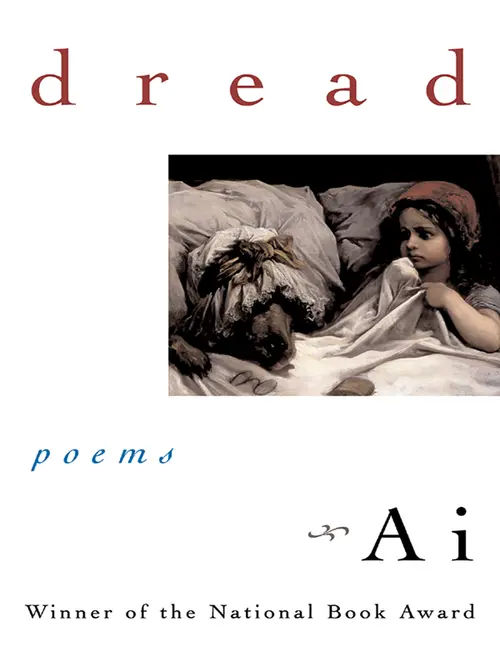
Cover
BOOKS BY AI
Vice, 1999
Greed, 1993
Fate, 1991
Sin, 1986
Killing Floor, 1979
Cruelty, 1973
Title

Adjusting type size may change line breaks. Landscape mode may help to preserve line breaks.
Dedication
THIS BOOK IS DEDICATED
TO THE SURVIVORS OF CHILDHOOD TRAUMA AND TO GWENDOLYN BROOKS
THE POEMS IN THIS BOOK HAVE APPEARED IN THE FOLLOWING MAGAZINES AND ANTHOLOGIES:
Callaloo: “The Greenwood Cycle,” “The White Homegirl”;
Canary River: “Dread”; Columbia Magazine: “Rude Awakening”; Crazy Horse: “Intercourse,”
“The Psychic Detective: Identity”; Divide: “Greetings Friend”; Estrella Mountain Community College:
“Family”; Etruscan Press: “Fairy Tale”; The Manthology:
“The Broker,” “The Calling”; New Delta Review: “The Secret”; Pacific Review: “Lullaby,” “Grandfather Says”;
Southeast Review: “Delusion”; Witness: “The Psychic Detective: Fantasy”; The Writer’s Garret: “Passage”
Dread
DREAD
My name is Shirley Herlihy,
but to the lowlifes on my beat,
I am Officer Girlie.
They do not mean to diss me.
It is a sign of respect
that I let them think is ok with me, and it is,
when I am trying to do my community policing.
After my brother disappeared
at the World Trade Center,
the word went out.
The lowlifes even gave me a bouquet of flowers
I could not accept.
They came from the Korean store
before somebody tossed a Molotov cocktail
through the front door
in retaliation for a “situation”
that involved the girlfriend of a drug dealer
shoplifting disposable diapers and Tampax.
The fact is I appreciated the thought
if not the deed.
I mean the flowers were at least a sign
I had not become a cop
turning a blind eye on the misery of the street.
I was known as someone who was tough,
but fair in meting out justice.
God knows it’s hard to toe the line
every single time a perp messes up, but I tried.
If somebody’s mother needed a ride
to a bail hearing,
my transportation specialist,
Bobby J, the gypsy cab guy would oblige.
I’d say thanks by slipping him
tickets to a ball game, a movie
or some lame excuse for entertainment.
I kept the wheels turning,
so I didn’t fall under them.
I only had to use my gun once in two years
against a sonofabitch
who murdered his uncle
and hid his body in a dumpster.
Original, huh?
Stanko, the wino, found him on his garbage rounds.
We cornered the asshole in an alley
behind that shooting gallery
in the building that’s now been gentrified
and is home to a decorater, six cats
and stacks of old cool jazz albums.
Anyway, the asshole said he had nothing to lose
fired and missed, fired again
and clipped me in the shins,
but I got him as I went down.
He died, but the paramedics revived him
and now he’s in prison.
He’s born again and keeps claiming Christ has risen,
as if nobody heard the news.
Once in a while, he calls me to apologize
and proselytize. I let him last time,
even as I sat, holding the telephone,
wishing my brother would come back.
I keep telling myself he’s gone forever,
but it’s so hard to accept.
He was always rescuing things
when we were kids—injured cats, birds,
even a German shepherd
who had been known to bite without provocation.
I used to tease him by singing,
“Patrick Kevin’s going to Heaven.”
I wonder if he made it,
or if he’s suspended between the life
that didn’t mean much to him
and the death that means everything to me?
He was such a good boy.
He would have been a better man, if only . . .
After our parents died
when I was fifteen going on twenty-five
and he was twelve, we raised ourselves.
No one else had the time.
It’s a busy world out there
the addicts tell me and I believe them
because I know.
I bet they’re lining up at Smitty’s
crack house right now to score.
I should be there to arrest someone,
but I’ve turned in my badge and gun
and come downtown to search this crater
for some sign of Pat,
even if it’s only a feeling
that he’s still around in spirit at least,
if not in body.
There’re just a few of us
who won’t give up.
With our shovels, picks and garden tools
we dig among the hunks of steel,
the concrete and remnants of people
who went to work one day
and vanished into our memories.
I dread finding him and dread I won’t
as I choke from the fumes less poisonous
than the hope that keeps me awake at night,
but I can’t give up.
He’d do the same for me.
Patrick Kevin Herlihy, I repeat under my breath
as I uncover another credit card
and a wallet with something that looks
suspiciously like blackened flesh fused to it.
I turn them in and return to digging
until faint from the effort and fumes, I collapse.
Two other searchers take me by each arm
and help me to a chair,
but I don’t stay there long.
After a candy bar and a glass of water,
I’m back at my task.
On the job, I never questioned what I was.
I had my role to play
in the day to day give
and mostly take of the criminals
who inhabited my world,
but this sixty acres is a city of ghosts
and I don’t know where I stand with them.
When I arrived this morning,
nothing greeted me but the wind
and a grackle making a din
as it pecked and scratched
at flat, charred patches of ground.
Maybe it’s a good sign
that the birds have returned,
a sign of rebirth. But whose? I wonder,
as I stare at my bruised hands.
Last year, I solved the robbery
of a palm reader.
As a lark, I let her read my lines.
She said, “In the future,
you’ll find the one you lost,
but it will cost you.”
Now as I stand above a hole seventy feet deep,
looking down, I don’t see Pat.
When I call his name,
my voice is swallowed up by the roar of machines.
At first, that sound signified the possibility
of finding him
and made my heart beat faster,
but now it’s just the white noise
I hear in my nightmares
that always begins at the scene of a shooting
that occurred during a domestic disturbance
between a man and a woman in Queens
that left two teens bereft of a mother and father
and made them cling to one another much too tightly,
so that now the one left behind is frightened
by her utter loneliness
and drinks Irish whiskey at the pub
where her brother, Pat, used to hold up the bar,
promising the patrons he was going to quit drinking
one of these days
and to assorted laughter
call for another round of drinks,
knowing his sister would never let him
sink as low as he wanted to go.
He’d seen the fight. I hadn’t
but I was haunted too
although I tried not to show it,
especially to him.
That day when I got home
from basketball practice,
I found Pat cowering under the stairway
as I had so many times before
when our parents fought,
but this time, I knew something was different.
He wasn’t crying for a change.
“Are Mom and Dad fighting again?” I asked.
“They were,” he said, without a trace of emotion,
then he told me Dad had come into his room,
hugged him and said goodbye.
That’s when I knew something terrible had happened.
All the years since, I’d nursed him
through the rough times, the blue funks
and the highs that were too much
and always ended in a rush
of promises to stop drinking.
He worked construction, he’d say,
I wouldn’t catch him falling off some scaffolding
high above Manhattan,
even drunk he could maintain his balance.
The truth was he was often unemployed,
but I supported him.
I’d long since moved into our parents’ room,
but he stayed in his
across the hall from where they’d died,
surrounded by all his trophies from high school, comics
and posters taped and retaped to the walls.
The week before the attack,
he’d told me he was going back to work.
He’d stopped drinking for good
and I believed him, as I looked deeply into his eyes,
and saw a boy who having barely escaped
the inferno of family violence
would still finally perish in fire’s cold embrace.
DELUSION
I watched the Trade Center Towers
burning, then collapse
repeatedly on television,
until I could see them clearly
when I shut my eyes.
The blackened skies even blotted out my vision,
until I screamed and threw myself on the floor
and rolled there as if I were on fire.
That’s when I decided to go and claim
my sister’s body.
The doctor said I had suffered a psychotic break
and in my delusional state,
it didn’t matter that she wasn’t there.
I carried a photograph of two women laughing,
one of whom was me, the other a stranger
I met on the street, but I pretended she was my sister.
It became my passport into the suffering of others.
I never took money, only sympathy.
I tried to repay everyone
by serving coffee to the firemen and police.
We shared our sorrow,
ate it like bread.
It was our defense
against the senselessness of it all.
They “wanted” to believe that I was seeking
someone I’d lost
and I absorbed their need.
I understood the power of belief and used it.
My phantom sister gave me the power to deceive.
Since I didn’t know what was real anymore,
sometimes I thought I’d died
and was a ghost come back to haunt myself.
I’d catch a glimpse of someone familiar
in the mirror before she disappeared
beneath my face.
Was I a mask the past had taken on,
or some magician’s trick gone wrong?
Maybe instead of being sawed in half,
I’d been sawed down the middle
and to the gasps of the audience
part of me had run in one direction
and part in the other.
I searched for my sister,
until at last, the looks of pity and concern
I’d learned to accept without question
made me yearn for escape,
so one day, I packed my suitcase
and faded into the landscape
where it all came back to me.
When I was twelve and my sister was ten,
she drowned in Cape Cod Bay.
At first, we swam side by side
in water so calm and blue
it was almost too beautiful.
When suddenly she sank beneath the waves,
I tried to save her, I really did,
but I couldn’t stay underwater long enough.
I could have blamed myself
for I had coaxed her
into swimming so far out when she grew tired,
we couldn’t reach shore easily,
but I didn’t, I was almost relieved.
She was my parents’ favorite
and she annoyed me endlessly.
She would have pulled me under, wouldn’t she?
I had to save myself.
At first, I didn’t even miss her,
oh it hurt, but like a blister
when you burst it,
then it heals and you forget how it felt,
but I began to dream about her.
Sometimes she cried,
but mostly she claimed she hadn’t died at all,
but was simply lost
and finally, I thought I found her
when the Twin Towers came down.
At nineteen, I dropped out of college,
left my family and roamed from city to city.
Sometimes, I took my sister’s name.
I played a game with myself.
Who am I today? I’d say, staring into the mirror.
Sometimes like a vampire,
I cast no reflection.
Other times, all I saw
was my wild desire to bring her back.
I was tired all the time.
I quit, or was fired from job after job.
Finally, I asked my parents to send money,
which I used to buy green contact lenses
and breast implants.
I dyed my blonde hair red
and adopted a brogue.
I learned to step dance
and joined an Irish troupe and went on the road.
I did what I fantasized my sister would do.
My mind flew everywhere like a bird on a dare.
I resolved to remain in flight,
but one night, during a performance
my feet simply would not move.
I had to be carried offstage
and lifted into an ambulance.
In the hospital, I chanced to see
the horrible events of September 11th on TV.
The day of my release, I told a nurse,
“I’m well, you know,”
and she didn’t even glance my way,
as she replied, “That’s what they all say.”
On the way to my apartment,
my sister came out of hiding.
“You’ll find me at ground zero,” she whispered
and I answered, “I know.”
“I had a conversation with the dead.
It was all in my head,” I said aloud.
No one paid any notice.
I was just another person “with issues”
and on that day in particular
attention was focused elsewhere.
So when I showed up at the lodging
for relatives of survivors,
I had an identity at last
that combined the past with the present.
Still, I couldn’t find my sister.
I wondered if she had vaporized,
or whether her body, or part of it
was fused to some piece of metal
I would never see, much less feel.
Maybe she was sealed in a room
beneath tons of debris, I told myself,
then I thought I heard her calling my name
over the cacaphony of machines,
the voices of rescue workers,
and dogs barking
when they caught the scent of a body,
only to discover another body part
and slink off dejectedly,
until at last, even they lost heart.
By then, I didn’t have to pretend
I hadn’t given up myself,
and given in to the grim truth
unfolding before my eyes.
I came to hate the lie of my sister
even as I became a symbol of sisterly devotion.
I knew I wasn’t worthy,
yet, I couldn’t stop the forward motion,
propelling me toward the ocean
where she drowned
in glass, metal, fire and ash.
When I couldn’t stand it anymore,
I said I got word she’d never been there afterall.
I had received a mysterious telephone call
informing me she’d left her job
at The World Trade Center months ago,
but didn’t know how to reach me.
A friend had seen her photo on a kiosk
with my contact number on it
and had gotten in touch with her.
Now she was calling to tell me
to come to her immediately,
so I packed and set out,
but after a few weeks in Atlantic City,
I felt irresistibly drawn back.
I rejoined the search,
until someone remembered me from before,
pausing, unable to allow that I had somehow
fooled him and asked why I had done it.
I’d run out of lies by then
and the energy it takes to keep
those multicolored balls spinning in the air.
I only wanted to be somewhere the grief of others
was as overwhelming as my own.
He didn’t understand,
so once again I made a narrow escape,
and found my sister waiting on the Red Line in Boston.
She hugged me, saying,
“We should come here more often,
just the two of us”
and I agreed, easing into the seat beside her.
“There’s seaweed in your hair,” I said
and she replied, “I don’t care. I’m dead.”
Then she laid her head against my shoulder.
It was so hot, my blouse burst into flame,
I told her I wouldn’t let her down, I’d hold her,
but like all the other times, I let her go.
At the next stop, I got out,
but instead of walking upstairs
and taking Amtrak to New York City,
I stepped into the path of an oncoming train,
because I preferred to stay in the underworld,
with all the other missing boys and girls.
FAIRY TALE
The first time I heard the story
of Red Riding Hood,
I was so afraid of the wolf
I dreamed he ate me for dinner.
The next morning,
mother found bite marks on my arms.
Even though I swore they weren’t my teeth,
she punished me for lying
by tying me to a chair,
facing the object of my dread—
a woodcut of the wolf in Grandma’s bed,
but I knew it wouldn’t make a difference
because the wolf had chosen me.
At twelve, I turned to model airplanes
and my dreams became a means of escape.
High above my body, looking down,
I’d find the wolf in my bed,
as if he too had been released
from some nightmare
and finally could sleep.
Eventually, I dreamed of girls,
but even so, my nocturnal emissions
often ended in visions of the wolf
dressed in women’s clothes
whispering my name seductively.
I came to him every time he came to me
just like the kamikaze did in nineteen forty-three,
when the United States was at war with Japan
and I was a pilot.
For some reason, neither of us fired at first.
We just flew side by side,
staring at each other
across the great military divide.
He wasn’t wearing goggles
and I swear I could see his eyes
gleaming like black opals
and the expression on his face
was the one the wolf wore
the first time he tasted me.
I think we Catholics call that look transfiguration.
I don’t remember how long our strange communion lasted
before I fired on the bastard.
I flew through the smoke and flames
of his disintegration sure that his death
had left me changed and whole,
but today, when borders and oceans
can be crossed as easily as tossing a coin,
as I am on my way to San Xavier Mission,
suddenly, I hear an explosion,
while all around me, the desert steams
under an empty turquoise sky
and once again, I feel as if I am a fragment of myself.
The highway stretches forward and back without traffic.
I am alone, yet I know the wolf’s returned to haunt me
as I stop the car by the side of the road.
When I close my eyes,
I remember watching with horror and relief
as the kamikaze’s burning body
shot from the wreckage of the plane
and dropped into the ocean below.
I made it home in one piece,
at least on the outside.
Now I’m retired, in good health,
relocated to Tucson, Arizona, from Baltimore
and I’ve returned to the Church
after forty years of drifting between the New Age
and whatever “this” is.
I breathe deeply, open my eyes and start the car.
I drive the few miles to the Mission,
where I learn of a terrorist attack on New York City.
I ask Father Anthony if what I experienced earlier
was a premonition,
but he says, “My son, I don’t know.”
“A miracle then,” I ask.
“Only if you pass certain tests.
You didn’t save anyone, did you?
But if you saw the Virgin, or a saint . . .”
“Only a wolf,” I answer, “and a dead man.”
“Was the dead man a good man?”
“Maybe once upon a time.”
“So was Adam before the Fall,” he says.
“Perhaps it was Satan you saw, for this is his work.”
“Yes, Father,” I say, but I don’t believe that either.
The kamikaze was only a man
and the wolf, I must admit at last, is me.
“You aren’t the wolf,” he says mysteriously . . .
“I’m not?”
“Don’t you remember I absolved you of all that?”
“No, I’m getting old,” I answer.
“So are we all, but some of us moreso.
You know the wolf is not necessarily evil.
To some Indian people it is a protector spirit.”
“But what could the wolf protect me from?”
“Yourself?”
“I’m not convinced of that,” I say.
“Then come have coffee,” he says.
“We can chat about this latest manmade disaster
and wait for the Second Coming with bated breath.”
“You are so eloquent, Father,
but I’m not in the mood for conversation.”
“I’ll just pray, until I run out of words,
then I’ll howl.”
“Have you noticed the absence of birdsong?
It’s as if they know of the tragedy.
All right, all right I’ll go.”
“You know the way,” he adds,
laying a hairy hand on mine
and I glimpse behind his benign gaze
the face I know so well.
The reports say people jumped to certain death
when the jets rammed into the Twin Towers.
Rather than let death come to them,
they went to him,
their clothes billowing in the wind,
making them look like the kamikaze
in a fiery tailspin.
I kneel, staring at the altar,
trying to connect the dots of my life
and not getting anywhere,
as mother looks at me with a wolfish grin
and pinches my cheek,
encouraging me to repeat with her,
“The end.”
RELATIVITY
Mama says she was lost,
says she asked directions from my father
and doesn’t know how they ended up in bed,
or how they created a baby from one afternoon,
a chance meeting at a streetcar stop
in the Japanese neighborhood of Denver.
She was married.
When she told him she was pregnant with his child,
he said, “Go home to your family.”
The rest is history, is my story
and I don’t know how it ends,
but I hope it’s painless when it does,
unlike the end of their affair
which left her gasping for air
as he boarded the streetcar home
to his family and a deep sleep
untroubled by dreams of souls to keep,
but my mother was another story,
Catholic, seventeen and married,
abandoned by the man
she describes as being kind to her,
but how kind could he have been
when he left her to fend for herself,
left her at the top of the stairs,
where she calculated that a fall
might end it all
and sent herself tumbling down them,
only to realize when she came to at the hospital
that she had survived and so had the baby
that was growing inside her
like the truth she could not hide.
When she confessed to her husband, he beat her.
While he was out drinking,
she called her mother and father in Tucson.
They sent her uncle Bill
to take her back home.
She says Uncle and she rode the bus,
not talking until they were out of Colorado.
Uncle had cried when he saw her.
He was that way, you know.
He didn’t like women, they said,
he was one of those men,
but they didn’t hold that against him
so he was dispatched
to bring my mother and her bastard back.
The family decided that they could hide it all
by allowing everyone to think
I was the husband’s daughter.
They didn’t worry about the future,
or what that lie might mean to me.
On my birth certificate,
it says he’s my father,
but I always knew he wasn’t.
The two times I saw him,
I realized my mother was lying,
knew I was the daughter of another,
but I was afraid to ask her about it
The Story Continues on BooksBarbecue!
Enjoyed this preview? ❤️ Do not stop here!
Read the complete book free online → 🔗
Continue reading now on BooksBarbecue and discover every page!
Love reading? Bookmark BooksBarbecue.com for more amazing books!
Happy Reading!