Domechild
Cover


INKED
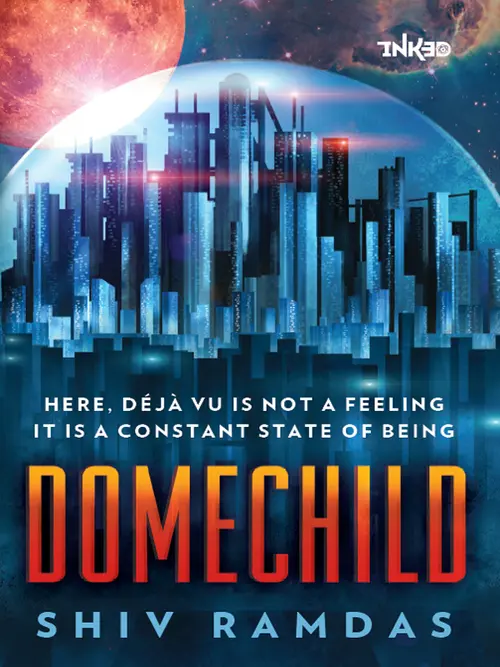
DOMECHILD
Shiv Ramdas is a former radio host and media non-personality who retired to play with words. Instead he ended up in Gurgaon.
Dedication
To Anish Chandy: a man with broad shoulders.
We have not made the Revolution, the Revolution has made us.
—Georg Buchner

1
It all began on the day the lawbots came for Tweedledum and dragged him away, screaming.
Everyone saw them take him, but nobody asked why, in case someone actually knew something. All Albert ever knew about him was that he liked to whistle and to wear tweed coats, even in summer. And that his name, in all probability, wasn’t actually Tweedledum.
The morning had begun in the usual fashion, with the sun rising, as suns tend to. Two hours later, Albert was already standing in line outside the Department, waiting for the first buzzer. When it came, he took a deep breath, holding it for a moment before exhaling heavily. Another day.
Then, along with everyone else, he stepped through the archway and the massive white doors and on to the conveyor belt that would carry him to his cubicle. His eyes were downcast and still they flickered, from left to right, over people’s shoes, skirts, the tails of their coats, anything but what surrounded them—there was no need to look at that, anyway. Everything was exactly the same as what preceded it. At the Employment Department, déjà vu was not a feeling; it was a constant state of being.
From the inside, the Department was nothing to write home about, and it wasn’t just because everyone in the City was here right now and there was no one at home to write to in the first place. Down the centre and all the way to the end of the room where it sloped upwards ran the conveyor belt, a thin black strip flanked on either side by an ocean of white cubicles that stretched as far as the eye could see, nestled back to back like featureless tiles in some gigantic game of dominoes. The next floor was the same. And the next, and the one above that, and so on—level upon level of stark, unrelenting sameness, a monument of monotony reaching up into the sky.
The second buzzer rang. A second later, he felt the faint vibrating purr under his feet as the conveyor belt hummed to life. Slowly, he began to count under his breath, eyes screwed tightly shut. At 1323 he stopped and, opening them again, stepped off the belt, heading for the cubicle on his right, nodding appreciatively to himself. Four years was easily long enough to perfect the timing but, even so, he couldn’t help feeling just a little smug. He paused for a moment, running a hand through his already messy hair, looking at the people on the other side of the conveyor belt. He looked at them every day, right here. He’d never spoken to any of them; of course, they were on his floor, which meant they weren’t accessible to him on the network, but he’d made up names for them, transposing personalities on to their faces, all the while wondering what they were really like. There stood Porky, simultaneously eating and brushing crumbs off his crumpled clothes. That’s right, thought Albert, keep those jaws working and your mind blank—must be the best way to deal with things after all this time. As he watched him, Porky reached into his pocket for another candy ration, still masticating, looking at Albert with the glassy-eyed, empty stare of a man for whom resignation has long since passed into indifference. How long had it been for him? Ten years? Twenty? Forty? He’d been around ever since Albert was assigned his cubicle and, by the looks of it, a good while longer.
Albert shook his head and turned, looking two rows ahead, to where King Leer was grinning vacantly round at everybody again. Could it be he actually was that happy? Not that he seemed to have any reason to be. Maybe the fellow had a secret life of some sort that he hid under that mask of vacuity. Or maybe he just had a single-digit IQ, which was far more likely. Albert shifted again, the frown quickly vanishing from his face as he looked straight across the conveyor belt. There she was. Sorrow.
As always, she fidgeted in her place as she waited for the door to open, tapping her feet, playing with her fingers, sometimes looking one way, sometimes another, so her lustrous black hair alternately covered and revealed her pale face like a living curtain. The face itself was inscrutable, but the faraway, forlorn expression in those deep, dark eyes said plenty. Albert wondered for the umpteenth time what trauma she was reliving. It was a futile exercise; he’d never know. She was just another person, one of the thousands here. Many thousands—the whole Dome was here. Literally.
Despite the fact that the Technological Revolution had made human occupation superfluous, the authorities were of the firm opinion that an unemployment rate of 100 per cent had no place on the resume of a perfect world and so, every morning, everyone who didn’t go to the Academy went to the Department instead, and sat out the requisite eight hours in their workspaces before catching the transport pods back home. Which was why Albert often secretly referred to the Employment Department as the Redundancy Corporation. More secretly than often, though, he had to admit.
A sudden sound—sharp and unfamiliar—caught his attention, and he turned to the right to see Tweedledum, short, tubby and tweedy as ever, pudgy cheeks puffing as he blew the notes outward. It wasn’t his usual melody either. No, this was a strange tune, almost like a dirge, both mournful and haunting. And though he whistled softly, the sound seemed to fill the entire floor.
Tweedledum shifted, noticing Albert’s interest in him, and stopped, looking at him sideways.
‘It’s called “Que sera sera”,’ he said.
Albert, well aware of the rules, glanced at him quickly and then looked down, pretending he hadn’t heard. The man continued to gaze at him and opened his mouth, as if to say something else, and then, with a slight shake of his head, he turned away and resumed whistling.
That was when Albert heard it, a low whirring—soft at first but getting louder and louder—rising above the murmurs and choked whispers that suddenly filled the air. Swinging to look to the left, Albert saw them, two lawbots whizzing down the conveyor belt, huge, fast and frightening. He felt a sudden thud shake his torso from within, then another and another, quicker and quicker, as his heart decided to compensate for the sudden cold feeling in his veins by putting in some good old-fashioned overtime. Next to him, Tweedledum had closed his mouth; he was shifting his weight uneasily from one foot to another.
The lawbots continued to zoom towards them, slowing down as they got closer and closer, virtually drawing to a halt as they came up alongside Albert. He felt the chill spread all over him, and a sudden twinge in his knees. What if they were coming for him? It wasn’t he who’d spoken, but what if he was the only one who knew it? What if there had been some mistake? His heart, ever mindful of its obligations at moment like this, now began to dutifully pound a tattoo on the inside of his chest.
Slowly, ever so slowly, the lawbots passed him, coming to a stop in front of his neighbour.
CITIZEN 3173, YOU WILL COME WITH US.
The words seemed to hang in the air long after the voice had faded away. Suddenly, there was silence all around—deathly silence—with not even the sound of breathing to ease its weight.
The little man blinked up at them. ‘I haven’t done anything.’
YOU WILL COME WITH US.
‘But I haven’t done anything. I just—’
NOW.
‘But you don’t understand. I just asked about it. I didn’t do anything. I didn’t—’
He broke off helplessly, turning to Albert, staring at him with wide, frightened eyes. Albert noticed that they were green.
‘Tell them I didn’t do anything.’
His lower lip quivered, his face contorted, one hand was half raised stiffly in the air like a little frozen claw.
Albert felt his stomach lurch once, then again, before settling into a regular heaving pattern, keeping almost perfect time with the pounding in his chest. He bit his lip and stared down at his shoelaces, saying nothing.
COME QUIETLY, 3173.
‘Please! I just asked! I swear!’
CITIZEN 3173, THIS IS YOUR LAST CHANCETO COOPERATE.
‘No! I just asked! I didn’t do anything!’
Albert felt a hand brush his, desperate fingers grasping at his sleeve, heard a voice, rising in pitch, higher and higher, still addressing him. ‘—won’t you say something? Why won’t you help me? Tell them I haven’t done anything!’
Albert looked up, turning his head towards the man, his hand coming up almost of its own accord, his mouth still opening when his eyes met Sorrow’s. She was looking straight at him, slightly, ever so imperceptibly shaking her head. Or had he imagined it? He hesitated momentarily and, when he turned, the little man was gone, being dragged inexorably away by a pair of massive steel arms, his heels scrabbling in vain on the smooth surface of the conveyor belt, screaming all the while.
‘—didn’t do anything! Somebody help me! Please! Somebody! We have to find him!’
He was staring straight at Albert, who turned away, unable to meet the look of accusation in those wide, stricken eyes. That didn’t make the voice go away, however.
‘Father! I have to find Father! And the Code! Don’t you see? It’s the only way! We have to find the Code! Help me! Please, somebody help me!’
The scrabbling got fainter, as did the voice, although it still carried well and truly to Albert.
‘Cowards! Cowards! Too scared to say a word! I was trying to help all of you! Why won’t you help me? Why won’t you do anything? It’s for you! Do it for you! And for Virgil! For Virgil!’
Albert stood there, gritting his teeth, feeling a wave of nausea coming on. He shut his eyes and began to count. By the time he reached ten, the voice had gone. By fifteen, so had the last echoes, and all that remained was stillness—awful, heavy, suffocating stillness—pressing down all around.
A second later, the third buzzer went off, shattering the silence. He had never thought he would be relieved to hear it. Opening his eyes, he turned away from the belt, in time to watch his door slide up smoothly. He turned around, looking for Sorrow, but she was gone, disappeared into the colourless depths of her cubicle.
Albert sighed and, slowly, in a manner befitting a person much older, he shuffled into his workspace. There he stood, just inside the threshold, listening to the electronic chiming of the door as it whizzed shut, the huge digital display counting down the time left before it would open again. He scowled, screwing up his face, biting his lip, finally recognizing the waves of emotion that had been washing over him for the last few minutes. Feeling the weight in his chest, he shook his head. He knew how impotent sadness was.
Shaking his head again, Albert opened his eyes and looked around. There wasn’t much to see—the inside of the workspace was as sterile as the outside. There was a chair, his water and rations for the day, a screen and a toilet section in the corner. A whiff of the air freshener of the day glazed the air. That was it. Nothing to tell a visitor to the cubicle anything about its owner or, indeed, to tell it apart from any other cubicle.
As he eased himself into the chair, he thought about how, if somebody ever went to the wrong workspace, he or she might never know the difference until the rightful occupant arrived to set them straight. Unless, of course, the rightful occupant was also in the wrong workspace. This gave way to an almost infinite loop of possibilities, which he was more than happy to explore. Anything to prevent returning to what he had just witnessed.
So he sat there and tried to occupy his mind by pondering the question of how many times he might have sat all day in the wrong place, or if he was truly in the right spot today. There was no way to tell, really, without actually checking the coordinates on his communicator. People sometimes did make marks on the walls, but every night the sanitation bots went around and restored each cubbyhole to its earlier pristine condition. Not that that deterred the scribblers, though. For instance, Luke, who had been with him at the Academy, spent his days merrily creating one panoramic masterpiece after another, all the while knowing full well that he would begin all over again on a fresh background the next morning. No doubt there were plenty more like him.
Albert now began to wonder why they bothered at all. Perhaps they wanted to feel a sense of belonging, or maybe they just wanted to know where they were. It could be anything. At the end of the day it didn’t matter—it was surprising how often that sentence crossed his mind these days.
He turned towards the screen and it switched on. He looked away, rubbing his eyes. Like most people, he’d been born slightly short-sighted. The near-continuous exposure to computer screens of successive generations had resulted in the condition becoming hereditary. Unlike most people, however, Albert had not received the Bionic Eye from the Department of Health; the carebot at the youth home where he had grown up refused to take him on the grounds that his myopia was an evolutionary development. The machine had been duly replaced the following week by an upgraded, less anthropologically oriented version but, somehow, the omission had never been corrected. Albert himself was glad for it. He liked his eyes as they were; they were a reminder of where he came from—who he came from. They were his inheritance, the gift his parents had left him—the only thing they’d left him. He scowled, shaking his head. They’d explained it often enough at the Academy. How, back in the days when reproduction was still dependent on physical contact, the primitive family unit served as a system whereby humans could collectively overcome their individual frailties. It was a system that was at first a necessity for survival, then became a tradition and, towards the end, a mere convention, until it had finally died out—just another quirky custom of the past, practised today only by degenerates like the Outliers. There was no place for it in a perfect, progressive world where every person was truly emancipated. Yet some part of him had never quite stopped wondering whether anyone on the long march to progress had ever realized how dreary being truly emancipated was.
Still scowling, he looked back at the screen, blinking slightly.
GOOD MORNING, ALBERT, the screen said.
Albert checked his communicator. Nothing. He turned back to the screen, which was now displaying a list. He didn’t bother to look at it. ‘Conversation,’ he said.
The screen blinked and cut to a view of different faces. Pursing his lips, Albert squinted at them for a moment, trying to decide.
Then he swivelled round again. He knew he should forget the whole thing—thrust the matter from his thoughts and move on—but somehow he just couldn’t manage. Not after what had just happened.
‘Never mind,’ he said.
He leaned back, his fingers steepled together, the voice still ringing in his ears. What was it the man had been shouting? Something about wanting to find his father. An odd choice to turn to in a moment of panic—a biological predecessor you’d never met—but then again, it was probably as much help as anyone or anything else, himself included. Now, what else had the chap said? Something about finding a code. No, not a code. The Code, he’d said. As if it was somehow supposed to be different from all the others even though, ironically, it fit in perfectly with the rest of them. The Code. The Way. The Word. The Book. They all had fancy names, and they all meant the same thing—idiocy, a chimera of hope for some deluded cyber-junkie. A secret message hidden away, somewhere outside the network. A word with the power to change the world forever. A lost text that told of a new way of life. There was no end to them, and they were all classified as Unapproved Content. No wonder—there should be a law against being that gullible. Which wasn’t the official reason of course; that had to do with how treasure hunts like these encouraged forays beyond the safe, sanitized confines of the network, towards unknown and potentially contaminated information sources. Or some big, wordy line like that. Of course, the bans only fuelled speculation, with the usual nonsense of there being no smoke without fire and so on. And every so often, some fool would pop up on the network, willing to risk his life and other people’s in pursuit of quasi-religious mumbo jumbo.
Albert snorted and, pleased with the effect, did so again. The Code. That was a new one, he’d never heard of it before. Maybe it was new—for all he knew, Tweedledum might have come up with it himself. Which could even be why the lawbots had come for him.
Albert frowned, shaking his head. No, that hadn’t been the reason. It was far more likely to have been what he’d said next. And there was no way he’d heard wrong; the man had said the word twice, loud and clear. Virgil. That one he had heard before. Everyone had, even though just mentioning the name was one of the most efficient ways of achieving state-assisted suicide in existence.
Virgil had been a guy at the Department who, early one morning, out of the blue, had posted a long, rambling message on the network. Nothing unusual about that—long, rambling messages appeared on the network often enough, usually as a preamble to the author throwing himself out of a window. But Virgil’s was different. It talked about how the authorities were controlling them all, using the tenets to keep them all isolated and the lawbots to keep them afraid. It was the duty of every Citizen, Virgil said, to unite, to reject the tenets and to take back the City that was rightfully theirs. And so, this very morning, he was going to give the Department a miss and march on to the Keeper’s residence instead, to demand that new tenets be written, and that anyone who agreed with him should join him in doing so.
Within minutes, scores of people had responded. Then scores more followed suit. The number swiftly rose into the hundreds and, for a few short hours, Virgil became the single most frequently used word in the City. Close to a dozen supporters even showed up for the march. They’d actually made it almost halfway to Elite Street before the lawbots showed up.
Albert had still been at the Academy when it had happened, so he never saw the messages or anything else. But he’d seen the consequences, all right. The Keeper had ordered the interrogations to be broadcast to the entire City, as an example of how the administration would leave no stone unturned to protect the people from dangerous dissidents who questioned the very values that had built everything they all cherished so dearly. Most of the interrogations—Virgil’s had never been shown, since the Keeper had no wish to make a martyr of him.
Despite his best efforts to prevent it, an image from one of the interrogations flashed across his mind, and he shuddered. Oh, he’d heard of Virgil, all right. In fact, more than anything else, it was the fact that he had heard of Virgil that had prevented him from trying to help Tweedledum, just as he suspected it had prevented everyone else on the floor. In that sense the Keeper had succeeded—a whole lot of people may have secretly admired what Virgil had done, but there wasn’t a person alive who wanted to be like him. Except apparently Tweedledum, who no doubt wouldn’t be alive much longer.
The Story Continues on BooksBarbecue!
Enjoyed this preview? ❤️ Do not stop here!
Read the complete book free online → 🔗
Continue reading now on BooksBarbecue and discover every page!
Love reading? Bookmark BooksBarbecue.com for more amazing books!
Happy Reading!