Chapters (50)
- A TOM DOHERTY ASSOCIATES BOOK NEW YORK
- Dedication
- Acknowledgments:
- Table of Contents
- Epigraph
- JOURNAL OF JULIUS GABRIEL
- PROLOGUE
- Chapter 1
- Chapter 2
- JOURNAL OF JULIUS GABRIEL
- Chapter 3
- JOURNAL OF JULIUS GABRIEL
- Chapter 4
- JOURNAL OF JULIUS GABRIEL
- Chapter 5
- Chapter 6
- Chapter 7
- JOURNAL OF JULIUS GABRIEL
- Chapter 8
- Chapter 9
- JOURNAL OF JULIUS GABRIEL
- Chapter 10
- Chapter 11
- Chapter 12
- Chapter 13
- Chapter 14
- JOURNAL OF JULIUS GABRIEL
- Chapter 15
- Chapter 16
- Chapter 17
- JOURNAL OF JULIUS GABRIEL
- Chapter 18
- JOURNAL OF JULIUS GABRIEL
- Chapter 19
- JOURNAL OF JULIUS GABRIEL
- Chapter 20
- Chapter 21
- JOURNAL OF JULIUS GABRIEL
- Chapter 22
- Chapter 23
- Chapter 24
- Chapter 25
- Chapter 26
- Chapter 27
- Chapter 28
- Chapter 29
- EPILOGUE
- Coming soon
- Permissions and Credits
- About the Author
We know the first people to arrive in the Andean region were hunters and fishermen who settled along the Peruvian coastline sometime around 10,000 BC. Then, around 400 BC, another group arrived on the Nazca plateau. We know little about these mysterious people, other than they referred to their leaders as the Viracochas, demigods who were said to have migrated to South America just after the Great Flood. The Viracochas were described as pale-skinned wise men with deep, ocean blue eyes and flowing white beards and hair. These ancient rulers apparently possessed superior intelligence and larger than normal craniums, their bizarre appearance no doubt influencing their followers to practice the art of skull deformation in an attempt to emulate their royal leaders.
The physical resemblance between the Viracochas and the great Mayan teacher, Kukulcan, is too incredible to ignore. The fact that a tall, bearded Caucasian also appears in the legends of numerous other ancient Andean cultures provides further clues of a link between Mesoamerican Indians and those of South America.
The most dominant Indian civilization to rise out of the mountainous jungles of South America were the Inca. Like the Maya, they too worshiped a great teacher, a wise man who advanced his people through the teachings of science, agriculture, and architecture. Although we now know that most feats credited to Inca ingenuity actually originated from earlier ethnic groups, written accounts tell us it was this bearded Caucasian who inspired the creation of the great Inca roadways as well as the famous agricultural terraces built along steep mountain slopes. The bearded one is also believed to have been the artist who created the older, more sophisticated drawings of Nazca. Although he is known by different names among various Andean cultures, the Inca worshiped him simply as Viracocha, meaning “foam from the sea.”
Like Kukulcan among the Maya and Quetzalcoatl to the Aztecs, Viracocha is the most revered figure in Inca history. Were the Viracochas of 400 BC his ancestors? Could he be a distant relative of Kukulcan? If so, does his presence in ancient South America have anything to do with the Mayan calendar and its forecast of doom?
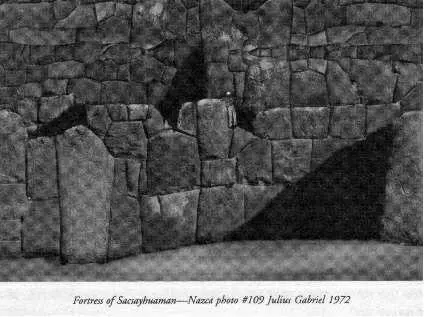
Seeking answers, we abandoned the Nazca desert and headed for the Andes Mountains, intent on exploring two ancient sites believed to have been created by the Inca deity. The first of these was the fortress of Sacsayhuaman, a monstrous structure erected just north of Cuzco. Like the royal tomb, the walls of this mind-boggling citadel are composed of giant irregularly shaped granite boulders which have miraculously been fitted so perfectly together that I could not wedge the edge of my pocketknife between the stones.