Chapters (50)
- A TOM DOHERTY ASSOCIATES BOOK NEW YORK
- Dedication
- Acknowledgments:
- Table of Contents
- Epigraph
- JOURNAL OF JULIUS GABRIEL
- PROLOGUE
- Chapter 1
- Chapter 2
- JOURNAL OF JULIUS GABRIEL
- Chapter 3
- JOURNAL OF JULIUS GABRIEL
- Chapter 4
- JOURNAL OF JULIUS GABRIEL
- Chapter 5
- Chapter 6
- Chapter 7
- JOURNAL OF JULIUS GABRIEL
- Chapter 8
- Chapter 9
- JOURNAL OF JULIUS GABRIEL
- Chapter 10
- Chapter 11
- Chapter 12
- Chapter 13
- Chapter 14
- JOURNAL OF JULIUS GABRIEL
- Chapter 15
- Chapter 16
- Chapter 17
- JOURNAL OF JULIUS GABRIEL
- Chapter 18
- JOURNAL OF JULIUS GABRIEL
- Chapter 19
- JOURNAL OF JULIUS GABRIEL
- Chapter 20
- Chapter 21
- JOURNAL OF JULIUS GABRIEL
- Chapter 22
- Chapter 23
- Chapter 24
- Chapter 25
- Chapter 26
- Chapter 27
- Chapter 28
- Chapter 29
- EPILOGUE
- Coming soon
- Permissions and Credits
- About the Author
In 1980, Nobel prize-winning physicist Luis Alvarez proposed that an extraterrestrial impact 65 million years ago was the cause of a mass extinction that ultimately ended the reign of the dinosaurs, forever changing the evolutionary pattern of life on Earth. This bold theory resulted from Alvarez’s discovery of a centimeter-thick clay layer of sediment deposited across the planet’s surface at the time of the asteroid cataclysm, between the Cretaceous (K) and Tertiary (T) geologic time periods. This K/T boundary clay was found to contain high concentrations of iridium, an extremely rare metal thought to exist deep within the Earth’s core. Iridium is the only metal capable of surviving temperatures in excess of 4,000 degrees Fahrenheit and is practically insoluble, even to the strongest acids. The fact that high concentrations of iridium have been found in meteorites led Alvarez to propose his theory that the K/T sediment was the remains of a settled dust cloud created by the impact of a large (7-mile-wide) asteroid that struck Earth 65 million years ago. All Alvarez needed to prove his theory was to find the impact site.
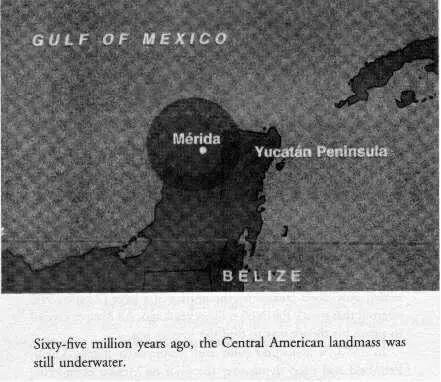
In 1978, a helicopter pilot and geophysicist named Glenn Pennfield had been flying over the Gulf of Mexico completing aerial surveys designed to measure faint variations in the Earth’s magnetic field, tell-tale signs indicating the presence of oil. Passing over an area of water just off the northwestern Yucatan Peninsula, Pennfield had detected a symmetrical ring of highly magnetic material one hundred miles across, buried one mile below the seafloor. Analysis of this immense donut-shaped configuration later confirmed that the area, covering both land and sea, was a crater—the impact site of a giant asteroid.
Named for the Yucatan town located between Progreso and Merida, the Chicxulub crater is the largest impact basin to form on our planet over the last billion years. The approximate center of the site is underwater, 21.4 degrees north latitude by 89.6 degrees west longitude, buried beneath 1,000 to 3,000 feet of limestone.
The crater is vast, 110 to 180 miles in diameter, spread out over the northwestern coast of the Yucatan Peninsula and the Gulf of Mexico. Surrounding the land-based section of the crater is a circular ring of sinkholes. These freshwater sources, called cenotes by the Mexican locals, are believed to have been formed in the Yucatan geography as a result of the extensive fracturing the limestone basin suffered during the asteroid’s impact.
Dominique looks up, slightly irritated “I don’t get it. What’s the big clue?”