Chapters (50)
- A TOM DOHERTY ASSOCIATES BOOK NEW YORK
- Dedication
- Acknowledgments:
- Table of Contents
- Epigraph
- JOURNAL OF JULIUS GABRIEL
- PROLOGUE
- Chapter 1
- Chapter 2
- JOURNAL OF JULIUS GABRIEL
- Chapter 3
- JOURNAL OF JULIUS GABRIEL
- Chapter 4
- JOURNAL OF JULIUS GABRIEL
- Chapter 5
- Chapter 6
- Chapter 7
- JOURNAL OF JULIUS GABRIEL
- Chapter 8
- Chapter 9
- JOURNAL OF JULIUS GABRIEL
- Chapter 10
- Chapter 11
- Chapter 12
- Chapter 13
- Chapter 14
- JOURNAL OF JULIUS GABRIEL
- Chapter 15
- Chapter 16
- Chapter 17
- JOURNAL OF JULIUS GABRIEL
- Chapter 18
- JOURNAL OF JULIUS GABRIEL
- Chapter 19
- JOURNAL OF JULIUS GABRIEL
- Chapter 20
- Chapter 21
- JOURNAL OF JULIUS GABRIEL
- Chapter 22
- Chapter 23
- Chapter 24
- Chapter 25
- Chapter 26
- Chapter 27
- Chapter 28
- Chapter 29
- EPILOGUE
- Coming soon
- Permissions and Credits
- About the Author
We don’t know much about Kukulcan, or his ancestors, although every Mesoamerican group appears to have worshiped a male deity who fits the same physical description. To the Maya, he was Kukulcan, to the Aztecs, Quetzalcoatl—a legendary bearded wise man who brought peace, prosperity, and great wisdom to the people. Records indicate that, sometime around AD 1000, Kukulcan/Quetzalcoatl was forced to abandon Chichén Itza. Legend tells that, before leaving, the mysterious wise man promised his people that he would eventually return to rid the world of evil.
Upon Kukulcan’s departure, a demonic influence quickly spread throughout the land. Both the Maya and Aztecs turned to human sacrifice, savagely killing tens of thousands of men, women, and children, all in an effort to usher in the return of their beloved god-king and forestall the prophesied end of humanity.
It was in the year 1519 that the Spanish Conquistador, Hernan Cortez, would arrive from Europe to invade the Yucatan. Though they easily outnumbered their enemy, the Mesoamerican Indians mistook Cortez (a bearded white man) as the Second Coming of Kukulcan/Quetzalcoatl and laid down their weapons. Having conquered the savages, Cortez sent for the Spanish priests, who, upon their arrival, were horrified to learn of the human sacrifices, as well as one other shocking ritual: Mayan mothers were strapping wooden boards to their infant’s heads in an attempt to deform their newborn child’s developing skull. By elongating the skull, the Mayan would appear more godlike, a belief no doubt inspired by evidence indicating the great teacher, Kukulcan, had possessed a similar elongated cranium.
Quickly proclaiming the Maya practice to be an influence of the Devil, the Spanish priests ordered the shamans burned alive and the rest of the Indians converted to Christianity—under penalty of death. The superstitious fools then proceeded to torch every important Mayan codex in existence. Thousands of volumes of text were destroyed—text that no doubt referenced the doomsday prophecy, and may have contained vital instructions, left to us by Kukulcan, to save our species from annihilation.
And so it came to pass that the Church, attempting to save our souls from the Devil, most likely condemned our species to ignorance some 500 years ago.
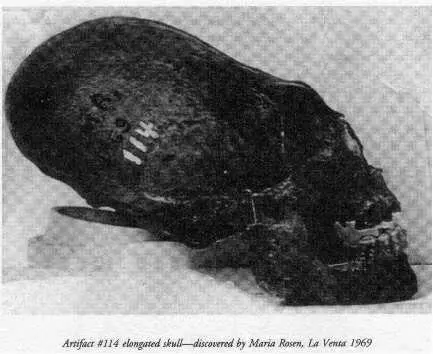
While Borgia and I argued over the identity of the bearded one depicted on the Olmec relief, our colleague, the beautiful Maria Rosen, came upon a find that would redirect our efforts away from Central America and onto the next leg of our journey.
While excavating an Olmec dig in La Venta, Maria discovered an ancient royal burial site, and unearthed the remains of an elongated skull. Although this bizarre, inhuman-looking cranium was not the first such skull ever located in Mesoamerica, it would turn out to be the only one found in the Olmec homeland referred to as the Serpent Sanctuary.