Chapters (50)
- A TOM DOHERTY ASSOCIATES BOOK NEW YORK
- Dedication
- Acknowledgments:
- Table of Contents
- Epigraph
- JOURNAL OF JULIUS GABRIEL
- PROLOGUE
- Chapter 1
- Chapter 2
- JOURNAL OF JULIUS GABRIEL
- Chapter 3
- JOURNAL OF JULIUS GABRIEL
- Chapter 4
- JOURNAL OF JULIUS GABRIEL
- Chapter 5
- Chapter 6
- Chapter 7
- JOURNAL OF JULIUS GABRIEL
- Chapter 8
- Chapter 9
- JOURNAL OF JULIUS GABRIEL
- Chapter 10
- Chapter 11
- Chapter 12
- Chapter 13
- Chapter 14
- JOURNAL OF JULIUS GABRIEL
- Chapter 15
- Chapter 16
- Chapter 17
- JOURNAL OF JULIUS GABRIEL
- Chapter 18
- JOURNAL OF JULIUS GABRIEL
- Chapter 19
- JOURNAL OF JULIUS GABRIEL
- Chapter 20
- Chapter 21
- JOURNAL OF JULIUS GABRIEL
- Chapter 22
- Chapter 23
- Chapter 24
- Chapter 25
- Chapter 26
- Chapter 27
- Chapter 28
- Chapter 29
- EPILOGUE
- Coming soon
- Permissions and Credits
- About the Author
Surrounding the sunburst, scattered about the plateau, are more than a dozen bizarre drawings of winged predatory creatures. Note that I am not referring to the more recent drawings of the hummingbird or pelican, two species indigenous to the area, but, instead, to a series of hellish-looking beings, the likes of which I still cannot identify. These mysterious, taloned creatures proliferate on the Nazca canvas, and I am still at a loss as to their function.
The longest zoomorph on the plateau is the 617-foot Nazca serpent. Unfortunately, much detail of the beast has been obliterated by the Pan American Highway, which cuts across its torso. The serpent’s presence on the pampa may symbolize the dark rift of the Milky Way, then again, its proximity to the Nazca pyramid, like the monkey and whales, may offer it as a signpost directing us to Chichén Itza, a Mayan city dominated by the image of the Feathered Serpent.
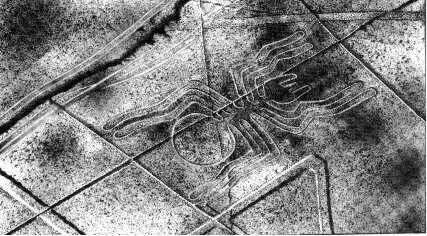
The serpent’s tail, like the sunburst and spider, has been oriented to Orion.
There are several other drawings that stand out as pieces of the Mayan prophecy. The last that I shall mention—and our favorite—is the figure we nicknamed the Nazca astronaut.
Suffice it to say that the presence of this 2,000-year-old extraterrestrial being remained a vision of comfort during our days on the pampa, a convincing reminder that we were not alone in our quest, at least in spirit. The owlish-looking humanoid male, adorned in uniform and boots, has his right hand raised in what could only be interpreted as a gesture of friendship. Clearly set apart from the rest of the Nazca message, the giant E.T. has been etched upon one of the hillsides like an artist’s signature on the margin of a painting.
DECEMBER 23, 1989
After more than four years of work on the Peruvian desert, I decided to take my family to visit the most impressive of the ancient drawings: the Trident of Paracas. Located 100 miles north of the desert pampa, this figure, often referred to as El Candelabro, or the Andes Candelabra, has never been officially linked to the Nazca drawings, even though its intricate pattern, size, and age easily qualify it as a work of our mysterious artist.
The Trident’s creator chose to engrave this colossal symbol on an entire mountainside facing the Bay of Paracas. The magnificent icon consists of a three-pronged candelabra design similar to that of a devil’s pitchfork, except the pointed ends, all facing up, are embellished with petal-like features. Because the etching is exposed to much harsher weather conditions than those of Nazca, the artist dug much deeper into the hillside, carving the icon’s outline a full three feet into the salty crustlike surface of the mountain. At 600 feet long and nearly 200 feet across, the Trident of Paracas is an easy landmark to spot.