Chapters (50)
- A TOM DOHERTY ASSOCIATES BOOK NEW YORK
- Dedication
- Acknowledgments:
- Table of Contents
- Epigraph
- JOURNAL OF JULIUS GABRIEL
- PROLOGUE
- Chapter 1
- Chapter 2
- JOURNAL OF JULIUS GABRIEL
- Chapter 3
- JOURNAL OF JULIUS GABRIEL
- Chapter 4
- JOURNAL OF JULIUS GABRIEL
- Chapter 5
- Chapter 6
- Chapter 7
- JOURNAL OF JULIUS GABRIEL
- Chapter 8
- Chapter 9
- JOURNAL OF JULIUS GABRIEL
- Chapter 10
- Chapter 11
- Chapter 12
- Chapter 13
- Chapter 14
- JOURNAL OF JULIUS GABRIEL
- Chapter 15
- Chapter 16
- Chapter 17
- JOURNAL OF JULIUS GABRIEL
- Chapter 18
- JOURNAL OF JULIUS GABRIEL
- Chapter 19
- JOURNAL OF JULIUS GABRIEL
- Chapter 20
- Chapter 21
- JOURNAL OF JULIUS GABRIEL
- Chapter 22
- Chapter 23
- Chapter 24
- Chapter 25
- Chapter 26
- Chapter 27
- Chapter 28
- Chapter 29
- EPILOGUE
- Coming soon
- Permissions and Credits
- About the Author
The city itself is divided into an old section and new. The Maya first settled in Old Chichén in AD 435 their civilization later joined by the Itza tribe, around AD 500. Little is known about the daily rituals and lifestyles of these people, although we do know they were ruled by their god-king, Kukulcan, whose legacy as the great Mayan teacher dominates the ancient city.
Maria, Michael, and I would spend many years exploring the ancient ruins and surrounding jungles of Chichén Itza. In the end, we felt convinced of the overwhelming importance of three particular structures, these being the sacred cenote, the Great Mayan Ball Court, and the Kukulcan pyramid.
Simply put, there is no other structure in the world like the Kukulcan pyramid. Towering above the Great Esplanade of Chichén Itza, the precision and astronomical placement of this thousand-year-old structure still baffles architects and engineers the world over.
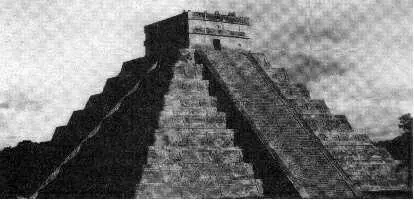
Maria and I eventually agreed that it was the Kukulcan pyramid the Nazca drawing had been intended to represent. The inverted jaguar within the desert icon, the serpent columns at the entrance to the temple’s northern corridor, the icon of the monkey and whales—everything seemed to fit. Somewhere, hidden within the city, had to be a secret passageway into the Kukulcan’s inner structure. The question was—where?
The first and most obvious solution that came to us was that the entrance was hidden within the sacred cenote, a naturally formed sinkhole located just north of the Kukulcan. The cenote was yet another symbol of the portal to the Mayan Underworld, and no cenote in all the Yucatan was more important than the sacred well in Chichén Itza, for it was here that so many maidens were sacrificed after Kukulcan’s abrupt departure.
Of more importance was the possible connection between the cenote and the Nazca pyramid drawing. Viewed from above (just as in Nazca) the sacred well’s layered, circular limestone walls could easily have been interpreted as a serious of concentric circles. In addition, the carved Mayan serpent heads, located along the northern base of the Kukulcan pyramid, point directly at the well.
Intrigued and excited, Maria and I put together a scuba diving expedition to explore the Mayan cenote. In the end, the only thing we found were the skeletal remains of the dead—nothing more.
Alas, it would be another structure in Chichén Itza that would change our lives forever.
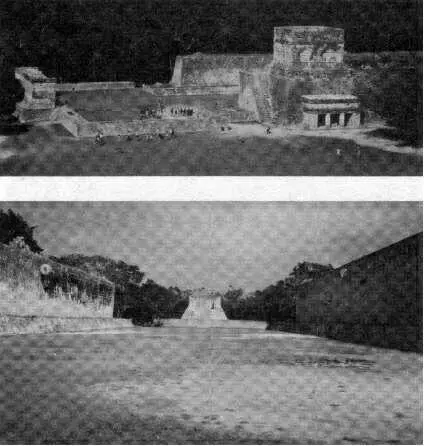
There are dozens of ancient ball courts in Mesoamerica, but none rival the Great Ball Court at Chichén Itza. Besides being the largest in the Yucatan, the Great Ball Court, like the Kukulcan pyramid, is a structure that has been painstakingly aligned with the heavens, in this case, the Milky Way galaxy. At midnight of every June solstice, the long axis of the I-shaped field points to where the Milky Way touches the horizon, the dark rift of the galaxy actually mirroring the ball court overhead.