Chapters (50)
- A TOM DOHERTY ASSOCIATES BOOK NEW YORK
- Dedication
- Acknowledgments:
- Table of Contents
- Epigraph
- JOURNAL OF JULIUS GABRIEL
- PROLOGUE
- Chapter 1
- Chapter 2
- JOURNAL OF JULIUS GABRIEL
- Chapter 3
- JOURNAL OF JULIUS GABRIEL
- Chapter 4
- JOURNAL OF JULIUS GABRIEL
- Chapter 5
- Chapter 6
- Chapter 7
- JOURNAL OF JULIUS GABRIEL
- Chapter 8
- Chapter 9
- JOURNAL OF JULIUS GABRIEL
- Chapter 10
- Chapter 11
- Chapter 12
- Chapter 13
- Chapter 14
- JOURNAL OF JULIUS GABRIEL
- Chapter 15
- Chapter 16
- Chapter 17
- JOURNAL OF JULIUS GABRIEL
- Chapter 18
- JOURNAL OF JULIUS GABRIEL
- Chapter 19
- JOURNAL OF JULIUS GABRIEL
- Chapter 20
- Chapter 21
- JOURNAL OF JULIUS GABRIEL
- Chapter 22
- Chapter 23
- Chapter 24
- Chapter 25
- Chapter 26
- Chapter 27
- Chapter 28
- Chapter 29
- EPILOGUE
- Coming soon
- Permissions and Credits
- About the Author
For seven years, our family searched the dense jungles of present-day Mexico, Belize, Guatemala, Honduras, and El Salvador. While other fathers taught their sons how to play baseball, I taught my son how to excavate artifacts. While other students learned a foreign language, Michael learned how to translate Mayan hieroglyphics. Together, the three of us climbed the temples of Uxmal, Palenque, and Tikal, explored the fortifications of Labna, Churihuhu, and Kewik, and marveled at the castle in Tulum. We investigated the Zapotec capital of Monte Alban, and the religious centers in Kaminaljuyu, and Copan. We crawled through tombs and scuba dived into subterranean caves. We unearthed ancient platforms and interviewed Mayan elders. And in the end, we narrowed the identity of the Nazca pyramid drawing down to one of two ancient sites, both of which we believed were puces of the Mayan calendar’s doomsday puzzle.
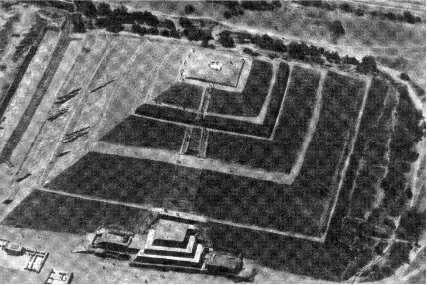
The first site was Teotihuacan, a magnificent Toltec city situated on a 6,600-foot-high plateau in the Mexican highlands, located some 30 miles northeast of present-day Mexico City. Believed to have been founded during the time of Christ, Teotihuacan was the first great metropolis of the Western Hemisphere, and was believed to be one of the largest.
Like the structures in Giza, the origins of Teotihuacan remain a mystery. We have no clue as to which culture designed the city, how the feat was accomplished, or even the language spoken by its original occupants. As is the case with the Sphinx and the Giza pyramids, the date of Teotihuacan’s construction is still widely debated. Even the name of the complex and its pyramids come to us from the Toltec civilization, which moved in centuries after the city was abandoned.
It has been estimated that the labor involved in building the structures of Teotihuacan would have taken an army of 20,000 men more than 40 years to complete. Yet it is not the mystery of how this city was constructed that first caught our attention, but its design and the obvious similarities to the site plan in Giza.
As mentioned earlier, there are three principal pyramids in Giza, laid out in reference to the stars of Orion’s belt, with the Nile intended as a reflection of the dark rift of the Milky Way. Teotihuacan also features three pyramids, situated in a surprisingly similar staggered formation, although the orientation differs by nearly 180 degrees. Connecting one end of the city to the other is the Avenue of the Dead, the major access route through the complex. The avenue, like the River Nile in Giza, was intended to represent the dark rift of the Milky Way.