Chapters (50)
- A TOM DOHERTY ASSOCIATES BOOK NEW YORK
- Dedication
- Acknowledgments:
- Table of Contents
- Epigraph
- JOURNAL OF JULIUS GABRIEL
- PROLOGUE
- Chapter 1
- Chapter 2
- JOURNAL OF JULIUS GABRIEL
- Chapter 3
- JOURNAL OF JULIUS GABRIEL
- Chapter 4
- JOURNAL OF JULIUS GABRIEL
- Chapter 5
- Chapter 6
- Chapter 7
- JOURNAL OF JULIUS GABRIEL
- Chapter 8
- Chapter 9
- JOURNAL OF JULIUS GABRIEL
- Chapter 10
- Chapter 11
- Chapter 12
- Chapter 13
- Chapter 14
- JOURNAL OF JULIUS GABRIEL
- Chapter 15
- Chapter 16
- Chapter 17
- JOURNAL OF JULIUS GABRIEL
- Chapter 18
- JOURNAL OF JULIUS GABRIEL
- Chapter 19
- JOURNAL OF JULIUS GABRIEL
- Chapter 20
- Chapter 21
- JOURNAL OF JULIUS GABRIEL
- Chapter 22
- Chapter 23
- Chapter 24
- Chapter 25
- Chapter 26
- Chapter 27
- Chapter 28
- Chapter 29
- EPILOGUE
- Coming soon
- Permissions and Credits
- About the Author
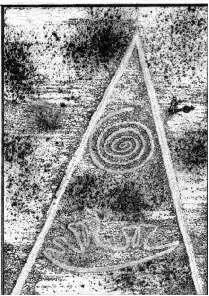
Maria and I were excited by the discovery. Both of us had, for some time, shared the belief that the Nazca drawings represented an ancient message of salvation relating to the doomsday prophecy, intended only for modern man. (Why else would the mysterious artist draw the figures so large that they could be seen only from an aircraft?) Our enthusiasm was quelled by the next logical question: Which pyramid did the Nazca drawing represent?
Maria insisted the structure had to be the Great Pyramid of Giza, the largest stone temple in the world. By her logic, Giza, Tiahuanaco, Sacsayhuaman, and Stonehenge all consisted of megalithic stones, their dates of construction were close (or so we believed) and the angle of the Nazca pyramid closely resembled the steep sides of the Egyptian pyramid.
I was not so easily convinced. It was my theory that many of the older etchings of Nazca were drawn as navigational markers, intended as references to point us in the right direction. Surrounding the Nazca pyramid were several clues which I believed had been left for us to identify the mysterious triangular figure.
The most important of these icons appears within the pyramid’s own border, drawn below the concentric circles. It is an image of an inverted, four-legged animal, one I reasoned to be a jaguar, arguably the most revered beast in all of Mesoamerica.
The second clue is that of the Nazca monkey. This immense icon, drawn in one continuous line, features a tail that ends in a concentric spiraling circle, identical to the shape appearing within the pyramid figure.
The Maya glorified the monkey, treating it as another species of people. In the creation myth of the Popol Vuh, the fourth cycle of the world was said to have been destroyed by a great flood. The few people who survived were believed to have been turned into monkeys. The fact that monkeys do not exist in either Giza or the southern region of Peru indicated to me that the pyramid referenced on the Nazca pampa had to be in Mesoamerica.
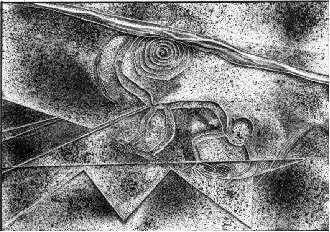
Whales do not belong in the desert either, yet there are likenesses of three of these majestic beasts present on the Nazca plateau. Theorizing the mysterious artist had used the whales to represent a three-skied boundary of water on the pampa, I attempted to convince Maria that the pyramid in question had to represent one of the Mayan temples located on the Yucatan Peninsula.