Chapters (50)
- A TOM DOHERTY ASSOCIATES BOOK NEW YORK
- Dedication
- Acknowledgments:
- Table of Contents
- Epigraph
- JOURNAL OF JULIUS GABRIEL
- PROLOGUE
- Chapter 1
- Chapter 2
- JOURNAL OF JULIUS GABRIEL
- Chapter 3
- JOURNAL OF JULIUS GABRIEL
- Chapter 4
- JOURNAL OF JULIUS GABRIEL
- Chapter 5
- Chapter 6
- Chapter 7
- JOURNAL OF JULIUS GABRIEL
- Chapter 8
- Chapter 9
- JOURNAL OF JULIUS GABRIEL
- Chapter 10
- Chapter 11
- Chapter 12
- Chapter 13
- Chapter 14
- JOURNAL OF JULIUS GABRIEL
- Chapter 15
- Chapter 16
- Chapter 17
- JOURNAL OF JULIUS GABRIEL
- Chapter 18
- JOURNAL OF JULIUS GABRIEL
- Chapter 19
- JOURNAL OF JULIUS GABRIEL
- Chapter 20
- Chapter 21
- JOURNAL OF JULIUS GABRIEL
- Chapter 22
- Chapter 23
- Chapter 24
- Chapter 25
- Chapter 26
- Chapter 27
- Chapter 28
- Chapter 29
- EPILOGUE
- Coming soon
- Permissions and Credits
- About the Author
Stonehenge is undoubtedly one of the most mysterious places on Earth, a bizarre temple of upright megalithic stones, arranged in a perfect circle as if by giants. Because we had spent time at the ancient site as part of our degree requirements, none of us truly expected to find any new revelations awaiting us on those rotting green plains of southern England.
We were wrong. Another piece of the puzzle was there, staring us straight in the face.
Although not nearly as old as Tiahuanaco, Stonehenge incorporates the same seemingly impossible feats of engineering and astronomy we had seen earlier. The site itself is believed to have been a spiritual magnet for farmers who first appeared on the plains following the end of the last ice age. The hillside must certainly have been deemed holy, for within a two-mile circumference of the monument are no less than 300 burial sites, several of which would provide us with vital clues linking the area with artifacts found earlier in Central and South America.
Carbon dating tells us that Stonehenge was built approximately 5,000 years ago. Phase one of the construction began with a precise, circular outline of 56 wooden totemlike poles surrounded by a ditch and embankment. Small blue stones, transported from a mountain range nearly 100 miles away, would later replace these wooden markings.
They, in turn, would be replaced by megalithic stones, the remains of which are still present today.
The mammoth vertical rocks that make up Stonehenge are called sarsan stones. They are the hardest rocks in the region and are found in the town of Avery, some 20 miles to the north. Stonehenge’s original design consisted of 30 such stones, each weighing an incredible 25 to 40 tons. Each of the great columns of rock had to be transported many miles over hilly terrain, then set upright to form a perfect circle, 100 feet across. Linking the top of these sarsans were nine-ton lintel stones, 30 in all. Each lintel had to be raised 20 feet off the ground, then set into place atop the sarsans. To ensure a proper fit, the ancient engineers carved rounded projections ontop of every sarsan column. These “plugs” fit into rounded-out hollow “sockets” formed along the underside of each lintel, allowing the pieces to fit together like giant Lego building blocks.
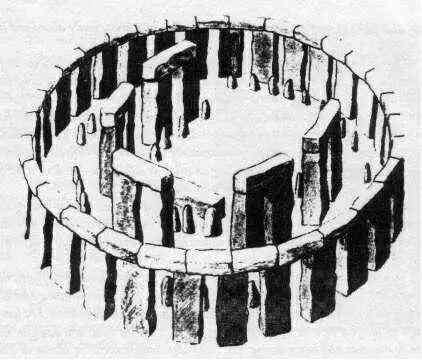
Once the monumental circle of stone was complete, the builders erected five pairs of trilithons, two upright sarsans connected by a single lintel. These trilithons, composed of the largest stones at the site, stand 25 feet off the ground, with another third of their mass buried underground. Five trilithons were set into place within the circle to form a horseshoe, the open end of which faces an altar stone aligned to the summer solstice. The center and largest of the trilithons has been set to the winter solstice, December 21, the day of the Mayan prophecy, a date considered by most ancient cultures to be associated with death.