Doing Time
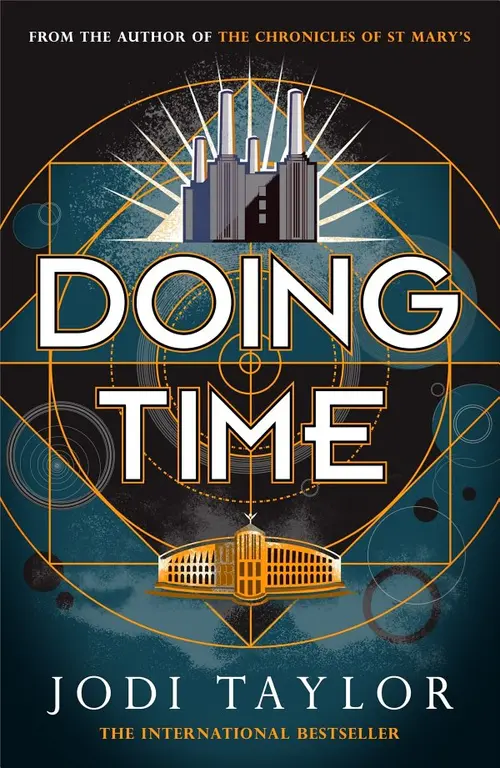
Title
Title
Copyright
Copyright
Copyright © 2019 Jodi Taylor
The right of Jodi Taylor to be identified as the Author of
the Work has been asserted by her in accordance with the
Copyright, Designs and Patents Act 1988.
First published in Great Britain in 2019 by
HEADLINE PUBLISHING GROUP
First published as an Ebook in Great Britain in 2019 by
HEADLINE PUBLISHING GROUP
1
Apart from any use permitted under UK copyright law, this publication may only be
reproduced, stored, or transmitted, in any form, or by any means, with prior
permission in writing of the publishers or, in the case of reprographic production, in
accordance with the terms of licences issued by the Copyright Licensing Agency.
All characters in this publication – other than the obvious historical figures – are
fictitious and any resemblance to real persons, living or dead, is purely coincidental.
Cataloguing in Publication Data is available from the British Library
ISBN 978 1 4722 6678 1
Cover design and illustration by [insert]
HEADLINE PUBLISHING GROUP
An Hachette UK Company
Carmelite House
50 Victoria Embankment
London EC4Y 0DZ
About the Book
About the Book
A long time ago in the future, the secret of time travel became known to all. Everyone seized the opportunity – and the world nearly ended. There will always be idiots who want to change history.
And so, the Time Police were formed. An all-powerful, international organisation tasked with keeping the timeline straight. At all costs.
Their success is legendary, and the Time Wars are over. But now the Time Police must fight to save a very different future – their own.
This is the story of Jane, Luke and Matthew – arguably the worst recruits in Time Police history. Or, very possibly, three young people who might just change everything.
About the Author
About the Author

Jodi Taylor is the internationally bestselling author of the Chronicles of St Mary’s series, the story of a bunch of disaster-prone individuals who investigate major historical events in contemporary time. Do NOT call it time travel!
Born in Bristol and now living in Gloucester (facts both cities vigorously deny), she spent many years with her head somewhere else, much to the dismay of family, teachers and employers, before finally deciding to put all that daydreaming to good use and write a novel. Nearly twenty books later, she still has no idea what she wants to do when she grows up.
Doing Time is the first in an irresistible spinoff series – a gateway into the world of the Time Police who are NOTHING like St Mary’s. Except, when they are.
Also By
Also By
By Jodi Taylor and available from Headline
The Chronicles of St Mary’s series
Just One Damned Thing After Another
A Symphony of Echoes
A Second Chance
A Trail Through Time
No Time Like the Past
What Could Possibly Go Wrong?
Lies, Damned Lies, and History
And the Rest is History
An Argumentation of Historians
Hope for the Best
The Long and Short of It (short-story collection)
Long story Short (short-story collection)
The Chronicles of St Mary’s digital shorts
When a Child is Born
Roman Holiday
Christmas Present
Ships and Stings and Wedding Rings
THE VERY FIRST DAMNED THING
The Great St Mary’s Day Out
My Name is Markham
A Perfect Storm
Christmas Past
Battersea Barricades
The Steam-Pump Jump
And Now For Something Completely Different
WHEN DID YOU LAST SEE YOUR FATHER?
Elizabeth Cage novels
White Silence
Dark Light
Frogmorton Farm Series
The Nothing Girl
The Something Girl
Little Donkey (digital short)
––––––––––––––
A Bachelor Establishment
Contents
Contents
Title
Copyright
About the Book
About the Author
Also By
Dedication
Roll Call
A Brief History of the Time Wars
Jane
Luke
Matthew
1
2
3
4
5
6
7
8
9
10
11
12
13
14
15
16
17
18
19
20
21
22
23
24
25
26
27
28
29
30
31
32
33
34
35
36
37
Epilogue
Author’s Note
A Note on Recruitment
Dedication
Dedication
For my Dad
Ut aliquando futurum praesidio.

Roll Call
Roll Call
Time Police Personnel
Commander Marietta Hay Commander of the Time Police. Attempting to modernise. A bit of an uphill struggle.
Captain Charlie Farenden Her adjutant. An astute young man.
Major Callen Head of Recruitment and Training. A bit of an enigma.
Major Matthew Ellis Recently promoted. Tipped for the top. If he lives long enough.
Lt Gordon Grint Recently promoted. Leading his first team. A very conventional Time Police officer.
Officer Celia North Formerly from St Mary’s. Fancied a change of career.
Officer Sarah Smith A bit of a bitch. Actually, quite a lot of a bitch.
Team 236 – Team Weird
Trainee Matthew Farrell Life’s a little more complicated these days. Still reluctant to have his hair cut.
Trainee Jane Lockland Brighter than everyone thinks. Definitely brighter than she herself thinks.
Trainee Luke Parrish Unwillingly trafficked into the Time Police. Not giving it his best shot.
Team 235 – All shaping up to be nice, conventional Time Police officers
Trainee Alek Anders
Trainee Alan Hansen
Trainee Stefan Kohl
Trainee Marco Rossi
Security
Officer Songül Varma Prisoner’s Friend, but not really.
St Mary’s Personnel – Grains of sand in the Time Police Sandwiches of Life
Deputy Director Tim Peterson Reprising his Roman patriarch role. Even less successfully this time around.
Dr Lucy Maxwell Historian. Enough said.
Miss Greta Van Owen Historian. As above.
Mr Markham Security. Got his hands full. Again.
Chief Technical Officer Very pleased to see his son.
Leon Farrell
Professor Andrew Rapson Unchanged over the years.
Dr Octavius Dowson As above.
Mr Tom Bashford Drowning – but only very slowly.
Miss Felix Lingoss Hair expert.
A Brief History of the Time Wars
A Brief History of the Time Wars
A long time ago in the future, the secret of time travel became available to all. Naturally, everyone wanted it and because the implications were imperfectly understood, the world nearly ended.
Old wars were fought and refought as world leaders continually pressed ‘Reset’ hoping for a more favourable outcome this time around.
New nations emerged, flickered briefly and then disappeared. The Confederate States of America, for example, arose from the wreckage of North America, was defeated, emerged again and refused all attempts to dismantle it. The subsequent long, bitter and bloody struggle so distorted the timeline that, for a dangerously long time, the Confederacy and the Union existed side by side, playing out their own histories simultaneously.
All over the world, people lived, died, then lived again.
Events happened. Then didn’t happen. Had never happened. Then happened again but differently. Some moments vital to the development of the human race never happened at all. Some happened more than once.
Everyone wanted to change the past for the better, but what was better for A was not necessarily better for B. Not surprisingly, whole new wars broke out.
Many, whose minds could not encompass the many versions of the same events, went mad. History was written and rewritten so many times that the fabric of reality began to wear thin. The world began to spiral downwards to destruction.
At the last moment, when it was almost too late, the Time Police were formed. It was an international effort. Personnel were drawn from the military, from the police, and even a few from a tiny organisation known as the Institute of Historical Research at St Mary’s Priory, situated outside Rushford in England, where they would explain, at enormous length, that they definitely didn’t do time travel – they investigated major historical events in contemporary time, and they’d been doing this for some time without anyone being any the wiser and that all of this was nothing to do with them.
A series of international laws were passed to deal with the situation. The punishment for time travel was death. Anyone caught indulging in time travel faced summary execution – together with everyone else involved. Or even those unfortunate enough to be standing nearby. No one ever bothered with a trial.
Every citizen was required to cooperate fully and completely with the Time Police. Failure to do so was death.
Armed with these powers, the Time Police set about their task of saving the world from its own stupidity.
Thus began what were known as the Time Wars. The Time Police’s remit was simple: to shut down time travel everywhere. No matter what it took – shut it down. With extreme prejudice if necessary. Just shut it down and get the situation back under control. They answered to no one. No one nation had overall control. Their reputation was fearful. Word soon got around. If the Time Police turned up, then things were not going to end well. Not for anyone within a five-mile radius, anyway.
It was bloody and brutal for a long time. A lot of people died. And not just the illegals, as they were known. The Time Police themselves paid an astronomically high price. After the first year, nearly all the original members were dead. Casualties were massive. It is doubtful whether they could have sustained these losses for very much longer but they never faltered, relentlessly pursuing their targets up and down the timeline. At one point they numbered less than thirteen officers in the whole world. No one ever knew how close the Time Police came to extinction.
Fortunately, by then, people were beginning to realise that possessing time travel is like holding a snake in your hand. If you don’t know what you’re doing, sooner or later, it will twist in your hand and bite you.
One by one, nations were induced to give it up. Many were secretly glad to see it go. They simply hadn’t wanted to be the first to surrender it. And by then, big business had discovered the past was not theirs to plunder. Their massive investment had led to no returns at all. They too lost interest.
In the shell-shocked aftermath, it was the Time Police, politically neutral, who brokered agreements, treaties and accords or, if that failed, knocked a few heads together. When done at street level, that sort of thing is known as a brawl. Do it at international level and it’s called diplomacy.
After a long while, things settled back down again but, as is always the way, those who had been the first to extol the virtues of the Time Police now began to perceive that the existence of an organisation with such wide-ranging powers might not be such a good thing after all.
Time travel, however, was not completely eradicated. There was Temporal Tourism – illegal but lucrative. Attempting to hide in another time to escape the consequences of an illegal act in this one was always popular. And every now and then, someone would put something up on the Dark Web, and armed with not even moderately accurate information, a hundred enthusiastic amateurs – for whom death by radiation was something that happened to other people – would beaver away in lock-ups, garages, spare bedrooms and science classes, apparently oblivious to the Time Police heading their way, determined to resolve the situation – whatever it took.
Whatever it took.
Jane
Jane
I’m where I am today because of a stuffed seagull. It stood in a glass case under a skylight at the top of the stairs in my grandmother’s house and it frightened me nearly as much as she did. Which is to say – a lot.
My grandmother was thin and brown-leathery and for years I thought she was a witch. Her room was right at the top of her tall, narrow house and she rarely left it, but somehow, she always knew when I’d dropped a cup or if I’d dawdled on the way back from the shops or stopped to buy myself a rare bar of chocolate.
Her voice, with that imperious rasp, would drift down the stairs.
‘Jane, come here at once,’ followed by the tinkle of her bell, demanding my instant presence.
I hated that bell. Nearly as much as I hated the seagull. But not as much as I hated her.
She was only one woman but I might as well have been toiling away in a large hotel, the amount of work she caused. Clean sheets every day. Whole herds of ghastly china animals to wash several times a month. Furniture to be polished – and with the old-style wax polish too, not the permanent spray-shine you can get these days. The windows were to be done every month – because she wouldn’t have stay-clean SmartGlass – and despite most of the rooms being shut up and never used, they still needed cleaning from top to bottom every month. Every now and then I would try missing one but she always knew. I never found out how.
I thought things would be easier after I left school because there would be more time for her insatiable demands, but that turned out not to be the case. There were just more of them. Her insatiable demands expanded to fit the time allocated. She could have had an army of servants and every single one of them would be as overworked and tired as I was.
My grandmother still left the house occasionally. She went to church on Sundays where, presumably, she harangued the Almighty for failing to wipe everyone not white, middle-class or English from the planet. With extreme prejudice. You always felt she was disappointed that God had confined himself to smiting only the firstborn of Egypt when he could, with just a little more effort, have wiped out the entire country. That would have taught them a lesson, wouldn’t it?
On the third Tuesday of every month, she was collected by someone who almost certainly was unable to get out of it and taken to the Social Centre a couple of miles away, where she found fault with everyone and everything, consumed every mouthful of a lunch that was hardly worth eating and was returned home, refreshed, invigorated and complaining every inch of the way.
And then there was the shopping. I visited the shops every day because everything had to be fresh. In vain did I murmur of refrigeration and its benefits. Every day at ten o’clock in the morning I left the house, squeezed tomatoes, inspected fish, sniffed at melons and then lugged the whole lot back home again. Every single day. I actually expected to be doing this for the rest of my life.
Which brings me back to the seagull. Almost every moment of every day was overlooked by that awful bird with its predatory beak and evil eyes. One of them wasn’t set quite right, giving it an evil leer which followed me wherever I went. Apparently, her husband, my grandad, had stuffed it for her as a personal gift – I’m not sure what that says about either of them – and then died shortly afterwards. The two events were probably unconnected, but it was enough for her to enshrine the thing in pride of place at the top of the stairs, where it was an eternal reminder of her dead husband.
And then I dropped the stupid thing.
I don’t know how it happened. Probably I was away with the fairies, which was how my grandmother usually described me. According to her I was a feckless daydreamer – a useless wimp – who would have starved to death on the streets if she hadn’t taken me in. Or perhaps I was more tired than I thought. I only know that as I picked up the glass case to dust underneath – because she’d know if I hadn’t – it was heavier than I remembered and the whole thing slipped out of my hands and crashed on to the floor.
The glass case shattered and the long-time inhabitant just fell apart. Heaven knows how old it was or how long it had been there, but it didn’t take kindly to being bounced off the gleaming parquet (forty-five minutes hard polish every other Thursday). The body hit the floor with a soft explosion of what looked like sawdust and the head skidded off underneath the highly polished walnut chest of drawers (fifteen minutes hard polish every other Thursday – before doing the floor but after cleaning the windows) and out of sight.
I stared, appalled. I had no idea what to do. When I thought of the way she carried on if I so much as dropped a cup, I could hardly begin to imagine what this disaster would earn me. My agitation even caused me to run in small circles as I tried to work out whether I should try to reassemble things – no chance. Or try to hide the evidence – no chance. Or even try to deny there had ever been anything there in the first place. ‘What seagull, Granny?’
Or – and I don’t know where this thought came from – I could simply . . . go. It wasn’t as if I’d never thought about it. I’d done it a thousand times in my dreams. I could grab a few things and leave. And never come back. I remember standing stock-still, suffering all the paralysis of someone whose dream could suddenly come true.
It was Tuesday. She would be gone for hours. I could be miles away before she got back. And then what would she do? What could she do? And she was perfectly capable of looking after herself if I wasn’t there to do it for her.
‘Don’t be so silly,’ said the voice within. ‘Where would you go?’
A good point, I had to concede – Gran always said I was about as much use as boil-in-the-bag ice cream – the venom in her voice robbing the comment of any humour – but compared with staying here with a shattered seagull, starving to death seemed a very viable option. If I remained, my life would hardly be worth living. And besides, I was old enough to go. In fact, I was too old to stay. Whoever heard of anyone my age living with their granny? And she could manage on her own. It wasn’t as if she needed me. She didn’t even like me. Thoughts I never knew were inside me came suddenly bubbling to the surface.
Wimpy Jane was horrified. ‘But I have no money.’
‘There’s the housekeeping. She keeps it tucked in her pillowcase.’
Wimpy Jane nearly fainted. ‘You mean . . . steal it? She’ll go ballistic.’
‘More or less ballistic than when she sees what you’ve done to her seagull?’
Wimpy Jane folded without a fight. ‘Good point. I should go. Now.’
‘What?’
Wimpy Jane cast aside the shackles of years. ‘I’m going.’
There’s nothing like suddenly giving yourself permission to do something you haven’t dared to do nearly all your life to catapult you into a vortex of panic and indecision.
I ran to my room. Halfway there I thought I’d better clear up the mess and veered off towards the stairs for a dustpan and brush. Halfway there I suddenly thought, what are you doing? Leave it. She’ll see what’s happened and at least then you won’t have to bother with an explanatory note along the lines of:
Dear Granny,
I broke your bird and by the way I’ve hated every moment here, and you claiming my carer allowance for yourself for my board and lodging was a really mean trick so I’m running away. I’ve taken the housekeeping in lieu of non-existent wages and I can promise you’ll never see me again.
Jane.
PS The seagull head is under the chest of drawers. Don’t think you’ll be able to reach it. Hope it doesn’t start to smell. Goodbye.
On second thoughts . . . why not? Why not leave a note just like that?
I left it lying on her pillow. Right next to where the housekeeping used to be.
My heart was thudding fit to burst. I think I was terrified she’d come home early and catch me. She never had – she paid what she always classed as ‘an enormous sum’ of money to the Centre to take her and feed her and entertain her and she’d never leave until she felt she’d had her money’s worth. I had plenty of time.
I made myself slow down, select stout shoes, something waterproof, warm clothes and some underwear. I stuffed the money – I hadn’t had time to stop and count it – into my toilet bag and shoved the whole lot into a carrier bag, because I never went anywhere, so why would I have a suitcase?
I threw on my coat, flung open the front door and ran down the path. I heard the door slam behind me and realised I’d left my key behind.
Now I couldn’t go back even if I wanted to.
I see I’ve begun in the middle but the seagull thing was a truly major event for me. It changed everything. Fear, coupled with shame and anger at being so afraid, propelled me from the house and out into the street and then deserted me completely. I found my way to the High Street and stood on the pavement watching the world go past. Where to go?
I couldn’t stay here. Everyone knew my grandmother, therefore, everyone knew me. I turned left for the airbus station. I would buy a ticket to . . . somewhere. In the meantime, I needed to survey my resources.
Actually, I was astonished at the really rather large sum of money I’d grabbed. Given the way she doled it out in pitifully small amounts whenever I went shopping and snarled at me if she thought there was insufficient change, there was a lot of money here. I could go almost anywhere.
I stuffed it all back into my bag before anyone saw it, bought myself a coffee and sat down on a bench to think. There was one of those holographic news and advertising boards on the wall. I sipped my coffee and watched the adverts slide by. Cheap airship travel, the latest blockbuster holos, Parrish Industries, cheap loans, national news, international news – image after image flickered by while the words slid past at the bottom of the screen. It was all on a continuous loop and I think I watched it twice before it registered.
The Time Police were recruiting. And they especially wanted women.
The Story Continues on BooksBarbecue!
Enjoyed this preview? ❤️ Do not stop here!
Read the complete book free online → 🔗
Continue reading now on BooksBarbecue and discover every page!
Love reading? Bookmark BooksBarbecue.com for more amazing books!
Happy Reading!