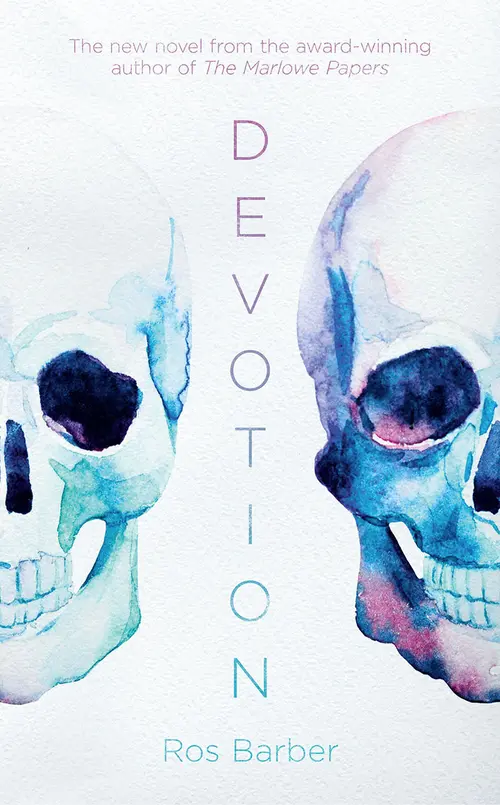
Devotion
Prologue
A Oneworld Book
This eBook edition published by Oneworld Publications 2015
First published in Great Britain and the Commonwealth by
Oneworld Publications, 2015
Copyright © Ros Barber 2015
The moral right of Ros Barber to be identified as the Author of this work has been asserted by her in accordance with the Copyright, Designs, and Patents Act 1988
ISBN 978-1-78074-728-6
ISBN 978-1-78074-729-3 (eBook)
Typesetting and eBook by Tetragon, London
This is a work of fiction. While, as in all fiction, the literary perceptions and insights are based on experience, all names, characters, places, and incidents either are products of the author’s imagination or are used fictitiously.
Oneworld Publications
10 Bloomsbury Street
London WC1B 3SR
England

For my brother Peter,
whom I am finally allowing
to slip under the ice.
Contents
- Prologue
- Atheists
- 1. Biology
- Left
- Hole
- Salmon
- Reality
- Surface
- That
- Contract
- Lost
- Found
- Accident
- Lodger
- Trees
- Gone
- Beans
- Song
- 2. Psychology
- Alarm
- Scrambled
- Peace
- Panini
- Beastly
- Epiphany
- Acts
- Stalk
- Observation
- Static
- Interpretations
- Wisdoms
- Determined
- Noodles
- Compassion
- Professional
- Semi-transparent
- 3a. Chemistry
- Reflected
- Clinical
- Turkey
- Things
- Bonds
- Medication
- Without
- Off
- Frozen
- Floored
- Deer
- Perfume
- Mad
- Remembered
- Breakers
- 3b. Physics
- Through
- Particular
- Peculiar
- Appreciation
- Presence
- April
- Meditation
- Revelations
- Headaches
- Ghost
- Alert
- Court
- Achilles
- Epilogue
- Opening
Prologue
Atheists
Bone-houses. Flesh-renters.
Reeling down the High Street, swear-gobbers, spit-flobbers. Dull-eyed beggar-dodgers, toddler-smackers, gum-droppers.
Watch them. Oblivious breathing machines. Coke-swiggers and chip-munchers. Spouse-slaggers and wife-borers.
Bus-chasers. Tube-crammers. Rattle-throwers left to cry all the way home at the knees of strap-hangers. Gummed up slow, or lurching too fast in their kid-scarers: nose-pickers, horn-thumpers.
Night brings its own brain-wasters. Packet-rustlers and plot-spoilers. Street-drinkers and ear-botherers. Late-bar minidress-totterers, naked-in-winters: rape-fodder pursued or steadied by beer-breathers, curry-spewers.
Where is God in all this?
God is a tame swear word. God is a lame joke. God is unfathomable: disaster-monger, famine-seeder. OMG, God is a teen-texted acronym. God is for nutters. For old ladies and nutters.
– APRIL’S JOURNAL, 12 FEBRUARY
1.
Biology
Left
This is his punishment. This is the price of blundering into love. Logan must trundle around the insensible world, grief snapped into his wallet, loss in his suit, and pretend to live. Pour coffee down his gullet as if he can taste it. Pick at a plate of food as though nourishment mattered. Have normal conversations with normal people on normal subjects. As if he cared about films, or laws, or the weather.
His daughter’s conception was a thoughtless act. A few minutes of drunken wrongdoing, succumbing to an urge to complete what he should never have begun. It was over with Rachel, whose insecurity had surfaced out of the deep pool of their lust sooner than expected; some brief weeks of buttock-gripping freedom dissolving into Where were yous and Who was thats. He became the stray tom she was trying to collar; had started to hook himself free on the chance branches of women who brushed across his path at work, or the squash club.
Why had he imagined he and Rachel could keep it casual? In retrospect the signs were as well marked as a national sporting event. In her childhood: benign neglect practised by middle-class divorcees, firm believers in the resilience of children, and determinedly oblivious to the havoc wreaked on a Daddy’s girl by alternate weekend access. A part-time man would never be enough. Certainly she had claimed to desire only a bit of fun. But no surprise if that kicked-sore heart asked of every even half-kind man, Are you The One?
How could he have missed the signs? Unforgivable in a psychologist, even one whose clients are criminals. Yet he had missed them utterly, creating the inevitable moment when he must add himself to her catalogue of vanishing men; men who melted away as fast as snow on the hot hearth of her need for love. True, he had been young. Who is not a fool when they’re twenty? Easy to imagine you are in control of a fling; that you can keep lust and love in their separate corners. Only later had he learned that while you are imagining sexual positions, she may be planning the furniture.
An error he’d had to correct. He’d not wanted to hurt her. So he’d drunk more whisky than was wise, but insufficient to incapacitate; gone late on a Friday to Rachel’s sad lilac flat, decked out in its Tibetan singing bowls and dreamcatchers, to bruise her with the words It’s over. Had said them with a cup of her sweetened chai in his hands, afraid to insist on what they had christened Normalitea in case the shared joke bound them more tightly together. And then, within a quartered hour, reassured by the words It’s safe, he had made their bond permanent and parental.
What was to blame for the sowing of that unbearably precious life? As he left Rachel’s arms that night, cursing himself for his weakness, oblivious to the creation of a new human being, he made a list.
- Rachel’s tears. Expected, obvious, braced against. Yet still he’d felt unprepared for the full stomach sickness of watching so much water spill out of this woman at his simple utterance, a two-word curse he could easily lift.
- His mother. Who had taught him how to quiet a woman’s sobbing through affectionate acquiescence: Give Mummy a hug.
- His biology. That persistently hopeful body part nodding into life, Yes, yes.
Stupid of him. Now how could he say it again? He’d have to detach more gently. Give her less of himself, until she was sick of his shadow and shooed him away. Do the right thing, Finlay Logan; extract yourself slowly. But six weeks later the cage came down: the pink window, and her insistence she would go ahead and have the baby, no matter what.
Oh, he’d wanted to blame her. Had added to his list:
- Rachel’s forgetfulness. If that’s what it was. Too busy chanting and meditating on life to prevent its creation by orderly contraception.
- Rachel’s insecurity. The urge to own him, even as she felt him slipping away, unconsciously erasing Take pill from her mental To Dos.
But in his heart he knew it was his fault. How in wanting to make things better, he always managed to make things worse. There she’d stood, crying, and what could he do but hold her, stroke her hair? Not considering she would respond with strokes of her own. And how could he quash that response without being unkind, without shoving her bodily off love’s kerb and back into tears? A chain of affection, like a series of small explosions, detonated desire; the passion stoked by the finding of something lost. Then they are stripping, kissing, fingers fumbling on catches and zips, and she has never been more ferocious, and before he knows it he is inside her again, thinking, One last time, then, one last time. Which she took as resolution. Which she took as retraction. What a mess. You, Finlay Logan, are an idiot.
But then his daughter arrived. And since he was banned from Rachel’s home until the bloody water of the birthing pool had been sluiced away, the placenta buried beneath a patio rose, he experienced his daughter not as a mess, but as a miracle.
Flora. Extraordinary, wonderful, Flora. He only has to think her name and he is lost.
Tickets?
He finds his phone without thinking. Inside pocket. Waved at the sensor; returned. He can do so much without thinking now. Has ordered and automated his life to float over this endless carpet of grief without putting its feet down. Yet there are moments that knock him against it, when he feels the sting of letting existence rattle on despite this ever-present absence, sharp as a friction burn. Today, across the carriage, a three-year-old, full of her me-ness, clambers into the preoccupied lap of her father, who, irritated, lumps her off again.
Do you not know how blessed you are? Do you not know—
The thought is caustic; he switches his gaze to the periscoping countryside. His eyes skip along power lines, blur the palisades of fences, trees, trees, trees – breathe. But he has touched it. The effervescent green of the trees is an assault.
Train journeys leave the mind rattling loose in its cage. But driving spooks him. Autonomous cars slink into your slipstream and maintain their perfect metre: too close, to his old-fashioned mind. And the way they lock on to you, mirror your every twitch: he finds himself fighting paranoia. On longer routes, great numbers will link up behind him, until he feels like he’s driving a train. He doesn’t want to drive a train. He wants to be alone.
No one sees the quiet tear from the eye closest to the window.
What to do, except pull up the file on his tablet? Work entices the mind out of despair: This way, this way. The more he feels the urge to sling a rope over the pulley on the garage ceiling, the harder he works. Back to the realm where it is painless to ask questions; where you may find answers.
Not yet, though. This case is new. April Smith, nineteen. Named by a mother skittering on the skid-pan of her life: creator of a girl – for she is barely a woman – whose name and face now dominate the news. An unfathomable photograph, courtesy of the police, who care to capture only height, build and distinguishing features. Standard procedures have robbed him of access to anything deeper. Where he would read her – those small dark green eyes – she is walled off, defiant. Violent, even. He wonders whether it’s police policy to goad suspected perpetrators into looking culpable. Or simply the unconscious result of their certainty in the suspect’s guilt: the certainty that is necessary for the arrest to occur in the first place.
Across the aisle, the father of the three-year-old has caught a glimpse of the photograph and is trying to read upside-down. Bloody idiot. Logan means himself but unwittingly speaks aloud and the man flinches. The file is confidential; he must move to first class and pay the extra should the guard return. Although Logan is thinner these last few months, he feels heavy. Bumping even momentarily into grief, his body grows sodden and sullen: blood thickens and slows, neurones clog with resistance. Effort is required to drag himself to the more comfortable seat where he can read alone.
April is saying nothing to anyone. Not even her defence team. But he has her diary. Opened at random, it is almost poetry… if poetry were hatred. But such contained hatred. Not the page-tearing, crossed-out scribbles of the enraged, the psychotic; no capitalized words, no vicious underscoring. Just a steady, girlish hand unleashing its controlled, cursive disgust. Another random page, and she is reporting a conversation with the Almighty.
Dear God, tell me through my left hand, what can I do with my anger?
Followed by a page of scrawl he cannot read.
It’s getting rare to see something written by hand. Young people don’t do that any more. They’re on keyboards at six, manually illiterate by twelve. Even teenaged diarists use apps. An echo of something he said to, who was it?
He can feel Flora breaking through like a radio signal, some disturbance in the airwaves, a distress call, a sudden swell of mental violins. He is being jolted against his will into the soundtrack of a tragedy and he won’t have it. He starts to hum – quietly, wary of being heard – one note after another. The resultant tune feels falsely jolly, deliberately trivial, a distracting melody you might muddle through as you committed some white-collar crime: fiddling the books, shuffling a justified claim to the end of the pile. Flora goes away.
Back to the page of scrawl. Though he cannot read it, there are words there. One of them looks like explode. It could be a metaphor: I’m so angry, I could just – Handwriting experts will be employed; transcripts produced. In the meantime, he must read April: immured, uncooperative April. He stares again at those frozen eyes. She isn’t there. But in the diary she is vivid. Only the left-hand portions, the portions where she is speaking as God, are unreadable. Fitting, he thinks, for the Great Author of the Mysterious. Speaks in tongues, writes in scribbles. The rest is as neatly inscribed as any bright girl’s homework. Daily, for fifteen and a half months, she has emptied the contents of her mind onto the page to produce this incriminating document. To quell the baying of her demons? To order her thoughts? To empty herself of pain? Or to justify her intentions: this astonishing, mouth-gaping crime? He swipes the notepad app, types a lucid exploration of obsessive misanthropy.
He imagines April in a student study bedroom, lying on the duvet on her stomach, inscribing her hatred with slow deliberation. The summer has dragged its residue heat into early autumn and a window is open; there is laughter outside. April records it with a sneer. Through the breeze-block walls of the halls of residence, a muffled gasp marks the crescendo of somebody masturbating. April records that too.
Foul cynical onanist next door at it again, she says. Name of Rick, but he’s more of a Dick. Ogled my tits while I scrubbed HIS burnt porridge out of my pan in the kitchen. Now wanking. Also fits. Dawkins fanatic. Arrogant atheist wanker asked if I wanted to join their Righteous Non-Believers’ Society.
Me: No.
Dick: You’re not a nutter, are you?
Me: Just don’t think Dawkins knew what he was talking about.
Dick (to three other housemates): Nutter.
General hilarity.
For the next half-page, lying on her belly with a halo of sunlight, April catalogues all the lines she failed to deliver in the communal kitchen. She is acidic. She is logical. She is devastatingly clever. But in the kitchen, she was silent.
Rick is one of the dead.
Rick has joined his idol, Richard Dawkins, in the Great Nothingness to which he and his friends in the Righteous Non-Believers Society subscribed. One of the most popular societies at April’s university, it seems to have been largely an excuse for the kind of nihilistic drinking which students have a long tradition of enjoying. But there was a serious core to it. In the decade since Dawkins’s death, radical atheism has only grown in popularity, especially among the young.
Without his noticing, the train has come to a halt. A brief announcement: there will be a delay due to ‘passenger trespass’.
A troublesome thought scuttles across his mind – briefly visible, then hidden in shadow – and as if in response, his phone vibrates on his nipple. The opening bars of Beethoven’s Fifth: his wife. The choice of tune once amusing, now true: Jules is ever the harbinger of drama.
Finlay. You’ve had your phone off again. I was that close to calling the police.
It isn’t actually a crime, he replies. And it wasn’t off. Must have been the signal.
I was watching the rail network website. There’s a body on the line.
It isn’t mine.
Her anxiety is a strategy for keeping him alive. She imagines her worry a thread that connects them and tugs him back to his responsibilities, insurance against his falling off the end of the world.
Clearly, clever man. Listen, Tom rang the house. He’s had his mobile stolen, he couldn’t remember your number. You’re meeting him, yes? Later?
That was the plan.
Logan holds himself still, as one holds a door to stop it swaying in a strong wind. His wife is jittery.
He told me to tell you seven o’clock in the Battle of Trafalgar. Your kind of place, he said. Just up from the station. You can’t text him because—
He’s had his mobile stolen. You said. You believe that?
In his own head, he is clear: the story is a convenient way for his son to avoid meeting him on campus. God knows what Tom has said to his friends in the beer-soaked confessions so common among bonding freshers. My father abandoned me when I was two. My father is an arsehole. Whatever Tom has said, his father’s turning up in person among them is now too embarrassing to contemplate. They’d agreed he would text when this meeting with Dr Salmon was over, and Tom would reply with directions to his halls of residence, but now it was to be a quick half by the station and Dad safely back on the train with none of his new mates any the wiser.
Jules has paused long enough to let him know she has considered the matter.
Tom’s flaky, Fin, but he’s not a liar. Are you—?
I’m fine.
He reads her disbelief in the silence. She is better equipped than the women of his past. With Rachel, with Johanna, where the dialogue would continue, You don’t sound fine, followed by increased irritation on both sides, Jules knows that I’m fine is a closed portcullis, and that attempting to storm it will only lead to his unleashing the boiling oil. Even when his carriage is empty, he can no more be drawn into personal discussions on public transport than he would run naked through Tesco’s. Jules’s understanding of the portcullis is the reason she’s his wife.
Call me when you’re close to home, she says. I’ll come and pick you up. Did you get some lunch?
When he’s done with the pleasantries Jules requires to reassure herself he will not, any time today, become the cause of major transport delays on the Southeast rail network, he opens the diary again.
More God. A great deal about God. It is not his area of expertise. He was raised in the pretence of Christianity by parents who understood the practical benefits of Sunday School. To be found in church themselves only for christenings, weddings and funerals, they nevertheless appreciated the grounding in morality that a general familiarity with the Bible might distil. He remembers the Reverend Holinshead once giving him a chocolate digestive. He remembers the story of the Good Samaritan, colouring a lot of pictures of bearded people, making stiff leafy crosses for Palm Sunday, little else. Religion was a web of fables decorated with a weekly dose of singing and praying. But God – whatever that is – was not something he experienced. Nothing that might inspire awe occurred, if you exclude (and he had tried) the unholy view of the vicar’s young and miniskirted wife bending over to pick up crayons. He can only have been six, seven, but he felt stirrings. Perhaps his later sexual appetites might be blamed on that far-too-early awakening, so that all his sins might be traced back to the revelation of Abigail Holinshead’s untouchable buttocks. His inability to stay with Rachel – the very seed of Flora’s creation – or Johanna – the source of Tom’s fury. Ask and it shall be given you, Mrs Holinshead had whispered as she returned crayon after crayon to his pudgy hand. So perhaps he had asked for it. Nevertheless the young woman’s misjudged combination of apparel and motion had influenced him more profoundly than any nugget of religious instruction. God was simply a word, and the more copiously it was defined the more thoroughly it slipped his understanding. God the creator. God the Father, Son and Holy Ghost. God is love. What could any of it mean? The concept was nebulous, unknowable.
April’s God is very real to her. She seeks His guidance and He is free with it. She issues Him instructions and He responds. They are pen pals. Every other page, Tell me through my left hand, and off He goes, spilling His incomprehensible guts as volubly as she spills hers on the pages in between. Logan feels a spike of jealousy. He longs for the comfort of being immersed in such a delusion. Is aware how pain might dissolve in the knowledge of an omniscient, omnipotent being who is both listening and responding, even if you have imagined that being into reality.
He will have a good chance, he thinks, of proving that this young woman’s religious convictions are a form of psychosis. He told Jules as much at breakfast, in answer to one of the questions she is routinely asking him these days, attempting to break into the Work cell where he is sheltering from his feelings.
You’ll be their champion, she said, jabbing a finger at the morning headline.
Surely not. People want the girl banged up for life. Properly punished. If she’s declared insane—
I think they’ll be rather happy about it. They’re calling for religious fundamentalism to be reclassified as a form of mental illness.
Who’s They? The media?
Everyone.
He sighed. Religious leaders?
Well, no. It doesn’t say—
Mental health organizations?
Don’t be pedantic, Finlay. You know what I mean.
You mean some people. You don’t mean everyone.
She buttered her toast as though she were combing out a child’s tangles.
There’s an editorial about it. The other papers are on it too. And politicians. There were questions in the House yesterday. You can see for yourself.
One unthinking hand launched the tablet into the channel of naked oak between them. It came to rest against the buoy of the marmalade pot.
He had been unable to read the news or listen to radio bulletins since Flora. He stayed clear of the television. There was always the danger that some story would leap out and barge him, bodily, against the wall of his emotions, smacking its knuckles into his skull. Yet hovering at a station kiosk for a bitter Americano, or failing to mute the kitchen radio at the top of the hour, he could still be ambushed. Four children have died in a house fire in Huddersfield – A toddler, battered to death by her stepfather – The police have confirmed that the body found in woods near Northampton is that of missing teenager – On public transport, his compulsion to read any text set in front of his eyes makes the free tabloids that commuters shake into his line of sight a menace. The unavoidable front page headline: Calls Grow to Recognize ‘God-Madness’ After Bus Girl Massacre. April’s was the third religiously inspired atrocity since Easter.
I don’t need to see, he said.
The Story Continues on BooksBarbecue!
Enjoyed this preview? ❤️ Do not stop here!
Read the complete book free online → 🔗
Continue reading now on BooksBarbecue and discover every page!
Love reading? Bookmark BooksBarbecue.com for more amazing books!
Happy Reading!