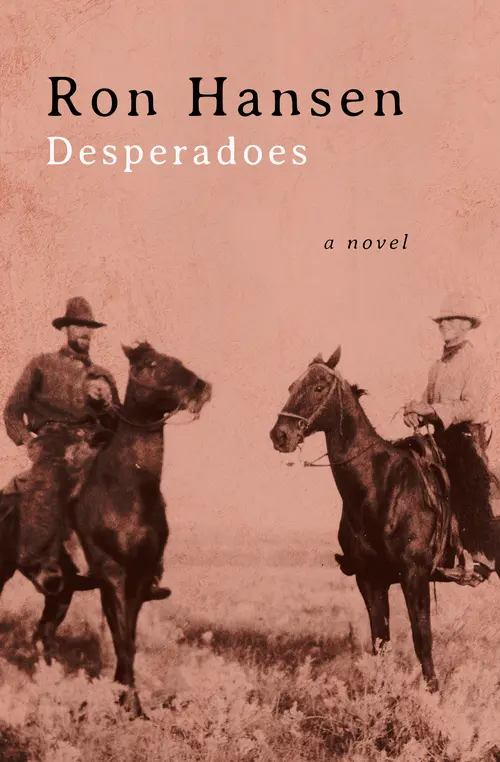
Desperadoes
Cover

EARLY BIRD BOOKS
FRESH EBOOK DEALS, DELIVERED DAILY
LOVE TO READ?
LOVE GREAT SALES?
GET FANTASTIC DEALS ON BESTSELLING EBOOKS DELIVERED TO YOUR INBOX EVERY DAY!


Desperadoes
A Novel
Ron Hansen

Dedication
For my brother, Rob
Epigraph
Of that marauding band I am the sole survivor. The rest have gone these many years, with their boots on. In fact, I am one of the very few yet alive of that whole elder school of border outlaws whose kind rides no more. And now that I am dry behind the ears I have a yearning to tell truthfully the tale of the Daltons and others of the old-timers whose lives and exploits have been so often garbled, fantastically romanticized, or vaguely related…
The tale will recount contacts with many of the less exploited desperadoes, as well as some of the more widely celebrated figures of the last frontier.
It will have dreadful and sinister things in it, of course: swift foray, desperate encounter, and the ultimate tests of reckless manhood; hot saddles, cracking guns, and last stands in a fated hour; fantastic courage and inglorious defeat—splendid things and mean, on both sides of the law’s deadline. The sowing of black oats, and the terrible harvest.
And to leaven the wild antic of hair-trigger men in hair pants, the story also will have the romantic presence of women, gentle, stoic, and tempestuous, whose lives were entwined with the destiny of outlawed Daltons.
—Emmett Dalton,
When the Daltons Rode
1
WHEN MARSHAL FRANK DALTON was murdered by whiskey runners in 1887, the federal government shipped him to Coffeyville, Kansas, in a mahogany box filled with ice. His face and hair were waxed by undertaker Lape and the body was hauled to Elmwood Cemetery in a quality black carriage with windows that did not warp what was looked at.
When my brothers Bob and Grat Dalton were shot dead in 1892, the bodies were handcuffed and stood in their stocking feet so photographs could be taken and the outlaws lay all night on a Coffeyville jail-house floor with blowflies crawling over their faces. Women came by with pinking shears to snip away bits of their hair and clothes, and the cartridges that were left in their belts sold for a dollar apiece.
And when Bill was gunned down by a marshal’s posse in 1894, he was displayed in a coffin covered with window glass until he was badly decomposed. Spectators journeyed by train from Kansas and Texas and Oklahoma, and thousands of people crowded the mortician’s parlor so they could file past and solemnly stare at the last of the notorious Daltons.
But I have spent these last years in Hollywood, California, where I suppose I will sleep one night and pass on to glory in striped pajamas, with my mouth open, and with a dozen medicine bottles on the bedside vanity. It is 1937 and I am sixty-five years old and not the kind of man I started out to be, but a real-estate broker, a building contractor, a scriptwriter for Western movies; a church man, a Rotarian, a member of Moose Lodge 29, which is a true comeuppance for a desperado of the Old West, for the boy Emmett I was, and something to consider as I stood at night on my kelly-green lawn, a tinkling glass of ginger ale in my freckled, shaking hand.
A girl I didn’t know was alone in the pool swimming slowly back and forth in satin underwear while in the dining room a combo from Havana played its trumpets and castanets in slick black hair and frilly sleeves. A week ago my wife and I returned from Coffeyville, Kansas, where I was the favorite son, where I was famous, so this was a welcoming party of sorts; but it was a celebration too, because my second book, When the Daltons Rode, had just been sold to a film studio here and I was made richer by quite a little. So male movie stars slouched around a billiards table in white flannels and sweaters tied at their necks and a makeup man was perched on our white corduroy couch with my stout and mankind-loving wife, hooting at Julia’s comments, saying how precious she was.
If I went inside that grand stucco house with its South American look, women with platinum hair and clinging gowns and perfume strong as onions would beg to see my velvet-wrapped pistol or inquire about the Dalton gang and expect me to enchant them, become the gabby sidekick, confess about how it really was, as it those years of robbery were no more than a yarn about a blue ox or some carnival geek who chewed glass. If I went back inside I could see a houseboy carting drinks and a tray of bread squares smeared with black fish eggs, see a studio vice-president nuzzling the neck of another man’s wife or a gaffer in a red cummerbund learning the rhumba with a girl from the typing pool. And I could see myself in an old silent movie that was flickering against the living room wall, see Emmett Dalton in middle age jabbing a six-gun at a bank teller’s face as jostling dancers interrupted the screen, my holster strapped over a woman’s back, a drawer of coins on someone’s tuxedo shoulder.
The past was closer to me then than the sweating glass in my hand and it seemed not long ago that I was a boy slumped against a sod house in the Indian Territory, watching Bitter Creek Newcomb wade through high yellow grass out to the buffalo wallow where he’d stare at a pane of water there with the white moon watered in it. I could hear pool water slap softly in the skimmer as some girl in satin underwear glided to the ladder near the diving board, but all I saw was my brother Grat as he slapped the Navaho blanket up and sagged a shoulder against the mud wall, a pottery jug of white alcohol hung from his middle finger. Horses would nicker at the pole fence and he’d look at the empty night and scratch himself. “Ain’t had this much fun since the circus.”
I walked back toward the house and saw that on the screened breakfast porch newspapermen were taking photographs of Julia hugged like a shy, baffled mother by four of her merry party guests: Andy Devine, Frank Albertson, Broderick Crawford, and Brian Donlevy; Hollywood’s latest version of Grat, Bill, Bob, and me. The stars clowned and made pistols of finger and thumb and Julia looked as amused as she could in her pearl necklace and navy blue party dress, a pretty hostess at sixty-four but less like the half-starved grand ladies here than a grocer’s wife or a good farm woman who each morning scatters feed to the chickens.
The newspapermen saw me and called me up onto the porch to pose with my wife and then to stand alone next to a movie-house poster framed under glass on the wall. I suppose they fancied that I’d grin for their cameras with a knife in my teeth and a pistol in every hand, that I’d fan a roaring gun at a coffee can to make it whang and hop across the patio, but I was forty-five years away from the boy who wanted to be famous; I didn’t want to be news anymore. The only picture they got for their rolls of black film was that of a tall, haggard man with a drink in his hand: Emmett Dalton in a charcoal suit, a rich executive with a needle of pain in his hip and a fourteen-year prison education, a man who golfs with bankers and stumps for good causes and talks to the governor on the phone.
I walked into the kitchen and put my glass in the sink and lit a cigarette. Julia came out of the dining room with a tray of lettuce and quivering gelatin dessert that she slid onto a shelf of the Frigidaire. She wiped her hands on a towel and asked, “Why are you frowning?”
“I ache.”
“I have some aspirin.”
“Maybe I’ll just suffer for a while.”
“Think how much they’re enjoying this,” she said.
My wife left with a dishrag she’d wrung out and I took the oaken stairs up to my locked study while a musician named Fernando lugged the combo’s drums out to a school bus. I used my key and closed the study door behind me and stood in a dark brown room that smelled of old newsprint. I sat at a library table with maybe fifty books about the Dalton gang marked with yellow paper scraps or weighted open with bricks. Framed under glass on the walls were browned reward posters, red-and-blue billboard paste-ups for some of the Dalton movies, and three newspaper front pages dated October 5, 1892. In one mahogany cabinet were magazine articles, mostly false, and in the other I had the more reliable files of Deputy Marshal Christian Madsen, manila envelopes once wrapped in twine and printed on each a name: Broadwell, Bryant, all four Daltons, Doolin, McElhanie, Eugenia Moore, Newcomb, Pierce, and Powers.
I switched on a study lamp and opened a cardboard box containing the clipping file on me. I unfolded my pocket bifocals and hooked them on an ear at a time, just as my brother Bob had when he said, “I can see clear to Nebraska with these.” Then I sat in a stuffed chair for most of an hour, turning the pages over onto the carpet after I’d read what they said.
I heard my wife’s high heels in the hallway and turned to see Julia in the room, a cup of hot milk and a saucer in her hands.
“Is it over?” I asked.
“There’s still a girl asleep on the floor of the bathroom and a barefoot man at the piano playing ‘Swanee’ with his left hand. The houseboy’s taking care of them.”
“Was I missed?”
She smiled. “They make allowances for you. They think you live in a foreign country. A reporter asked about you.”
“Did he use the word ‘truculent’?”
She ignored that and said, “There’s a young man here who’s read your book,” and in the doorway there appeared a boy in a green zigzag sweater and a white shirt with the collar spread out to his shoulders. I put him at twenty. I said, “What do you want?”
“I’m not sure. I drove all the way from San Bernardino.”
I flicked my hand out. “Drive all the way back.”
But Julia said, “You could at least visit for a minute, couldn’t you, Em?”
The boy stood next to the coat tree with a tablet in his hand. “I read your book,” he said. “It’s fascinating.”
I removed my bifocals and pulled up from the stuffed chair with pain. “Do you want to see my gun? I’ll show you my gun and you can go back to San Bernardino and brag in some soda shop.”
I limped to a mahogany cabinet where the pistol, a 44-40 Colt, was wrapped in red velvet and stuffed between some manila files, a protection against common house thieves. I heard Julia say, “He’s not really such a grouch; that’s just his way of teasing.”
I suppose the boy wrote that down.
Then Julia left and the boy and I sat at my library table next to the study lamp. He weighed the pistol in his hand, aimed it at a streetlight, folded the velvet cloth over it. I showed him a black bullet big as the top knuckle of his little finger. “That was dug out of my shoulder in Coffeyville. I was awake and face down on a mattress and rifles were held to my head. I remember it dropped in the doctor’s pan like a marble.”
He slouched in the chair, amused. “That must’ve hurt.”
I squinted and asked him if he knew anything about the Old West.
“Not much, I’m afraid.”
“You’ve heard about Jesse James.”
“Yes.”
“The Younger brothers?”
“I think so.”
“Cole Younger was my cousin; neighbored the James boys in Kearney, Missouri. The James-Younger gang was our inspiration. They robbed stagecoaches, trains, the Kansas City Fair, a bank in Northfield, Minnesota, that did them in; shopkeepers took after the villains with shotguns, spade handles, and rocks they’d picked up in the street.”
I was boring the boy; I could see his eyes stray. But I kept on and talked about other things: the Coffeyville reunion that Julia and I were just back from, about the movie Hollywood was making; about Eugenia Moore with her wing chaps, the law books my brother Bill read, the rifle called the Yellow Boy that Bob used once on a man; and the horses we rustled, the Mexican cantina we robbed, the locomotives big as shoe stores. I storied long enough to burn a candle down and when I quit the boy just sat there and frowned. He said, “You don’t seem very sorry about any of this.”
I stared at him.
“I mean, you murdered all these people.”
“I didn’t.”
“Okay, your brothers then. I sort of expected you to repent more than you do.”
“I was in a Kansas prison from 1893 to 1907. Penance is something I’ve already done.”
“But you don’t even—”
“Get out.”
“Excuse me?”
“Get out!” I pulled up onto my shoes and stood there with my hands quivering at the red velvet that covered the pistol, cocking back the hammer with both thumbs.
Then I was alone in the house except for my sleeping wife, and I sat at the foot of our bed in the dark, smoking down a Camel. I went into the bathroom and turned on the light and hung my suit and shirt on hangers. And I looked at my back in the long door-mirror, at the eighteen wicked scars of double-ought shot that were like cigarette burns on the skin, at the scar on my hip left by a rifle slug, that still registered rain and cold and too much time in my shoes with twinges sharp as cat bites. I peeled away a yellowed square of gauze taped to my festering right shoulder and squeezed a cream medicine from a silver tube into the ugly red eruption of skin, the result of a rifle shot that shattered the bone when I was twenty years old, that is still uncured forty-five years later. I tore the paper wrapper off a clean bandage and fixed it on. I buttoned on pajamas and tied my robe and with a glass of water swallowed three pills from three bottles, then carried my wife’s cup and saucer downstairs to the kitchen sink where I left them for the maid.
And I stood in the living room next to the movie projector with its motor switched to reverse. I lit another cigarette and waved out the match and squinted through smoke to see the film collect off of the take-up reel, but after several hundred feet I stopped the machine and flipped the switch from rewind to forward and turned on the projector lamp, so that I could view my nickelodeon film: Beyond the Law, a movie starring me and written by me, produced by myself and John B. Tackett, adapted from the reminiscence I serialized in Wide World magazine. Tackett and I toured the country with it in 1918 and made a boodle of money even though it was pretty awful. I’d stared down dangerous men in my time but I was scared in front of Tackett’s camera, the scowliest character ever on film. I flung my hands around, I slapped my shooting iron out of a polished black holster, I dressed like a buckaroo; and I was forty-six years old in that film, not the boy of my adventures; I looked ridiculous. Tackett was a fine showman, however, and he’d stand on movie-house stages in strange cities to deliver a stirring narrative about the Dalton gang, what trains we robbed and the way my brothers blazed to their deaths, ending with a list of the men we murdered:
“Charlie Montgomery, bushwacked over a woman. Then a Wharton ticket agent. Bill Starmer, after stealing his horse. Marshal Ed Short in a railroad car. An innocent bystander named Dr. W. L. Goff. And on a sunny morning in October, Lucius Baldwin, Charles Brown, George Cubine, and City Marshal Connelly; all of Coffeyville, Kansas.”
And then as a surprise, an added attraction, I’d walk onto that stage with him and stare over the footlights to the farmers and clerks and secretaries who gasped or hushed or whispered to each other while the children slunk down in their seats like I was an ogre that feasted on noses and toes. Maybe I’d wave my white hat, maybe I’d autograph a program that was pushed at my fancy lizard-skin boots; then Tackett would signal the projection booth and I’d sit on a chair next to the curtain cables offstage, my back to the screen while three vicious, two-gunned bandits crouched out of the Condon bank and scurried across the bricked street to a dirt alley where two other glowering outlaws in frock coats fired pistols at clerks in a hardware store.
It was two in the morning in my Hollywood house and I saw myself with a boot in a stirrup and a money sack wrapped around the saddle horn, my damaged right arm hanging down in its sleeve as my eyes slid to take cues from the director behind a ratcheting camera. I jerked my skittering horse around and it balked at the artificial blue smoke and the hammering gunfire while actors with shotguns and sleeve garters stalked out into the street. I rode into a cross fire and I leaned down for my brother Bob without stopping my horse, bent as far as I could to pick him up, with blood dripping off of my fingers.
I stayed with that streaked, brown film to its slam-bang end and then the projector lamp flashed a square of white and I sat there hearing the film feed through the sprockets and onto the take-up reel.
Jesse James was shot in the back and Bob Younger died of tuberculosis and his brothers Cole and Jim were paroled from a Minnesota prison after twenty-five years on a life sentence. Jim took a job as a traveling salesman and committed suicide in 1902. Cole spent his last years with carnivals, lecturing on the evils of crime, and just before Frank James died of consumption in 1915, he was paid to stand by a theater door and tear children’s movie tickets in half.
And Emmett Dalton spent his last years in Hollywood, California, or walking the streets of Coffeyville, Kansas, with a crowd shoved around me, adults and children gaping at the picket fence with pea vines on it where getaway horses were once tied to a pipe, and then at peach crates stacked at the rear of a restaurant that had been the barn where my brother Bob lay dying.
Bob is dead; that’s what I’m sorry about. Sometimes it seems I return for him over and over again.
2
“ALL THE NOTORIOUS DALTON boys served as peace officers in the Indian Territories at some time. The best of us was my brother Frank who was murdered by whiskey runners on a Sunday morning in November of 1887. He was a marshal working for Judge Isaac Parker in the Choctaw and Chickasaw nations of what would become Oklahoma, and he was paid a paltry two dollars for every criminal he hauled into the federal court at Fort Smith, Arkansas, with any necessary burials being deducted from his paycheck. So he could not have been anticipating much extra spending money when he and Deputy Jim Cole got word that the Bill Smith bunch were selling hard liquor to the Indians out of a nester camp in the Arkansas River bottoms.
They rode through canebrake from three in the morning till five. Marsh fog splashed away from the horses’ shoes. Then the sun lifted and they saw in the green morass a white tent with walls of mud and hickory logs. My brother Frank and Deputy Cole picketed their horses and crept up so close to the camp they could burn their hands on the cooking embers, and there espied the bootlegger Lee Dixon in a sleeping bag and Baldy Smith himself, in a black suit on a stained mattress with a chub whore out of Tupelo who called herself Mrs. Smith. The officers did not notice young Bill Towerly squatted down near the horse tie-ups drinking a cup of grainy coffee.
Frank stood up and walked toward the tent with a warrant in his hand that charged Smith with larceny and introducing. He stomped his boot heel on the board floor and Smith raised up his head from sleep and the two men talked for a minute and Lee Dixon got up on his elbow and rubbed his eyes and stared at Jim Cole.
Then Smith fired a derringer at my brother’s stomach. Frank groaned and dropped down to his knees, holding the front of his coat, and he cocked his Peacemaker and shot Smith in the neck, and cocked it again and shot Smith’s whore in the heart and Deputy Cole shot the man in the sleeping bag as he was hunting for the Dragoon he kept hidden under his pillow.
The Story Continues on BooksBarbecue!
Enjoyed this preview? ❤️ Do not stop here!
Read the complete book free online → 🔗
Continue reading now on BooksBarbecue and discover every page!
Love reading? Bookmark BooksBarbecue.com for more amazing books!
Happy Reading!