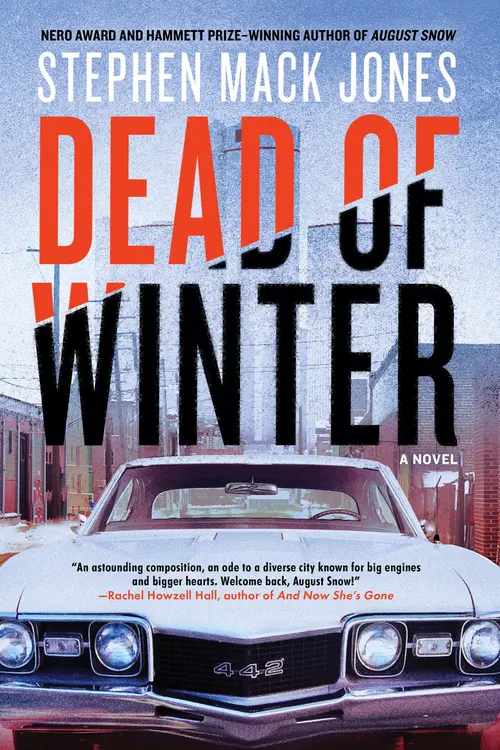
Dead of Winter
Books by Stephen Mack Jones
August Snow
Lives Laid Away
Dead of Winter
Copyright © 2021 by Stephen Mack Jones
Published by
Soho Press, Inc.
227 W 17th street
New York, NY 10011
Library of Congress Cataloging-in-Publication Data
Names: Jones, Stephen Mack, 1954- author.
Title: Dead of winter / Stephen Mack Jones.
Description: New York, NY : Soho Crime [2021]
Series: The August Snow novels ; 3
Identifiers: LCCN 2020052288
ISBN 978-1-64129-102-6
eISBN 978-1-64129-103-3
Classification: LCC PS3610.O6289 D43 2021
DDC 813/.6—dc23
Interior design by Janine Agro, Soho Press, Inc.
Printed in the United States of America
10 9 8 7 6 5 4 3 2 1
For the strong, brave women who have often picked me up, patched me up, dusted me off and pushed me forward: my mom, Evelyn Louise; MK + Lauren + Christina; Mars; Karen B.; Aunt Sadie; and, of course, Viva La Valentina!
Also for Dr. Marc Lindy & the artist Nan Capogna . . .
the best of humanity
1
1
My house is quietly becoming Frankenstein’s monster.
Carlos Rodriguez and Jimmy Radmon, my good friends and partners in the business of flipping houses in the southwest Detroit neighborhood of Mexicantown, have for the past several years used my house as a laboratory guinea pig for features they’d like to integrate into our renovations. Several months ago, it was “smart house” features: light switches, door locks and thermostats I could operate through an app on my smartphone.
“It’s seamless technology, boss man,” Jimmy told me. “You don’t even need no key or nothin’!”
“What if I drop my phone in a gas station toilet?” I said.
“Then you’re kind of screwed, boss,” Carlos said. “You don’t want to reach inside a gas station toilet. Toilet snakes are poisonous, man.”
“Toilet snakes?” Jimmy said.
“He’s yankin’ your chain, Jimmy,” I said.
“Don’t be doin’ that, man!” Jimmy said, punching Carlos in the shoulder.
Without my having given them my permission to install it, or even a key to the house, a vented gas fireplace log (with remote) appeared in my living room. I hadn’t used the fireplace since I’d moved back to the house, my late parents’, after my $12 million wrongful dismissal dustup with the Detroit Police Department. Every Michigan winter since then the hearth had seemed like a sad waste of a hole in the wall.
In the winters of my childhood, my parents would sometimes sit in front of the fireplace staring at a wood log burning, my mother swaddled in a wool throw blanket, my father’s strong arm around her shoulders.
“What are we doing?” I’d ask after a while, not understanding how something with no plot or exposition could be so interesting.
“Thinking,” my father once answered.
“Or not thinking,” added my mother.
It’s quite possible I hadn’t used the fireplace for exactly this reason: remembrance of those long-ago times with my beloved parents might prove a bit difficult on top of whatever moderate Afghanistan-induced PTSD I brought with me here back in the world.
I was even less keen on the new-tech voice-assistant pods: The wonderful women in my life hardly ever listen to me anyway. Why add the disembodied female voice of a robot to the mix?
“I’ve got an idea,” I said, when I came home to find the pods installed. “How’s about this, guys? Maybe you could install door locks on my house that even you guys can’t pick?”
Carlos and Jimmy exchanged a look, then burst out laughing.
“Ain’t no such luck with no such lock, Mr. Snow,” Jimmy said.
Begrudgingly, I let the boys work on the house. Mainly because when I saw them these days, I felt guilty: what had looked like promising employment for a kid with no future (Jimmy) and a Mexican immigrant not authorized to work in the US (Carlos) had come down to one last house to renovate and flip on Markham Street. Certainly, there were other properties in Mexicantown, but with Detroit’s recent renaissance, more suburbanites and real estate companies were buying up properties with a solid promise of a 300 percent return on investment. Instead of a one-and-a-half-square-mile lower- to middle-income working-class brown-and-Black “ghetto,” Mexicantown was quickly becoming the hipster, urban-chic place to be. I couldn’t find properties fast enough, and when I did, I was outgunned on fair market price.
My real estate agent (who is, I suspect, part-time Oracle of Delphi) had warned me this day was coming five years ago.
“What was lost, abandoned and forgotten all them years will be found again, young Snow,” Miss Jesse had told me over hibiscus tea and gingersnaps at her 6,000-square-foot Neo-Renaissance Louis Kamper-designed Indian Village home. “Everybody done forgot about the ’08 mortgage meltdown. The pirates are soon to find your little island nation of Mexicantown, and they will spread they money like cancer.”
Had I known I’d be responsible for the livelihoods of two good men, I would have listened a bit harder to Miss Jesse.
“You guys haven’t touched anything in the kitchen, have you?” I said.
They were tinkering with the personal-assistant pod on my fireplace mantel.
“No, on account we know you like it just like it is,” Jimmy said.
“And somehow that didn’t translate to the rest of my house?”
Carlos and his family, who had been chased out of the US by white nationalists wearing federal badges, were now hardworking, taxpaying, poutine-and-hockey-loving Canadian residents living only fifteen minutes south of Mexicantown (via the US/Canada bridge across the narrow churn of the Detroit River) in Windsor, Ontario. He’d started a heating-and-cooling business that was struggling but promised growth if he could just hold on for another year. A bridge pass made for easy commuting to this side of the Detroit River for Carlos to work on my flip jobs and collect cash infusions.
I’d convinced Jimmy to take a few college classes between his reno work, karate lessons at Club Brutus and video game nights. He’d been sure he would fail. His first term at Wayne State University he’d brought home a 4.1 GPA for a course load including Introduction to Electrical Engineering and Mechanical Engineering 101. Still, we were down to the last house on Markham, and I had no dependable employment to offer him. He was worried because he had become a homeowner. And as every middle- to upper-middle-class working stiff knows, money is how you keep a home running. I’d told Jimmy he didn’t need to worry. I’d be there for him.
“Boss,” he’d said, “I don’t mean no disrespect, but a grown man don’t want no charity. He wants his shot. He wants what he earns.”
Hard to argue with that.
“Okay, Mr. Snow,” Carlos said. “Check it out.”
“Check what out?”
“Ginger! Your personalized home assistant,” Jimmy said. “Go ahead! Ask her something.”
“Ginger,” I said reluctantly, “can you make a Guadalajara-style mole sauce?”
The pod on the mantel of my now-functional fireplace lit up. After a second, the pod said, “I’m afraid I can’t make a Guadalajara-style mole sauce. I did, however, find a number of recipes for mole sauce. Would you like to hear the top five? Or shall I print them for you?”
“Hey, Ginger,” I said, “who do you like more, Smokey Robinson or Marvin Gaye?”
“Both were award-winning musical artists signed with music impresario Berry Gordy’s Motown record label in—”
“Ginger,” Carlos interrupted, “what’s today’s temperature—in Celsius?” Carlos smiled and gave me a sideways glance. “That’s what we use in Canada.”
“Socialist,” I said with mock disgust.
“Today will have a high of seven degrees Celsius,” the pod said.
“She plays chess and Jeopardy!, too, Mr. Snow!” Jimmy said.
“Be still, my beating heart,” I said feeling fairly creeped out by the prospect of having more data points collected on me. “Guys, I’ll be honest with you—I’m not too keen on having some machine connected to an eighty-acre corporate server farm listening to my every whisper, fart and flying fornication.”
“I told you,” Carlos said to Jimmy.
“You can turn it off anytime!” Jimmy said.
“Then what’s the sense in having it in the first place?” I said.
“But you can order food for delivery, boss,” Jimmy said with a tinge of desperation. “You don’t have to go out or nothing!”
“When I get that hungry or lazy, shoot me. Ginger ain’t my kinda gal, guys.”
“Doggone it,” Jimmy said as he fished a five-dollar bill from a pocket and handed it to Carlos.
“Yep,” Carlos said, accepting the money. “Told you.”
“You mind if I go to Windsor for a couple days to help Carlos out, Mr. Snow?” Jimmy said as the two men collected their tools. “Drywall for this last house ain’t coming in until Friday, and Carlos got a restaurant heating job.”
“Help Carlos out,” I said.
The two men unplugged and boxed up the three personal assistant units they had installed in the house. Then Jimmy scrubbed any memory of Ginger from my router before both men left, one of them five dollars richer.
I was in the middle of steam cleaning my face by hovering over a pan of chicken, shrimp and oyster paella (no mussels—too much work for too little return) when my phone rang.
“Octavio!” Elena said. “Do you have a moment?”
“For you,” I said to my beloved godmother, “always.” I sprinkled a bit more cayenne pepper into the aromatic mix.
“You think perhaps you could come with me tomorrow morning to Authentico Foods to meet with Mr. Ochoa?”
“Old man Ochoa?” I said. “What’s going on?”
“He has some sort of business proposition for you,” Elena said. “Plus, Jackie will be there. You remember Jackie.”
I did; she was my unrequited middle- and high-school crush and a teen-in-heat top of the list at Saturday confession.
“I’m sure you’d like to see her.”
“I’d love to see Jackie,” I said, slowly stirring my concoction. “But to be honest with you, Elena, I’m not much on expanding the Snow business empire, or investing in someone else’s.”
“He’s dying, August,” Elena said with sincere gravitas. “Por favor.”
“I’ll drive,” I said.
“No, querido,” Elena said. “I’ll drive.”
2
2
When I was a kid, the only reason I liked Mr. Ochoa was that my mother liked him.
Or rather, she “understood” him.
While my cop father patrolled the potholed streets of Detroit, my mother—during my school hours—had worked as a batch mixer at Mr. Ochoa’s corn and flour tortilla business in Mexicantown. Between my second and eighth grades, Mr. Ochoa’s business grew from a cramped Mexicantown storefront mom-and-pop to a major Midwestern-restaurant supplier of tortillas, restaurant-branded salsas and specialty blended tomato-and-queso white sauces—all organic because Mr. Ochoa didn’t know any other way.
My mother, having worked for Mr. Ochoa and his wife, Esme, since the beginning, was promoted to a quality assurance position, watching over a small team of bakers and packagers, ingredient inventories, cooking equipment and Ochoa family recipes, which she both protected and executed like a culinary guardian angel.
“He’s from the old days,” my mother used to say to my father, who had little regard for Mr. Ochoa. “Not as enlightened as one would hope. Not as bad as one might think.”
Truth is, Mr. Ochoa was never very fond of Black people—mayates—even though his unflappably loyal director of accounts billable for thirty years, Francine Evers, was a petite, rail-thin Black woman with thick-lens glasses and a shy demeanor. He told my mother Francine was an exception; she wasn’t like the rest of them. Apparently, my father was another exception to the mayate rule, since he had married into the greater Chicano family and was a cop who had chosen to live in Mexicantown. My mother believed Esme, Ochoa’s late wife, had been the quiet catalyst behind her husband’s growing list of exceptions to the myths and assumptions about the mayate.
Now, twenty years later, I sat across from Mr. Ochoa in the second-floor Authentico Foods, Inc. office, still located in Mexicantown on a city-block-long stretch of Vernor Highway a mile east of the I-75 freeway. With me was my godmother, Elena Gutierrez, wife of my godfather and best friend, Tomás.
To Mr. Ochoa’s right was his beautiful, dark-eyed daughter, Jacqueline. When I’d known Jackie in middle and high school, she had always been nice enough, but distant. Fifteen years later, she still inspired a quickened heartbeat and electrified hormones. For college, she had gone away to USC. I had mended my broken heart by going to Wayne State and chasing other girls who might have resembled Jackie.
Standing next to her like a sentry in a snappy suit was Daniel Antonio Romero, Esq. Danny was the Ochoa family lawyer and a self-inflated, insufferable prick. I’d known him since middle and high school, too. A snake-skinned bully, moderately talented football jock and ladies’ man, who, not unlike myself, could never get next to the one love of his life—Jackie Ochoa. Even now, when he had one hand gently placed on Jackie’s shoulder, it was easy to see he wanted to impress her. At one point she looked up at Danny and dispassionately assured him she was quite all right. Reluctantly he removed his hand. Clearly, Danny was a horse with a bit in his mouth and saddle on his back.
To Mr. Ochoa’s left was Francine Evers, frailer than I remembered her, cradling a stack of thick, overstuffed binders.
“It’s good to see you, Octavio,” Mr. Ochoa said in a strained voice. “You served our country just like our beloved Norberto.” Save for Jackie, we all made the Sign of the Cross. “And your mother—she was a wonderful woman. A woman of God. Like my Esme. My heart was broken when she went home to Jesus.” He paused to suck in a long breath of oxygen through his nose-mounted breathing tube.
Mr. Ochoa had suffered through two bouts of throat cancer. Chemo, radiation and two surgeries had left him a gaunt, ashen man with a whisper-thin voice. Now he was succumbing to lymphoma, which wanted what scraps remained of him.
“Thank you for your kind words about my mother,” I said in the tone one uses to respectfully address the dying.
“That painting,” he said, gesturing to the large portrait of his younger self that hung behind his desk. “Your dear mother painted that. I’ve always loved that painting. She captured a spirit I never quite saw in myself. A spirit that I’ve tried to live up to over the years.” The painting was centered on the wall behind his desk. It was flanked by numerous high school and army photos of his son, Norberto, and a shadow box displaying his assortment of ribbons and medals, including a Purple Heart. He had been KIA in the Uruzgan Province of Afghanistan. He was twenty.
The British hadn’t been able to hold it.
Neither had the Soviets.
Now it’s our turn to bleed out in the same sand where other empires have gone to die.
At the bottom right of Norberto’s memorial wall, a single high school graduation picture of Jackie was barely noticeable. Nothing that indicated she’d achieved an MBA from the University of Southern California, had authored two bestselling business books, and was often the number-one photogenic choice when Bloomberg News, Reuters TV, CNBC or Cheddar needed a brown face for stories on female entrepreneurs.
Mr. Ochoa coughed. Jackie, who had been beautifully stoic save for the occasional smile sent my way, patted him on the heaving bones of his back and offered him water. He waved it off with a skeleton’s hand. “Your father,” Mr. Ochoa rasped. His daughter held a water bottle for him, and he consented, taking birdlike sips. “He looked out for us. A good man. A police officer. There were things I said that I should never have said—”
“Señor Ochoa, forgive me for interrupting,” I said. “I’m not a priest, so may I suggest you save your confession? None of us has ever truly been the person we could have been—maybe should have been. I know I’m not. But I have the feeling that when God weighs your soul on His scales, He’ll find yours to be the exact weight of an angel’s feather.” His daughter mechanically patted one of his hands while Miss Evers gently held the other as if it were a piece of priceless china. Danny Romero just glared at me. “You’ve given people in this community good livings for over thirty years. When neighbors couldn’t afford food, you fed them. When their kids walked to school in worn-out shoes in the dead of winter, you put boots on their feet, gloves on their hands and scarves around their necks.”
“I’ve—said things—” he croaked.
“The LEGO Air Tech Claw Rig,” I said.
Everyone in the room looked at me as if I’d just floated a shiny non sequitur midair during a deathly serious moment.
“The—what?” Mr. Ochoa said.
“I was eight when my mother brought home the LEGO Air Tech Claw Rig,” I said. “A 954-piece toy semi-truck with a working pneumatic crane. You bought that for me as a Christmas gift. For over two weeks, me and my dad lay on the living room floor putting that model together in front of the fireplace. You gave me an incredible two weeks with my dad. Sometimes what a man says doesn’t truly represent who the man truly is.”
Mr. Ochoa lowered his head. “Thank you, Octavio.”
Elena spoke up. “Octavio, Mr. Ochoa wanted to see you because he needs to ask you something. Something you might want to take a bit of time to think about—”
“But not too much time,” Mr. Ochoa said with a wheeze. “I don’t think there’s a road back for me this time.”
“There’s always hope, Mr. Ochoa,” Danny said in Spanish.
“No,” Mr. Ochoa said curtly, “there isn’t.”
“Anything I can do, it’s done,” I said.
“August,” Jackie said, her voice raising my pulse a bit, “Papa wants you to consider buying the company.”
I sat in shock for a moment before I found my voice. “I don’t know the first thing about running a company. I barely know how to run my own house,” I said. “Plus, Jackie’s your daughter. Your blood. Why not her?”
“Because I don’t want it, August,” Jackie said brusquely. “I’ve worked hard to build my own life. A life outside of the frozen prairies and plains of the Midwest. Outside of my hero brother’s memory. And one that definitely does not include selling tortillas and cheesy whatevers.”
Then they told me what was really going on: They’d been approached by a real estate speculator who went only by “Mr. Sloane.” Sloane—described by Francine Evers as an instantly forgettable skinny white man with male-pattern baldness and wire-rim glasses—claimed to be working on behalf of Detroit’s resident billionaire, Vic Bronson, a man who’d made his fortune selling mortgages and collecting adjustable-rate mortgage balloon payments in an overleveraged housing market almost twenty years earlier. Since moving his empire’s headquarters from suburban Birmingham to the revitalized Guardian Building in the heart of Detroit, Bronson had purchased thirty buildings through his Sextant Properties Group.
Now, it seemed, his larger-than-life shadow was falling on the edges of Mexicantown.
“He wants to demolish this place,” Danny said. “Turn it into some sort of boutique ‘ethnic destination’ shopping mall: tapas restaurants, avant-garde shops, an art gallery, ten to twenty high-end flats above. ‘Casa Nuevo Sol.’”
“Vic Bronson and this Mr. Sloane know everything about acquisition and possession,” Francine Evers said, “but they don’t seem to know boo about appreciating another person’s history or cultural heritage. A gentrified Mexican theme park is what he’s talking about. Ride the giant sombrero down the waterfall. Makes about as much sense as cornrows on a white girl.”
“No doubt,” Danny began, “this area could benefit from a large capital infusion and some forward-thinking development, but—”
Jackie cut her eyes up to Danny. He stopped speaking.
They told me how much Sloane had offered for the building.
I might have whistled.
“Even had the nerve to bring it up in here! In cash. Showed us!” Francine said. “Two big ol’ suitcases stacked on a luggage dolly!” She gave a shiver. “Gave me the midnight willies ’cause you just know that kind of cash don’t come from no good.”
“Folks,” I began, “I’ve got a lot of money. Frankly, more than I’ll ever need. But comparatively speaking, I don’t have that much. I’m sorry. I just couldn’t—”
“We’ll sell it to you—everything, Octavio!—for a third of his offer,” Mr. Ochoa pleaded. “Just—just make sure my people—I’ve got to take care of my employees. Francine. And Jacqueline.”
“I can take care of myself,” Francine said. “Don’t you worry about me, you old fool.”
“Ditto,” Jackie said. “Do whatever you want, Papa. But the clock’s running on the offer. And you.”
“I’m sure this is a lot for you to think about, Octavio,” Elena said. “But every day, the character—the history—of Mexicantown is being eaten away. Please. Promise me you’ll think about Jackie and Mr. Ochoa’s proposal.”
“For the record,” Danny said, puffing out his lawyer’s chest for all to see, “I think this is a grave mistake—and not very good business sense—to make this offer to Snow.”
“Wow,” I said. “It speaks!”
Danny took a step my way. “Hey, at least I didn’t get booted off the police force like your scrawny ass.”
“Scrawny?” I laughed. “Adonis-like, yes. But ‘scrawny’?”
Jackie smiled. An unexpected and much appreciated check-mark in the win-column for yours truly.
“He may have conned a good deal of money out of the city. And he may have renovated and flipped a few houses. Any third-rate grifter could do that. But he’s no businessman,” Danny said, keeping me in his steely glare. “You put a dirty ex-cop in this company’s driver’s seat, and Authentico’s sold for parts in three months.”
“As much as it pains me, I have to agree with Danny,” I said to Mr. Ochoa. “Except for the dirty cop part. You’ve got a very rich offer on the table from Vic Bronson through this Sloane guy. An offer that could take care of your employees and leave Jackie sitting prettier than she already is.”
“It is a handsome offer,” Jackie said.
“Let’s just leave things at I’ll think about it,” I said. “That’s all I can promise, Señor Ochoa.”
“One more thing before you go, Mr. Snow,” Francine Evers said. With a trembling hand, she offered me a forest-green file folder.
“Oh, Jesus,” Danny said. “Is this really necessary?”
The Story Continues on BooksBarbecue!
Enjoyed this preview? ❤️ Do not stop here!
Read the complete book free online → 🔗
Continue reading now on BooksBarbecue and discover every page!
Love reading? Bookmark BooksBarbecue.com for more amazing books!
Happy Reading!