Cwen
Cover
Praise for Cwen:
‘A clever, strange and wonderful book, which brims with mystery. A group of women recount their past and present stories, revealing their visions of the future. Cwen by Alice Albinia is a rare book, bold and powerful’ Xiaolu Guo
‘A wild, original, sure-footed feminist reimagining of the present and the past that brushes up against the mythical. It reminds us, eloquently and passionately, what is or can be possible, and in its depiction of a revolution becomes a revolutionary book itself. Beautiful work’ Neel Mukherjee
‘From the very first page, Alice Albinia’s Cwen draws you into a world that is glittering with beauty and aching with promise. A portrait of the British Isles, Cwen is also an absorbing saga of women’s lives drawn from different parts of the world, skilfully weaving in strands from Bosnia, Pakistan, France. This is a book that speaks of the persistent human need for freedom and community, and of the as-persistent clash of these impulses with power and authority. A story for our times, and a book that will endure’ Taran Khan, author of Shadow City: A Woman Walks Kabul
‘A phenomenal novel showing us that learning to love our female selves is essential for survival. Alice Albinia’s diverse cast, from ancient Britain to contemporary Pakistan, step up to support each other, take down patriarchy and create a new collective story’ Farhana Yamin, Environmental Lawyer, Woman’s Hour Power List: Our Planet
‘An unforgettable story with a dazzling cast of characters that will stay with me for a long, long time. As Albinia inverts and recreates our man-made world layer by layer, the novel reminds us of the epic range of human possibility, of who we might have been, and of who we still could be. A breathtaking, beautifully told, profound novel for our times and beyond. I loved it’ Mirza Waheed, author of The Collaborator
‘Swept on the current of so many centuries, this transporting tale lands powerfully at the point where vision and errancy combine in pursuit of what one wants most: a place to truly belong’ Sharifa Rhodes-Pitts, author of Harlem is Nowhere: A Journey to the Mecca of Black America
‘Alice Albinia’s Cwen is a skilful counter-history, a disruptive and compelling reimagining in microcosm of a society designed and controlled by women. Albinia brilliantly weaves together historical material and a narrative of life in contemporary Britain to demonstrate how our history might play out if women took charge. The book leaves me disoriented in the best possible way – a superb achievement’ Daniyal Mueenuddin, author of In Other Rooms, Other Wonders
‘A superb book: original, fierce, elegant and full of surprises from beginning to end’ Sonia Faleiro, author of The Good Girls
Also by Alice Albinia
Also by Alice Albinia
Empires of the Indus: The Story of a River
Leela’s Book
Cwen
Alice Albinia

Copyright Page
First published in Great Britain in 2021 by
Serpent’s Tail,
an imprint of PROFILE BOOKS LTD
29 Cloth Fair
London
EC1A 7JQ
Copyright © Alice Albinia, 2021
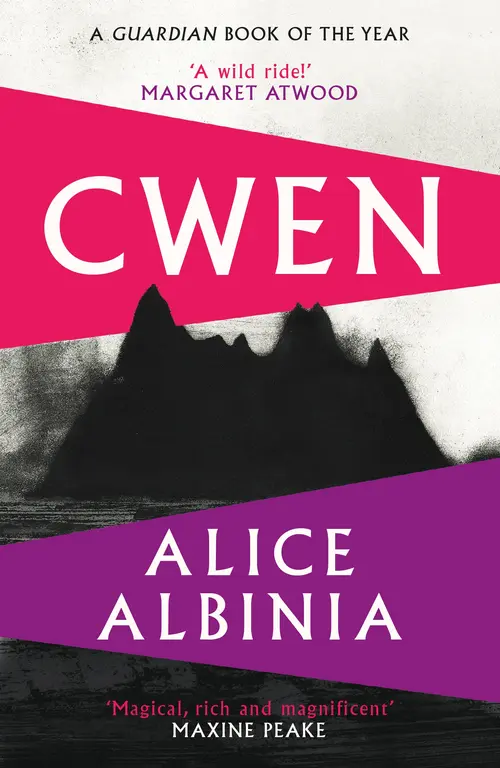
Mountain motif: Image Detail from Boreray & Dun Hirta (diptych). © Jason Hicklin.
Courtesy of Eames Fine Art
While every effort has been made to contact copyright-holders of reproduced material, the author and publisher would be grateful for information where they have been unable to contact them, and would be glad to make amendments in further editions.
The moral right of the author has been asserted.
All rights reserved. Without limiting the rights under copyright reserved above, no part of this publication may be reproduced, stored or introduced into a retrieval system, or transmitted, in any form or by any means (electronic, mechanical, photocopying, recording or otherwise), without the prior written permission of both the copyright owner and the publisher of this book.
A CIP catalogue record for this book is available from the British Library.
ISBN 9781788166607
eISBN 9781782837718
Dedication
For Adi & Aphra
Epigraph
cwēn
Woman, wife, female ruler of a state.
cwēn old English
queynte middle English
cunt modern English

Cwen is a thing with a womb and two breasts. A brain and two far-seeing eyes. A clever nose and nimble fingers. The clouds are her children, and the waves, and the shells which the waves spit on to the sand. The islanders opposite, they are her children, too; and the sheep up on her island’s high bank; and her chickens, down by the shore. The birds crouch under her stroking hand; she raised them from chicks. Now, if they have a mother, it is her.
There were people here before her, she knows that, for they left a cairn on the hillside just up from the shore. An ancient mound, grass-covered, it is three paces from her spring, bigger than her hut, and shaped like a breast, or a belly-full-of-child. There is a large stone, blocking the way in. Cwen sits there in the early morning, her back against the stone, her body full of spring water, as she waits for the islanders opposite to arrive in their boats, with their offerings of grain, and slices of dried meat, and their questions, all quite predictable, about their harvests and wombs, their neighbours and the gods. In winter, the stone receives the glare of the rising sun. In summer, when the sunrays touch the top of the mound, Cwen sits up there instead, looking out over the other islands, all twelve of them. In this way, she bathes in gold.
Inside the cairn are the histories that remain to guard this island, her spring, and her. Every morning, every evening, she stands on the cliff and looks down at the tide; how the sea rustles in, and is sucked back out. Twice a month, when Moon is at its thinnest and its fullest, its birth and its death, the bay below her cliff empties completely of water, and on those days she walks right out, in her long dress and leather boots, to ease sea creatures from the sand.
She calls herself Cwen, and Cwen is what the island will be called after she is gone; after her bones and her hair have been dispersed to the sea, and her thoughts to the winds, and the sea creatures whose relatives she ate are eating her. Cwen, call the tides; Cwen, say the bubbles of her spring; Cwen says the Moon, as the sea aligns and realigns her island’s bounds.

There is an island beside Britain where sacrifices and rites are performed like those at Samothrace in honour of the goddesses Demeter and her daughter Persephone.
Strabo, Geography (Greek), 7 BC
0
Judge
The night Eva went out in her boat, the storm came in off the sea. It span across the islands in a great wailing tumult, blowing chickens into the air in Astrid; pulling washing off the lines in Tarn; darkening and deepening the sea in the harbour; causing the beech trees in the wood to rend their clothes and tear their hair. It lashed the shore with water, great sheets of it, grabbing at the earth, sucking at sand and rock.
Within hours of her leaving, there was little hope. But they went on looking: early in the morning, islanders were out, walking up and down the coast on both sides of the channel, as two creel fishermen searched the island of Cwen. Texts and emails flew back and forth. Have you heard? Such a tragedy. They tried–the coastguard was out all night.
When the storm abated, and the deserted main street in Ayrness filled again with people, opinions flared. ‘There’s still no sign of her boat.’ ‘What did she think she was doing? What possessed her?’ ‘It’s awful, not knowing.’ ‘We went to that Christmas party once, at the big house.’ ‘Do you remember her late husband, the minister?’ ‘She became a different person after his death.’ ‘She was flamboyant, wasn’t she.’ ‘She was a bit too much; everything she did was over the top.’ ‘I liked her. She taught my daughter.’ ‘What will happen now, to the Islands of Women Study Centre?’ ‘Not just that – the Archipelago Women’s Club. Wasn’t she the one supporting Inga at the council?’
To some islanders, Eva’s disappearance proved what they had always known; that despite her efforts, she wasn’t local. Nobody who’d grown up in the islands would have gone out in that storm. It was a north-easterly; the wind was at forty knots—
Not when she went out; the wind got up suddenly, out of nowhere. —it could only have been an incomer doing something so stupid. She did other stupid things, too. The sort of people she’d been consorting with recently. Even before she disappeared, there had been murmurings. The nonsense they were feeding the young boys and girls at Ayrness High. The preferential treatment of female entrepreneurs. The secret symbolism of the island flag; how wicked it was, when you really looked at it. The money that became available for the museum to rewrite its exhibits – Neolithic female what?! – destabilising millennia of good solid island history. Not to mention the books in the library. They’d even installed women’s urinals; behind the abbey, of all places. Somebody must have encouraged Eva in these insane schemes and untenable positions.
In the days after Eva disappeared, women were seen going down to the Islands of Women Study Centre, one by one, and in groups. Not just incomers; islanders, too. They walked there, heads down, coats tight around their bodies, cowrie shells in hand. People love honouring the departed with flowers. But these women left a flotsam of seashells outside Eva’s office in the harbour. Shells, being aerodynamic, survive the wind’s scouring better than sunset-pink supermarket tulips, or fragile white lilies in crackly plastic.
Eva had set out from England; but who knows where she ended up. Scotland; Norway; Thule. Despite everything, there were women who continued to say that Eva would return to them. Cwen had taken her; Cwen would give her back.
Others were less sanguine, given the circumstances.
Some – men – found the sight of all those women with their seashells difficult to take. At the supermarket checkout, in the harbour, on the gangway of the ferries, they began calling one another out. Did you ... ? Had you ... ? Some of them had known; might just’ve gleaned it in passing from their daughters or wives. Others denied it. Online, lists of offences were exchanged, magnified. They were changing the street names! The hospital too. And the library. They tried to promote women in fishing, in the fire service, as farmers. Did you hear about Pregnancy Celebration Day? It would’ve wiped out Chri—
The English coroner made her judgement: ‘presumption of death’. Nobody could have survived, out in those seas, for more than a few hours.
The law had recently changed in England, making it possible, in the case of the missing, to settle their estate without waiting the customary seven years. So the will was read, and Eva’s sons, the Harcourt-Vane boys, found out about the house, and the money. In Ayrness, there were public denunciations; inflamed meetings in the town hall. Eva’s solicitor threw up his hands – he’d done everything by the book. Newspapers printed photographs of Zoe, Eva’s granddaughter, fleeing Harcourt House with a cardigan over her head. There were calls for certain community leaders to be fired. A top London immigration lawyer offered to represent Mariam, the Pakistani woman Eva had taken in, pro bono. A crowdfunding page was set up, to have Mariam’s quilt returned to her. There were angry interviews on television. It became libellous to suggest to journalists that Sister Lucija from All Our Holy Mothers Convent might have stolen Eva’s rare photographic print by the late Bosnian photographer Mevludin. In Westminster, in private, special advisers began looking it up on their phones: the archipelago’s whereabouts and relationship to the United Kingdom. As the price of Mevludins went up ninefold on the global art market, questions were put to the prime minister on a succession of Wednesdays. Eventually, the Minister for Women announced she was asserting her power under the Inquiries Act, by sending up a judge to arbitrate between the islands’ now-irreconcilable positions.
A public inquiry is not a legal entity, nor is it a court of law. But it is full disclosure: a dissection, in public, of society’s function. It can be embarrassing. It can vilify or redeem. It can drag on for weeks, sometimes months or years. It can be random, personal, and imprecise. Few on the islands liked the sound of it; but by then they had no choice.
When Colin Grieves, acting press adviser to the Archipelago Council, made the announcement, his forehead broke into a sweat, his freshly ironed shirt developed damp patches, his arms flew up and down: his body unable to contain his excitement at having finally caught and pinned to a board the archipelago’s most famous butterfly, Eva insula (turquoise, iridescent, insouciant), sole cause of his late-life discontent. He spoke at length about Eva. Within a decade of moving to the islands, she had ‘become enthused with the zeal of a convert’. Over the ensuing fifteen years, ‘everybody who lives in our beautiful archipelago was to suffer, unknowingly, the effects of her social experiment. She set out to promote women in every one of the islands’ major institutions, businesses, the very education system itself. She did this with every resource available to her: her late husband’s money, her children’s inheritance, and by raising funds from unwitting public bodies in the name of the All Islands’ College, of which she was deputy principal until her presumed death by drowning, late last year. Over the next several weeks we will be conducting a far-reaching inquiry into her activities, bringing together church leaders, past and present council members, and other pillars of our community, as well as Mrs Harcourt-Vane’s own sons. Details of the appointment of the judge to head the inquiry will become available within the—’
The official title was An Inquiry into Unfair Female Advantage in the Islands.
But Eva’s women called it the Grievance.
Most of Eva’s women refused to speak to the press, saying they didn’t want to prejudice due process. This was true, because most of them – almost all of them – had been called as witnesses. Also, they were scared. The women whom Eva helped elect to positions of island power; those like Barbara and Lucette who took grants or loans from the Foundation; staff at the museum, college, council – they were all under suspicion. Mx Thompson at Ayrness High was put on unpaid leave. Inga Stenbridge, head of the council, was suspended pending investigation. The Archipelago Women’s Club stayed open – female-only private members’ clubs are mere historical tit for tat – but any other women working in positions of traditional male power, from the three ferrywomen to the director of the museum, editor of the paper, and Jen, head of the Islands of Women Study Centre, were visited by a solicitor from the inquiry.
As if to call her back, the schoolchildren, with their disgraced teacher, painted a huge mural of Eva: smiling, arms outstretched, rainbows in her hair, a garland of flowers around her neck. After it was defaced (dick in mouth), some women began backsliding. Late at night, hurt by the shocked whispers – the even more shocking online comments – there were women who felt ashamed for stepping out of line. They wondered whether Inga’s female takeover of the council had been necessary, actually; felt guilty about the many good solid male start-ups that must’ve suffered because of Eva’s rampant ideology. Maybe Eva had gone too far? Maybe they had? But all they’d done was act on instructions from Eva. Not even instructions. More like hints. Because, whatever Eva intended always remained a bit inscrutable. Plus, she never did understand the island way, coming as she did from outside. Typical incomer’s error. Islanders never rock the boat. Some things have been this way forever.
And so it might have ended, had it not been for Cwen.
Cwen is a tiny speck of an island. At the time of the inquiry, it was uninhabited save for a flock of hardy black sheep. But it has always been alive and resplendent with its years of use as a sacred site. The island’s skyline was permanently altered by a grass mound, constructed four and a half thousand years ago with untold hours of human labour. Cwen’s iconic swollen belly catches the eye almost every day, if you live in Ayrness, or drive that way along the coast. Perhaps because it is so very near the mainland – only five minutes by outboard-motor dinghy; twenty minutes or so, if you row – islanders see Cwen all the time, in all its phases. How the island changes with the passing clouds and coming storms. The obscene lightning. The multitude of rainbows.
By the time the inquiry was announced, threatening everything, Inga had been convening regular women’s meetings on Cwen for at least a year. After the judge opened proceedings, Inga put out an open call to all women of the archipelago. Together, the assembled women came up with a strategy for community healing. They decided that whatever the conclusions of the inquiry, on the day that judgement was handed down, the schools and college would empty of women, the female-run businesses and leaders whom Eva had supported would put down their tools, and all would meet to give each other succour. In the hour before the judge began summing up, the women would set out from Harcourt House, to march on Ayrness. Island women. The nuns from Papa Astrid. Tara, Inga, Jen. Stella with her fiddle. The women would walk across the public footpath, over the field, and along the coast road, as the sun rose higher over the sea. Zoe, with her Eva-hair, would march in front. The women would smile and laugh, singing one of the ancient epics Eva loved. There would be energetic squalls of rain but the sun would come out through the clouds, filling the air, and the fields, and the sea, with its gold. When they arrived on the outskirts of Ayrness, armed with nothing but their chant, other women would join them, and island men, too. Waiting for them in town would be women’s groups from all over Britain and beyond – Lerwick, Lyon, Lima. As the numbers swelled, they would march on the library, on the inquiry, to show those people, the television crews, the judge, the men, the force they were. Zoe would take the microphone from Inga and speak directly to the crowds of everything her grandmother had taught her, of the sacred women-shaped spaces that ancient people built – the regenerative principles they were steeped in. She would ask them if they could imagine a world like this. And the crowd would roar its approval.
That was Inga’s plan.
Of course, everybody knows how hard it is to countenance the idea of women-only gatherings, women-only groups. The mere sight of women assembling en masse makes certain people, women as well as men, feel uneasy. Queasy. Everyone’s felt this way, at some point. There’s something deeply disgusting about female gatherings. Women just shouldn’t express solidarity with each other.
The Story Continues on BooksBarbecue!
Enjoyed this preview? ❤️ Do not stop here!
Read the complete book free online → 🔗
Continue reading now on BooksBarbecue and discover every page!
Love reading? Bookmark BooksBarbecue.com for more amazing books!
Happy Reading!