Crossing Stones
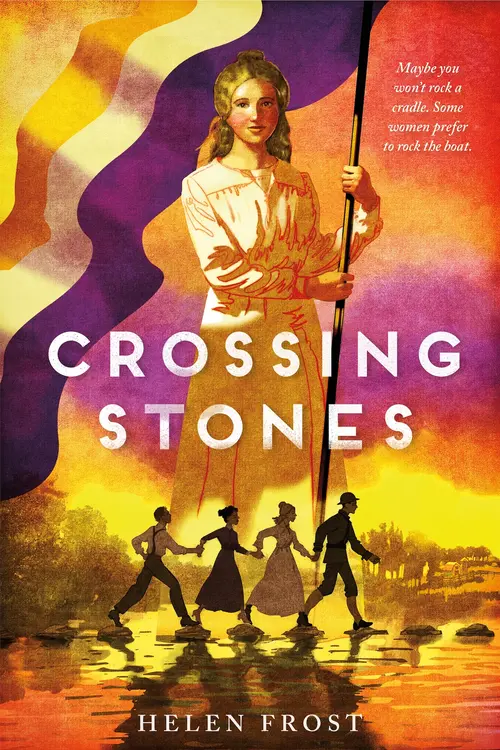
Title Page

Copyright Notice
The author and publisher have provided this e-book to you for your personal use only. You may not make this e-book publicly available in any way. Copyright infringement is against the law. If you believe the copy of this e-book you are reading infringes on the author’s copyright, please notify the publisher at: us.macmillanusa.com/piracy.
Dedication
Dedicated with love
to my brothers,
Richard and Herb,
in memory of our mother,
Jean Elizabeth Timmons Frost,
1917–2008
My Mind Meanders Like the Creek / April 1917
My Mind Meanders Like the Creek
April 1917
My Crooked Mind / Muriel
My Crooked Mind
Muriel
You’d better straighten out your mind, Young Lady.
That’s what the teacher, Mr. Sander, tells me. As if I could
stretch the corners of my thoughts like you’d pull
a rumpled quilt across a bed in an attempt to make
it look like no one slept there, no one ever
woke up screaming from a nightmare, or lay there
sweating till their fever broke, everybody
scared they’d die—but then they didn’t, they got up
and made the bed. My mind sets off at a gallop
down that twisty road, flashes by “Young Lady,”
hears the accusation in it—as if it’s
a crime just being young, and “lady”
is what anyone can see I’ll never be
no matter how I try, and it’s obvious
that I’m not trying. It’s history class, which,
as far as I can tell, they might as well call
war class, all those battlefields, and Generals,
and Secretaries, capitalized like that—
not secretaries like Aunt Vera, who
works for the city of Chicago, and travels
on her own with money she has saved
even after she has purchased both the hat
with three red feathers and the one of deep blue
wool that’s lined with silk. No, the Secretaries
whose names we have to memorize for Monday’s test
are important people: Secretary of the Treasury,
Secretary of the Interior—in other words,
men. Which is my mistake, to point that out.
Why is it, Mr. Sander, that in real life
secretaries are always women, but here
in school, all the ones we learn about are men?
It’s a perfectly reasonable question, but everybody
turns to stare, first at me, then at the teacher’s blaze of anger:
Miss Jorgensen, are you being smart with me? How
do you answer a question like that? No, I’m
not, or Yes, I am—either way just gets you
in the same place, only deeper. I try for
middle ground. Maybe I am, I say, maybe
I’m not—trying to decide what it might mean
to be smart like Aunt Vera and express my own opinions,
compared to what it means when Mr. Sander says it.
I keep on thinking back and forth along
those crooked lines while he is giving me a
talking-to I barely hear until he gets to that
last line—I’d better straighten out my
mind? No thank you, Mister Sir Secretary
Reverend General Your Honor, I think
but do not say. I like the way my mind meanders
like the creek that flows into the northern tip
of Reuben Lake, out the southwest side
into the Little Betsy River, and on and on
from there to who knows where, until
eventually it joins the wild sea.
Our Lives and Our Fortunes / Muriel
Our Lives and Our Fortunes
Muriel
We’ve all heard what is coming: we know
the president will take us right into the middle
of this war they’re fighting overseas, yet I can’t help
hoping against hope that someone, somehow
might find a way to keep us out of it.
Our neighbors, Emma Norman and her parents,
step carefully across Crabapple Creek on their way
to our house to listen to the president address the nation.
Mr. Norman brings his usual peppermints for Grace,
and she, as always, passes them around until there’s only one
left in the bag, then gives the bag to Mrs. Norman—
Take this home, she says, and save it
for when Frank comes back. She’s done that
at least once a week for the past six months,
since Frank left for basic training. I have no idea
if Mrs. Norman actually saves them, but the thought is so
big-hearted for a seven-year-old child, maybe Frank
can taste some kind of sweetness; even all those
miles away in Kansas, he must know that here
in Michigan we’re missing him. And never more so
than this evening, as we gather close around
the radio and hear the president proclaim: The world
must be made safe for democracy … To such a task
we can dedicate our lives and our fortunes,
everything that we are and everything
that we have. He needs an army of 500,000 men;
he invokes the principle of universal liability
to service. Ollie stands up, puffs out his chest,
and glances across the room at Emma.
Tell me, Mr. President, is my brother
“everything that we are” or is he “everything
that we have”? I only know I’m grateful
he is just sixteen, not old enough
to offer up his everything into your hands.
Apple Trees / Emma
Apple Trees
Emma
I remember last September, before
Frank left for basic training, he and Ollie
waiting in the apple trees—Ollie on their side
of the creek, and Frank on ours—watching for Muriel
and me to cross Crabapple Creek. Halfway across, where
an eddy spins between two stones, I looked up just in time
to see Ollie throw an apple down at me. I caught it, threw it
back, and to everyone’s immense surprise, I somehow hit
Ollie in the arm, which made him lose his balance. I’m
still not sure how he got from tree to water, but there
he was in the creek, spluttering his staunch denial:
I didn’t fall, I jumped! Sitting on his backside,
laughing. Tonight I’m remembering that jolly
scene. Muriel, Ollie, Frank, me—us four.
Should We? / Ollie
Should We?
Ollie
Sit down and play a tune, Pa suggests.
Should we? In wartime, is it right for us to
make music? Almost half the senior boys, like
Frank and his friends last year, are planning to enlist.
I’d go with them if I could—heck, I’d join up tomorrow
if I thought they’d accept a sixteen-year-old. Could I gain
enough weight, go down to the recruiting office, and try to
bluff my way in by claiming to be eighteen? I bet I’d get a
different reaction from Pa than Ma. Ma would take it in
stride, or try to act like she did. Pa would be furious:
(Blankety-blank) President Wilson thinks he can just
take away our sons to use for his cannon fodder!
Would he actually try to stop me, though?
It’s likely—so I wouldn’t tell him.
Moral Compass / Muriel
Moral Compass
Muriel
Have you raised this girl with no moral compass?
Mr. Sander questions my parents, then turns
to me: If you continue to question our president
and the decisions he has made, other students
may wonder if their classmates are risking
their lives for nothing. You should be ashamed.
Mama does hang her head in shame, but I don’t, so
Mr. Sander pushes on: If we can’t stand together
as a free country, what are our boys fighting for? At that,
Papa looks straight into Mr. Sander’s eyes. He doesn’t say
what he sees (the eyes of a coward?), because Papa is kind,
thoughtful about others’ feelings. I know my daughter
is opinionated, he says, but there is no law
against that. (So far, he mutters under his breath.)
Muriel has every right to speak her mind.
Mr. Sander withers under Papa’s steady gaze, and we
go home. Papa drives the horses gently; we ride in silence
for a mile or so, and then he says, You’re graduating soon;
don’t worry too much about what Mr. Sander thinks—
but there are others like him in this world.
Be a little careful of such people, Muriel.
“A little careful”—maybe—but then Mama adds,
You may need to learn to bite your tongue.
Is that what women—“ladies”—are supposed to do?
Bite off little pieces of ourselves,
our very thoughts? Chew on them
until they don’t seem so worthwhile—
and then what? Swallow them? Or spit them out
and crush them underfoot, until we can
be absolutely sure no one will know
they ever crossed our minds!
Fragrance of Lilacs, Sweet Scent of Skunk / May 1917
Fragrance of Lilacs, Sweet Scent of Skunk
May 1917
Deep Quiet / Emma
Deep Quiet
Emma
Such good solid stuff
Ollie is made of—these words
declaring war are playing on his mind.
When anything “must be made safe,” Frank
and Ollie always volunteer. Now, with Frank’s life
on the line, Ollie tries to help my family. Our fence has
been broken for a month; no doubt he started fixing it today
because it keeps his hands occupied as he tries to find a way
to think about what this war will mean, for all of us. He’s as
quiet as the fence itself: measure the wire, open the knife,
cut the wire, close the knife, quick twist, hard yank—
yes, the fence will hold. Above us, the kind
of sky that greets a thousand bluebirds.
So sweet a day. So tough.
Socks / Muriel
Socks
Muriel
Thirty-seven years ago in Denmark,
two sisters married two brothers. It’s
like an anthem, the way Papa tells it: To
this day, your Danish relatives would claim you
if you walked into the old family home.
But when Mama tells the story, she’s seeing
Ollie with the Normans’ daughter, Emma—
and me with Emma’s older brother, Frank,
pairing us up like she rolls up pairs of socks,
that little sigh of satisfaction when they come out even—
or “close enough,” if there’s one black sock,
one navy blue, left over at the end.
Emma is my closest friend; Frank and Ollie
are like brothers. Mrs. Norman comes here
with her sewing almost every afternoon,
or Mother goes to their house—they seem to think
they know us better than we know ourselves.
But I don’t see myself going down the road they
see me on, leading to a clean white farmhouse
not too far from here, me out in the yard, my
apron pockets full of corn I’m scattering
for biddy hens. I love Emma like a sister, and
I’m as scared as anyone that Frank will be
sent overseas to fight this war—I’m delighted
that he’s coming home on leave next week—
but slow down, Mother: I have no
intention of becoming the Mrs. Norman of your
imaginary future. Who I am remains to be seen—
and I alone intend to be the one to see it.
Lightning / Ollie
Lightning
Ollie
Gray sky, all-day rain,
thunder coming closer. Lightning
struck the barn in just this kind of storm
last summer. It took us the entire fall and winter
to rebuild the part of the hayloft that burned in the fire
that night. Our work is sound—Pa and I work well together,
though I wonder: Will he do as well without me? Ollie, let me
show you something! Grace runs up. I’ve told her we can use the
scrap wood for a playhouse; now she’s found a place to build it.
You said you would, Ollie. Come on—look! If I work hard and
fast I might get it done in my spare time. (Maybe, with
luck, I’ll build up my muscle and look older.) I sort the
lumber. I might not finish it before … I start to
say. Before what, Ollie? I don’t answer.
Ten Days Home / Muriel
Ten Days Home
Muriel
Frank has finished his training; now
he has ten days of home leave. Then—
nobody can say for sure, but it looks like
he’ll be shipped overseas. We meet him
at the station—I’m the first to see him (I can’t
help noticing how his shoulders fill his uniform),
but I stand back when three girls surround him
as he jumps from the train, swinging his duffel bag
across his back. He scans the crowd—his eyes light on us
(on me?) as Grace sees him and runs to hug him.
He lifts her in the air and swings her high (she
almost kicks Edith Morgan in the jaw),
and Frank is ours for these few days.
We all gather at the Normans’ house for dinner—
Mrs. Norman slices a clove-studded ham; Emma’s baked
a batch of “Grandma Jean’s Best Dinner Rolls”;
Mama and I made a four-layer devil’s food cake;
and after Frank has eaten three large pieces, he plays
a few tunes on his banjo, Papa plays his fiddle,
and we sing until long after dark. Mama
lets Grace stay up an hour past her bedtime—
Frank shows her how to pluck a few notes
of “It’s a Long Way to Tipperary,”
and teaches her six verses, nodding to her
when he sings “to the sweetest girl I know.”
Grace smiles up at him—she may just be
the sweetest girl any of us will ever know.
I breathe in this all-together of our life—
how can there be war in a world where
Ollie’s baritone and Emma’s alto
harmonize so perfectly?
Why Not? / Muriel
Why Not?
Muriel
Frank’s home leave threatens to eclipse
my graduation, until he asks if I’m going
to my graduation dance with anyone—
Well, no—and, if I’d like him to take me.
I’m so surprised, I almost ask the question
that pops into my mind: Was this your mother’s
idea, Frank, or yours? I stop myself because
he stutters as he asks me—M-M-Muriel,
shifting from one foot to the other—Frank
who is always so confident and full of fun.
I can’t help smiling as I answer: Yes, I’d like that.
He stops stuttering, grins, and says, Our mothers
will be happy. Exactly what I’m thinking.
A little too happy for my taste, I say.
Frank shrugs. Who says we have to tell them?
We agree—we don’t! As I’m sewing my dress
(blue satin that swirls around me when I walk), I refer to it
as my graduation dress. And when Mama asks me
if I’m going to the dance, I simply say, as she
so often does, We’ll see, when the time comes.
A Greater Good / Muriel
A Greater Good
Muriel
I should have been the valedictorian. Does it bother you,
Emma asked me, to be smarter than all the boys?
No, it doesn’t bother me, but Mr. Sander couldn’t stand
to hear me give a speech—who knows what radical ideas
I might express. He gave me a D in comportment
(Comportment: Who I am! How I conduct myself!)
so my final average fell one quarter point below
Arthur Anderson’s, and now we are listening
to Arthur lecture us: We must all Put Others First
in this Time of our Country’s Greatest Need.
We must Sacrifice our Selfish Dreams
for a Greater Good. The teachers and parents
and half the students get out their handkerchiefs
to dab tears from their eyes, and call attention to
their sniffles. Silently, I argue against every word
that Arthur says: If we do put others first, if we love
the ones we love and trust people everywhere
to do the same, wouldn’t we stop sacrificing one another,
fooling ourselves into believing that such sacrifice would solve
our problems? Wouldn’t we be free to pursue
those selfish dreams that might, if
everyone is putting others first,
lead to a genuinely greater good?
I’m still steaming about all this
when Frank offers me his arm to walk
from the school to the dance hall. The soft swish
of my dress doesn’t stop me from stomping along,
arguing point by point with Arthur’s speech.
Why is everyone just doing what they’re told?
The presidents of all the countries should
meet somewhere and fight this war themselves
if they think it’s worth fighting.
What are they sacrificing? Have they asked the mothers
who gave the best years of their lives to raise
these boys the presidents are sending into battle?
No! Women don’t even get to vote—it isn’t fair!
Frank listens for a while, then says, You’re starting
to sound like one of those Woman Suffragists, Muriel.
It doesn’t sound very patriotic. But who cares?
You graduated! Let’s dance! And so we do,
together, and with other friends—I dance with all
the boys except for Arthur, who doesn’t ask me,
and Frank dances with each of the twelve girls
in my class, and then he and I dance
the last dance, relaxing into each other’s arms,
Frank’s heartbeat steady in my ear. I have to admit,
I’m enjoying this, and when the dance is over,
it’s nice to walk outside into the night,
with Frank, my almost-but-not-quite brother.
Someone / Muriel
Someone
Muriel
The horses clip-clop down the road ahead of us—
the fragrance of lilacs, then the sweet scent of skunk,
a chorus of crickets and spring peepers. It’s not often
Frank and I are alone together, neither Emma
nor Ollie with us. Frank clears his throat.
Did you know, Muriel, that Ed and Howard
enlisted yesterday? I say nothing. He goes on.
John and Hal are planning to sign up next week. It’s dark—
Frank can’t see me roll my eyes. The ants go marching …
is my only comment. That childish song is still
singing itself in my head as we come home
and Frank holds out his hand to help me
from the buggy, as if I were a fine lady,
and he Sir Galahad. And then: May I
kiss you, Muriel? So gently asked,
a sweet surprise. A kiss would change
so much—I hesitate. Ordinarily, he says, I wouldn’t be
in such a hurry; you know me, I always take my time.
But—I’ve been trying to tell you—
I’m going to France. I leave next Monday.
It would sure be nice to have a girl
back home to write to—someone waiting
for me, someone to keep fighting for.
A girl. Someone. He doesn’t have time
to choose, to court, to fall in love,
and here I stand. It must seem easy, obvious.
But— No, Frank, I answer, I can’t
do that for you. I’ll be glad to write to you;
you know we all will. Grace will keep on
sending you her little drawings. We’ll miss you—
I’ll miss you—more than I can say.
I wish you wouldn’t go. I wish no one would …
Frank shakes his head. Am I confusing him?
Has he planned how this should work—get a girl,
go to war, come home a hero, and get married?
His smile fades—if I believed that one sweet kiss
could bring it back, I might
want to give him that small comfort.
But no. Frank signed up for this.
I didn’t. It is not up to me
to make it easier.
Would It Hurt? / Emma
Would It Hurt?
Emma
A kiss is not a marriage vow,
I argue with Muriel. For pity’s sake,
would it hurt you to give Frank a little dream
to tuck into his heart before he leaves? One kiss—
you wouldn’t be engaged, just something for my brother
to hang on to in the lonely times when he’s far from home.
I don’t know exactly what happened between you last night,
but from Frank’s face today, it’s not hard to guess. He might
not come back from this war! Are your ideas so set in stone
that you can’t put them aside, or at least consider another,
more gentle point of view? Believe me, Muriel, I hate this
war as much as you do, but truly, in the overall scheme
of things, would one little kiss be so hard to take?
Muriel’s only answer is, I don’t know.
Right in Front of Everyone / Ollie
Right in Front of Everyone
Ollie
Light in the eastern sky has turned
from red to gold in the hour we’ve been
standing here with Frank, waiting for the train
to take him back to camp. Emma looks at her brother
as if she thinks he’s already been to war and is returning
home a few feet taller, covered in ribbons and medals. She
stands on tiptoe and kisses him on the cheek, then folds her
hands around his arm. (For a look like that from Emma, I’d
roam the earth, swim across oceans and fight lions.) Muriel
has not yet said goodbye. Looking up at Frank, she says,
You don’t always have to be the hero. You stay safe now!
Commanding him with such ferocity that he jokes,
Come here and say that. And when she does,
right in front of everyone, he kisses her!
Circles for the Crossing Stones / June 1917
Circles for the Crossing Stones
June 1917
Would You Be Willing? / Muriel
Would You Be Willing?
Muriel
Look, Mama—Papa forgot his lunch—
Ollie’s over at the Normans’, helping
with the planting—I’ll hitch up the horses
and take this to Papa at the lumberyard.
It’s good to be out on this warm day,
half an hour into town, and half an hour back,
time to think my own thoughts, sing to the horses,
wave to men out in the fields—though lately
half the people in the fields are women,
and at the lumberyard, six women, wearing overalls,
are working just as hard as men. They’re filling in
for men who have been drafted, Papa tells me.
All the way home, and all afternoon, I think about
applying for a job myself—I’d earn some money, and
it’s considered “the patriotic thing to do” these days.
But at supper, Mama tells us she has decided to go to work
at a shop in town. The bookkeeper was drafted,
and the manager asked Mama to help out
“for the duration”—that’s the phrase they’re using, to avoid
having to say “war.” (No one knows, of course, how long
the duration will be.) Muriel, would you be willing
to take care of Grace and help with the housework?
“Help with the housework”—ironing and mending,
washing dishes, cooking, milking, churning, mopping.
And, oh yes, “take care of Grace,” as if that’s
a little thing you do when all the other work
is finished. Mama and I together are barely
keeping up with everything; I don’t see how
I’ll do it all myself. But this is not a question.
It’s a request that will define my days—
for the duration. Grace shines a little grin
my way when Mama turns her back—
no doubt thinking of some mischief
I’ll allow that Mama wouldn’t.
The Gentleman Should Always / Muriel
The Gentleman Should Always
Muriel
Grace draws a picture: our two houses with the creek
The Story Continues on BooksBarbecue!
Enjoyed this preview? ❤️ Do not stop here!
Read the complete book free online → 🔗
Continue reading now on BooksBarbecue and discover every page!
Love reading? Bookmark BooksBarbecue.com for more amazing books!
Happy Reading!