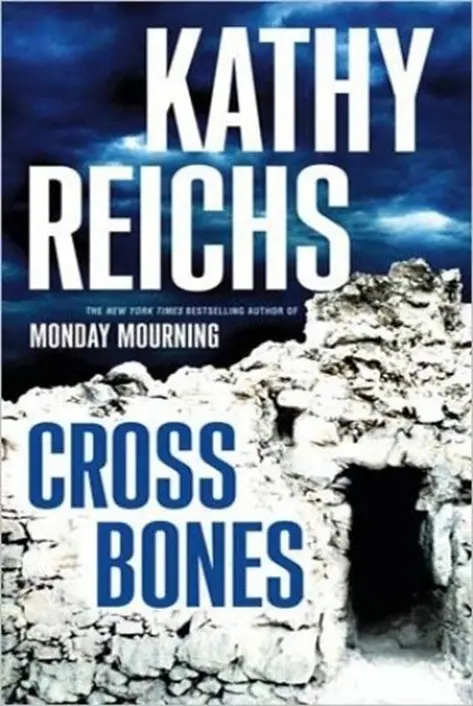
Cross Bones

From the Forensic Files of Dr. Kathy Reichs
About the Author
Also by Kathy Reichs
MONDAY MOURNING
BARE BONES
GRAVE SECRETS
FATAL VOYAGE
DEADLY DÉCISIONS
DEATH DU JOUR
DÉJÀ DEAD
SCRIBNER
1230 Avenue of the Americas
New York, NY 10020
This book is a work of fiction. Names, characters, places, and incidents either are products of the author’s imagination or are used fictitiously. Any resemblance to actual events or locales or persons, living or dead, is entirely coincidental.
Copyright © 2005 by Temperance Brennan, L.P.
Al rights reserved, including the right of reproduction in whole or in part in any form.
SCRIBNERand design are trademarks of Macmil an Library Reference USA, Inc., used under license by Simon & Schuster, the publisher of this work.
DESIGNED BY ERICH HOBBING
Library of Congress Cataloging-in-Publication Data
Reichs, Kathy.
Cross bones/Kathy Reichs.
p. cm.
1. Brennan, Temperance (Fictitious character)—Fiction.
2. Women forensic anthropologists—Fiction. 3. Bible—Antiquities—Fiction.
4. Montréal (Québec)—Fiction. 5. North Carolina—Fiction. 6. Israel—Fiction. I. Title.
PS3568.E476345C76 2005
813’.54—dc22
2005040822
ISBN 0-7432-9244-8
Visit us on the World Wide Web:
Acknowledgments
As usual, I am deeply indebted to many of my col eagues, family, and friends for their time, expertise, and advice.
Dr. James Tabor, Chair, Department of Religious Studies, University of North Carolina at Charlotte, lit the initial spark forCross Bones, shared his personal notes and research findings, checked a thousand fine points, and gal antly squired me around Israel.
Dr. Charles Greenblatt and Kim Vernon, Science and Antiquity Group, The Hebrew University of Jerusalem, and Dr. Carney Matheson, Paleo-DNA Laboratory, Lakehead University, coached me on ancient DNA. Dr. Mark Leney, DNA Coordinator, CILHI, Joint POW-MIA Accounting Command, and Dr.
David Sweet, Director, Bureau of Forensic Dentistry, University of British Columbia, answered questions about modern DNA.
Azriel Gorsky, Head (Emeritus), Fibers and Polymers Laboratory, Division of Identification and Forensic Science, Israel National Police, gave advice on hair and fiber analysis, and on the workings of Israeli law enforcement.
Dr. Elazor Zadok, Brigadier General, Director, Division of Identification and Forensic Science, Israel National Police, al owed a tour of their Forensic Science facility. Dr. Tzipi Kahana, Chief Inspector, Forensic Anthropologist, Division of Identification and Forensic Science, Israel National Police, familiarized me with the Israeli medical examiner system.
Dr. Shimon Gibson, Jerusalem Archaeological Field Unit, took me to sites throughout Israel, and answered many questions about his homeland.
Debbie Sklar, Israel Antiquities Authority, provided a private tour of the Rockefel er Museum.
Officer Christopher Dozier, Charlotte-Mecklenburg Police Department, and Sergent-détective Stephen Rudman, Superviseur, Analyse et Liaison, Communauté Urbaine de Montréal Police (retired), supplied information on obtaining phone records.
Roz Lippel helped keep the Hebrew honest. Marie-Eve Provost did the same for the French.
Special thanks go to Paul Reichs for his insightful comments on the manuscript.
Credit must be given to two books mentioned in the text:Masada: Herod’s Fortress and the Zealots’ Last Stand by Yigael Yadin, George Weidenfeld & Nicolson Limited, 1966;The Jesus Scrol by Donovan Joyce, Dial Press, 1973.
Last, but far from least, heartfelt thanks to my editor, Nan Graham. Her advice madeCross Bones a far better book. Thanks also to my editor across the pond, Susan Sandon.
And, of course, to Jennifer Rudolph Walsh, Co-Head of the Worldwide Literary Department, Executive Vice President, and one of the first two women appointed to the Board of Directors of the Wil iam Morris Agency. Way to go, girl! Thanks for hanging in as my agent.
For Susanne Kirk, editor, Scribner, 1975–2004
and
For Dr. James Woodward, chancel or,
University of North Carolina at Charlotte, 1989–2005
Thanks for the years of support and encouragement.
Enjoy your retirements!
Depart from evil, and do good. Seek peace, and pursue it.
—Jewish Holy Scripture,
Psalm 34:14
The fruit of righteousness is sown in peace for them that make peace.
—New Testament, James 3:18
And make not Al ah because of your swearing (by him) an obstacle to your doing good and guarding (against evil) and making peace between men, and Al ah is Hearing, Knowing.
—Koran 2:224
The Facts
• From 1963 to 1965, Masada, site of a first-century Jewish revolt against the Romans, was excavated by Israeli archaeologist Yigael Yadin and a team of international volunteers. Yadin’s workers recovered the fragmentary and commingled remains of approximately twenty-five skeletons from a cave complex, designated Loci 2001/2002, located below the casement wal at the southern tip of the summit. Unlike other human remains found within the main complex of ruins at the northern end of Masada, these bones were not immediately reported to the press.
In the 1990s, a photo surfaced of a single intact skeleton that was also recovered from Loci 2001/2002 during the 1963 to 1965 excavation. That skeleton was never mentioned or described by the project’s physical anthropologist, Nicu Haas. It was not discussed by Yadin in his published reports or interviews.
* Formal field notes were not kept during the Masada excavation, but oral briefings took place regularly between Yadin and his staff. Transcripts of these sessions are archived at the Mount Scopus Campus of Hebrew University. Pages covering the period of the discovery and clearing of Loci 2001/2002
are missing.
* Neither the bones from the twenty-five commingled individuals, nor the articulated skeleton, nor the contents of Loci 2001/2002, are described in the six volumes of the final Masada excavation publication.
* Though Nicu Haas was in possession of the bones for more than five years, he published nothing on the commingled individuals or on the complete skeleton recovered at Loci 2001/2002. Haas’s handwritten notes, including a ful bone inventory, indicate he never received the complete skeleton.
* In the late 1960s, Yigael Yadin stated in press interviews that carbon-14 dating was seldom done, and that it was not his job to initiate such tests. The journalRadiocarbon indicates that Yadin sent samples for carbon-14 dating from other Israeli excavations during that period. Despite uncertainty concerning the age of the Loci 2001/2002 remains, Yadin never sent samples for radiocarbon dating.
• In 1968, the skeletal remains of a “crucified man” were found during road construction north of the Old City of Jerusalem. The deceased, Yehochanan, died at approximately twenty-five years of age, during the first century. A nail and wood fragments were embedded in one of Yehochanan’s heel bones.
• In 1973, Australian journalist Donovan Joyce publishedThe Jesus Scrol (Dial Press). Joyce claimed to have visited Israel, met a volunteer from Yadin’s excavation team, and seen a stolen first-century scrol from Masada containing the last wil and testament of “Jesus, son of James.” According to Joyce, the scrol was smuggled out of Israel, presumably to the USSR.
• In 1980, roadworkers uncovered a tomb in Talpiot, just south of the Old City of Jerusalem. The tomb contained ossuaries inscribed with the names Mara (Mary), Yehuda, son of Yeshua (Jude, son of Jesus), Matya (Matthew), Yeshua, son of Yehosef (Jesus, son of Joseph), Yose (Joseph), and Marya (Mary). The coexistence of the names in one tomb is rare. Skeletal materials have been submitted for DNA testing.
• In 2000, American archaeologist James Tabor and his team discovered a freshly robbed tomb in the Hinnom Val ey, outside Jerusalem. The tomb contained twenty ossuaries, al but one shattered. The lower chamber held a burial shroud wrapping a fragmentary human skeleton and hair. Carbon-14
testing showed the shroud was first-century in age. Microscopic examination revealed the hair was clean and vermin-free, indicating the deceased had been of high status. Anthropological analysis determined the remains were those of an adult male. DNA sequencing demonstrated a familial relationship among most of the other individuals buried in the tomb.
• In 2002, Israeli antiquities col ector Oded Golan revealed the existence of a first-century ossuary inscribed “James, son of Joseph, brother of Jesus.” That fal , the ossuary was made public. While experts agree that the smal stone coffin is first-century in age, controversy surrounds the authenticity of the inscription. Circumstantial evidence suggests the ossuary came from the vicinity of the Hinnom, possibly from Tabor’s “shroud” tomb.
A formal request was submitted to the Israel Antiquities Authority for DNA testing of bone material found in the James ossuary. DNA sequencing would al ow comparison of the James ossuary remains with those recovered from Tabor’s Hinnom “shroud” tomb. The request was denied.
As this book went to press:
• In January of 2005, indictments were issued against Oded Golan and several others for the forgery of antiquities. Mr. Golan maintains his innocence, and continues in his insistence that the James ossuary is authentic. Experts remain divided.
1
FOLLOWING ANEASTER DINNER OF HAM, PEAS, AND CREAMEDpotatoes, Charles “Le Cowboy” Bel emare pinched a twenty from his sister, drove to a crack house in Verdun, and vanished.
That summer the crack house was sold up-market. That winter the new homeowners grew frustrated with the draw in their fireplace. On Monday, February seventh, the man of the house opened the flue and thrust upward with a rake handle. A desiccated leg tumbled into the ash bed.
Papa cal ed the cops. The cops cal ed the fire department and the Bureau du coroner. The coroner cal ed our forensics lab. Pel etier caught the case.
Pel etier and two morgue techs were standing on the lawn within an hour of the leg drop. To say the scene was confused would be like saying D-day was hectic. Outraged father. Hysterical mother. Overwrought kids. Mesmerized neighbors. Annoyed cops. Mystified firefighters.
Dr. Jean Pel etier is the most senior of the five pathologists at the Laboratoire de sciences judiciaires et de médecine légale, Quebec’s central crime and medico-legal lab. He’s got bad joints and bad dentures, and zero tolerance for anything or anyone that wastes his time. Pel etier took one look and ordered a wrecking bal .
The exterior wal of the chimney was pulverized. A wel -smoked corpse was extracted, strapped to a gurney, and transported to our lab. The next day Pel etier eyebal ed the remains and said,“ossements.” Bones.
Enter I, Dr. Temperance Brennan, forensic anthropologist for North Carolina and Quebec. La Bel e Province and Dixie? Long story, starting with a faculty swap between my home university, UNC-Charlotte, and McGil . When the exchange year ended, I headed south, but continued consulting for the lab in Montreal. A decade later, I’m stil commuting, and lay claim to the mother lode of frequent flyer miles.
Pel etier’sdemande d’expertise en anthropologie was on my desk when I arrived in Montreal for my February rotation.
It was now Wednesday, February 16, and the chimney bones formed a complete skeleton on my worktable. Though the victim hadn’t been a believer in regular checkups, eliminating dental records as an option, al skeletal indicators fit Bel emare. Age, sex, race, and height estimates, along with surgical pins in the right fibula and tibia, told me I was looking at the long-lost Cowboy.
Other than a hairline fracture of the cranial base, probably caused by the unplanned chimney dive, I’d found no evidence of trauma.
I was pondering how and why a man goes up on a roof and fal s down the chimney, when the phone rang.
“It seems I need your assistance, Temperance.” Only Pierre LaManche cal ed me by my ful name, hitting hard on the last syl able, and rhyming it with
“sconce” instead of “fence.” LaManche had assigned himself a cadaver that I suspected might present decomposition issues.
“Advanced putrefaction?”
“Oui.”My boss paused. “And other complicating factors.”
“Complicating factors?”
“Cats.”
Oh, boy.
“I’l be right down.”
After saving the Bel emare report on disk, I left my lab, passed through the glass doors separating the medico-legal section from the rest of the floor, turned into a side corridor, and pushed a button beside a solitary elevator. Accessible only through the two secure levels comprising the LSJML, and through the coroner’s office below on eleven, this lift had a single destination: the morgue.
Descending to the basement, I reviewed what I’d learned at that morning’s staff meeting.
Avram Ferris, a fifty-six-year-old Orthodox Jew, had gone missing a week earlier. Ferris’s body had been discovered late yesterday in a storage closet on the upper floor of his place of business. No signs of a break-in. No signs of a struggle. Employee said he’d been acting odd. Death by self-inflicted gunshot wound was the on-scene assessment. The man’s family was adamant in its rejection of suicide as an explanation.
The coroner had ordered an autopsy. Ferris’s relatives and rabbi had objected. Negotiations had been heated.
I was about to see the compromise that had been reached.
And the handiwork of the cats.
From the elevator, I turned left, then right toward the morgue. Nearing the outer door to the autopsy wing, I heard sounds drifting from the family room, a forlorn little chamber reserved for those cal ed upon to identify the dead.
Soft sobbing. A female voice.
I pictured the bleak little space with its plastic plants and plastic chairs and discreetly curtained window, and felt the usual ache. We did no hospital autopsies at the LSJML. No end-stage liver disease. No pancreatic cancer. We were scripted for murder, suicide, accidental and sudden and unexpected death. The family room held those just ambushed by the unthinkable and unforeseen. Their grief never failed to touch me.
Pul ing open a bright blue door, I proceeded down a narrow corridor, passing computer stations, drying racks, and stainless steel carts on my right, more blue doors on my left, each labeledSALLE D’AUTOPSIE . At the fourth door, I took a deep breath and entered.
Along with the skeletal, I get the burned, the mummified, the mutilated, and the decomposed. My job is to restore the identity death has erased. I frequently use room four since it is outfitted with special ventilation. This morning the system was barely keeping up with the odor of decay.
Some autopsies play to an empty house. Some pack them in. Despite the stench, Avram Ferris’s postmortem was standing room only.
LaManche. His autopsy tech, Lisa. A police photographer. Two uniforms. A Sûrété du Québec detective I didn’t know. Tal guy, freckled, and paler than tofu.
An SQ detective Idid know. Wel . Andrew Ryan. Six-two. Sandy hair. Viking blue eyes.
We nodded to each other. Ryan the cop. Tempe the anthropologist.
If the official players weren’t crowd enough, four outsiders formed a shoulder-to-shoulder wal of disapproval at the foot of the corpse.
I did a quick scan. Al male. Two midfifties, two maybe closing out their sixties. Dark hair. Glasses. Beards. Black suits. Yarmulkes.
The wal regarded me with appraising eyes. Eight hands stayed clasped behind four rigid backs.
LaManche lowered his mask and introduced me to the quartet of observers.
“Given the condition of Mr. Ferris’s body, an anthropologist is needed.”
Four puzzled looks.
“Dr. Brennan’s expertise is skeletal anatomy.” LaManche spoke English. “She is ful y aware of your special needs.” Other than careful col ection of al blood and tissue, I hadn’t a clue of their special needs.
“I’m very sorry for your loss,” I said, pressing my clipboard to my chest.
Four somber nods.
Their loss lay at center stage, plastic sheeting stretched between his body and the stainless steel. More sheeting had been spread on the floor below and around the table. Empty tubs, jars, and vials sat ready on a rol ing cart.
The body had been stripped and washed, but no incision had been made. Two paper bags lay flattened on the counter. I assumed LaManche had completed his external exam, including tests for gunpowder and other trace evidence on Ferris’s hands.
Eight eyes tracked me as I crossed to the deceased. Observer number four reclasped his hands in front of his genitals.
Avram Ferris didn’t look like he’d died last week. He looked like he’d died during the Clinton years. His eyes were black, his tongue purple, his skin mottled olive and eggplant. His gut was distended, his scrotum bal ooned to the size of beach bal s.
I looked to Ryan for an explanation.
“Temperature in the closet was pushing ninety-two,” he said.
“Why so hot?”
“We figure one of the cats brushed the thermostat,” Ryan said.
I did a quick calculation. Ninety-two Fahrenheit. About thirty-five Celsius. No wonder Ferris was setting a land record for decomposition.
But heat had been just one of this gentleman’s problems.
When hungry, the most docile among us grow cranky. When starved, we grow desperate. Id overrides ethics. We eat. We survive. That common instinct drives herd animals, predators, wagon trains, and soccer teams.
Even Fido and Fluffy go vulture.
Avram Ferris had made the mistake of punching out while trapped with two domestic shorthairs and a Siamese.
And a short supply of Friskies.
I moved around the table.
Ferris’s left temporal and parietal bones were oddly splayed. Though I couldn’t see the occipital, it was obvious the back of his head had taken a hit.
Pul ing on gloves, I wedged two fingers under the skul and palpated. The bone yielded like sludge. Only scalp tissue was keeping the flip side together.
I eased the head down and examined the face.
It was difficult to imagine what Ferris had looked like in life. His left cheek was macerated. Tooth marks scored the underlying bone, and fragments glistened opalescent in the angry red stew.
Though swol en and marbled, Ferris’s face was largely intact on the right.
I straightened, considered the patterning of the mutilation. Despite the heat and the smel of putrefaction, the cats hadn’t ventured to the right of Ferris’s nose or south to the rest of the body.
I understood why LaManche needed me.
“There was an open wound on the left side of the face?” I asked him.
“Oui.And another at the back of the skul . The putrefaction and scavenging make it impossible to determine bul et trajectory.”
“I’l need a ful set of cranial X-rays,” I said to Lisa.
“Orientation?”
“Al angles. And I’l need the skul .”
“Impossible.” Observer four again came alive. “We have an agreement.”
LaManche raised a gloved hand. “I have the responsibility to determine the truth in this matter.”
“You gave your word there would be no retention of specimens.” Though the man’s face was the color of oatmeal, a pink bud was mushrooming on each of his cheeks.
“Unless absolutely unavoidable.” LaManche was al reason.
Observer four turned to the man on his left. Observer three raised his chin and gazed down through lowered lids.
“Let him speak.” Unruffled. The rabbi counseling patience.
LaManche turned to me.
“Dr. Brennan, proceed with your analysis, leaving the skul and al untraumatized bone in place.”
“Dr. LaManche—”
“If that proves unworkable, resume normal protocol.”
I do not like being told how to do my job. I do not like working with less than the maximum available information, or employing less than optimum procedure.
Ido like and respect Pierre LaManche. He is the finest pathologist I’ve ever known.
I looked at my boss. The old man nodded almost imperceptibly.Work with me, he was signaling.
I shifted my gaze to the faces hovering above Avram Ferris. In each I saw the age-old struggle of dogma versus pragmatics. The body as temple. The body as ducts and ganglia and piss and bile.
In each I saw the anguish of loss.
The same anguish I’d overheard just minutes before.
“Of course,” I said quietly. “Cal when you’re ready to retract the scalp.”
I looked at Ryan. He winked, Ryan the cop hinting at Ryan the lover.
The woman was stil crying when I left the autopsy wing. Her companion, or companions, were now silent.
I hesitated, not wanting to intrude on personal sorrow.
Was that it? Or was that merely an excuse to shield myself?
I often witness grief. Time and again I am present for that head-on col ision when survivors face the realization of their altered lives. Meals that wil never be shared. Conversations that wil never be spoken. Little Golden Books that wil never be read aloud.
I see the pain, but have no help to offer. I am an outsider, a voyeur looking on after the crash, after the fire, after the shooting. I am part of the screaming sirens, the stretching of the yel ow tape, the zipping of the body bag.
I cannot diminish the overwhelming sorrow. And I hate my impotence.
Feeling like a coward, I turned into the family room.
Two women sat side by side, together but not touching. The younger could have been thirty or fifty. She had pale skin, heavy brows, and curly dark hair tied back on her neck. She wore a black skirt and a long black sweater with a high cowl that brushed her jaw.
The older woman was so wrinkled she reminded me of the dried-apple dol s crafted in the Carolina mountains. She wore an ankle-length dress whose color fel somewhere between black and purple. Loose threads spiraled where the top three buttons should have been.
I cleared my throat.
Apple Granny glanced up, tears glistening on the face of ten thousand creases.
“Mrs. Ferris?”
The gnarled fingers bunched and rebunched a hanky.
“I’m Temperance Brennan. I’l be helping with Mr. Ferris’s autopsy.”
The old woman’s head dropped to the right, jolting her wig to a suboptimal angle.
“Please accept my condolences. I know how difficult this is for you.”
The younger woman raised two heart-stopping lilac eyes. “Do you?”
Good question.
Loss is difficult to understand. I know that. My understanding of loss is incomplete. I know that, too.
I lost my brother to leukemia when he was three. I lost my grandmother when she’d lived more than ninety years. Each time, the grief was like a living thing, invading my body and nesting deep in my marrow and nerve endings.
Kevin had been barely past baby. Gran was living in memories that didn’t include me. I loved them. They loved me. But they were not the entire focus of my life, and both deaths were anticipated.
How did anyone deal with the sudden loss of a spouse? Of a child?
I didn’t want to imagine.
The younger woman pressed her point. “You can’t presume to understand the sorrow we feel.” Unnecessarily confrontational, I thought. Clumsy condolences are stil condolences.
“Of course not,” I said, looking from her to her companion and back. “That was presumptuous of me.” Neither woman spoke.
“I am very sorry for your loss.”
The younger woman waited so long I thought she wasn’t going to respond.
“I’m Miriam Ferris. Avram is…was my husband.” Miriam’s hand came up and paused, as if uncertain as to its mission. “Dora is Avram’s mother.” The hand fluttered toward Dora, then dropped to rejoin its counterpart.
The Story Continues on BooksBarbecue!
Enjoyed this preview? ❤️ Do not stop here!
Read the complete book free online → 🔗
Continue reading now on BooksBarbecue and discover every page!
Love reading? Bookmark BooksBarbecue.com for more amazing books!
Happy Reading!