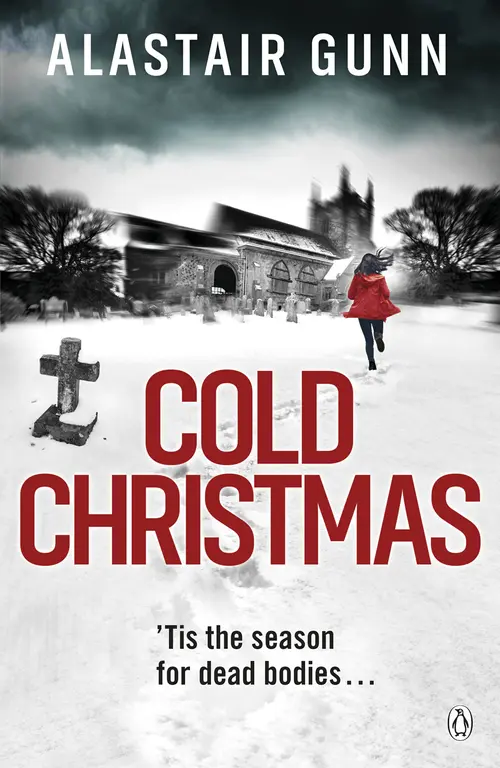
Cold Christmas
Cover

PENGUIN BOOKS
Cold Christmas
Alastair Gunn is an experienced magazine journalist. The Advent Killer was his first novel in the series featuring DCI Antonia Hawkins, followed by My Bloody Valentine and The Keeper, which was published in April 2017.
Alastair lives in Hertfordshire with his fiancée, Anna.
Dedication
For Anna

Prologue
Joel lay still.
Blindfolded.
Gagged.
Bound.
He fought the panic swirling in his gut, tried to concentrate on the soft rustles and clicks happening a few feet away, only just audible above his own ragged breaths, and the hammering sound of his pulse in his ears.
To his right the low hum started again, punctuated by the same slow whispers of clothing; the same plastic tap-tap-tap.
Then the same cracking jolt.
His heart leapt even harder this time, because the whipping scratch that followed was not only nearer than it had been before, but also a lot more intense.
Moving was dangerous; they’d all been warned about it, but his head snapped instinctively towards the noise.
Now he was properly scared.
‘Hello?’ he mumbled through the gag, breathing even harder through his nose. After a few seconds, there was a quiet shuffle.
But no reply.
He tried adjusting the material with his tongue, but once more his voice came out a muffled slur. ‘Please. What’s going on?’
Nothing.
‘Will, Colin?’ He panted, straining against his bonds. ‘Can you hear me?’
Someone shushed him, though he couldn’t tell who, as red patches started flashing across the blackness in front of his eyes. The moisture that had formed around the edges of the fabric stretched across his skin began to sting. A bead of sweat ran down his cheek into his ear.
Frantic now, Joel began flexing his brow, trying to dislodge the blindfold. But it was made of the same clingy black material as the gag, and moulded itself to his face.
He gasped through the wet gag. ‘Please stop.’
He tried to sit up, but the ropes were tight, and he slumped, his heart smashing against his ribs. Then footsteps.
Coming his way.
‘I’m sorry,’ he garbled. ‘I don’t want this.’
Whoever it was arrived beside him and crouched next to his head, their knee-joints cracking.
Perhaps the scratching sounds had been the others getting up; leaving the room. Maybe that’s why they hadn’t answered, and this would all be over soon.
‘Sorr—’ he started to repeat, as a hand was jammed over his mouth and nose, pressing his head hard against the rough carpet.
Joel bucked, unable to breathe. But another weight arrived on his forehead, pinning him down, a cracked, clammy palm grinding itself against his hot, stinging skin.
Suffocating him.
He started to thrash, trying to scream through the gag, but the pressure didn’t ease until he heard the hissing voice, right next to his ear.
‘Shut … the fuck up.’
Joel nodded as hard as he could, still fighting for breath, even though his head didn’t move. But the resistance must have been felt, because the hands lifted, letting Joel drag in a deep, shuddering breath through the cloth.
There was a click, followed by a small whizzing sound.
A pause.
Gentle pressure applied to his chest.
Before the blinding pain crashed in.
1
There were two sharp knocks followed by a muted American rumble. ‘Toni, you in there?’
‘Yes.’ Hawkins glanced up from her perch on the rim of the bath.
‘Come on, already. We’re late.’
‘I know.’ She checked the time on her mobile. ‘I’ll be out in a minute.’
There was a pause. ‘You sick?’
‘No. Fine.’
‘Then hustle. Our appointment’s in a half-hour.’
‘Okaaay.’ She tried to stop her voice flaring.
More silence, then, ‘I’ll be out front.’
She listened to his footsteps descending the stairs, heard the front door open and close, and sighed.
Things weren’t going well.
She and DI Mike Maguire had been living together now for almost a year. The love was still there, she didn’t question that, but no patch in their time together had been as rocky as this. Their arguments – regular as ever, but normally just heated banter – had escalated in recent months.
Partly the problem was lack of excitement. They both endured the daily grind of police work because it meant they got to take down a dyed-in-the-wool psychopathic killer once in a while. And to be honest, in the past they’d had their fair share. But their last decent specimen was now inside for life, and there was only one word that encapsulated life in Hawkins’ Murder Investigation Team since his apprehension.
Dull.
There had been murders since, of course; a capital city like London would always produce a steady stream of those. But the seemingly endless flow of domestic homicides, hate killings and drunken, out-of-hand brawls had become like a treadmill with no off switch. Recently every case seemed familiar; the same old story, just with different faces and names.
Hawkins glanced up as an engine kicked over outside the window, indicating that Mike had started the Range Rover, and would shortly pull round in front of the house. She needed to move, but his plan for their morning was her vision of hell.
She sighed as her phone pinged, retrieving it from the window sill and waking the screen, expecting to find an impatient text message from Mike.
Get your ass out here.
Seeing instead:
3xb, circ sus, soc os, 42 Priory Walk, Park Gardens, SW2.
Translated: Three bodies, circumstances suspicious, Scenes of Crime on site, and the location. Exhilaration flared as she called up the address. Brixton. Forty-eight minutes away.
Hawkins checked herself in the bathroom cabinet mirror, pinching at a clump of hastily applied mascara. Her off-day wear, a jade turtleneck and tight jeans, would raise eyebrows among colleagues used to more formal attire, but there wasn’t time to change.
She pushed her hair out of her eyes then rattled downstairs, collecting coat and bag on the way to the car, and stopped beside Mike’s door, tapping on the thick glass.
He glanced up from his phone, apparent confusion turning quickly to insight as he lowered the window, fixing her with fractious, dark brown eyes. ‘Don’t tell me, something came up.’
She held out her phone for him to verify the message, and watched him read, thinking about the last time they had genuinely enjoyed each other’s company without the pressure of an argument threatening to overwhelm the proverbial flood defences.
It had been a Sunday the previous month, the occasion filed away in her memory as if her subconscious had somehow known it was a turning point. Her sister Siobhan had dropped Antonia’s niece and nephew off for the day, while she covered an emergency shift for a colleague. Hawkins had refereed the making of fairy cakes for the kids’ pending school Christmas party, before Mike entertained them by letting them help with his weekly head-shaving routine. Then they had played ball games in the garden, making the most of a surprisingly temperate November, and all fallen asleep watching Disney films, to be woken by the doorbell when Siobhan returned to retrieve her offspring. Hawkins had lifted her head off Mike’s shoulder and gone to let her sister in, not noticing until they returned to the front room that Kyle wasn’t there. He was subsequently traced to the bathroom, just as the battery on Mike’s electric razor ran out, leaving the semi-bald youngster looking a lot less like his favourite adopted uncle than he’d intended. Alone once more, Hawkins and Mike had spent a dispute-free evening at home, laughing together; actually talking.
It seemed like a lifetime ago.
The corner of Mike’s mouth twitched as he handed the phone back.
She took it. ‘We’ll go next weekend. I promise.’
‘Sure we will.’
‘You know I can’t ignore this.’
‘I get it.’ He half turned away. ‘You’re devastated.’
‘I’m sorry.’
‘Hey, my boss didn’t want me to take today off in the first place, so he’ll be happy to see me. And it saves us both a day’s vacation time, right?’ The window started coming up. ‘See you tonight.’
‘Don’t be like tha—’ Hawkins began as the Range Rover roared away from the kerb. She watched it round the bend and disappear.
She stood for a moment, wondering if a text now, later, or at all would have any impact on the inevitable argument about conflicting priorities.
Probably not.
But she felt a surge of energy as she turned and headed for her car, revelling in the unexpected prospect of a decent investigation.
Distraction at last.
2
Park Gardens could have passed for a war zone.
Hawkins stepped over the jagged edge of yet another lifted flagstone, distastefully scanning the burnt-out meter boxes and crumbling brickwork of Priory Walk.
According to the bright yellow signs posted at regular intervals on the mesh safety fencing, these thirties brick flats were scheduled for demolition early next year.
Until then, the largely condemned estate made a great dumping ground for dead bodies.
She checked her mobile, dismayed to find that even a heavy right foot had only shaved a few minutes off her projected travel time from Ealing. On the way she had called her two most regular detective sergeants, Amala Yasir and Aaron Sharpe. Aaron was on compulsory training for revised arrest protocols until lunchtime and couldn’t make it, but Amala had been in the team’s office at Becke House, and would have beaten Hawkins here.
Then she’d taken a deep breath and rung Maguire.
Voicemail.
She hadn’t left a message, because a missed call made a stronger statement that she was trying. But the whole argument would have to wait, at least until she got a handle on this new case.
She passed through an underpass that reeked of piss, emerging, head turned against an icy breeze, into what by comparison was the desirable end of Park Gardens.
Two storeys of the same bare brick housing overlooked a tatty grass area, kids’ bicycles strewn here and there, near an upended bin bag disgorging an intermittent stream of crisp packets to the wind. At least at this end of the estate half the windows had glass; the remainder simply boarded instead of breeze-blocked up. Not a soul had shown themselves yet, but she caught ripples in at least two sets of curtains, one from a flat displaying a string of idly flashing Christmas lights. Somewhere in the background, a kids’ TV show blared.
There were families here.
Movement from the far corner of the square caught her attention, as DS Amala Yasir came out from the shadows of another cut-through and waved her across.
Hawkins walked over, their greeting limited to stoic nods as the sergeant turned back the way she had come. ‘This way, ma’am.’
Hawkins followed, pleased to note the assurance of her younger colleague. Not so long ago there would have been hesitation, an implied transfer of control; perhaps a hangover from some early career complications with idiot colleagues who had made an issue of the sergeant’s South-East Asian origins and small stature. Yet Amala had come on in leaps and bounds in recent months. Organized, intuitive and committed as ever, the only thing holding the DS back had been a lack of self-confidence. But Hawkins’ regular efforts to prod the sergeant out of her comfort zone had finally started paying off. These days, Amala’s delicate physique simply ensured more of a shock for anyone stupid enough to challenge her.
The downside was that others had noticed the change, too, so it probably wouldn’t be long before Hawkins’ protégée was tempted from the nest.
They walked across a courtyard, before entering a second one, smaller than the first. More two-storey flats ran left to right across the cracked and pitted pavement, dirty walls and boarded windows lining the grimy corridor that led back towards the main road. Through the clumsy network of ageing concrete stairs and walkways at the far end, Hawkins noted the SOCO van.
But there was no mistaking their destination. Directly ahead, one of the ground-floor flats was already swamped in blue-and-white crime scene tape, as overalled SOCOs ducked in and out, ferrying various pieces of evidence past the tiny forest of rampant weeds that estate agents might have called a garden, to stow them in the truck for later analysis.
She also saw a group of eight kids hovering outside one of the adjacent properties. The oldest few looked twelve or thirteen and were slouching on their bike seats, flicking cigarettes.
Hawkins touched Amala’s arm as they walked. ‘Can we lose the audience?’
‘Sorry, ma’am, should have said. They found the bodies, called it in.’
‘Fair enough. Have we got names and addresses in case they get bored?’
‘Already done, but they all live on the estate.’
‘Good. We’ll talk to them afterwards. What about CCTV?’
Amala gave her a rueful look. ‘No, the estate isn’t wired. They’re doing the main road after Christmas.’
Hawkins swore under her breath. ‘Find out where the nearest cameras are, just in case. We may need them later on.’ She pointed at the warped piece of chipboard propped under a smashed window. ‘Do we know who broke in?’
‘The kids said the board’s been off for a couple of weeks.’ The sergeant dropped her voice as they passed the group. ‘They thought it was squatters – apparently there’s a lot of that around here. Parents told them to stay clear, but the smell was getting hard to ignore.’
‘Can’t argue there.’ Hawkins switched to breathing through her mouth as they reached the cordon. Even outside, the rancid stench of decaying flesh was overpowering, like fermenting meat sprayed with cheap, sickly perfume, and left out in the sun. Her stomach gave a cautionary lurch.
They showed warrant cards, suited up, and went in. Hawkins paused briefly to inspect the door frame which carried apparently recent scars from a sizeable crowbar. She raised an elbow, estimating that whoever created the damage was two to four inches taller than her: unhelpfully meaning they were the height of the average man. She turned her attention to the poky hallway. The cramped space had claustrophobically low ceilings, ill-matched colours, and the efficient underlying buzz of a professional investigation team at work. But no evidence of the offending tool.
She turned to find Amala watching her and nodded. The sergeant let one of the SOCOs pass them in the narrow corridor before heading for the rear of the property. Hawkins followed, inspecting the place as they went.
Like its neighbours, the flat clearly hadn’t received any attention for years. The mottled blue carpet crunched underfoot, while huge discoloured stains on the ceiling suggested that upstairs’ plumbing also needed work. They passed a kitchen crammed into a medium-sized cupboard, with a burnt-out toaster and tiles smeared in a brown substance Hawkins decided not to investigate. A poky bedroom came next, filthy blankets and a duvet shoved into the rear corner, everything being slowly conquered by damp, suggesting that no one had lived here in the recent past.
Amala moved straight ahead into an unfurnished lounge, where the odour’s intensity kicked again, going from playful assault to brick-in-the-face.
Hawkins swallowed the small shot of bile that rose in her throat.
In front of her, Amala slid sideways into the room, her romper suit rasping quietly against the textured wallpaper, allowing Hawkins to step fully inside.
Dull winter sunlight drifted aimlessly through the open patio doors and cheap curtains on to dreary, part-papered walls. Flies criss-crossed the ceiling, their expired predecessors littering the patchy carpet below. The stagnant air seemed to drag the walls even closer.
Four white-overalled figures crouched in the centre of the room, temporarily blocking Hawkins’ view of the main attraction. Camera flashes identified one as the forensic photographer, while swabs and sample bags in the hands of two others denoted crime scene technicians.
Seconds later the formation broke, dispersing as if theatrically choreographed to reveal the grim reason for everyone’s presence.
Three bloated male bodies lay on their backs in the middle of the floor. Each wore jeans and trainers. A neat line, arms by sides, naked from the waist up. Blue-black skin eaten away in places, burst or blistering in others. Dark patches of escaped fluids formed a dirty halo around each man. Three neat piles of clothing were lined up against one wall.
The unidentified overall stood, turning away from the bodies to reveal its occupier’s face.
‘Cavalry at last.’ Gerald Pritchard crossed the short distance to meet them at the door, addressing Hawkins. ‘I trust you’re well, Detective?’
‘Fine, thanks.’ She dodged further civilities. Rumours had been circulating Becke House that the Home Office pathologist had recently remarried, mere months after his ailing wife had passed away, to a Thai woman twenty-five years his junior, yet it remained to be seen if this would temper his infamously lecherous approach to female colleagues.
She nodded past his shoulder. ‘Looks interesting.’
‘Doesn’t it just.’ Pritchard glanced back at the corpses, his nasal voice exaggerated by the sprung nose clip he reserved for the most pungent crime scenes. ‘A rare treat, you might say.’
Hawkins exchanged nauseated looks with Amala, asking as Pritchard turned back, ‘So what do we know?’
The pathologist rubbed at his chin with the back of a gloved hand. ‘Three dead males, all early to mid-twenties, at a loose estimate. Advanced pupae development and decomposition, hence the patently high levels of putrescine and cadaverine, and the accompanying malodour, of course.’ His head cocked in consideration. ‘They’ve probably been here ten days or so, though I’ll be able to speculate more accurately once I get them back to the lab. We minimize physical interference in such cases, you understand, because the bodies will disintegrate if handled. The cutis tends to slide off like rice pudding skin—’
‘So less than two weeks in situ,’ Hawkins interrupted before he got any more graphic. ‘Were any of them living here?’
I’d say not.’ Pritchard blinked slowly. ‘Aside from the discarded clothing, there’s a complete lack of personal effects elsewhere in the flat, and no food in the kitchen that isn’t at least six months past its best. We’ll confirm once samples from the other rooms have been analysed, but I think our protagonists arrived here in good health, shortly before meeting their ends. Speaking of which …’ He wandered over and collected a few items from near the piles of clothing, returning to hold them out towards the detectives.
Three mobile phones, two wallets and a bank card.
Hawkins quickly checked the phones – all locked. She put each one in a separate evidence bag, while Amala took the card. ‘J. Kowalski. Sounds Eastern European.’
Pritchard nodded. ‘Aside from a small amount of cash, it’s all we have for that one.’
Hawkins chose the first wallet, a practical black fabric fold-over, either recently cleaned out, or the property of someone who thought there was a place for everything. Tucked in a side pocket she found a publishing house security pass for a freelance journalist named Colin Wilson.
Pritchard produced five identical, expensively finished business cards from the remaining tan leather wallet. All were emblazoned Director, Business Solutions, and the accompanying driver’s licence showed matching details for a William Tennent.
Hawkins memorized the names as she eyed the slowly putrefying cadavers. ‘At least whoever’s responsible for this clearly doesn’t mind us knowing who these three were.’ She collected all the IDs in another evidence bag, which she passed to Amala, before turning back to Pritchard. ‘So, what actually killed them?’
The pathologist sucked in a long breath, huffed it back out. ‘I’ll have to get back to you on that one.’
‘We don’t need absolutes, Gerry.’
His expression soured. ‘We’ve checked all three bodies and—’
‘You can’t be certain,’ Hawkins said. ‘Fair enough. How many possibilities are there?’
‘That’s just it, Detective. I can’t give you a potential cause of death …’ Pritchard exchanged disconsolate glances with one of his team before going on, ‘… because we can’t find one.’
3
Hawkins stared down at the bodies, trying to fathom the implications of Pritchard’s statement.
No apparent cause of death.
The scenario was almost unheard of in crime scene investigation, especially with more than one body involved. It wasn’t unusual for murder victims to exhibit two or more potentially fatal injuries. Often the question wasn’t which would have killed the subject; just which had occurred first.
She regarded the pathologist. ‘How do you rule out somatic causes at this stage, when the bodies are so badly damaged?’
Pritchard swiped unsuccessfully at a passing fly. ‘Because everything you see here happened post-mortem, Detective. The deterioration is just nature reclaiming temporarily leased materials. As far as we can tell, all three bone structures are intact. There are no residual signs of physical assault, certainly nothing serious enough to kill.’
‘Drugs?’ Amala asked.
‘That’s possible, Sergeant, of course, but there are no needle marks on what remains of exposed vein-rich areas, nor powder traces in nasal cavities, indeed any signs of substance abuse at all. We found no vessels or packets in which drugs could have arrived.’
‘How about environmental toxicity?’ Hawkins pointed at the section of gas pipe inexplicably traversing one corner of the room.
The pathologist narrowed his eyes at her. ‘Also routinely explored. In this case we lack chemical burns to what’s left of airways. More convincingly, perhaps, carbon monoxide poisoning would be unlikely to have killed one of them, let alone all three. Unless they all happened to be lying here unconscious and stripped to the waist when such a leak occurred – a leak that has since corrected itself, by the way. This was no accident.’
‘OK,’ Amala said. ‘So how do we know it’s murder and not suicide?’
The Story Continues on BooksBarbecue!
Enjoyed this preview? ❤️ Do not stop here!
Read the complete book free online → 🔗
Continue reading now on BooksBarbecue and discover every page!
Love reading? Bookmark BooksBarbecue.com for more amazing books!
Happy Reading!