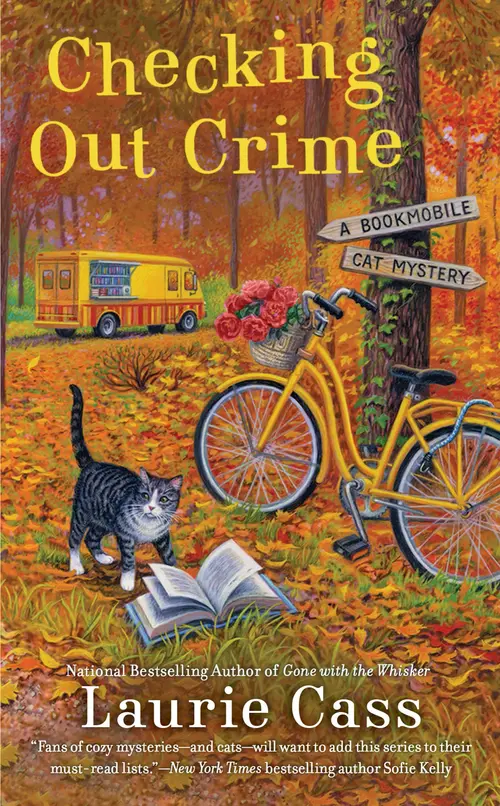
Checking Out Crime
Cover
Praise for the Bookmobile Cat Mysteries
Praise for the National Bestselling Bookmobile Cat Mysteries
“With humor and panache, Cass delivers an intriguing mystery and interesting characters.”
—Bristol Herald Courier (VA)
“Almost impossible to put down . . . the story is filled with humor and warmth.”
—MyShelf.com
“[With] Eddie’s adorableness [and] penchant to try to get more snacks, and Minnie’s determination to solve the crime, this duo will win over even those that don’t like cats.”
—Cozy Mystery Book Reviews
“A pleasant read. . . . [Minnie is] a spunky investigator.”
—Gumshoe
“A fast-paced page-turner that had me guessing until the last dramatic scenes.”
—Melissa’s Mochas, Mysteries & Meows
“Reading Cass’s cozies feels like sharing a bottle of wine with an adventurous friend as she regales you with the story of her latest escapade.”
—The Cuddlywumps Cat Chronicles
“Books, family, romance, and of course, a library cat make this a winning series for mystery readers and fans of these cozy adventures.”
—Kings River Life Magazine
Titles by Laurie Cass
Lending a Paw
Tailing a Tabby
Borrowed Crime
Pouncing on Murder
Cat with a Clue
Wrong Side of the Paw
Booking the Crook
Gone with the Whisker
Checking Out Crime
Dedication
To all small businesses everywhere. In large part because of you and your hard work, our communities are not merely places to live, but are places we’re proud to call home. (Note: Paddles & Pedals of Bellaire graciously allowed me to use their name in this book. Any other resemblance between the fictional and real version is completely accidental.)
Chapter 1
When we’re children, we have all sorts of expectations. We expect to go to school. To learn things. Make friends. Memorize locker combinations. We also expect that someday we’ll do things. Maybe great things. That we’ll go forth and conquer. Be successful. Marry. Have children. Travel.
For me, the husband and child predictions had been a bit fuzzy, but my career expectations had been specific. At the ripe old age of seven, I decided I wanted to work in a library because then I’d be able to read all day and no one would order me to put my book down and go outside and play because otherwise my eyes were going to get stuck and I’d have to wear progressively stronger glasses the rest of my life.
In due course, I followed through with my decision and was now, at age thirty-five, the happy assistant director of a library in Chilson, Michigan, a lakeshore town in northwest lower Michigan. What I hadn’t expected was that I’d be living on a houseboat and driving a bookmobile with a cat as my copilot. But it was an adorable houseboat, running the bookmobile program was tremendously rewarding, and the cat . . . well, he somehow made everything shinier.
Most of the time, anyway.
It was a fresh September morning. Birds were singing, the sun was shining, and I was humming to myself as I tidied up after breakfast, when my feline companion started making troubling noises. “Eddie,” I asked, “what are you doing?”
Catlike, he didn’t say a thing. Which could have been because he was busy trying to get his nose into the tiny gap at the back of the houseboat’s dinette seats. More likely, he didn’t feel like responding. And, since he was a cat, whatever he didn’t feel like doing, he didn’t do.
“There are days,” I said, “that I wish I were more like you.”
Eddie’s yellow eyes flicked in my direction, then away.
For once, reading between the kitty lines was easy. “Yes, I know that anyone with any sense wishes to be a cat in general, and you in particular, but not everyone has sense, now, do they?”
My black-and-white tabby abruptly abandoned his efforts, jumped to the floor, and bumped the top of his head against the back of my leg. Since Eddie is a good-sized cat, this popped my leg forward against the kitchen cabinet.
“Ow!” I tossed the dish towel onto the tiny counter and rubbed my knee. “That’s proof. Washing breakfast dishes is hazardous to my health.”
“Mrr.”
“A bowl of cereal and a glass of orange juice is the definition of breakfast, my furry friend. At least for all five feet of Minnie Hamilton.” I eyeballed myself from toe to shoulder. Other youthful expectations of mine had been that I’d grow taller than my mother and that my freakishly curly black hair would magically straighten. I’d given up on the height thing, but there was always a chance my hair would fix itself someday.
“Ready, Freddie?” I opened the door of the cat carrier. Eddie trotted inside, flopped onto his soft pink blanket, and glared at me.
“Giving me The Look won’t get us there any faster,” I told him.
“Mrr,” he said, and kept on saying that as I carried him into my car, as we pulled out of the marina parking lot and drove past the house where I’d soon be living, and the entire time we drove through downtown Chilson and to the library.
Downtown, with its mix of old and new buildings, some made with wood, some with brick, and a few made with stones hauled years ago from nearby fields, was a complex delight every time I remembered to look around. Today, however, my noticing capacity was limited because Eddie kept distracting me with a running commentary I had no chance of understanding. After we reached the library, he mrr’d as I ran through the preflight bookmobile checks. He mrr’d as I carried him inside and strapped the carrier to the floor of the passenger’s side, and he mrr’d at Julia Beaton, my outstanding part-time bookmobile clerk, as she bounded up the stairs.
“And a good ‘mrr’ to you, too, Mr. Eduardo,” she sang out.
I squinted at her. “Do I detect a new accent?”
“My dear assistant library director, there is no such thing as a new accent.”
What she’d said sounded familiar, but only sort of. “Did that start as a Mark Twain quote? About ideas?”
“Ideas, accents.” She waved a suddenly languid hand. “What’s the difference?”
I grinned. It was going to be one of those days, in which the only thing to expect was the unexpected. Julia was in her mid-sixties and had spent years onstage in New York swooping up suitcases full of awards. When the roles started to dry up, she convinced her husband to move back to her hometown of Chilson, where she grew increasingly bored until my aunt Frances mentioned that I was looking for part-time help. Five minutes after we’d met, I made up my mind to hire her. This decision was confirmed her first day on the job when she started to talk to Eddie just like I did, pretending that he understood every word.
This was important because Eddie was a fixture not only in my life, but also on the bookmobile. He’d stowed away on the vehicle’s maiden voyage, and though I’d tried to keep his presence a secret, Eddie wasn’t big on secrecy, and even less big on staying in the cabinet I’d tried to hide him in.
Keeping my then boss, Stephen the Stickler-for-Rules, from knowing about Eddie’s presence had kept me in anxiety for some time, but it had worked out in the long run and these days I couldn’t go anywhere without someone asking how Eddie was doing.
I settled into the driver’s seat and glanced over at my furry friend. Two and a half years ago, Eddie had attached himself to me when I’d gone for a walk on an unseasonably warm April day. The fact that this attachment had happened in a cemetery, next to the final resting place of Alonzo Tillotson, born 1847 and died 1926, should have meant that the cat’s name would be Alonzo. But Alonzo is a very long name to call a cat, especially since they never come when called, and the name Eddie just fit. He was a very Eddie-like cat.
“Nothing yet?” Julia asked as she buckled herself into the passenger’s seat.
“More specifics, please.” I started the engine, dropped the transmission into gear, and eased the thirty-one-foot-long vehicle out of the library’s back parking lot. “Nothing as in nothing ventured, nothing gained?” I started warming to my theme. “Wasn’t it Maya Angelou who said ‘Ain’t nothin’ to it, but to do it’? And don’t forget Emily Dickinson’s poem that ‘Saying nothing sometimes says the most’? Or—”
Julia flung out her long arm and pointed in the direction of my hands. “As in no engagement ring.”
I looked at my naked finger. “Oh, that.”
“Yes, that.”
Fun fact: When a Broadway actress wants her tone to be sarcastic, the sarcasm is so thick it’s almost visible.
“How long ago did he propose?” She tsked at me. “Without a ring, can you trust the man?”
I thought for a moment, then gave a heavy sigh. “That’s a good question.”
Julia’s head whipped around fast enough to send her long strawberry blond braid flying. “It is?” Her mouth dropped open.
“Well, no,” I said. “Rafe is the most trustworthy man on the planet. But it was fun to see that shocked look on your face.”
“Huh.” Julia’s feet tapped the top of Eddie’s carrier. “Did you hear that, my fine feline friend? Minnie caught me by surprise. Who would have thunk it?”
“Mrr.”
The two of them carried on a conversation that didn’t include me, so I started thinking about Rafe Niswander, my fiancé. He’d proposed just over a month ago, but we hadn’t taken any steps toward the actual wedding since then. This was mostly because Rafe was a middle school principal and right now, at the beginning of the school year, he was busy with zillions of meetings, which left him with little time to think about how and when we wanted to get married.
“See that?” Julia asked, nodding in my direction, but still looking at the carrier. “She’s thinking about Rafe.”
“Mrr?”
“How can I tell? Soft eyes, goofy smile, warm heart. All of that.”
“Mrr.”
“I absolutely agree,” Julia said. “She’s known the man for how long? More than twenty years? And now she’s suddenly all goo-goo about him? I mean, he’s the same guy he was when she got the library job and moved to Chilson permanently. Why the lovefest now, and not then?”
Another good question, and one I’d pondered myself. Rafe, tallish, darkish, and handsome-ish, had indeed not changed a bit since I’d first met him on Chilson’s city beach, the first summer I’d been sent north to stay with my aunt Frances. That was the same summer I’d met my best friend, Kristen Jurek, so maybe the two-girls-against-one-boy element had something to do with the delayed love. Or maybe it had taken me this long to recognize that Rafe’s annoying habit of pretending to be far dumber than he was would never change and I might as well get used to it.
Or, far more likely, I simply hadn’t been ready. Rafe had recently confessed that the gorgeous old house he’d been renovating for three years had been for me all along, and he’d almost given up hope I’d ever come around to loving him.
Every time I thought about that, I shivered. “Timing is everything,” I said to Julia.
“Huh.” She flopped back against her seat. “Truth in three words. But I still want to see a ring.”
So did my mother, sister-in-law, and oldest niece. My dad, brother, nephew, and younger niece were more concerned with making sure we picked a wedding date that didn’t interfere with the play-off schedules of multiple sports teams. “What kind of ring would you like me to have?”
Julia perked up. “I get to pick?”
“No. But before you slump, all exaggerated and actor-like, I’d be happy to hear your ideas.”
“Nothing normal,” she immediately said. “There’s nothing average about the two of you, so your rings should reflect non-normality.”
I wasn’t sure “non-normality” was a word, but I let it go. “You made ‘ring’ into a plural. How many are we talking about?” I wiggled my empty fingers against the steering wheel. “I’m not used to wearing any.” Long ago, I’d had a high school class ring, but that had been lost after my junior year when I’d jumped into Lake Michigan on Memorial Day after being dared to by Kristen. Every part of me had shrunk from the frigid water temperature and my ring had slipped off into the sandy bottom, lost forever to the vagaries of water and wind.
Julia held up her left hand, three fingers extended. “One engagement ring for you. One wedding band for you. One wedding band for Rafe.”
“Sounds normal. I thought normal was out.”
“You have to maintain some semblance of normalcy to function in society,” she said severely. “All three rings need to match, but they can’t be overly matchy-matchy. That’s cutesy and I can’t recommend that in this case. You’re too short to do cutesy.”
“Or inclined,” I said.
“What? Never mind. Doesn’t matter. Now, as I was saying, the style of all three rings needs to match.”
“Why?”
Julia sighed. “Have you not been paying attention to wedding fashions? No, don’t answer that. I’m sure you have not, in spite of both Kristen and your aunt Frances getting married this year, so it’s a good thing you have me to help out.”
“So lucky,” I murmured.
“Yes, you are. Now. The engagement ring is the first step in your forever relationship. This ring symbolizes everything the two of you have done to date and everything that will happen in the future.”
Since we’d come to a stop sign, I felt free to raise my hand. “Question. Isn’t that a big burden for a hunk of metal and rock?”
“Can’t quite hear you over this noisy engine,” Julia said, unnecessarily raising her voice. “You might want to have that looked into. But rings are important,” she went on more moderately. “Every day for the rest of your life, there they are. Every waking hour you’ll notice them on your hand. Make a bad choice, and you’ll regret the decision forever.”
I glanced over, trying to remember the kind of rings Julia wore. “Voice of experience?”
“You tell me.” She pointed at the tiny diamond and narrow wedding band on her left hand. “We were young and poor and bought the cheapest rings in the store. All we could afford, see? We could buy something fancy now, but we like to remember those early years.”
I smiled. Julia had a streak of sentimentality in her. Who would have guessed?
“Now,” she said, settling back into her seat. “Let’s talk rocks. Big ones, because you deserve it.”
So we did—or at least she did—the rest of the day. And since it was a very long day, my interest in talking about rings, weddings, receptions, and honeymoons had waned hours before we finally turned toward home. Even Julia’s deep well of imagination must have been running dry because her final attempt was weak.
“You could,” she said, “have your engagement ring match your wedding. Wait, I have it! An emerald ring and a Wizard of Oz theme. Wedding gown like Glinda’s dress, put Eddie in a basket like Toto, and the three of you can leave in a balloon.”
The idea was ludicrous and I was about to say so, when Eddie did it for me.
“MrrRRR!”
Julia sighed. “Sorry, Edmeister. I know that one was stupid. I’m tired, that’s all.” She looked over at me. “We’re not going to do this kind of day again, are we?”
I hadn’t wanted to have such a long day in the first place, but my boss, Graydon Cain, director of the Chilson District Library, had asked us to try it. Though he was a decent guy, he’d only been director for a few months, and I wasn’t sure enough of our relationship to say a flat-out “no” when he asked if the bookmobile would be willing to attend a township board meeting in the farthest-flung corner of Tonedagana County.
“It’s a night meeting,” he’d said, “but it starts at seven and the township clerk says their meetings hardly ever run more than an hour. The days up here are so long you’ll be back before sunset.”
He’d been right, but only partly. Though the meeting, which included a tour of the bookmobile by the board members, had indeed lasted less than an hour, the sun was dropping behind the tree line as we pulled out of the parking lot. Twilight lingered long in midsummer, but now that the equinox was approaching, it would be full dark in less than half an hour.
“It was a long day,” I said to Julia. “A good one, though, don’t you think?”
“Huh.” She tapped the cat carrier with her toes. “Did you notice that, Eddie? She didn’t swear on a stack of first-edition Angela Thirkell books that we are never, ever, ever going to spend another fifteen-hour day in the bookmobile.”
Assuming we didn’t get lost on the way back to Chilson, which was unlikely since I’d driven this route through the county’s hilly back roads a hundred times in the last two years, her number was an exaggeration by at least four hours. “Ours not to reason why,” I said. “And the board members really enjoyed going through the bookmobile.”
“Sure, but there’s no way we can fit another stop into our route. We’re already starting to turn people away from some stops to get to the next one on time. And soon we’ll have to be dealing with snow and our driving times will be a huge question mark.”
These were all things I knew. And Julia knew that I knew, because we’d already talked about them ad nauseam.
“It’s only September,” I said.
“Mid-September.” Julia slouched down. “Look out there. The leaves are starting to change.”
I squinted through the windshield. Sure, there were a couple of orange- and red-tipped maple leaves in the passing trees, but roughly 99.9 percent of them were still a lush green.
“It’s only September,” I repeated. “There are weeks to go before we have to start thinking about snow-covered and slippery roads.”
“Minnie, how are—”
I cut her off. “We’re not going to worry about it.”
The unspoken question chewed at both of us. If Graydon wanted more stops on the route, we’d need more bookmobile staff. And that meant . . . well, I wasn’t sure what it meant, exactly. But it would certainly mean changes for us and for our patrons, which meant there would be issues to deal with, both foreseen and unforeseen.
The foreseen things we could take care of. It was those sneaky unforeseen things that could throw the whole program into disarray and chaos and start it sliding into a downhill trajectory that ended in a quick sale of the bookmobile to the highest bidder, who I was already envisioning would be a local plumber, and I’d have to spend the next twenty years of my life watching it haul pipe.
“I thought you said we weren’t going to worry.” Julia was looking at me, doing the one-eyebrow thing. “No saying you weren’t, because that little vertical line between your eyebrows is telling the truth.”
My right hand went to my face and felt around. Sure enough. I scrubbed at my eyebrows with my palm. “Ta-da! All gone, see?” I turned to show her.
Gasping, she pointed at the windshield.
I whipped around to face front. Though the bookmobile hadn’t strayed a millimeter from the center of our lane during my second and a half of inattention, during that brief period of time, an oncoming car had zoomed into view.
Its headlights pierced the dusk and flared bright into my eyes. I immediately did as I’d been trained and looked down and right to watch the white line at the edge of the asphalt. But since we were on a back road there was no white line, so I trained my gaze on the edge of the crumbling asphalt.
From the angle of the approaching vehicle’s headlights, I could tell that it was encroaching into our lane. Careful, oh so carefully, I edged the bookmobile as far right as possible. On this road, falling off the pavement could mean a drop into soft soil. With the bookmobile’s weight, that could mean a sudden shift in center of gravity and a rollover, something I desperately wanted to avoid.
“He’s going to hit us,” Julia said in a high voice.
My attention was focused entirely on keeping us on the far edge of the road. “It’ll be fine,” I said calmly. “I got this.”
“He’s going to—”
The vehicle zoomed past in a quick swoosh and was already out of view when I glanced in the side mirror.
“Well.” I realized there was no air in my lungs, so I pulled in a deep breath and let it out. Wherever the driver was going in such a hurry, I hoped he or she got there without hitting anyone or anything. “That was interesting. Eddie, are you okay?”
“Mrr.”
The Story Continues on BooksBarbecue!
Enjoyed this preview? ❤️ Do not stop here!
Read the complete book free online → 🔗
Continue reading now on BooksBarbecue and discover every page!
Love reading? Bookmark BooksBarbecue.com for more amazing books!
Happy Reading!