Cape Fear Rising
Cover
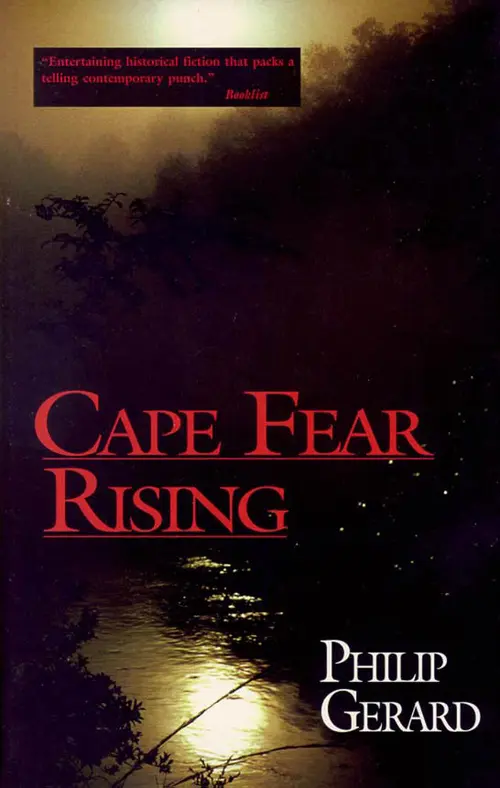
C A P E F E A R R I S I N G
B O O K S B Y P H I L I P G E R A R D
Hatteras Light (novel)
Brilliant Passage (nonfiction)
Title

Dedication
For Kate,
à jamais
Acknowledgments
A C K N O W L E D G M E N T S
The author is grateful to the following people for their valuable help in researching the historical figures and events portrayed in this novel:
The Cape Fear Museum staff, especially Harry Warren
Robert R. Crews, Wilmington Light Infantry Reserve Corps
Bob Ferguson, building manager, Public Services Division, city of Wilmington
Leland Smith and the staff of the Fort Fisher Museum and Historical Site
Michael Glancy
The Archives and Manuscripts staff of Joyner Library, East Carolina University
The Lower Cape Fear Historical Society archival staff, especially Diane C. Cashman and Merle Chamberlain
Aileen Leblanc of WHQR public radio
Dr. Melton McLaurin, UNC-Wilmington, Department of History
Dr. Daniel Noland, linguist, UNC-Wilmington, Department of English
The New Hanover County Courthouse Vital Records staff
The staff of the North Carolina Room at the New Hanover County Library
The staff of the William R. Perkins Library Special Collections, Duke University
The staff of William Madison Randall Library, UNC-Wilmington
The Thalian Hall staff
The staff of the United States Army Ordnance Museum, Aberdeen, Maryland
The staff of the Wilmington Railroad Museum
The staffs of the Southern Historical Collection, the North Carolina Collection, and the Photographic Services and Photographic Archives Sections at Wilson Library, UNC-Chapel Hill
Robert H. Wooley, historian
Thanks to Stephen D. Kirk for his good work in preparing this manuscript for publication.
The author is grateful for a research grant from UNC-Wilmington and a fellowship from the North Carolina Arts Council in support of this book.
This novel was inspired by events that actually happened. Some of the characters are based on historical persons. In taking dramatic liberties with the action, the author has tried to remain true to the spirit of the facts.
But this is fiction—only a storyteller’s history.
An event has happened, upon which it is difficult to speak, and impossible to be silent.
Edmund Burke, 1789
Prologue
P R O L O G U E

1 8 3 1
STRANGERS, THEY COME TO TOWN. Six men—black, furtive, traveling by night. They cross the Cape Fear River by rowboat from the west bank and gather in the shadows of stacked cotton bales on the wharf.
The August heat steams off the river in a clinging fog.
The six are frightened. There has been an uprising up north in Virginia—black men murdering whites in their beds. The roads are busy with armed riders—runaway patrols—galloping here and there after rumors of fugitives.
But there is work here for free blacks, they’ve been told. This is a free port. Full of West Indians, freedmen, mulattoes from white mothers. A place that needs strong backs and clever hands. Worth the risk. There’s a man they have to see—owns a mill. Come daylight, they’ll find him and show him their papers. Meantime, best lie low.
All but one are wearing homespun. Their faces are dusky and lined, their hands horny and rough from work. The other, the one they call Daniel Grant, is slender and lithe. His hands are smooth as a woman’s, and yellow—like his face. His complexion is so fair that even in daylight he can pass for white. He wears a flannel suit and a linen shirt with a white man’s name, the mill owner’s, inked onto the inside of the left cuff. He is the only one of the six wearing shoes.
His voice is soft and resonant, a voice that comes up from his stomach and whispers things that sound so true five men have followed him a hundred miles from home to this river town.
They hunker on the wharf listening to the rush of the outgoing tide. The moon is invisible above the fog, silvering it with an otherworldly light.
One of the country men says, “The spirits is up and walking around, brothers.” He carries a forked cypress switch to ward off evil spirits. Now, he rubs it between thumb and fingers until it is warm from friction.
“Hush, now,” Grant says. “Don’t go talking haints and voodoo. It’s only the river fog.”
“Feel that chill? The spirits is floating down the river to the ocean. Going back to Africa, brother.” The country man rubs the forked stick some more. The love of Jesus is one thing, but a body needs every edge he can get in this wild river country.
“Just the night air cooling down,” Grant says. The fishy stink of low tide fills the close air. “ ‘The Lord on high is mightier than the noise of many waters,’ ” he continues quietly, “ ‘yea, than the mighty waves of the sea.’ ”
“Amen,” one of the men murmurs.
Another laughs. “For spirits, they’s pretty ripe.”
“Don’t be taking it lightly, brother. Time of night to be indoors, bolt the shutters.”
“Ain’t that the word. Give me a soft place to lay my head.”
They have been sleeping out-of-doors for weeks. For two whole days, they wandered lost in the swamps, eyes peeled for cotton-mouths and gators. At last, they found the river. Providence had left a derelict rowboat stranded on the mud flats at the mouth of a feeder creek. “We’ll just borrow this boat awhile,” Grant had declared, and they oared across at turn of tide. The current was stalled, and the dark water piled up in foaming ridges—unnatural.
Now, the Cape Fear is once again rising.
Stiff and travel-weary, they settle in among the bales to sleep one last night in the open. But all at once, the river sounds change. There’s murmuring out in the fog, the rasp of boots on rough boards—a boat?
Grant and the others peer into the fog. But it is a trick of the ear—the men come not from the water but from behind, down Market Street.
“Dust yourself off, brothers,” Grant says when he sees them, “and mind your manners.” In the sudden glow of a dozen lanterns, they all get to their feet, hands clasped at their stomachs, backs slightly stooped, heads nodded forward: don’t look the man in the eye.
Except Grant. He stands erect, hands clasped behind his back. He balances on the balls of his feet, ready to move.
The crowd of whites, armed with tool handles and rifles, fills in around them, backing them against the river. They listen to the steady slap of ax handles against palms.
“What have we here?” A tall white man approaches. Unlike the others, he is unarmed. He wears a frock coat and a four-in-hand, even in this heat. The lanterns make it hotter. His hair and beard gleam with oil. As he speaks, his long, smooth fingers play with a silk handkerchief.
“Cap’n,” Grant says, “pardon us for loitering at your wharf. We meant no harm. We have come seeking work.”
“Hear that, Colonel?” one of the white men says. “Damned fugitives.”
“You want to work?”
“Yes, cap’n. We only just arrived.”
The white man lifts a lantern and thrusts it close to Grant’s face. Grant doesn’t look away. The man leans in, squinting. “Why, you’re the creamiest nigger I ever did see!”
“A volunteer nigger,” someone in the crowd says. “Could pass, if he was smart enough to try.” Laughter.
“Bad night to be a volunteer nigger,” someone else says. More laughter.
Grant says, “My daddy was a white—”
The Colonel slaps him—not hard, but so quickly that Grant is taken by surprise. The slap is almost ladylike—it hardly stings. “Don’t ever let me hear you talking like that around here,” the Colonel says quietly.
“Yes sir, cap’n.”
“Don’t look me in the eye, boy.”
“Yes sir, cap’n.”
“Why are you niggers skulking about at this hour? Plotting murder, are you?”
“We weren’t skulking, cap’n. We’re freedmen.”
“Come into the light, all of you, where I can see you.”
One by one, they shuffle closer to the lanterns. The Colonel scrutinizes their dark faces. “You one of Nat Turner’s niggers?” he softly asks each in turn—speaking close to their faces. Grant can smell sweat, naphtha, perfume.
“No sir, cap’n.”
“I think perhaps you are,” he says to Grant. “Part of that murdering gang of wild apes up in Virginia. Going to slit our throats while we slept, were you?”
“We’re freedmen, cap’n—I told you.”
The Colonel yanks Grant’s collar, tearing his shirt. “Where is your badge, boy?”
“Cap’n?” Something’s wrong now, Grant thinks, getting more wrong every second.
“Every free nigger is required to wear a badge of cloth sewn onto his left shoulder—here.” He cuffs Grant, hard. “The badge says ‘Free.’ Cost you a dollar at the town hall.”
Someone murmurs, “Colonel, nobody goes by that old law.”
“Cap’n, we don’t mind buying a badge, once we working.”
“Too late. Can’t buy it now. You-all are unregistered niggers violating our curfew.”
The country man fingers his stick and mutters, “Now they making up all kind of laws.”
One of the white men snatches his stick and snaps it in half. “Don’t be running that African voodoo on us.”
“Colonel!” one of the men calls from the sea wall. “It’s Parmele’s skiff—got all his gear in it.”
The Colonel folds his arms. “What have you done with the fisherman who owns this boat? What have you done with his body?”
“Wasn’t no fisherman,” the country man mutters.
“Please, cap’n, we’re just poor field niggers looking for a job of work.”
“Carter! Henry!” the Colonel says. “See if you can find Dal Parmele.” The two men disappear into the darkness, and soon hooves are clopping fast on cobblestones. “What about you?” He grips Grant again by his linen shirt. “You a field nigger? You don’t look like any field nigger I ever saw.” He turns to his followers. “Gentlemen, what is your opinion of this fellow?”
“Damned rabble-rouser,” one of them says. Others murmur assent.
“No sir, cap’n—”
“Yes, that’s what I think. A rabble-rouser.”
Grant remembers the name inked on his cuff. “Mr. MacIver can vouch for us, cap’n.”
“MacIver? The Scots are all upriver. Make up another name.” The men behind him laugh. “Are you the leader of these fugitives?”
“Cap’n, these are freedmen. They go where they please. We have papers—”
He tears the papers out of Grant’s hand. “I don’t see any papers.”
“You didn’t even look—”
“Don’t back-sass me, boy,” he warns softly. He riffles through the papers impatiently. “Well, what do we have here?” he announces, unfolding a yellowed newsprint pamphlet—David Walker’s Appeal to the Enslaved Negroes of the American South. Walker, the son of a North Carolina slave, went to Boston to preach against the evils of slavery. Grant was given the tract by a liveried slave on a rice plantation across the river. He meant to throw it away in the swamp.
“Read us a lesson from your tract.” He offers it to Grant.
“Cap’n, I swear, somebody just gave that—”
“Read us a lesson, boy.”
Grant opens the pamphlet and, haltingly, reads aloud in the lantern light: “ ‘I tell you Americans—unless you speedily alter your course, you and your country are gone—’ ”
“You the ones is going to get gone!” somebody yells.
“ ‘God will not suffer us always to be oppressed—our sufferings will come to an end.’ ”
“That is quite enough. You six may be sure your sufferings will come to a speedy end.”
“But cap’n—”
“You heard him, gentlemen.” The Colonel holds up the pamphlet. “Preaching insurrection.”
“Spell it out,” says one of the men. “Read us the law.”
The Colonel clasps his hands behind his back. “The Insurrection Law of 1741 requires that three or more slaves found guilty of conspiring to rebel must be put to death. These niggers claim to be free, but they have no proof. Therefore, under the law, they are held to be slaves. They are strangers—dangerous lurkers-about. They have on their persons evidence of conspiracy.”
He turns to a man next to him, who is waving a horse pistol. “Take them to the marketplace. The time has come for Anglo-Saxon justice.”
Sunrise, at the foot of Market Street. They have had their trial, in the slave marketplace. The white men line up in two ranks of twenty-odd each between the six black men and the river.
The river is running fast and high, the tide sweeping up from the sea in brown wavelets. There is no breeze. The sun is up behind the town, but the wharf still lies in shadow. Grant looks west across the river and, though he knows better, begins to calculate how far the other bank is, how long it will take to swim there—a quarter of a mile, more, the swift current choked with logs and debris. His hands are tied behind his back. Without his hands, any man in that fast water will surely drown.
“You came from the river,” the Colonel says quietly. “Now go back where you came from.”
On his signal, the first black man is shoved into the gauntlet. Hands behind him, he cannot quite maintain his balance. He lurches from side to side as the first blows strike him—ax handles, gun butts, fists, boots. Halfway down the line, he is snorting bloody mist.
Pistols are cocked.
He is four, then just three long steps from the sea wall, running—trying to run—on his knees.
They all fire at once. The bullets kick him headlong into the dirt. His body convulses, sprawling, legs spastic. Then he is still. They fire again into the corpse. Then there is a ringing silence into which the Colonel says softly, “Reload.” It is almost military.
The crowd cheers them, even the women and children.
Grant watches. As each new man is fed to the gauntlet, he feels his tongue swell larger in his mouth. He has no words—his tongue is a dry lump. His eyes burn. He must quiet himself, he thinks. Regain control.
Names, he thinks. These country men have names. The Colonel never even asked their names. He concentrates, watches the third man reel into the gauntlet, racing toward the two sprawled bodies on the riverbank.
Tucker, he makes himself remember, that’s his name. The first bullets knock the man down.
Big Gee. Willis. Terel. Coates.
Then they seize Grant by his elbows.
“You have no right!” He has found his voice. “We have papers!” His five companions lie in a single heap so close to the water they could reach out and wash their dead hands in it.
“Untie his hands,” the Colonel orders, his tone full of regret.
Grant rubs circulation back into his wrists. But before he can grab or punch, strong hands are clamping his arms.
“As you seem to have a higher opinion of yourself than those blue-gum nigger cohorts of yours,” the Colonel says, “we must take you down a peg.”
Grant stares at the Colonel, stares at those soft gray eyes. But it is another man who has the knife. A fist closes on Grant’s right index finger, yanking it taut at the knuckle. The knife flashes so fast, the finger is already gone before the pain blinds him in one quick burn. He wills himself to remain conscious.
The Colonel recites, as if he has said it before, “ ‘He shall bring upon them their own iniquity, and shall cut them off in their own wickedness. Yea, the Lord our God shall cut them off.’ ”
They take all the fingers, and the thumb. As each digit is severed, the Colonel’s man tosses it to the crowd. Grant stares in horror at the mutilated stump of his hand, nausea washing over him. Then, running through his mind, over and over, is the old rhyme his daddy taught him in the fields, counting it out on his fingers: ought is an ought and a figure is a figure, all for the white man and nothin’ for the nigger.
The back of his throat constricts. The crowd goes silent. His arm feels heavy and dead. He tucks it tightly into his left armpit, and, before they can shove him toward the gauntlet, he charges through it on his own, roaring. The Psalm of David is coming out of his mouth in tongues: “ ‘I will early destroy all the wicked of the land! I will cut off all wicked doers from the City of the Lord!’ ”
They are not quite ready for him. He is halfway down the lines before they lay a hand on him. He hears the snick of revolvers being cocked, like a chain of beads being counted, hears the bellowing of men on either side as a dull, surfy roar.
The sun is up over the town. The brown river glistens suddenly silver. Grant runs for it. He can make it—for one instant, he believes this. He is invisible, a wraith, a bloodless haint.
His feet are not touching the ground—he is flying, weightless, pure spirit. He can feel the wind rushing past his ears.
The world ends in a thunderclap, the river explodes behind his eyes.
They untangle the heap of bodies and lay them in a row, heads toward the river. Somebody fetches a sharp, double-bladed ax. One man places a rock-maple block under each neck in turn. Another swings the ax—thwack. In this manner, they collect six Negro heads to be raised on poles along the roads leading into town—a warning to other strangers who might bring trouble.
Tucker’s head is placed alongside the northbound road at Smith’s Creek Bridge, facing north.
Big Gee’s is raised beside the tollhouse on the Shell Road, leading to the ocean.
The heads of Willis and Terel are rowed across the river to the swampy peninsula where the channel forks into the Cape Fear and the Northeast Branch. The poles are twenty feet tall, so the heads can be seen from passing boats.
Coates’s head is paraded up Market Street a mile and a half from the river, where the city peters out into longleaf pine forest, and is mounted beside the wrought-iron hitching post of a tavern.
They raise Grant’s head right beside the ferry landing at the foot of Market Street, the place of execution. Boys wing stones at it with slingshots. Overhead, gulls wheel and rant, quarreling over the flesh. Men point it out to visitors. Women hurry by without looking up.
Black servants weep behind closed doors. Word carries to the cotton fields, to the mills, to the rice and turpentine plantations up and down the river. It is a bad time. Mothers keep their children close. Something is loose upon the land. Nat Turner is killing whitefolks in the Virginia tidewater, and no good will ever come of it. All the way up north in Boston, David Walker has been poisoned right outside his own tailor shop. Jesus is not coming again in this century.
Having slept off an evil drunk, Dal Parmele has retrieved his skiff and gone fishing.
Late in the afternoon, when the tide has turned, husky men working in pairs sling the decapitated bodies off the sea wall into the river. Headless, they all look alike. Each one floats briefly, tumbling in the current. A southwesterly breeze has risen, pushing whitecaps against the brown tide.
At last, the river has them all, surging toward the Atlantic, spiriting them away toward Africa.
Arms akimbo, the Colonel stands on the wharf watching them go. After a time, he sees only a greasy smear of blood on the receding tide. To the pairs of husky men, he remarks, “This has always been a peaceful town. A good town.”
To himself, he says, “ ‘In those days there was no king in Israel, and every man did that which was right in his own eyes.’ ”
The men nod, grunt, then stoop to rinse their hands in the cool river.
Part I: The Word
P A R T I
T H E W O R D
1 8 9 8
Chapter One
The city of Wilmington has a population of about 25,000. It is situated on the Cape Fear river, twenty-five miles from its mouth, and at the junction of the northwest and northeast branches. The harbor is commodious, and is a resort for vessels from all ports of the world.
There is a direct steamer line to New York, and a good business is done by sailing vessels to all domestic ports. Considerable trade is also done with the West Indies by sailing vessels and steamships. There are five railroad lines reaching the city, besides a short line to the coast, which handles quantities of coast products. Fish and game are abundant. There are two fine pleasure and health resorts on the beach, reached by rail and steamer. The beach is said to be one of the finest on either side of the continent. Malignant diseases are unknown. The death rate is abnormally low. No city of the South offers better natural and acquired advantages for men of energy and enterprise.
| Wilmington, N.C., | |
| City Directory, 1897 |
C H A P T E R O N E
Sunday, August 14
FROM THE OPEN WINDOW of the train, Sam Jenks watched the river—wide and brown, here and there silvered by pools of glare. The brown color came from tannin, his cousin Hugh MacRae had explained in his letter. All that rotting pine and cypress leaching into the current. The Cape Fear basin was practically tropical. Hugh ought to know—he was native and had a cotton mill on the river.
This was the regular train from Raleigh and Goldsboro that brought businessmen back to town after a weekend in the country. The car was full of men in summer-weight suits reading newspapers.
Sam leaned closer to the window, searching the brown water for something else—alligators. Hugh had sworn there were alligators down here, though Sam had not yet spied one. A wild country, Hugh had written: out in the swamp and lowland forest lurked water moccasins, copperheads, rattlers, whitetail deer, wild pigs, raccoons, and foxes.
Sam turned to his wife, Gray Ellen, and took her right hand in both of his. His hands were pink—he was blond, with a fair complexion. During the weeks at the sanatorium, he’d lost the sunburn he’d gotten in Cuba. Gray Ellen was black Irish, with brown eyes and tawny skin, even in winter. “This time, it’s going to work out fine,” he said. “I can feel it.”
Gray Ellen didn’t speak, didn’t look his way.
“Chicago was a mistake,” he said. “They don’t give a man a chance.” Sam was feeling stronger, confident again, now that he was no longer drinking.
The Story Continues on BooksBarbecue!
Enjoyed this preview? ❤️ Do not stop here!
Read the complete book free online → 🔗
Continue reading now on BooksBarbecue and discover every page!
Love reading? Bookmark BooksBarbecue.com for more amazing books!
Happy Reading!