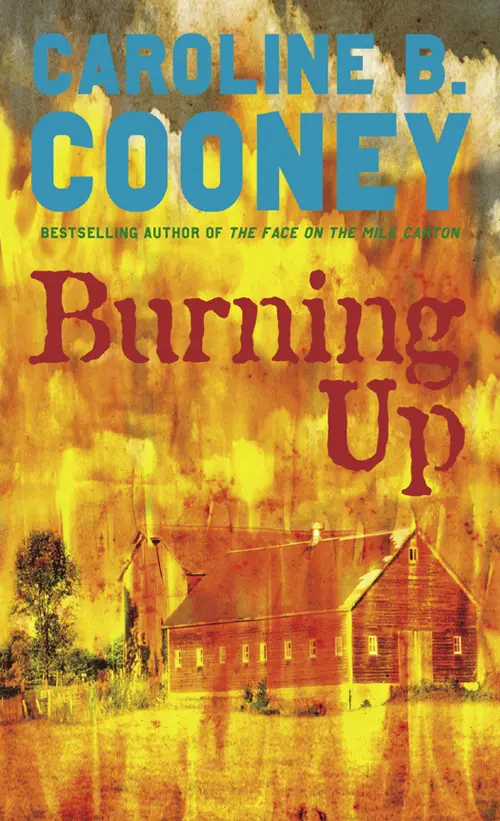
Burning Up
Cover
Praise for Burning Up
An ALA Quick Pick for Young Adults
“Cooney has produced another tantalizing dark secret for her protagonist and readers to unravel together.”
—Publishers Weekly
“Macey’s pursuit of the truth is compellingly chronicled.”
—The Bulletin of the Center for Children’s Books
“This thought-provoking story has a powerful message, effortlessly woven into the ordinary trappings of a teenager’s life.”
—Kirkus Reviews
Burning Up
Other Books by This Author
Novels by Caroline B. Cooney
The Lost Songs
Three Black Swans
They Never Came Back
If the Witness Lied
Diamonds in the Shadow
A Friend at Midnight
Hit the Road
Code Orange
The Girl Who Invented Romance
Family Reunion
Goddess of Yesterday
The Ransom of Mercy Carter
Tune In Anytime
Burning Up
What Child Is This?
Driver’s Ed
Twenty Pageants Later
Among Friends
The Time Travelers, Volumes I and II
The Janie Books
The Face on the Milk Carton
Whatever Happened to Janie?
The Voice on the Radio
What Janie Found
What Janie Saw (an ebook original short story)
Janie Face to Face
The Time Travel Quartet
Both Sides of Time
Out of Time
Prisoner of Time
For All Time
Title Page

Copyright
This is a work of fiction. Names, characters, places, and incidents either are the product of the author’s imagination or are used fictitiously. Any resemblance to actual persons, living or dead, events, or locales is entirely coincidental.
Text copyright © 1999 by Caroline B. Cooney
Cover art copyright © 2006 by Diane Fenster
All rights reserved. Published in the United States by Delacorte Press, an imprint of Random House Children’s Books, a division of Random House, Inc., New York. Originally published in hardcover by Delacorte Press in 1999.
Delacorte Press is a registered trademark and the colophon is a trademark of Random House, Inc.
Visit us on the Web! randomhouse.com/teens
Educators and librarians, for a variety of teaching tools, visit us at RHTeachersLibrarians.com
The Library of Congress has cataloged the hardcover edition of this work as follows:
Cooney, Caroline B.
Burning up : a novel / by Caroline B. Cooney.
p. cm.
Summary: When a girl she had met at an inner city church is murdered, fifteen-year-old Macey channels her grief into a school project that leads her to uncover prejudice she had not imagined in her grandparents and their wealthy Connecticut community.
eISBN: 978-0-307-81891-1
[1. Racism—Fiction.] I. Title
PZ7.C7834 Bu 1999
[Fic]—dc22
98019343
Random House Children’s Books supports the First Amendment and celebrates the right to read.
v3.1
1
Macey dashed out of the high school, filled with the energy of Friday afternoon. She always had to run toward the weekend. The first thing she did on Friday was put distance between herself and the school. Macey was good at school, had friends, liked her teachers—and yet the end of every school week was such a relief.
Around her, sports teams were piling into vans and buses: tennis, baseball, golf and swim teams. Kids with cars shot out of the student parking lot, windows down, so everybody could shout to everybody else.
“Hey, Mace!” came two voices. “Want a ride?” Macey’s best friends, Lindsay and Grace, leaned out the window of a Volvo. Grace’s mother had come to pick them up.
“I’m walking, thanks!” yelled Macey.
“Oh, right, it’s Friday,” said Lindsay, rolling her eyes. “She’s got her shortcuts to take.”
“Oh, brother,” said Grace, laughing out the car window. “Being a juvenile again?”
Grace’s mother blew a kiss to Macey, and they drove on. Macey waved no to the driver of her own school bus. It was a three-mile hike to her grandparents’, but Macey took shortcuts. Her route was closer to a mile and a half, and if she ran, she could make it in twenty minutes. What the run really did was cut her off from school, making the weekend clean and separate and safe. Macey cut through the golf course, cut through the woods and behind the old supermarket, through backyards and finally through the swamp.
The swamp wasn’t a hundred feet across, and it wasn’t a block long, but it had the strength of a canyon. Nobody but Macey ever crossed it.
A few years ago, she’d dragged boards into the swamp to give herself a path over the wettest parts. She hopped on the edge of the first board to be sure it wouldn’t split when she put her weight on it.
From a hundred yards away drifted the rich scent of ocean: mudflats and fish and salt water. It was a warm-weather smell. Last week had been March, when school was a thing that would last forever—but today it was the first week in April, and Macey could shade her eyes and catch a glimpse of summer.
Beyond the swamp was the old stone foundation of a barn. Come summer, wild roses and tiger lilies would make it a sunken garden. Macey was not basically a sitting-down person, but she loved to sit here. It was peaceful. Even in early April, the sun warmed the stones.
Back when there were horses, all these old shorefront houses had had stables. This one, turned into a garage and apartment, had burned when Macey’s mother was a girl. Supposedly a man had been in it at the time. When Macey was very little, she’d been afraid of the foundation, because what if the body was still there, waiting for her to find the bones?
But now, at fifteen and a half, she found the idea of discovering bones appealing, like archaeology or journalism.
Ten seconds was plenty of time to sit and consider the olden days. Macey jumped up and cut across the backyards of Shell Beach to her grandparents’ house.
Her parents were staying in New York City for dinner. This was good. Mom and Dad were so exhausted at the end of a week that they were useless; on Fridays they just plopped down and faded away, while the television droned and the pizza got cold.
Macey came in Nana and Papa’s back door. Her grandparents’ back porch was a large glassed-in room, sagging with piles of stuff. There were broken china cups filled with beach glass. There were collections of knotty driftwood and yellow seashells. There were old bathing suits, hung up to dry when Macey was six, or twelve, and never worn again, because Mom bought new ones that weekend. There were magazines that somebody meant to clip something from and lawn chairs somebody meant to repair. There were old golf clubs and new fishing rods and an outboard motor.
Hot cinnamon smells drifted out from the kitchen. Nana and Papa were baking. Food was the centerpiece of their lives. They watched all the TV cooking shows and quoted the great chefs as if they were family friends. They greeted Macey with hugs and kisses and went straight to the crucial topic: what to have for dinner.
“Three-cheese pasta?” suggested Papa. Papa had very high blood pressure and cholesterol, but he didn’t care; he ate whatever he felt like. He usually felt like eating a lot.
“No, dear, I found luscious asparagus in the market this morning,” said Nana. “We’ll have asparagus omelets.” Nana ate more than Papa, and together they made a very roly-poly couple. They were even fatter in their red-and-white-striped French chef aprons.
“Asparagus. Yuck,” said Macey. “It’s tall, thin slime.”
Two sets of blue eyes turned on her. Two identical frowns beneath snowy white hair. “You walk the dogs,” ordered Nana. “And we’ll decide the menu,” said Papa.
Zipper was an old collie, tired and lame, and the leash was not needed, because he would never stray from her side. Zipper liked to walk down to the sandy edge and sniff the salt water, maybe think about fish for a minute or two, and then totter home.
Moose was a chocolate Lab so large they had respelled his name from (chocolate) Mousse. Macey and Moose would fly down Shell Road, Macey more on the leash than Moose. If Macey didn’t take care of Moose’s exercise, nobody would, because her grandparents had pretty much surrendered on the exercise front.
Macey took each dog separately, five minutes for Zipper and half an hour for Moose. Back in the kitchen, her grandparents were between cooking shows, and so they turned to their second favorite subject: what Macey was up to.
“We have to do a local history paper,” said Macey. “When Mrs. Johnson assigned it this morning, it felt like a ten-ton truck driving over my shoulders. But I ran all the way here, and now I think it might be okay.”
“Tomorrow morning we’ll go to the library and dig for a topic,” said Papa, waving a sifter. Flour dusted his face.
“Papa, I’m not that excited about it. Anyway,” she said gloomily, “tomorrow I have Saturday Group.”
There was an expedition arranged, and they were to meet at 8:30 A.M. Macey did not feel like showing up. Saturday Group was hard. Volunteer work was supposed to make you feel wonderful, but Macey just came home feeling guilty. She was not in a Saturday Group mood. She was in a sleep late, watch cartoons, eat stacks of waffles and do nothing mood.
Nana rolled a lemon around the counter, softening it up before slicing it. “Did you remember that the first beach bonfire is tonight?”
“No, I didn’t! Ooooh, that’s wonderful! It’s good I’m spending the night.” Macey loved the first bonfire. It meant spring had come, and the window was open to summer: long, slow, hot summer. Sailing and crabbing, picnics and relatives.
Shell Beach was a crescent of sand and granite outcroppings, with twisty pines and tawny marsh grass. Only people who lived on Shell Road could use the beach, but they hardly ever did. People paid a million dollars for beach rights, but they didn’t go to the beach. They just liked knowing it was there.
The little beach attracted debris. Tree trunks and broken moorings, Clorox bottles and smashed Styrofoam picnic baskets washed up. Every spring, the residents of Shell Beach would carry away the garbage and prepare the wood for a beach bonfire. Branches and broken oars and planks from hurricane-wrecked docks were piled tepee fashion, eight or ten feet tall. The tepee was built way down on the sand, where it wouldn’t matter how high the flames were or whether sparks flew; nothing was around to catch fire.
“Did you buy lots of marshmallows?” asked Macey.
“Of course I bought lots of marshmallows,” said Nana. “That’s been my job for fifty years and I haven’t forgotten yet.”
Macey set the table. Dinner here was leisurely, at a beautiful table with fresh flowers. Nana and Papa were never in a rush. Perhaps they had rushed earlier in life, but they were over it now. They used cloth napkins, which they ironed, and silver, which they polished.
This was totally the opposite of home, where her parents ate off paper plates. This was supposed to be a secret from Nana and Papa, who felt they had failed as parents. Their daughter—their own child, Cordelia, this defective stranger—used paper plates at dinner. As for cooking, Macey’s parents hardly ever did such a thing. They lived on take-out.
Macey had her own bedroom at her grandparents’ house and kept plenty of clothes there. She knew kids who had two homes and hated it, because it was from divorce, but she had two homes and it was perfect.
Her parents loved their jobs, and wanted to be the best and the first. They lived here because it was an easy commute into New York City by train, and Macey could grow up in a house with a yard and a dog, and her grandparents would be right down the road to pitch in. Her mother was in marine insurance, oil tankers and stuff, and her father in banking, mostly foreign loans.
They were wildly proud of Macey, but they were wildly proud of themselves, too, so it was relaxing to be around Nana and Papa, who just muttered and rolled out pastry. She was the only grandchild, and they adored her. In their eyes, she was the most intelligent, interesting, beautiful and talented girl in America. When Macey reached high school, and there was a lot of competition for those slots, she found out Nana and Papa were wrong: She was not the most intelligent, interesting, beautiful and talented girl in her class, let alone America. But still, it was nice to hear.
“For my local history paper, I was thinking of doing the construction collapse,” said Macey. “Remember how eight floors fell in? Think of the photographs and sound effects!” She bet the newspaper had done a special issue, which would certainly make the research quicker.
“That was seven years ago,” said Nana. “The history of this town begins in 1652.”
“And we’re all very proud of the settlers of 1652,” agreed Macey, “but things happened in the nineteen nineties, too.”
“They aren’t history!”
“They will be eventually,” said Macey. “You just have to wait awhile.”
Nana slid the perfect nine-egg omelet neatly onto a serving platter and divided it in three. Macey decided she could eat around the asparagus. They sat down at the table and asked the Lord’s blessing.
Macey broke off a piece of brioche, a soft, buttery bread that was Papa’s this-month favorite to bake.
“How do you do a term paper with sound effects?” said her grandfather.
“If you get an A, you can put your paper on the school Web page,” said Macey.
This was the first time Macey had ever seen boys thrilled by a history assignment. Normally, a boy sadly wrote his name all crammed up into the corner of a blank piece of paper and then watched his signature, hoping the letters would spread and fill the rest of the page. This condition could last for days, until the boy finally admitted that letter spread was not a known scientific possibility. Gloomily, and acting betrayed, the boy would finally start to write.
But this was different. Their papers would go online.
“In school you have a Web page?” said Nana. She flounced in her chair, a technique Macey wanted to learn: how to look huffy while sitting down.
“It’s not evil,” said Macey, laughing. “We’re not making rugs out of endangered animals or exchanging recipes for dolphin sandwiches.”
“You like computers,” accused Nana.
“I love computers. I love the Internet. Except now that I consider it, I’ll skip sound effects. They take too long and people would give up.”
“Your parents allow you to use the Internet?” said Papa, scandalized.
“Now, Papa. Who else’s parents would be involved?” Macey didn’t usually give her grandparents an opening to discuss Mom and Dad’s lifestyle. Mom and Dad avoided confrontation by not visiting a whole lot. They were only two miles away, and they saw Nana and Papa barely once a month.
“Or maybe the fire,” said Macey. “That would be a good story.”
“What fire, dear?” said Nana.
“The one that burned the Demitroffs’ barn down. I was just resting on the foundation this afternoon. That old arson. With the man trapped inside. I could read old newspapers and go to the fire department and get old records.”
There was an odd pause. It was long enough for Macey to look up from her excavation of asparagus out of her omelet and see that her grandmother and grandfather were looking at each other and not at her.
“Macey, that isn’t history,” said her grandfather. “That isn’t anything. It’s just an old building that isn’t there anymore.”
“And nobody was trapped inside,” said Nana. “Is Austin going tomorrow with the Saturday Group? I am so interested that he is still living here. He’s such a cutie. Do you know any details yet?”
Austin’s grandparents, the Fents, lived across Shell Road from Macey’s grandparents. Macey and Austin hardly knew each other, although he had visited Shell Beach for a month every summer. Austin was Macey’s age but always acted either ten years older or ten years younger, so no matter how cute he was, Macey had not bothered to get to know him better. She didn’t know what he was doing here for the school year. Couldn’t be anything good. You didn’t skip your sophomore year at your own high school in Chicago with your lifelong friends and then go live with your grandparents in another state just for the fun of it.
Nana was as fond of gossip as she was of food. “Even when I ask the gentlest, most neighborly questions,” she said, hurt to be left out of such an important loop, “his grandparents change the subject. I assume his mother is behaving badly and they are ashamed of her. I cannot believe you have gone to school with this boy for so many months and not found out why he’s living here.”
Austin was not in any classes with Macey, although he had several of the same teachers. He’d been here since November, and now it was April, and she had no clue. “He’s probably going with Saturday Group,” she said. “He went last month when they did the soup kitchen.”
Macey had not done the soup kitchen. She hated things where people were sad and grimy and lost.
But tomorrow’s field trip was painting the Sunday school rooms at their sister church, Good Shepherd, an inner-city church to which they gave a little money and their old furniture. Macey detested art class, but she loved painting big things, like walls. An art teacher had sketched a master plan for the project. The rooms would be daffodil yellow and sunset orange, barn red and ocean blue. Crayon colors, to brighten the dark.
“Then that’s your assignment,” said Nana, meaning Austin. “Research the situation. Report back.”
In their attempt to divorce, Austin’s mother and father had become bickering, screaming children. It was unbearable. His perfectly nice, intelligent, good parents yelling foul names, setting traps for each other, ambushing each other with legal problems. With all that fighting, they had no time to raise a son. When Grandmother and Grandfather suggested that Austin stay with them until things cooled down, he was glad to put distance between himself and his shrieking parents.
The shock was, his mother and father were also glad. Glad to wave good-bye so they could concentrate on their war.
The second shock was how fast the first shock wore off.
He arrived too late in the school year to be in any fall sport or get a part in the drama production. Austin had never been able to sit still, so he needed a job, any job, and he agreed to get advertising for the play program. Kids crept up to him in school and whispered that they were responsible for selling two ads, but they couldn’t do it, they couldn’t go up to strangers and beg; would Austin do it for them?
He set a school record, more sales than anybody had accomplished in the 110-year history of the high school. His math teacher adjusted it for inflation and Austin was still the highest.
So he was successful, a hero, and had more poise than anybody in the entire high school. Not bad.
The best thing, though, was Grandfather.
Grandfather had owned a small bank, which was kind of a neat thought, your own personal bank, but it had been bought out and merged into an enormous Boston bank. Grandfather was still involved, and at seventy-nine had not retired.
Austin felt as if Grandfather had been waiting for years, needing a grandson to do things with. They went to air shows together, they went to ice hockey games, they were restoring an old wooden boat. When Austin mentioned his lifelong dream of hiking the Appalachian Trail, Grandfather said he’d always wanted to do that, and so they were planning to do some of the New England section this summer, a day or two at a time.
Grandfather wanted to rebuild the old stone wall that divided his property from the Demitroffs’. Shifting a couple hundred feet of fieldstone was no minor event. So they’d joined a gym and were working out.
Austin’s mind was a snow flurry of plans. He had a hard time falling asleep at night because his thoughts about the next day wouldn’t lie down and relax. When his parents called (which wasn’t often), he was startled. Oh, yeah, he would think. Parents.
And now, with spring here, plans had to be made for the summer.
He could not imagine telling his father—Dad, I’m busy. Can’t fit you in.
Or his mother—Mom, I like your parents. I’m staying here.
This was a problem he needed to move to the front of his planning, but he kept forgetting. After school, which would have been good thinking time, he rarely took the bus, but ran. It was three miles from the high school to his grandparents’. He loved to time himself.
The Fents finished dinner. Their meals were solid and predictable. The rib roast; the leftovers from the rib roast. The roast chicken; the leftovers from the chicken. That was four nights right there, and they’d go out the other three. Austin’s grandmother instructed him about the coat he must wear to keep off the evening chill, and said to her husband, “We’ve been having these bonfires how many years now, dear?”
“Half a century, I suppose,” said Grandfather.
Half a century! It seemed an impossible length of time, a stretch from here to a comet’s tail. Austin was fascinated by the comet of 1997. It shivered him that a comet nobody expected and nobody had predicted, captured by the minds and eyes of a man named Hale and a man named Bopp, had suddenly stained the night sky. On clear nights, he liked to walk out on the farthest tip of beach and examine the sky.
“Exactly what are the plans for Saturday Group?” asked his grandmother.
“We’re painting Sunday school rooms at Good Shepherd,” he told his grandparents. “We get eight hours’ credit. Two adults, ten kids.” One would be Macey Clare. Austin could not understand how he was living across the street from Macey’s second home and he never saw her and could not seem to get to know her. The church van held fifteen, and his theory was that he would manage to sit with her. (It wouldn’t happen. Macey would be escorted by her girlfriends Lindsay and Grace.)
The Story Continues on BooksBarbecue!
Enjoyed this preview? ❤️ Do not stop here!
Read the complete book free online → 🔗
Continue reading now on BooksBarbecue and discover every page!
Love reading? Bookmark BooksBarbecue.com for more amazing books!
Happy Reading!