Book of the Edge
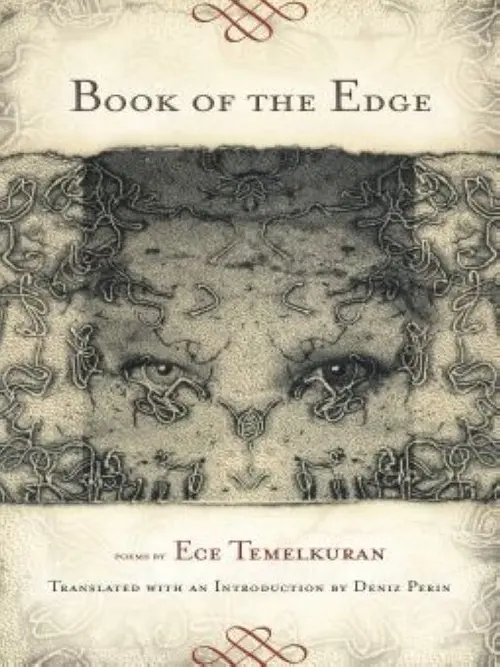
Title Page

Introduction
Introduction
Ever since the Republic of Turkey was founded in 1923, the country has often been in a state of political turmoil. In the latter half of the 20th century, three coups d’état overturned the governments of the time: in 1960, 1971, and 1980. Each of these coups was followed by a period of military rule, direct or indirect, and was accompanied by an atmosphere of suppression.
Today, in the 21st century, though the political situation has relatively stabilized, the military continues to play an important role in government, and many Turkish citizens feel that the country is never far from the potential for another coup. The reality is that political prisoners, ethnic tensions, and human rights abuses are as much a part of Turkey’s history and contemporary life as are its mosques, palaces, and hand-woven carpets.
Ece Temelkuran was born in 1973 ; she was seven years old when the 1980 coup d’état, arguably the most brutal and repressive of the three, took place. She grew up in a highly politicized environment: both of her parents were left-wing, social activists. In fact, they had met in jail: when her mother was arrested for leftist activities, her father was the lawyer who helped release her. Growing up in this socially and politically conscious atmosphere, paired with her natural love of writing, led Temelkuran to pursue a career in journalism.
As a journalist, Temelkuran has tackled many highly sensitive issues. In articles, columns, and investigative journalism books, she has addressed such subjects as women’s rights, political prisoners, Armenian-Turkish relations, and the “Kurdish problem,” as it is frequently referred to in Turkey. Her most recent book, Ağrinn Derinliği (The Deep Mountain), investigates Turkish-Armenian history and the lives of contemporary Armenians. For this book, she interviewed Armenians both in Armenia and Turkey, as well as the Armenian diaspora in France and the United States. During this time, her friend Hrant Dink, a prominent Armenian journalist and human rights activist living in Istanbul, was assassinated by a radically nationalist Turkish youth. Due to its controversial nature, Temelkuran’s book, too, could easily have incited the anger, even the rage, of radical nationalists. Despite the risks, she published the book in 2008.
Temelkuran does not write only about Turkish-related issues. Her work has taken her to several countries in South Asia, the Middle East, Europe, and Latin America. The traveling she did—she lived in many of those places—provided her with a global perspective. We’re Having a Revolution Here, Senorita!, published in 2006, examines Venezuela’s anti-capitalist revolution and argues, based on her discoveries there, that a new world view is possible. Observing power and human rights struggles in her country and across the globe had a deep effect on both her psyche and her writing. In its own, subtle way, her poetry reflects this influence.
The poems in Book of the Edge are not overtly political. Some are not political at all. Those that make political statements do so in an understated, allegorical way. Temelkuran’s goal in these poems is to explore the human condition, exposing our weaknesses and our potential. But her insight into, and interpretation of, this human condition are undoubtedly inspired, at least in part, by her socially-involved upbringing and her many years of work as a journalist.
The book is, to use Baudelaire’s words, an invitation to a voyage. The speaker asks the reader to become an explorer, to leave the city and embark upon a journey of self-discovery. Although each poem stands alone, the poems work together to describe this quest; they turn into a modern, poetic fable, in which speaker, explorer, and reader merge into one. “You may not know it yet,” says the speaker in the prologue, a wink at what is to come. “You are just like me.”
The book contains six sections: we begin in the doorway, where the explorer must prepare to leave her hum-drum, comfortable life and embark.1 The first place she arrives is a meadow, where various animals display their virtues, and in so doing, teach her different aspects of what it is to be truly human. The bull, for instance, refuses to use his physical power over his attackers, for he knows that “To the truly powerful, / power is more hateful than weakness.” The squirrel is elated, simply at the mystery and joy of being alive.
The journey proceeds in the air and water. The explorer has begun to lose her mistaken sense of identity, to discover her true self. When she falls from the sky into a river, she encounters a fish, which shows her the meaning of understanding, for the fish “lives in understanding’s widest, most intrinsic vein.” As all rivers do, this river flows into the sea. Here, the explorer begins to grow, to incorporate into her being the entities she has encountered along the way. The speaker notices, “I swelled, swelled, swelled in the seawater / Engraving the names of a thousand and one blurred creatures in my mind.” Soon after that, she arrives at the city gates.
“The City” is the fifth, and perhaps most disturbing, section of the book. With a newfound understanding of the natural world—and thus, of the truly human world—the explorer sees city life for what it really is: cruel, merciless, and predatory. City dwellers are voracious jaguars; the newcomer to the city is, in their eyes, nothing but savory flesh to be consumed. The explorer is urged to leave the city as quickly as possible. It is, perhaps, in this section that Temelkuran’s work in journalism, particularly in the fields of politics and human rights, comes through most clearly: the crowds in the city, all-powerful, “have no mercy,” they don’t think twice about preying on the weak.
By the final section, “Home,” the journey has come full circle. The explorer must now settle down and take in the knowledge she has gained upon the path. It is time to “stop at this edge” for a time, and linger there until the next voyage beckons—which could happen at any time, because “the explorer becomes the path, in the end.”
The politics of the work lies in the very lessons the explorer learns from the creatures she meets. In a sense, the bull can be likened to a kind ruler, toppled by cruel minions: he is tortured and killed by villains who carry “ knives that veil cowardice with ornaments.” The butterfly represents the revolutionary, who has come to earth before his time, and gets mercilessly attacked by “grizzly insect guards.” Like the bull, the butterfly’s dark fate has been sealed: “having failed to change the laws of the earth,” his carcass becomes “a more valuable fertilizer than the earth deserves.”
Many such instances of power struggles—bet ween wisdom and ignorance, kindness and cruelty, joy and pain—appear throughout the collection. But, more than politics, the role of spirituality is central to these poems. With Book of the Edge, Temelkuran clearly defines herself as a descendant of the Sufi tradition. The Sufis believe in the importance of discovering one’s true self, only to then let go of that self and become united with God. According to Sufis, there is no such thing as a separate identity: the concept of “I” and “you” is mere illusion. The structure of Temelkuran’s poems reflects this philosophy: from poem to poem, the voice alternates between first and second person. It is not always clear if the explorer is the speaker or the reader, but this fluid identity is exactly what Temelkuran is after.
The content of the poems, too, speaks to the Sufi tradition, which remains influential in Turkey. From the start, the explorer is urged to let go of her ego. In preparation for the journey, she is told to “empty your saddlebag—your Me—/ as much as possible.” As the poems progress, it becomes clear that the goal of the journey is to complete this banishing of the “Me.” Lines occasionally appear that allow the reader to track the explorer’s progress on this path, lines like, “You now consist only of yourself,” “It was tender, honestly: my mind was turning into water,” and “you aren’t water yet.” But in the end, though we may believe in a separate self, the “Me” is mere appearance. The book ends with the assertion that “though we may be / Water, earth, air, and we may each be a universe, / We appear as somebody among the crowds.”
Finally, in Book of the Edge, the Sufi path laid out for us converges with the pathways of another tradition. In many ways, Temelkuran’s work returns to a time that predates the Sufis, predates Christianity and even monotheism: hers is a shamanistic journey. As in shamanism, the animals in these poems guide the explorer from place to place, communicating with her directly, even touching her, and they teach her all she needs to learn. A swordfish cuts her with its sword, inserts silver into her spine, then explains, “You are now poor like silver, wise as silver.” A male albatross carries her to his partner’s nest; while he searches for food, the female albatross uses her “expressive eye” to “tell me a secret about love.” After all, what better way to lose oneself than through the shamanic journey, in which the body is often left behind, or at the very least is likely to shift dimensions? Near the end of the book, the speaker playfully voices, “When the ripples from your hand dwindle and disappear / What will remain of you—perhaps—is a plump bug.”
In Book of the Edge, the three traditions of political poetry, Sufism, and shamanism coalesce to create a collection rife with life and death, body and spirit, serenity and chaos. Ece Temelkuran, who does not place herself in one particular school or movement of Turkish poetry, nevertheless proves, in these poems, to be a part of a larger movement—the great tradition of the poets of the world.
I met Ece Temelkuran in December 2004. I had been reading Book of the Edge with translation in mind, but had not yet begun translating. Over tea and snacks in a small café in the heart of Istanbul, I bombarded her with questions—a phenomenon that would last, via email and telephone, throughout the entire translation process. Luckily for me, Temelkuran never ceased to be helpful, in every aspect of the translation.
An important facet of Ece Temelkuran’s work is the innovative language. The juxtaposition between verse and prose, the playing with syntax and words, all make for a fresh use of language in the original text. Whenever possible, I have tried to capture a parallel wordplay in English.
One issue that came up repeatedly was how to translate the third-person pronoun. In Turkish, a single pronoun is used for men, women, and object in the third person. The author was very helpful in helping me determine what gender to give the animals in the poems. The question of how to gender people—especially the explorer—was more problematic. For Temelkuran, it was important to leave the explorer as genderless and universal as possible. Luckily, the explorer is referred to only once in third person in the collection. In this case, as in this Introduction, I opted to use the female pronoun, but I hope the reader will picture a “universal she,” rather than a woman necessarily.
I have tried, as best I could, to safeguard the essence of Temelkuran’s work so that the English-speaking reader may experience the sincerity and inventiveness of this new voice. I hope you enjoy it.
—Deniz Perin
Offering
Offering
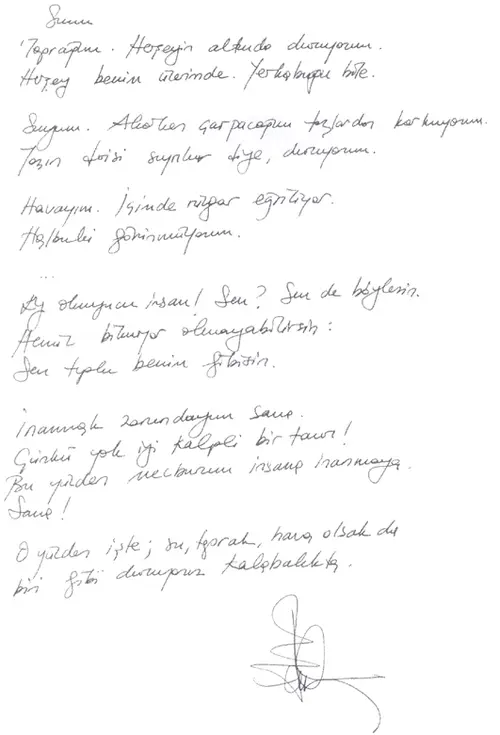
I am earth. I lie beneath everything.
Everything is above me. Even the earth’s crust.
I am water. I am afraid of the stones I will strike as I flow.
I stop, for fear that the stone’s skin be scraped.
I am air. Wind curves inside me. Whereas I am invisible.

O reader! You? You are like this, too.
You may not know it yet:
You are just like me.
I must believe you. For there are no kindhearted gods!
This is why I am obliged to believe you.
You!
And that is why, though we may be water, earth, and air,
we appear as somebody among the crowds.

I. DOOR
Necessary Things for Any Journey
What You Must Know
Whereas I’ve said it: I’m not permanent amid the noise.
I need to find new couch grass inside myself.
Otherwise I might believe I’m really part of the crowd.
My right hand is cold as a bird that couldn’t keep up with the migration.
Whereas I was to cross oceans
to build vast sentences.
I’ve wasted too much time in the playpens of narrow rooms.
The crowd suppressed the warm, familiar voices inside me.
That’s the price one pays for building know-it-all sentences
on paper, like a single day’s monarch.
Whereas I’ve never enjoyed being “someone.”
How could I? They never had anything to do with me,
all these things
the crowds call “good.”
I can be no “one” ! All I can be is: No one.
I never say it. Because they’ll “announce it.”
They’ll make noise. Those who are truly
“nobody”
know.
I’m compelled
to climb again today, to alpine plateaus.
I shall embark upon a long voyage
to heal the organ I’ve rotted in paltry rooms.
If I still have a voice when I arrive
I shall wish for acceptance
from my beloved mother tongue, my inner tongue, my self.
If I can’t reenter,
I’ll end up like all who remain outside—I’ll be done for.
This is the story of a compulsory journey.
If there’s anything worth telling on the way—who knows, things may speak for themselves.

What You Must Leave Behind
If the journey to be embarked upon is one that seeks its own path,
you are not to load your saddlebag. Empty your saddlebag—your Me—
as much as possible.
You own so many things now! Perhaps that’s why
you can’t go. You’re brimming, your hands are cluttered. Let go:
the sounds will release you as soon as you stop grasping them.
Shred all those long sentences you’ve formed, and stuff them
into mattresses for others to thrash upon.
Those who remain
need the safe embrace of mattresses filled with straw sentences.
Those who have come to this world as overnight guests
need the security of hackneyed sentences.
You did not come as an overnight guest. If you had,
you would be satisfied
with a tiny empire of playpens and narrow rooms.
You would be at ease.
But you are not at ease.
Leave this knowledge behind, for shameless pillagers to use.
Look how merry, how pleased they become!
When they speak, they think important things are happening
on the face of the earth.
With organized, disciplined guile
they gather information in dark corners, to use when it gets light. Leave
your knowledge in this house, for them, as they find it, to rejoice.
As, strip by strip, the flesh rips off those trite emotions
they love so much for you to speak of. Make the emotions obsolete. For,
they have a price: someone could find and sell them, avidly.
Pillagers don’t recoil at the thought of packing shriveled emotions.
Give back those fleeting faces of encounters to their owners.
Give them back their eyes.
Those eyes, when yours, saw so many different people!
Try not to laugh at them when you return their imagined faces.
Don’t laugh! Or they’ll take you seriously.
They understand nothing correctly,
but they’ll quickly realize they’re being made fun of.
You’ll recoil, when the time comes to comprehend
how cunning they can be.
Leave behind these guffaws, these drinks and excursions. Let
the crowd’s children absorb the sweet
and slippery circumstances of night. This
is the painful picture of wretched souls’ attempts at diversion.
And don’t take these daytimes with you,
the stumbles of uncertain greetings,
the cowardice of planned encounters,
daylight’s tiring courtesies…
Those who can’t manage,
who don’t gaze at their own faces, are pummeled.
Hope creates the feeling that bad things will happen. Don’t take it with
you!
It invites bad luck. Hope is essential to lingerers.
Because they think something will happen—suddenly happen,
every one of them secretly believes.
The cowards say something terrible shall take place in the world.
Those who boast of their crippling courage
retort that everything will be splendid.
Whereas nothing suddenly happens.
Humanity’s time consists only of humanity’s time!
To understand is a past tense verb. You are in the present simple tense,
a spacious tense. You are moving toward a time of shared knowledge
between what has passed and what is to come.
Chafe yourself until all that is left is a knowing in the present.
Compose yourself of knowing—if you truly intend
to journey.
If you remain silent a while, you will see.
A journey is desolation.
You may not take anyone along.
If only love were small enough to fit into the palm of the hand…
If only you could keep it, take it with you.
Nothing that sidetracks the heart may join.
Leave it behind, in its own home.
No one can accompany another for such a long road.
Don’t say you didn’t know!
The most one can do is to pass another’s magma. When it comes to seeds…
When the path reaches the seed of humanity,
every great love turns into a muddy brew.
All that’s defined shall remain in this world of definitions.
Men need this, so that one will not interfere
with another. Their work becomes easier, and so they pass
the time. Leave your defined self behind.
Your defined self is your greatest burden. Or,
whatever you think of as yourself…
Now, you are a creature of the journey. You are about to become a path.
You must truly lighten for this voyage.
In order to become a path, you must diminish until you become no one.
You must understand: you will grow as you diminish.

What You Must Take Along
Now let me specify the items you may take with you.
You will need these.
Nothing will protect you on your voyage
except for the things you carry.
You might not know yet all you must bring;
they’re sleeping inside of you. To take them,
you shall waken them one by one. Prepare yourself.
Don’t be afraid! They won’t weigh you down on your journey. But don’t forget:
That which does not weigh you down is not, in fact, light.
You must take your crazy eye along, your lidless eye
that never dries, the eye that only sees one foot ahead.
There are no footsteps to follow. Your hand shouldn’t touch
the weathered maps of your heart. The sketches drawn by your mind
can’t help you, either. This is a journey which seeks its own path,
whose route only nameless birds may tell you,
only migrants of long ago know.
Take your animal nose.
It will prevent you from taking the wrong road. You are an animal,
shapeless. A genderless, airborne animal. One that recognizes
trodden roads by their odor.
You are an animal that protects itself by keeping
a safe distance. Angelic enough not to use your wild teeth,
cowardly enough not to exchange wounds.
So you’ve decided to stand close enough
to see everything, but
far enough to run away if needed.
The farther you stand, the more you sing.
The more you sing,
the wider your view.
Remove your birdlike hands from their gauze.
You might wish to say something,
make a heart-shaped sign.
You have no tongue if you have no hands.
You always speak with fluttering hands;
that is why you remain clumsy here.
But on journeys
tulle women, glass trees, silver children, or sky-men
cross your path. Because you are a child,
you touch things
as you speak to them.
Fasten your snake ears to both sides of your head.
Your ears measure heat, detect movement. You may hear
a secret in your ear. Warm sounds may enter your ear
and melt the snow; may you drink its waters.
You cannot know the value of this until you thirst.
Put your shapeliest cheeks on your face.
You can’t think without cheeks.
Your face needs a place
for your hands to rest upon, if you are to daydream. You’re to reflect
upon all that you see as long and as deep as it commands.
You cannot do this without cheeks.
Place your stomach in the center of your body.
Your stomach is the strongest part of you. So primitive and beautiful it is
because it has reached you unaltered from your ancestors.
Your stomach is deep and powerful as the skies that rain upon us.
It is your beastliest, most human part. It prevents you from being
more human than necessary.
Take your youngest feet.
You need feet that pay no attention to themselves.
Your feet mustn’t think about themselves at all, but be flexible and strong.
Your toes reveal the beauty of movement.
They mustn’t look at the roads they’ve trodden and show off, but always
mourn
those they don’t reach. Your feet should be young
but wise. Still, your toes must remain unaware of these states—
mustn’t form sentences.
Take your weariest, your noblest mouth.
Your lips must move only what utterly needs to be said. This
mouth of yours shouldn’t slaver after the slightest extra sound.
Choose the loneliest, hoarsest sounds and put them in your mouth.
You are not to attract anyone’s attention. You may only
take your mouth that cannot boast.
Know your place vis-à-vis the path and the truth.
You are not among the talkative.
If you’ve finished packing, it’s time to go now.
Go on! Now, take your first step towards yourself.

II. MEADOW
The Explorer Encounters the Virtues in the Shapes of Animals
Butterfly
I saw something upon my first step.
He moved.
A purple insect. In a great hurry. He scurried
obsessively to his target, didn’t dawdle with the grass or earth.
Judging from his gait, he was an important personality in the insect
kingdom.
One must take all the signs seriously.
A person on a journey which seeks its own path
must know the value of everything they see.
And for the map-less, ill-timed explorer,
what could be truer than to follow
an insect with purple armor?
He was certainly an important man of the underground.
Judging from his sparkling purple armor, all the bugs
bowed down to him in greeting, inside the earth’s
dark corridors. He surely knew the odor of crowded ant colonies
rerouting merely to receive his salutation—
when one observes the revolted trembling of his leg hairs
at the slightest contact.
His gigantic purple armor was suspiciously spotless.
So, he must have left several carcasses behind.
The Story Continues on BooksBarbecue!
Enjoyed this preview? ❤️ Do not stop here!
Read the complete book free online → 🔗
Continue reading now on BooksBarbecue and discover every page!
Love reading? Bookmark BooksBarbecue.com for more amazing books!
Happy Reading!