Bombay Monsoon
Cover

ALSO BY JAMES W. ZISKIN
The Ellie Stone Novels
Styx & Stone
No Stone Unturned
Stone Cold Dead
Heart of Stone
Cast the First Stone
A Stone’s Throw
Turn to Stone
Dedication
To Bill, whom I miss every day.
So proud of you, brother.
ACKNOWLEDGMENTS
This book would not have been possible without the advice and encouragement of a lot of dear people. I must thank friends and family for their generous assistance. From vetting the language—Hindi and Marathi—to confirming everyday details about Bombay in the 1970s, to reading and critiquing my story and characters, these wonderful folks have earned my heartfelt gratitude.
For helping me navigate the India of 1975—and today—thank you to Dr. Kunda, Vidhya Kannan, Vinu Syriac, Raik Sabeel, Anand Sethi, and Deepa Raghavan Sethi.
To my writer friends who offered their advice and expertise, I’m grateful to Robert Rotstein, Keenan Powell, Keith Raffel, Diana Chambers, Claire Thompson, and Kim Hays.
To Lani Stone and Fred Glienna, I appreciate your friendship and willingness to read an unfinished product.
To Bill Reiss, Ann Hawkins, Moses Cardona, and Warren Frazier of John Hawkins and Associates, thank you for your honest critiques and all you’ve done for me.
Thank you to the team at Oceanview Publishing: Bob and Pat Gussin, Lee Randall, Faith Matson, and Christian Storm.
Warmest appreciation to my brilliant, tireless agent and champion, Kimberley Cameron.
To my siblings, Bill Ziskin, Jennifer Ziskin, Lynnette Ziskin, Mary Ziskin, Susie Mudge, and Joe Ziskin, thank you for your support and opinions.
And, of course, my greatest gratitude—as always—is reserved for Lakshmi.
PART ONE
THE EMERGENCY
CHAPTER ONE
BOMBAY, INDIA
TUESDAY, JUNE 17, 1975, 4:15 P.M.
“Tell me. Why did you plant the bomb?”
The guy squinted at me in the low light of the hut. I stared back at him. We sat cross-legged on the dirt floor. What little concrete there was had crumbled long ago and been swept into the corners.
“To kill him,” he said.
His eyes twinkled. I couldn’t tell if he was smiling beneath the scarf he’d tied over his face, but I thought so.
“Well, good job, then,” I said, shifting in my uncomfortable seat.
The hut was tucked away deep inside the dense labyrinth of Dharavi, Bombay’s—and the world’s—largest slum. Acre after acre of shacks packed together as far as you could see. Some—the nicer ones—were built partially of brick, semi-permanent if lopsided. Most, however, were corrugated tin with burlap sacks for doors and tarpaulins on the roof to keep out the rain. Rat’s nests of wires, strung along crooked poles, carried stolen electricity to the shanties. And there was even the odd TV antenna, aimed cockeyed at the sky.
I asked him why he’d wanted to kill a sub-inspector of the CID—the Criminal Investigation Department—in the first place.
“Revolution,” was all he said.
I found that obvious and trite.
“What do I call you in my story?”
“Bikas.”
I noted it in my pad. “Can I take a photo?”
He seemed to be debating with himself. It was risky, even with the scarf over his face. Risky but bold, he must have decided. In the end, he wagged his head in that way Indians do. His ego had won out. He simply couldn’t resist the attention.

TUESDAY, JUNE 24, 1975, 8:43 P.M.
The first time I met Willy Smets, he told me I could think of Indians either as the obstacles to my happiness or the means to achieve it. Having materialized from the smoke and chatter behind me, he spoke directly into my ear and scared the hell out of me. I reeled around to see who belonged to the voice with an accent I couldn’t quite place. A European man of about forty-five or fifty.
“My name is Willy Smets,” he said. His thin lips stretched into a smile, baring a line of long teeth. “This is my place. And you, young man, have only recently arrived in Bombay.”
I blushed. “Is it so obvious?”
“It is.” He sipped his cordial. “But no worries, my boy. You’re the new tenant in the flat on the twelfth floor, isn’t it? What’s your name again?”
“Daniel Jacobs,” I said, the words sticking in my throat. “Dan. Danny.”
He put an arm around my shoulder to give me a friendly squeeze. No handshake, just a half-hug. “I shall call you Danny Boy.”
I offered one of those numb smiles in return. The kind that betrays your discomfort despite your best efforts to hide it.
No, I’d never seen Willy Smets before, but I’d heard about him. The expatriate community in Bombay tended to stick together. Socialize and play together. It didn’t matter if you were an American or a Brit, German or French, you ran in the same circles, and everyone knew everyone else. Except for me. I’d arrived six weeks earlier and was still finding my way. But I knew about Willy Smets, by name and reputation at least.
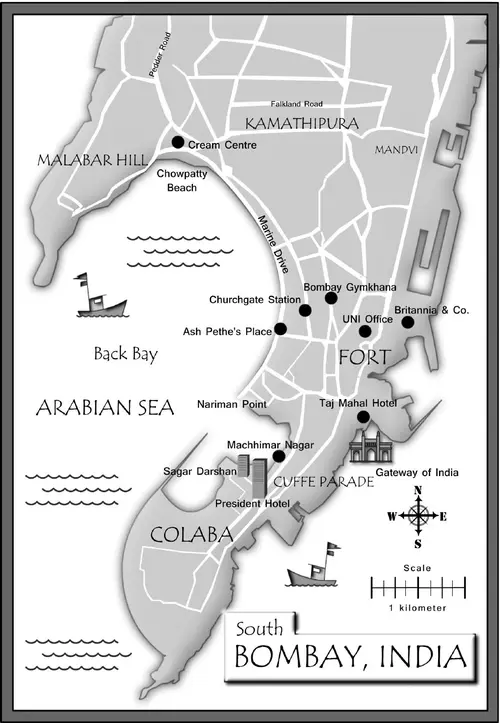
A couple of weeks before, an Irish stringer from the office—Flaherty—had asked me where I was living. You didn’t so much go by street addresses in India, but sectors and building names. I’d told him I had a two-bedroom flat in a building called Sagar Darshan, Cuffe Parade, in South Bombay. Small by American standards, but of recent construction and comfortable, except for the lack of air conditioning.
“Sagar Darshan? Right, you’re in Eric’s old flat,” he said, referring to my predecessor. “It’s Willy Smets’s building. Have you been to one of his parties?”
I hadn’t. And even though he’d never been invited to one himself, Flaherty said they were the best gatherings for foreigners in Bombay, with beautiful women and free-flowing liquor—a scarce and expensive commodity in India. Eric Nielsen—the guy who’d occupied my flat before me—had been obsessed with the parties, according to Flaherty. He’d talked about this Willy Smets constantly.
And then one day, I received a handwritten note inviting me for cocktails in the penthouse flat. I’d made the grade. Now I stood beside the celebrated Willy Smets, still thinking about his first words to me.
“What was that you said before?” I asked him. “Something about Indians and happiness?”
“Some friendly advice for a boy who looks lost in a strange land. India is an enchanting place, but it can be overwhelming to foreigners.”
That hardly cleared up my confusion. He took note and explained that he was advising me to take the second path. Let Indians be the means to achieving my happiness.
Smets signaled to a young servant across the room. Domestic help was ubiquitous in India. Middle-class households—even lower-middle-class—always had one or more servants. The rich had several. I didn’t like the word, servant, when I first heard it. An outdated and condescending way to refer to people. But that’s what they were called in India.
Willy Smets’s guy was outfitted in wrinkled white livery a few sizes too large for his frame. He glided over to us on bare feet. Smets called him Sandip.
“Yes, sahib?” he said. When he opened his mouth, I saw his teeth were stained red from paan, a betel leaf preparation that some folks chewed like tobacco.
“A drink for my guest,” said Smets. Then he turned to me. “What will you have, Danny Boy?”
I didn’t drink a lot, but I enjoyed the occasional scotch. My dad always said, “One to whet your appetite and one to rinse down dessert.”
“Whisky, please,” I said. “I mean, if you have any.”
“Of course we do.”
He relayed the order to Sandip, then waved him away. “Jaldi, jaldi.”
“You don’t want the local spirits,” said Smets. “The beer and rum are okay, but not the whisky. If you find yourself running dry, I can help you.”
I thanked him, feeling like a charity case. He asked if I was satisfied with my servant.
There was that word again.
“He only started this morning,” I said. “I’ll have to let you know.”
“You’ve been without help all this time? I wish we’d met sooner; I could have arranged something for you.”
“My office is handling it, thanks,” I said. “I’m still getting used to the idea. I never thought I’d have someone taking care of me.”
“A very American attitude. Canadians are even worse. It’s as if they feel they don’t deserve to be comfortable. But that’s a habit you must break here. Servants are one of the pluses we enjoy in India, even if they’re always underfoot.” He sipped his drink then winked at me. “Provided they don’t slit your throat in the night.”
A pretty German woman, Marthe, interrupted us to speak with Smets. I assumed he was German since he spoke the language as effortlessly as he did English. Only later did I find out he was Belgian. Flemish, but he also spoke French perfectly.
I studied him as he entertained the lady with what sounded like a humorous story. Bony and toothy, he was, by any objective standard, a homely man. Of average height and weight, he managed nevertheless to project a wiry magnetism that was mismatched to his unremarkable frame. His baritone voice, seasoned by what I was sure were decades of wine and brandy and black-tobacco cigarettes, bore witness to a lifestyle well enjoyed, if not healthy. Yet, despite his want of physical gifts, Willy Smets had confidence and natural social facility in spades. An unexpected charisma.
Sandip returned with my drink, which was sloshing about in a crystal tumbler on a salver. He balanced two glass bottles on the tray as well. They were identical in every detail except for the crown caps. One was red, the other yellow.
“Do you take soda, or would you like some ice?” Smets asked.
“Soda, please,” I said.
Ice never lasted long in that heat, of course, and you were never sure how safe it might be. Soda was the wiser choice. My host must have read my mind. He assured me that all the water was boiled in the kitchen and the ice was perfectly pure.
“Soda’s fine,” I said.
Smets smiled to indulge me, then told Sandip to add some soda to my whisky. The kid reached for the bottle with the yellow cap.
“No, Sandip,” said my host. “That’s tonic water. Never serve tonic with whisky.”
Sandip said nothing. He poured from the red-capped bottle instead, then slipped away.
“He’s new,” said Smets as he raised his glass to mine. “Welcome to Bombay.” We sipped our drinks. “Is it true you’re a reporter for United News?”
“Yes. But how did you know I was with UNI?”
“The fellow who occupied the flat before you. He was also UNI.”
“Eric Nielsen? Did he come to your parties?”
“Only once,” he said with a frown. “He behaved badly. Didn’t understand that Indian girls are not as liberal-minded as Americans. I didn’t invite him back.”
Smets gazed around, taking inventory of his guests and their needs. I returned to what he’d said in my ear a few minutes earlier. Had he meant that the locals—the Indians—were beneath him? Beneath me? Should I be afraid of them? He’d mentioned slit throats, after all.
I wondered if Smets might not be some kind of latter-day colonialist, pining for the old days of the Raj. Or was he merely looking out for a newcomer in an exotic and challenging place? A spoiled American, used to clean water running from the tap and bottles marked clearly to distinguish soda from tonic. I tried to convince myself that he was only telling me how things stood for a gora, that’s what they called white people in India. Yet, the taste left in my mouth was the same either way. Like whisky and tonic. Undrinkable.
What happened next, however, gave me cause to consider him in a totally different light. The inspiration for my change of heart was the arrival of a bright-eyed young woman as beautiful as Smets was not.
Her name was Sushmita. Easily half Smets’s age, she was a couple of years younger than I was, too. An extremely attractive girl, she was sexy, but hardly perfect. There was that one slightly crooked incisor, for example, and a small scar at the side of her right eye, caused perhaps by a childhood fall. And those matrimonial classifieds in Indian newspapers might have described her complexion as dusky. Shameful, I thought. She wasn’t quite as fair-skinned as the Hindi film starlets, but so what? I found her enchanting. I entertained a brief fantasy, wondering what chances I might have with such a woman. Then it became painfully clear that, not only was she uninterested in me, she was unavailable.
Draped in a shimmering green sari, which revealed her fetching midriff for all—for me—to see, Sushmita leaned her left hip against Smets in a casual, intimate gesture and regarded me with what I could only describe as sociable indifference. Even if she hadn’t been attached to my newfound friend and neighbor, I’d never have had a shot with her.
“You’re quite tall,” she said, extending her right hand to me. Her voice was smooth and easy, like her confidence.
Fully aware that my American imperialist attitudes were at play, I found her accent exotic and bewitching. I’m sure she thought mine was unsophisticated and dull.
As I took gentle hold of her fingers, four diamond-encrusted bangles slid down her wrist and clattered to a stop at the heel of her thumb. She squeezed my hand, enough to make me wonder about her intentions. That was stupid. Wishful thinking.
The social niceties completed, she smiled, withdrew her hand, and cocked her head to one side as she sized me up. I couldn’t tear my gaze away from the bindi on her forehead. Not the red dot I’d seen on some women, but a small crescent-shaped moon with the horns pointing upward.
“It’s impolite to stare, Mr. Jacobs,” she said. “Would you like me to remove it?”
“I … I’m sorry. Of course not. I was … admiring it.”
“Don’t mind her games,” said Smets, interrupting my stammering. “Mita is a playful girl.”
He even had a pet name for her.
“It’s called a chandrakor bindi,” she said. “Typically Maharashtrian.”
“It looks like a crescent moon. What does chandrakor mean?”
“It means crescent moon,” she said.
“Oh,” was the wittiest riposte I could manage.
I suspected she was laughing at me. At my awkward attempt at sophistication. And each smile, every spark glinting off a tooth, and the curl of her lips only made my discomfort more difficult to hide. I took a sip of my whisky, which dribbled down my chin.
“What are you doing in Bombay, Mr. Jacobs?” she asked, shifting her weight from her left foot to her right, opening a narrow space between her hip and Smets.
My eyes betrayed me again. Without realizing it, I glanced at the bare skin of her waist, where the fabric of her sari wrapped around her middle. She uttered a soft cough. Trying to act as if I hadn’t been ogling her, I told her I was a reporter for UNI.
“How interesting,” she said, those brilliant eyes fixed on mine, a mischievous smile on her lips. “Can you tell me about that without spilling your drink?”
But, in that moment, I could think of nothing remotely interesting to share with her. Instead, trying to calm my nerves, I tapped the roll of film in my pocket, the one that I’d been carrying around for days. The one with the bomber I’d interviewed. The one I was so afraid to lose that I kept it with me always. I put that thought aside and told Sushmita I worked at the UNI bureau in Fort, on Phirozshah Mehta Road.
“Of course, I know the place. Have you tried the pani puri from the chaatwallah outside?”
“You mean the … that guy who sells food in the street?” I asked. “With all the flies?”
“That’s the one. And don’t worry about the flies. You’re going to get Delhi belly sooner or later. You might as well be done with it.”
“That’s enough for now, Mita,” said Smets. A man in a white safari jacket approached us. “Danny Boy, I must introduce you to Ashok Pethe. Ash to his friends.”
Ash, an engineer for GE, was in his forties, with longish black hair and a friendly smile. He was single and knew every corner of the city. He’d lived in South Bombay his whole life, in fact, and tooled around town in a large Chevrolet. Where he’d found it, I couldn’t guess. The only cars I’d seen on the road were round-bodied Ambassadors, black-and-yellow taxis, and tiny Fiats. And, of course, the two-wheelers—bikes, scooters, and motorcycles.
Ash seemed like a nice guy. He invited me to a dinner party he was hosting the following week at his place on Marine Drive. Fancy area, also known as the Queen’s Necklace. The buildings along the seawall offered great views of the Arabian Sea. I knew that because I ran there every morning.
“You should go, Danny Boy,” said Smets. “Ash always invites pretty girls.”
“Are you two going?” I asked, referring to him and Sushmita.
“We’ll be out of station next week.”
I shrugged and, embarrassed by the pity everyone was taking on me, said I’d love to go.
Ash waved to someone across the room and, taking my business card, excused himself with a promise to send me details for the dinner party.
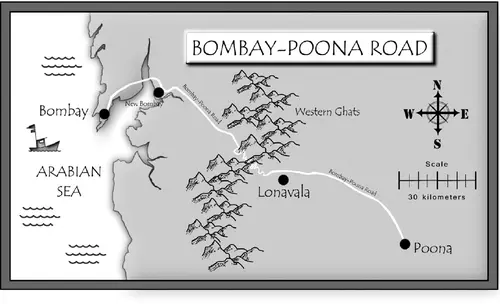
“And now Mita and I must attend to our other guests,” said Smets. “We’re off to Poona tomorrow for a couple of days, but don’t hesitate to let me know if you need anything when we return. A gas cylinder, a driver, or liquor. Anything.”
“Goodbye, Mr. Jacobs,” said Sushmita, fixing me again with those sparkling eyes. “I enjoyed our conversation. And I was joking, of course. Please don’t eat anything from the chaatwallah in the street.”
“Thank you,” I said. “I’ll remember that.”
Smets led her away. I watched them go. More specifically, I watched her go. And—just my luck—she threw a glance over her shoulder in time to catch me contemplating the swaying backside of her sari.
CHAPTER TWO
WEDNESDAY, JUNE 25, 1975, 2:43 A.M.
I was adrift in a warm cloud, swirling into the gentle eddy of stupor. A seductive snare—a silk scarf or a length of green sari—tightened around me and drew me toward sleep’s embrace. My consciousness dissolved.
What the hell is that pounding?
Nothing more than a pulsing at first. Then it swelled into a warped, surreal thumping, like a mallet beating on a kettle drum. Finally, it surged into focus, and my dream burst.
Where am I?
The rain was streaming down the window. The onset of the monsoon had fallen a week earlier. Now I lay in the dark, sticking to the sheet as the clicking ceiling fan twirled overhead. It barely managed to move the wet air from one fold of the bedding to another, with no appreciable relief that I could detect.
The banging resumed with loud, rough voices bellowing on the other side of the front door. I shook the fog from my head, tumbled out of bed, and flicked on the light. Where the hell was Ramu and why wasn’t he answering the door? Hadn’t he assured me just hours earlier not to worry about a thing? That he would take care of everything? Cooking, washing, ironing, cleaning. Everything. Except answering the door in the dead of night.
“Who’s there?” I shouted.
A gruff voice answered in Marathi or Hindi—I couldn’t tell which. But I recognized one word. “Police.”
“Open the door,” called one of them in a fierce, strangled, high-pitched voice.
Bleary and sweating, I pulled on a T-shirt. Then I obliged, turning the dead bolt and unlatching the chain. A stocky cop in a khaki uniform and cap stepped through the doorway. He glared at me, sizing me up, then flicked his bristly mustache with his right forefinger. Unsettled by the menacing squint, I stepped back to give him wide berth.
His four stout adjutants, each carrying a lathi—a long stick used to beat back protesters—remained outside the door, dripping rain on the terrazzo floor. The cop in charge was dry; surely he’d arrived in the back of a police car driven by an underling. He issued some orders to his men before striding past me for the veranda. I had no idea what he was after, but he seemed to know where it was.
He removed his cap and, bent at the waist, stuck his head out the sliding window. He craned his neck upward to see as the rain pelted his head and shoulders, soaking his hair and epaulettes. Then a powerful beacon flooded the window with light, nearly blinding me. The beam hovered for a moment on the cop, framing him in the window, then twitched to the left and back again before climbing skyward against the building.
The cop barked at someone above. He rattled off an angry string of orders, punctuated by sharp whacks of his right hand against the windowsill. Clearly he was yelling at whoever was there. But who could be outside the window in such a downpour in the middle of the night? There was nothing but a narrow ledge and twelve stories of air.
The Story Continues on BooksBarbecue!
Enjoyed this preview? ❤️ Do not stop here!
Read the complete book free online → 🔗
Continue reading now on BooksBarbecue and discover every page!
Love reading? Bookmark BooksBarbecue.com for more amazing books!
Happy Reading!