Bluest Nude
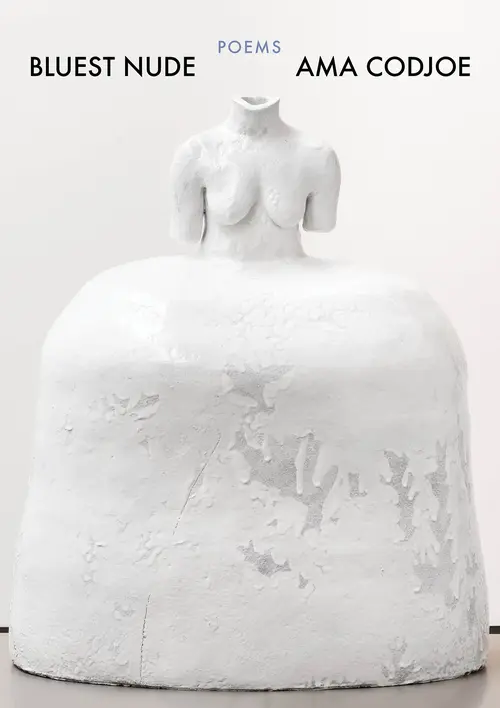
Cover
Dedication
To the most beautiful
“To name ourselves rather than be named
we must first see ourselves …
So long unmirrored in our true selves
we may have forgotten how we look.”
— LORRAINE O’GRADY
I.
Blueprint
As I lay on the prickly grass, grasshoppers chattered
in my hair. I stroked the ground like a beard. No one
sang. The whole sky was watching. It’s animal
piss in the dye pot that makes indigo blue. Blue
seeped out of me, but I wanted to forge it myself.
I was obsessed with making. The yellow leaves
browned; the sugar pine needles refused
to shed. I couldn’t get the pigment right, it kept turning
to mud. I had attempted this before, making wine
from another’s body, stamping and stomping
my grape-stained feet. When I rose, I left the print
of a woman behind. I noticed the pear tree, how it gave
without question; I asked anyway, was asking
again, collecting broken seashells and tiny
elephant figurines. I needed a herd of blue.
I soaked black beans for the color they left. My blue
was a habit, a kind of river I stepped into—sometimes
crossed—because it held the sky so perfectly.
I swung the axe. I swam with my arms.
I hammered nails—though crookedly. Timber
was my sacrum, timber were my metatarsals,
timber was my lungs’ pink flesh, timber was my skull.
I was a blueprint, blue on blue, mapless
but for those warm bones and my red heart barking.
—And when I turned without making my skirt
a basket, when I turned from all the fallen
pears, the sky was full of shaking: wet
with river-water. It wasn’t rain that fell—whatever it was
I collected in the cups of my hands.
On Seeing and Being Seen
I don’t like being photographed. When we kissed
at a wedding, the night grew long and luminous.
You unhooked my bra. A photograph
passes for proof, Sontag says, that a given thing
has happened. Or you leaned back to watch
as I eased the straps from my shoulders.
Hooks and eyes. Right now, my breasts
are too tender to be touched. Their breasts
were horrifying, Elizabeth Bishop writes. Tell her
someone wanted to touch them. I am touching
the photograph of my last seduction. It is as slick
as a magazine page, as dark as a street
darkened by rain. When I want to remember
something beautiful, instead of taking
a photograph, I close my eyes.
I watched as you covered my nipple
with your mouth. Desire made you
beautiful. I closed my eyes.
Tonight, I am alone in my tenderness.
There is nothing in my hand except a certain
grasping. In my mind’s eye, I am
stroking your hair with damp fingertips. This is exactly
how it happened. On the lit-up hotel bed,
I remember thinking, My body is a lens
I can look through with my mind.
Two Girls Bathing
I’m thirteen when my cousin teaches me
how to bathe. We carry buckets
from Auntie’s kitchen, limping
to the pendulum of water swinging.
Undressed, we stand side by side
on the concrete fl or. Carol’s hands
don’t handle like my mother’s did:
propping me in the bathtub beside
my brothers, constructing an assembly line
of our limbs, as she lathered
and polished us clean. This was before
boys became unlike girls, before
our mother, whose flesh we ate,
whose nipples we cracked,
was exiled from us. Carol instructs me
wordlessly. In deliberate movements,
she rubs across her torso’s cross
and sweeps beneath each breast.
I mimic her gestures: tipping the bucket
slightly, so as not to dirty the water.
I watch how easily she bares
her supple body. She wears her nakedness
like it’s been woven from air.
Carol points to a spot on my back.
I resist the urge to hide my chest.
Tucked inside her is what hangs
from my brothers like pockets turned
inside out. I tilt my head like a mirror,
envy the gold beads hugging her waist,
and bring the washcloth to where I’ve missed:
not knowing when and from whom
I learned to be ashamed.
Marigolds of Fire
1.
He had a caribou’s face. Once he let me
lick the sadness there. It tasted of salt
and moss-covered rocks. He grew the beard
of a mountain goat. He scaled the face
of a mountain. Lying beside him, I stared
into the face of faceless waters whose velvet
antlers cradled us. He wore a bison’s
face. Sometimes he wallowed in the dust,
tossing his head from side to side,
wearing deep grooves into the braided
rug. Mornings, he refused to betray
his dreams. He had an antelope’s face—I could
go on like this. I liked how he led me, almost
a shove, how he kissed me—mercy—how I
kissed him back: my back against the foyer
wall. Sometimes we called to each other
like birds. It wasn’t ritual—how can I
explain—he laced his fingers, made his knees
a ladder. I braced myself on his backward horns.
I climbed him then, into the tree.
2.
In the end, we were delivered back
to the strange mud from which we crawled.
The bed gave us back, unastonished,
our aching, separate bodies.
This is skin, it told us. Skin, I wrote.
I would commit its meaning to memory.
3.
A football player slaps the butt
of a passing girl. She turns
to face a silvered hand dangling
from each player’s wrist: windless
chimes. Under their helmets,
the teammates wear the same blank face.
—Can I tell you I wanted them all?
4.
In the beginning, there was blood or the threat
of blood. Formed from clay, we sought a fire
that could finish us. We sewed a garland
of marigolds. We ate good blossoms whole.
5.
He takes his coff e with cream
and sugar; she takes it black.
She scans her wardrobe
for a dress. They respond to emails
and tidy their desks. At 4 am,
the garbage truck jostles her awake. He sleeps best
on his side, on his back,
on his belly. He calls her lady. Though before she’d wince
at this term of endearment, she hears the word babe
slip out of her.
It slips out of her mouth … His eyes
are tired. She has bags under her eyes. She waters
the cactus in a slip. The sky
turns stormy. He forgets the umbrella. She wants
to storm out. He believes she’ll leave. He forgets
to call. She calls him a name. She takes it
back … He takes it black, no
sugar. He’s confused. He wants a baby. She
winces. They rub their eyes. It was a slip. A mistake.
He packs his bags. She irons the sky-blue
dress. She can’t stand his silences. The way he slips
in and out of her. The phone was on silent.
The ringer was off. She removes the ring
from the tub … He sleeps
on the couch, on his side. The sky
is a bath of coff e grounds. Her face is full
of clouds. His eye waters. Somewhere
near a marsh there’s a starling roosting.
I’m saying the middle
was filled with the end.
Labor
Manhattan, New York
The Upper West Side brims
with Black women heaving Bugaboo
strollers as if maneuvering horseless plows.
I’m walking up Broadway with a white friend
whose mother’s food stamps we used
as kids to buy Sour Straws, barbecue
chips, and frosted pints of Cherry Garcia.
While we zigzag between pedestrians,
she argues that there may be as many
white, working-class nannies steering
double-wide strollers as Black.
It’s hard to tell, she insists,
whether the white women caring
for white babies are laborers
or mothers. I know we use
the same word to describe work
and the work of giving birth.
Still, I’m tempted to call her bluff.
Today, I do not want children.
I recall instances when I’ve been mistaken
for mother. Like last May, when a man
clutching a fistful of blush roses
wished me Happy Mother’s Day.
Or in a muggy subway car,
as the child beside me rested his head
on my arm. A nearby passenger’s eyes
softened at our portrait.
I claimed the sleeping child then,
briefly, I claimed him.
More than once, I’ve held tightly
the hands of my twin nephews,
who could be confused
for each other—or as mine.
Together, we’ve waited near
the chasm of the street—gust of cars
stealing their reflections. I’ve spent hours,
brief minutes, tending to children
I in no way labored for—and then,
with some relief, I have let them go.
Poem After Betye Saar’s The Liberation of Aunt Jemima
What if, Betye, instead of a rifle or hand
grenade—I mean, what if after
the loaded gun that takes two hands
to fire, I lay down the splintered broom
and the steel so cold it wets
my cheek? What if I unclench the valleys
of my fist, and lay down
the wailing baby?
Gonna burn the moon in a cast-iron skillet.
Gonna climb the men who, when they see my face, turn into stony mountains.
Gonna get out of the kitchen.
Gonna try on my nakedness like a silk kimono.
Gonna find me a lover who eats nothing but pussy.
Let the whites of my eyes roll, roll.
Gonna clench my toes.
Gonna purr beneath my own hand.
Gonna take down my hair.
Try on a crown of crow feathers.
Gonna roam the wide aisles of the peach grove, light dripping off ranches like syrup, leaves brushing the fuzz on my arms.
—You dig?—
Gonna let the juice trickle down my chin.
Gonna smear the sun like war paint across my chest.
Gonna shimmy into a pair of royal blue bell-bottoms.
Gonna trample the far-out thunderclouds, heavy in their lightness.
Watch them slink away.
Gonna grimace. Gonna grin.
Gonna lay down my sword.
Pick up the delicate eggs of my fists.
Gonna jab the face that hovered over mine.
It’s easy to find the lips, surrounded as they are in minstrel black.
Gonna bloody the head of every god, ghost, or swan who has torn into me—pried me open with its beak.
Gonna catch my breath in a hunting trap.
Gonna lean against the ropes.
Gonna break the nose of mythology.
—Goodnight John-Boy—
Gonna ice my hands in April’s stream.
Gonna scowl and scream and shepherd my hollering into a green pasture.
Gonna mend my annihilations into a white picket fence.
Gonna whip a tornado with my scarlet handkerchief.
Spin myself dizzy as a purple-lipped drunkard.
Gonna lay down, by the riverside, sticky and braless in the golden sand.
Ain’t gonna study war no more.
Ain’t gonna study war no more.
Ain’t gonna study war no more.
Diamondback
Like an organ coiled
deep inside or a lasso
of lightning and high
noon, the rattlesnake
traveled the length
of my spine, sunning itself
inside me. Then death—some
call it god—drew a diamond
on the snake’s back,
and marked my chest
with feeling. How godly
the two of us were, shaking
what was hollow.
Dirt stained
the front of my blouse.
I felt venom
rise in my ears. I rubbed myself
against a rock,
turning my skin bronze
and flawless. This is how
I became a woman,
sun slithering
across my back,
dust glittering my tongue,
the snake’s tail whirring.
After the __________, I yearned to be reckless. To smash
a glass brought first to my lips. To privilege lust over
tomorrow. To walk naked down the middle of a two-lane
road. But, too late, without my bidding, life cracked open,
rushed, openmouthed, like a panting dog whose name
I did not call—my lips shut like a purse. The last man
I kissed was different than the last man I fucked.
We were so desperate then, the two of us, undone
by longing, drawing night from the cracks
inside us, drawing the night out, as long as we could,
until dawn broke like a beat egg and our heartbeats
quieted in private fatigue. I’d be lying if I said I don’t recall
his name. The end of the world has ended, and desire is still
all I crave. Oh, to be a stone, sexless and impenetrable.
Over half of me is water, a river spilling into restless limbs,
the rest of me is a scalding heat like the asphalt under my feet.
Detail from “Poem After Betye Saar’s The Liberation of Aunt Jemima”
And out of her gushing head, I witnessed
four fully-grown women spring forth
like winged beasts: the first woman
wore the charm of her unmasked hair
and a taken-for-granted beauty that made
her all the more enticing; the last woman
modeled an anonymous version of herself—
an “I” that didn’t remind anyone
of anyone else, but who reminded Aunt Jemima
of freedom; the second woman brandished
a handheld mirror she spat on
then polished with the ruffled hem
of her apron, a mirror all the women,
except the last, gathered around
like campfire; and the second to last
woman carried a pink mulatto, squirming
on her hip—in the baby’s hand a rattle,
in the rattle a shattered lightbulb,
in the filament, a portrait
of the child’s father, who some say
Aunt Jemima tempted with her bottle-shaped
hips, but who was known to be monstrous—
a so-called god—and I beheld a sea
of blood, dark as syrup, oozing
from Aunt Jemima’s neck,
and four women flying, without shoes
or wings, from her maternal, amber body.
Primordial Mirror
I was newly naked: aware of myself
as a separate self, distinct from dirt and bone.
I had not hands enough,
and so, finally, uncrossed my arms.
In trying to examine one body part,
I’d lose sight of another. I couldn’t
imagine what I looked like during
the fractured angles of sex.
At the river’s edge, it was impossible
to see all of myself at once.
I began to understand nakedness
as a feeling.
It was a snake, loose and green;
it was the snake skin, coiled and discarded.
The shedding chained itself
like a balloon ribboned to a child’s wrist.
Morning’s birdsong reminded me
of the sloughing off f skin.
The rumored beauty of my husband’s first
wife never bothered me before.
I missed the sensation of being fixed
in amber. Then the hair in the comb,
fingernail clippings, the red mole on my
left breast grown suddenly bigger.
I perceived my likeness in everything:
the lines on my palm as the veins
of a leaf, my mind as a swarm of flies
humming over something sugary or dead,
my vulnerability as the buck
I’d kill, then wrap myself inside,
my hair as switchgrass, twine, and nest,
a roving cloud my every limb.
Le Sacre du printemps
after Pina Bausch
At this time of night, the theater is empty:
draped in its velvet robes, echoing with ghosts
and applause. I’ve been tossing and turning
all night, as headlights flash across the ceiling.
Inside the ornate opera house, it felt close to midnight—
bottomless, like tonight—though it was the middle
of the day when I arrived and the usher
escorted me to my seat. An ocean of dirt
covered the stage. The dancers performed
underneath and on top of Stravinsky’s score.
With their bodies, they made another music:
full of lunges, panting, slaps, stomps,
and whatever sounds the body makes
when it yields to unyielding earth.
Men and women threw themselves on the fl or
and into each other: smearing their skins
with dirt, violence, and sweat.
I am restless. Tonight, I remember
I vowed to feel as alive as the woman
who, in a rite of spring, must dance herself
to death. Hair frazzled, clothes soiled, the fated
woman fell to the earth then sprang back up,
slashing the air and contracting her body as if
she’d been punched repeatedly. She fell
and danced, danced and fell, until she collapsed
for the last time. —The stage went black.
How quickly I walked into the bright day,
leaving her there, behind me. On nights
like this one, when I’m crazed by wakefulness,
and darkness sacrifices itself, anxious limb
by anxious limb, into the day’s endless mouth,
I steal the red dress from the dead woman’s body
and dance wildly, with such abandon,
the room turns stained, swirling, terrible, pink.
After the __________, I had the urge to dance
on the president’s grave. The dispossessed threw me
a belated quinceañera. My godmother wore a necklace
of the dictator’s teeth. She sliced an upside-down cake, licked
her forefinger, and said, You have mastered sadness, querida,
may your rage be sticky and sweet. My father off red
his hand—this time I took it. We glided like
ballroom dancers across the red dirt fl or. He wore
a grave expression. I embraced him tightly
so as to cloak my face. Instead of a toast, he handed me
a handkerchief wet with tears. My father circled
the guests silently, dabbing gently each of their cheeks.
This too was a dance unfolding. I folded the handkerchief
into a fist and raised my fist like a glass of champagne.
The pain in my father’s eyes sparkled like the sequins
on my tattered gown. If it hadn’t been so ugly,
it would’ve been beautiful. The party ended just as
the world had: with the sound of rain beating
against the earth and each of us on our hands
and knees, peering into pools of mud and thirst.
II.
She Said
Hello
Can you hear me
Can you hear me now
Hello
I can’t hear you
I’m sorry you’re breaking up
Is this better
Can you hear me now
Hello
Hello
Can you hear me now
Hello
*
And the said Agostino retorted that … [hole in page] and that he should find it, that otherwise he would have … [hole in page] for this ugly … [holes in page]
[[20. How long after it happened [did you tell]? Why didn’t you tell it immediately, and, if immediately, why didn’t you bring suit? Why have you said it now and what induced you to say it?]]
To the twentieth, she said
To the twenty-first, she said
To the twenty-second, she said
To the tenth one she answered as above
To the twelfth, she referred to the next one
And to the first [question] she answered
And while they were writing this down
To the third one she answered
To the thirteenth, she answered
To the eighth one she said
And the said summoned woman answered
*
FOOTNOTE 58: Hole in the page, one or two words missing.
FOOTNOTE 51: Hole in the page; three words missing.
I’m sorry you’re breaking—
She was asked
She answered
FOOTNOTE 68: The page is torn; two or three words are missing at the beginning of the line, and a line or more is cut off at the bottom of the page.
The said summoned woman retorting
Can you—
FOOTNOTE 63: See ms. 10.
*
And while the guard tightened the said cords with a running string, the said woman began to say
Then the judge, having heard [all this], etc., terminated the interrogation and ordered that the witness be sent back to her house for the time being.
*
When considering this poem, I know the “I” is missing. Twelve years ago, on one occasion, [ ] was robbed, assaulted, and almost raped by the same man, a stranger.
*
Is this better
Footnote 26: Literally, “lying in his throat” (mentirà per la gola).
How about now
The connection is bad
Sorry
Hold on
Hold on
Literally, “lying in his throat”
How about now
How
repeating the above words over and over, and then saying,
o
sorry
breaking
Hell
o
sorry
about
no
now
o
Hell
He
better
hear
breaking
break
better
be
breaking
this
can’t
me
*
the hear in hearing the ear the he the he in she the sh in shame the me the shh in me the ssshhhhh the y in saying the why the say the said the sad the sad i the scared i terrified she tried to say the test in testify the be in believed the lie the lived the silent i the why in silence the shh in she the she before the space before the space between she and said the ears in years the saying the said between
*
She added afterward voluntarily
She answered
She added afterward voluntarily
She added afterward
She added afterward voluntarily
She answered
She answered
She added afterward voluntarily
*
“At this point, I will do my best to answer your questions.”
*
FOOTNOTE 70: Page is torn; a final line not legible.
III.
“It’s essential that I do this workand it’s essential that I do it with my body.”
—CARRIE MAE WEEMS
Posing Nude
after Living Room, Brownsville, Brooklynby Deana Lawson
If I were to choose a man to pose nude
with, it would be the ex whose hand
in mine, I couldn’t distinguish
from my own—just as, studying
this photograph, it’s hard to tell
the male’s fingers, pressed
into a triangle, from the female’s,
decorated by acrylic nails so long
they curve like a penis might.
This particular ex anticipated
my needs like a photographer considers
sources of light. He’d wrap me in a blanket
before opening the window
to smoke a cigarette. We gazed at each other
from a certain distance.
In choosing him, I choose
the feeling of waiting naked
beneath the throw, wanting nothing
but the last dashed ember—and next
his mouth sucking
my earlobes and neck.
In Living Room, a male figure bares
a tattooed chest, cuff d jeans,
and Timberlands. Behind him, a woman
sits, propped on the radiator. Leaning back,
he rests on her right breast.
The couple stares at the camera.
I know the composition is staged—
down to the cast-off hoes, askew
on the fl or. A photograph tells truths
and lies. The couple pictured are not
lovers. Lawson asked the female subject
who she’d feel most comfortable
posing nude with: she chose a friend.
Years ago, my ex sent me nude photos.
At the time, he was living
with the woman he would later
marry. His face remains just
outside the frame. The subject
of the email read, “For Your Eyes Only.”
In the only photograph of us I’ve kept,
I’m wearing a necklace. The clasp
will soon break. Tenderness closes
my eyes into lines. He stares at me
instead of the camera; his face breaks
into laughter. That night in bed,
after the picture was taken, a mosquito
worried past his ear. My mouth rested
on his chest. He woke bitten and swollen.
Burying Seeds
for Betty Shabazz
Who, when they killed her husband, was carrying
twin girls—not in her arms, but in an armless
sea, with bits of blood as food. She covered
her daughters in the waters of her body.
She covered her daughters in the rooms
her body built, pressed against the wooden
fl or of the Audubon Ballroom. She must have
cried, as my mother did, when she stuttered, Twins?
into the paper gown of the hospital room.
The body longs for its double. Even twins
stretch long their arms toward other strangers.
The first time I visited a mosque, I was surprised
to be separated from my father and brothers.
I sat, with the women and girls, alone.
From across the aisle, I stared at the men
The Story Continues on BooksBarbecue!
Enjoyed this preview? ❤️ Do not stop here!
Read the complete book free online → 🔗
Continue reading now on BooksBarbecue and discover every page!
Love reading? Bookmark BooksBarbecue.com for more amazing books!
Happy Reading!