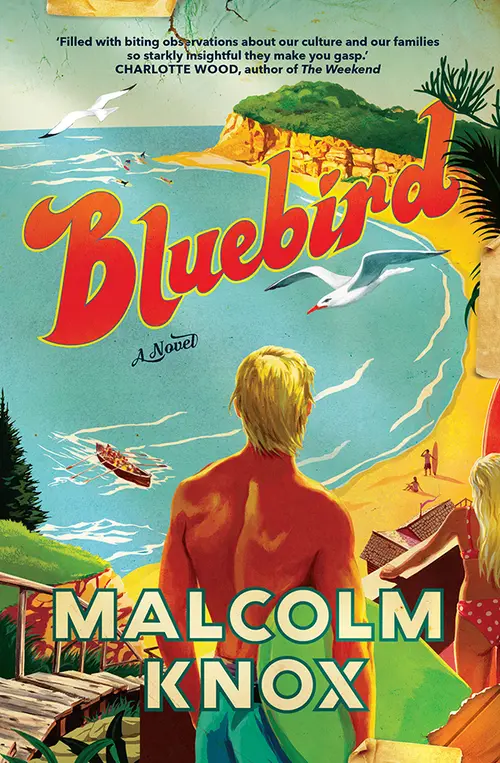
Bluebird
COVER PAGE
Praise for Bluebird
‘Bluebird is engrossing: a sharp-witted and exact satire about our contemporary world and our contemporary families. Yet the satire is never smug and the characters never lose their complexity or their individuality. Malcolm Knox’s writing now has such confidence and clarity that he is exhilarating to read. He’s a maestro, and I didn’t want Bluebird to end.’ Christos Tsiolkas, author of Damascus and The Slap
‘Malcolm Knox is in scathing top form with this brutal takedown of white male nostalgia, real-estate greed, wasted privilege and bronzed-Aussie delusion.
‘Gordon’s an unlikely hero, trapped in the collapsing halfway house of his marriage, his elderly father’s crumbling tyranny, loyalty to his abysmal friends—and the toppling Lodge, the symbol of everything he can’t bear to lose. The novel perfectly skewers the hypocrisy, racism, class warfare and misogyny at work in the power-plays of ageing surfside gladiators, clinging to their personal and communal mythologies of an Australia that no longer exists, if it ever did. It’s a mark of Knox’s supreme skill that he can render his protagonist’s failures with such ruthless clarity, yet somehow elicit such genuine sympathy that I found myself desperate for Gordon, urging him on to step up, and save himself.
‘Filled with biting observations about our culture and our families so starkly insightful they make you gasp and read them out loud, Bluebird showcases Knox’s dexterity as a satirist more savagely astute than ever.’ Charlotte Wood, author of The Weekend
Praise for The Wonder Lover
‘A strange and beautiful creation. It reveals Knox to be an author of a controlled virtuosity with few peers in this country. Indeed, along with 2011’s The Life, it marks a considerable leap in Knox’s formal ambition: an evolution thrilling to watch unfold.’ The Saturday Paper
‘Malcolm Knox has established himself as one of the most ambitious and exciting fiction writers at work in Australia. It is a testament to Knox’s talent and creativity that we remain, throughout, excited by the ambition and potential of this novel. We marvel at this writer who stretches himself, and for that reason we read much of The Wonder Lover in awe of its creator’s inventiveness.’ Australian Book Review
‘This is one of the big books of the year. You know that phrase that critics use about a writer at the peak of his powers? Well, this is the time to apply that to Knox, who has been one of our most significant writers mining aspects of contemporary masculinity for a while in novels like Summerland and The Life.’ Caroline Baum, Booktopia
‘Malcolm Knox has … made a speciality of interpreting the lives and emotions of men … Genuinely original and intriguing.’ Katharine England, Adelaide Advertiser
‘Few authors have such a sharp eye—or stylish pen—for the secret lives of men.’ Jennifer Byrne, Australian Women’s Weekly
‘Malcolm Knox’s The Wonder Lover is a book in love with language and the possibilities of storytelling. I loved it.’ Christos Tsiolkas, The Saturday Age/Spectrum
‘I loved it. Wonderful and sad. Sad and wonderful. He is a brilliant writer.’ Don Watson, ABC Book Club
‘Gradually unfolding the three marriages, with the tone growing more dark and complex, it becomes an exquisitely wrought dissection of one man’s downfall and a reminder that of all the records and extremities Wonder encounters, the most revelatory is the damage human beings inflict on one another.’ Sunday Age
Praise for The Life
‘A vivid and essential piece of work.’ Australian Book Review
‘It confirms what ought to have been more widely recognised, that he [Knox] is one of the most considerable of our novelists in what is at least a silver, if not a golden, age of Australian fiction.’ Peter Pierce, Sydney Morning Herald
‘Malcolm Knox explores the inner life of men with both surgical insight and heartfelt compassion … The Life digs in deep.’ Michael McGirr, The Age
‘Plot is one thing, mere reviewer’s necessity, but voice is another. Here is where the novel seduces and converts … it is clear Knox is on to something here. He has written a vivid and essential piece of work.’ Adam Rivett, Australian Bookseller & Publisher
‘The Life is also just a bloody good read.’ Stephen Romei, The Australian
‘You don’t have to be a surfer or be familiar with the story of Peterson to appreciate Knox’s superb storytelling and his rhythmic, evocative prose in homage to one of Australia’s most intriguing sporting characters.’ Greg Stolz, Sunday Times
‘Knox has never written better than in The Life. Page after page is radiant with the energy.’ Geordie Williamson, Weekend Australian
‘The book is worded in the crackling stream of detritus that flows from Keith’s broken mind—a sort of Catcher in the Rye for Antipodean surfers.’ Inside Sport
‘I envy the confidence and the naturalness of that book—it moves and shrugs, completely itself, like a wave.’ Charlotte Wood, Bookseller & Publisher
‘If Winton is an aria, Knox is early Rolling Stones.’ The Guardian
Malcolm Knox was born in 1966. His award-winning novels and non-fiction titles have been published in Australia and internationally. A journalist with the Sydney Morning Herald since 1994, he has won three Walkley Awards for investigative journalism, magazine feature writing and sports journalism, as well as a Human Rights Commission Award. He lives in Sydney with his family.
DEDICATION
For my family
FIRST PART
BIRD’S EYE
Bird’s eye
When I close my eyes and think of Bluebird, I picture it from above. I glide on the sea breeze, hold my position, and turn my salted beak upon them. Avian and condescending—they have called me worse. An outsider, I arrived with an innocent gaze to which they imputed evil character. I was a vulture waiting for my host to die before feeding on his flesh, which tribal magic turned into their own. I was predator, scavenger and judge, an unhappy triple threat.
They were wrong! I am but a gull drawing circles on this cloudless sky. Until I act, I watch. There below, a white van knifes into the last space in the top car park. Clothes are shrugged off, a wetsuit zipper fumbled in excitement. A square of wax grates over a surfboard, doors are locked and keys stashed in wheel well, footprints skip over the dune and down the sand. They float on the water as I float, without a wingbeat, upon my lighter element.
Over here, more. Latecomers who thought they were early risers discover what those in the know already knew. It’s going to be one of those days. You wouldn’t want to be caught napping. Earliness is the stamp of belonging.
A rustic signboard stands at the top of the dune path. When I arrived here, the visitors welcome sign had been burnt mute by persons unknown. Its charred cinders, trodden into the sand to form a foot-blackening compound to tattoo departing soles, represented honesty.
More recently, a newly-appointed deputy general manager of the local council declared that a new sign had to be erected. What, he asked in a printed leaflet, is a place without a sign? A public plebiscite (participation rate <20 percent), given three alternatives, settled on a new slogan: Bluebird. Like No Other. The popular favourite—Car Park Full—was not among the options.
Within hours of the sign’s erection, guerrilla graffitists vandalised, or corrected, it to Bluebird. LikeS No OtherS. And so it remains, like its burnt predecessor, eloquent in its defacement.
Bluebird whispers a history of self-concealment. If I cast my eyes to the smoggy horizon (no, I don’t go there either), I flinch from the high-rise nightmare of Ocean City, that beach camp of four million. In the old days, Bluebird was OC’s last secret, the land that public transport forgot. Old Bluebirders chose weatherboard obscurity, the pride in self-sacrifice, the decency of being overlooked by each property boom. Bluebird was OC’s blind spot, under-value its badge of honour. Any suggestions of a train link from OC to Bluebird were greeted by pitchforks.
Alas, out of sight has lost the battle to out of mind. Preservation from access couldn’t ensure preservation from progress. Bluebird’s quest to be Nowhere has been surrendered. Nouveaux Bluebirders—expat English bankers, locals made good, adventurers from the far side of the harbour, blue-chipsters and craft beer barons, rock royalty, fashion designers, self-styled purveyors of digital-age culture—and they call me a parvenu?—have scorched this earth. From its ashes arise mirrored shrines for maximally magnified self-reflection.
And here come the daytrippers. Ugh. Sunlight bounces off windscreens in the bottom car park on the flat between the surf club and the electrical substation. Families insert into overflow parking in the grass lot beside the firehouse. Nippers parents are bickering about how much space between cars is really necessary. Having deposited their children in the care of the surf club—Sunday morning babysitting service—they queue for early-opening caffeine at the Beach Cafe. I own that. Hate me if you will, Bluebird, but I own you too.
Out on the water, surfers jostle for the main break. The day’s first threats echo with the first birdsquawk. Hello, friends! Less combative surfers filter out to the sub-premium take-offs. Council lifeguards, erect Desert Foxes in their beach buggies, plant red-and-yellow patrol flags and chequerboard buffer zone lollipops, and megaphone border-force instructions to surfcraft riders: ‘Attention in the water!’
When was paradise lost: an hour, a decade, two centuries ago? Even I miss Old Bluebird, and I wasn’t there. I have contracted the local infection: crippling nostalgia.
I tilt my wings away from this scene to the sea, from human faces to cliff faces. Try as it may, all that restless meat cannot spoil Bluebird’s native glory. A claw of sandstone clasps its jewels: surf club, ocean bath, open-air public shower, refoliated dunes, alpha to omega told by one smile of golden sand and a drenching of scents: salt, wrack, sandstone, Norfolk Island pine resin. Not just a beach, but the idea of a beach. Everything in its right place.
At some point, each new arrival will ask the Bluebird question. Surfers and swimmers gazing from the warm water, walkers and waders, bakers and bathers, even tough old birds like me ponder the houses and unit blocks cascading at illegal angles down the cliff faces, the six-storey apartment tower teetering on pillars shrouded in scaffolding for concrete cancer surgeons to cut out the corruption of bygone bad habits.
How did they get away with that?
We ask it of the rough-as-guts males barnacled to the rocks, the melanoma farmers practising their military surf club march-past on the sand, the hard men out on their big boards, working-class relics in a high-end landscape.
How do they keep getting away with it?
A question, like a fire, needs a provocation, and Bluebird’s raised middle finger to the monuments to greed and folly and rapacious optimism is one structure that clings to the sandstone cliff in the southern corner, defying gravity, connected to the world by a pair of wooden staircases, one leading up via four zigzags and a narrow pass between two duplexes to the street, the other thirty-three steps down to a jump rock onto the sand; staircases like rope ladders on which the building is paralysed, unable to climb or descend. A gob of bleached driftwood and cement render thrown against the cliff face, surely it must slip into the sea. This house is not an answer but a question: absolute beachfront yet virtually inaccessible, sitting on premium real estate that is somehow not real estate at all, a historic abuse protected by custom.
How the fuck did they get away with that?
That is The Lodge, and if you have to ask what The Lodge is, you’re not a Bluebirder.
Gordon and Kelly Grimes are living there now. They used to rent an ex-housing commission cottage near the high school, but separated after Kelly fucked Gordon’s best mate. As separations go, theirs was unorthodox: Kelly and their sixteen-year-old son Ben moved out of the broken family home and into The Lodge, followed by Gordon himself, thanks to the manipulations of Kelly’s widowed wicked stepmother, who, for good measure, claimed the queen room. Kelly has the double, separated by half an inch of asbestos sheeting from the bunk room, which is occupied by Gordon, his twenty-two-year-old goddaughter Lou, and Ben.
Lodge and family: held together by the gravity of their fractures.
What have they got away with? As the godless say, pull up a pew. Long story.
GORDON
Gordon
On the deck of The Lodge, Gordon Grimes screened his eyes. The sun was playing peek-a-boo over a bank of clouds that would soon burn off, summer continuing its insurgency against the season formerly known as spring.
Hearing a whistle from his left, Gordon turned to see his bearded young neighbour waving cheerfully. David Archer’s humble grin spoke of disbelief at their shared good fortune. Gordon, on edge due to both an ongoing dispute with Archer and the underlying fact that Archer’s fortune was built on a more solid economic base than his, raised his hand tentatively, torn between the suspicion that Archer was taking the piss and the greater anxiety that his friendliness was genuine. Archer cupped his hands worshipfully to the sky. In their single mediation session before the dispute was given a court date, Archer had referred to this headland as Bluebird’s ‘dress circle’, which Gordon took to mean that the people down below must be actors.
Gordon, bracing against his balcony rail, might have held a premium ticket, but he felt far from premium. He had got away with nothing except the view.
He swept his eyes over the beach. Six ancient clubbies were practising their march-past, pausing around the reel to debate who would pick up which corner. Six into four never did go. Mathematics, like their opinions, stood immutably against progress. Gordon squinted down at the top car park, where his crew had been rolling up since the pre-dawn. He could pick them out of the Sunday crowd just as animals, in a mass of humans, see only the fellows of their species. Morning surfs complete, they milled about, a cluster of non-working working folk falsely remembering empty waves, bandying hot air and urban myth.
Snake, tradie in tradies’ heaven, first in the car park as usual in his customised van fitted out with shadow boards for metalwork tools and a seven-stick surfboard quiver, was flying on a vertical run of surf talk with Red Cap, a fifty-one-year-old who no longer surfed because of reconstructed shoulders dangling from synthetic tendons, yet still the most regular of the regulars. On days like this, Snake and Red Cap claimed the sunrise like respondents to a call to prayer; if they were not first here, the Bluebird sky might fall in.
Firie Sam clambered up the dune path to join their conversation around the green-painted park chair that Kelly had christened The Bench of Broken Dreams. Mid-fifties, handlebar moustache and fruity voice box, mobile loans officer by day, safety officer with the volunteer rural fire service by days off, an anomalous Old Bluebirder in gainful employ, Firie Sam was unzipping his sleeveless vest, its shine like sealskin. Nobody knew how Sam maintained a supply of that discontinued line of zipper vests; there were rumours of a long-ago stock theft.
Old Bluebirders didn’t arrive so much as occur. Tonsure Man, whose stringy beard and luxuriant mullet appeared on loan from the yarmulke of exposed wrinkled-apple skin atop his head, was exchanging information with the tattooed nude-nut Cnut, whose name was likely Canute or Knut, going by his Nordic facial planes, but who spells in the surf? Cnut by nature, therefore Cnut by name. Up popped the obligatory Macca and Chook, one per beach from here to the border, and an interchangeable posse of Maccalikes and Chookalikes. There now was the sole woman in the pack, the eight-time state champ, her ebullient hoarse monologues piercing the morning. Friendly with everyone and remembering no-one’s name, the eight-time champ formed a surf-buddy couple with Japan Ned, a Bluebird resident since the Japanese eighties. Japan Ned had not mastered a comprehensible English beyond ‘Good out’ and ‘Shit out’, all he needed for car park conferences. You lost yourself in contemplation of his carved white grin and his bewitching, almost edible skin tone. It was said that Japan Ned’s nickname originated with a local cabinet-maker and surfer who likened Ned’s complexion—so darkened by daily exposure to a sun that had turned him into a mid-Pacific race all his own—to the colour of japanned wood, but it was also said that none of the local tradies could be quite that eloquent.
This bunch, every morning of the year. Permanent holiday. How did they get away with it?
But yeah, Gordon knew:
Snake, divorced, had moved back to Bluebird to live with his widowed mother.
Red Cap, divorced, also lived with his widowed mother.
Tonsure Man, never married, lived in Bluebird in a bachelor flat beneath his widowed mother’s house.
Cnut, never married, lived in his car.
Firie Sam, divorced, had moved with his widowed father into the disused firehouse.
Japan Ned, who could only be divorced, lived nearby, no-one had worked out where or with whom.
The eight-time state champ had made nothing from the sport but lived on the clifftop, prime possie, doctor’s wife.
And now the turd dropped into the bowl.
Rocking up to work the car park like a party host was Doug ‘Dog’ Gilsenan, a Bluebird lifer who had marked his fiftieth year by switching from surfing to stand-up paddleboarding so he could continue to bully the south-end peak in a world of seven billion potential blow-ins. On big days, small days, in-between days, good days and shit days, Dog, his face a voodoo mask of factor-50 war paint, statuesque on his paddleboard, picked off the best waves, sounding his warning with a shrill whistle as he careered down the line in his budgie smugglers. Dog would fancy himself a marble Caesar, though the parabolic folds of his flesh toga were the legacy of no greater conquest than the recovering sugar user’s weight loss.
Gordon saw the group ripple away from Dog’s merry greetings. The eight-time state champ cut herself into silence. Snake shuffled back to his van with Red Cap. Firie Sam went to the shower to wring out his zipper vest. Tonsure Man and Cnut scratched the ground with their toes.
‘What you reckon?’ Dog would be saying to Japan Ned, the only one on whom he could rely for a response.
‘Shit out,’ Japan Ned would say with a smile that was not for Dog.
As if he had only graced them with his presence while on his way to more pressing business, Dog feigned not to notice their snubs and made for The Lodge, the rest following him with their eyes as he crossed the grass down to the corner of the beach. He stepped from the jump rock onto the staircase. He cock-sparrowed up the wooden stairs, straining his ribcage to flatten his man boobs, marshalling energy against age. He paused on the middle landing so he wouldn’t sound puffed-out on arrival, while pretending to appraise the house clinging to the rock face. As a property lawyer, Dog perceived The Lodge as a list of litigation risks. Something had to be done.
Did it? From the inside looking out, possession was nine-tenths of the law and eleven-tenths of fuck-you. For Gordon, The Lodge was a monument to the glorious and improbable reign of nothing: a manifestation of the human will to resist change, a temple dedicated to miracles within miracles. Weather-beaten couches, tables and other furniture of the ‘found’ variety, including two queen beds and a double bunk, had been human-chained down the staircase from Cliff Street into The Lodge, not a soul could remember when. For Gordon, The Lodge was a mighty ruin, a castle redoubt worth the last drop of its defenders’ blood.
But Dog was a can-do guy. A semi-retired practitioner who ran his own race and much else, Dog lived with his wife Sally in the penthouse of the newest unit block behind the surf club, their kids having moved to interstate universities. As an emptynester needs a hobby, Dog’s hobby was Gordon’s wife. When that had begun to go off like yesterday’s milk, Dog had refocused his attention on Gordon, his stated project to fix up his best mate’s life and stop it from going so badly wrong again.
Gordon went inside and knocked an agreed double-rap code on Kelly’s door. Moments later she was a blur up the steps to Cliff Street, clothes bunched under her arm. Gordon preferred not to reflect on his actions, protecting her from having to see him. Funny old world.
The Story Continues on BooksBarbecue!
Enjoyed this preview? ❤️ Do not stop here!
Read the complete book free online → 🔗
Continue reading now on BooksBarbecue and discover every page!
Love reading? Bookmark BooksBarbecue.com for more amazing books!
Happy Reading!