Blood Sisters
Cover

About the Authors
Barbara and Stephanie Keating grew up in Kenya. One sister now lives in France and the other in Dublin. Their first novel was the bestselling To My Daughter in France. . . .
ALSO BY BARBARA & STEPHANIE KEATING
To My Daughter in France . . .
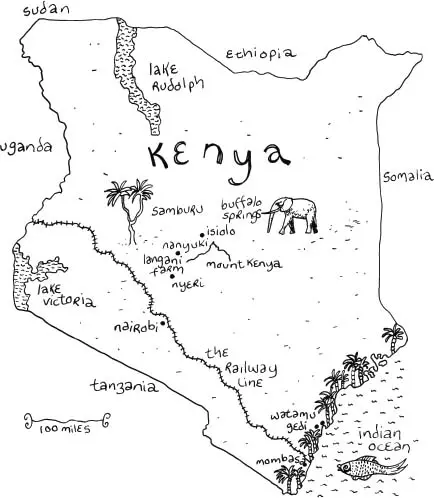
Map
Dedication
FOR THE KANISAS
Blood Sisters
Barbara & Stephanie Keating

Prologue
He had been running for more than two hours, his breath heaving in and out now, in ragged gasps. His body was drenched in sweat. It ran in rivulets down his greased torso, through the crusting of dried blood, sliding under the beaded wrist and arm ornaments, the copper leg bracelets and the leather loincloth which was all he wore. All around him, the bush rustled with the sound of creatures hunting for food. The African night reverberated with the heavy cough of a lion calling to his mate and the manic cackle of a hyena behind him on the plains. In the distance there was a rumble of buffalo, moving between their grazing grounds and the winding course of the river. The warrior heard none of these. He was only aware of his own breath, the saw and rasp of it, in and out, and the screaming that still echoed in his head.
There should have been only one at the killing ground, one man to scream, to beg, to plead for mercy. But he had remained silent to the last. Only his eyes spoke his contempt for his executioner, until the warrior could face their judgment no longer and his bloodied knife scoured out their condemnation for ever. He had not expected that there would be so much blood, or that the ripe, sweet smell would stay all this time in his nostrils. His body seemed to reek of it as he ran. Every predator in the bush must be able to smell him. Like the hyena. It had come for the blood, hunching and shuffling through the bush with its rank breath, and its matted, spotty coat. Drawn by the smell of death, and the promise of flesh and bone to tear.
He should have let it kill the woman. He had not counted on her appearance and she had no defence. In that one second, when he saw her eyes widen with recognition, the hyena had made its rush. He had flung the spear, seen it find its mark, watched the creature topple. Then the woman was falling too, and when the screaming began he knew what she had seen. He could see it too, no matter which way he turned his head. The body of the man was staked out on the ground, arms and legs spread wide, genitals sliced away and stuffed into the silent agony of his mouth, belly ripped open so that his entrails spilled on to the earth, sightless eye sockets turned in darkness to the moon. The warrior still saw that vision, still heard the screaming, long after he had escaped the place of sacrifice. He had left the spear in the hyena’s neck and slipped into the surrounding bush, covering the marks of his passing in the way of his people, knowing that the trackers would soon be searching for him, casting all around the ridge for signs of the direction in which he had gone.
In those first moments he had been filled with a savage euphoria, had felt himself invincible. He had completed his quest, had carried out his oath. He could feel the power of the bhang that he had taken prior to the ritual, still coursing through his body, flashing scenes of colour and mystery before his eyes. He was beyond pain as he drew the air down into the fiery passage of his throat. It filled his chest with seared oxygen, whistling out again through his clenched teeth in a shower of foaming spittle. His heart was pounding, muffling the sounds he left behind him so that they were a distant buzz in the back of his consciousness. He came to an area of dense bush and thorn, and ran along its edge, veering away after a few minutes to climb on to a rocky outcrop where his footprints would be lost to anyone following. Then he retraced his path slowly, stepping in his own tracks until he came to another section of the scrub. He crouched and slid into the thicket, mindless of the thorns that tore at him. The drug gave him an altered vision, as though he was looking down into some far-off scene from a great height, and he could see himself moving under the bushes, undulating like a serpent, until he emerged on the other side of the dense undergrowth. His skin was ripped, and blood welled up to mingle with the blood of his victim, which already covered his body. He did not try to clean it away.
He had proved himself, slain the enemy. The great god Kirinyaga would be appeased. The spirits of his ancestors would be placated; his father’s spirit would be placated. He straightened, turned and vanished into the forest, avoiding the animal trails until he reached a clearing far from the ridge. There he stopped, satisfied that he had covered his tracks sufficiently. His hands shook as he unfastened a small pouch from the leather thong around his waist, tapped some of its dark powder on to his palm, and inhaled it deeply into both nostrils. There was another rush of adrenalin to his system so that he shook with the power and the strength of it, and then he began to run again, loping through the night and out of the forest, along the edge of the plain, making for his other sanctuary. Twice more, he stopped to give himself another burst of energy from the contents of the leather pouch. But then it was all gone, and he still had a great distance to cover before he reached his destination.
The screaming had begun again in his head, and flashes of remembrance were confusing his vision, causing him to stumble on the rough terrain. The smell of the dead man’s blood invaded his lungs, so that he felt he was inhaling his victim’s death with every breath. Now he began to see shapes in the shadows around him. Hyenas. Running behind him. Tracking him. He thought he could smell them too, but it might be the scent of the animal he had speared, or the odour of the victim’s sacrificial blood turned rancid by the heat of his own body. For a moment he thought he saw a fire flickering some distance ahead of him. In his imagination, figures moved in the red light, and his nostrils were filled with the stench of burning flesh. He swerved away, not wanting to see who might have built the fire, or what would be burning there. The image faded.
The darkness was beginning to dissipate, and in the limbo world between night and dawn, when all was grey and misted, he was no longer sure what was real and what was not. He feared that inadvertently he had entered the spirit world, that he would not be able to find his way back. He should not have killed the hyena. It had been coming to devour the spirit of the man, and he had prevented it from its task. Hyena and dead man wandering the spirit path, looking for him. They could smell the blood on him. He felt a surge of panic and tried to run faster. A branch whipped across his face and he felt his headdress fall, but he resisted the urge to stop and retrieve it. He was a true warrior now, whether or not he wore the plumed and beaded headdress.
He could hear a new scream, over the first one, and he knew it was coming from his own lips as he saw the fire again. This time it was right in front of him. This time it was real. There was a man standing beside it, holding up the panga with which he was skinning a bushbuck. The warrior saw the blade gleaming in the firelight. He stopped, panting. No one must be allowed to see him, to know he had passed this way. The man had stepped back, staring at him in alarm. A hunter. He had been chopping brushwood, making a fire to protect himself from the wild animals, but now he was facing a more dangerous enemy. A short spear lay on the ground beside him. Terrified, he bent to pick it up as the warrior sprang at him, snarling, his knife making the first slash.
In the distance, the pack of hyenas yipped and chuckled, and called out the news to one another. There was blood. Soon there would be feasting. As first light broke over the landscape they moved in, and the air was filled with the sound of their growling and squabbling, with the snapping of jaws and the crunching of bone as they buried their muzzles in the fresh carcass.
Chapter 1
Kenya, July 1957
The school bell rang, but the girl stayed where she was, halfway down the drive. Sooner or later she would be missed. In trouble again. But maybe the car would turn in through the gates before they realised she wasn’t there, and then everything would be all right. She had been watching for it all morning from the classroom window, until she was reprimanded. After study she had slipped away down the avenue, stationing herself out of sight of the school buildings. It was a bright afternoon, with high clouds riding in a washed-blue sky after yesterday’s downpour. Perhaps the rain and the muddy roads had made the going slow.
Sarah Mackay fixed her gaze on the band of murram road, the red soil still damp. Around her the boundary of blue gum trees rocked and shivered in conversation with the wind. She loved these high, silver-barked sentinels of the plateau, growing up here at 7,000 feet above sea level. At night they whispered and sighed to her as she lay in her narrow dormitory bed, imagining herself at the coast, at home in Mombasa, almost five hundred miles away.
The playing fields were deserted following the summons of the bell. A curious sense of abandonment engulfed her, as though the world had whirled away without her and she would never catch up with it again. She might survive for centuries in a time warp, waiting for a car that would never come. She had inherited her father’s stocky form and dishevelled appearance, and whatever she did with them her clothes always looked crumpled. Sarah began to sing, trying to keep unease at bay. She was a sturdy girl with a round face and hazel eyes, small for her thirteen years. Singing helped to push worry or loneliness away until she could no longer feel them, and she knew that she was a natural singer. Sometimes she sang songs that other people knew, but often she composed secret words and melodies just for herself. It was like flying, never knowing if you were going to swoop or soar on the next phrase, or land on one of those long, satisfying notes that you recognised as the perfect ending. But this particular song, Sarah realised, was refusing to resolve itself. She paused to imitate the call of a golden oriole, perched in the wattle tree at the edge of the drive. His responding whistle pleased her, but he refused to prolong their chat and disappeared in search of insects. She liked to talk to animals. Smiling to herself, she made several grunting noises in an imaginary conversation with a warthog.
The sun was sinking, creating a soft chill that carried the scent of wood fires being lit for the night. Sarah was beginning to feel hungry. The road beyond the school stretched away, across miles of wheat and open fields to the dark band of trees on the edge of the escarpment. When she was out riding, she liked to lean down from the saddle and gather handfuls of seeds and berries. Later she would thread a wire through them and make a bracelet or a choker. They were in demand, these pieces of jewellery she crafted, and she was working on a birthday present for her best friend. She liked Camilla Broughton-Smith, even though she was so organised, always top of their class and very popular. Her father was important and popular too. Perhaps these things ran in families. They had started boarding school together, and on that first evening Sarah had wept inconsolably for hours, after her parents’ car disappeared down the long drive. During the days that followed, her loneliness had increased. The other girls had made fun of her homesickness, of the dip in the hem of her uniform and the new school shoes that were too shiny. Camilla had come to her rescue, scornfully disposing of would-be bullies, offering to help with homework and to share her impressive weekend wardrobe. Camilla’s pen never leaked, never smudged her fingers or her school shirt. Her exercise books were neat and so was her cupboard. She casually dismissed problems that made other people cry. The teachers sometimes said that the girl was unnaturally hard for her age, that her veneer would crack one day, with disastrous consequences. Sarah wished that she had been given the same tough shell.
She glanced up at the darkening sky. There would be deep trouble if they had to send someone out to look for her after tea. It could be nearly as bad as when she had found a grass snake and let it loose in the classroom. It was Hannah van der Beer who had given her away, looking over at Sarah, covering her wide, laughing mouth with her hand as Sister Evangelis shrieked and leapt up from her chair. Hannah, with her thick, flax-coloured hair, her loud voice and flat accent. Sarah secretly envied the overbearing manner of the Afrikaans girl. She made you feel inadequate, a weakling. Boers, her mother said they were, people of Dutch origin from South Africa. They had come at the turn of the century, trekking in their covered wagons to reach the highlands of Kenya and carve their farms out of the bushland.
Sarah’s thoughts scattered as she saw the distant plume of dust behind an approaching car. Excitement burgeoned into whooping happiness, as the vehicle came into view, moving like a comet before its attendant dust tail. Yes! A grey Mercedes, slowing down now, turning in at the bottom of the drive. Her face was alight, eyes shining, arms outstretched in greeting as she ran to meet her mother. She had counted the hours it would take to drive up from Nairobi, where Betty Mackay would have spent last night. The school was halfway between their home at the coast and the capital of Uganda where her father, Raphael, was at a medical conference. Sarah had been given permission to stay at the Country Club with her mother for two nights, and to come in to school in the morning, like a day pupil. Just like Hannah van der Beer.
‘Mummy! Mummy!’ She was shouting out her welcome. The car had stopped. The door opened, and a figure stepped out. Sarah halted, confused. This was not her mother.
‘Mummy?’ The sun was in her eyes. She couldn’t make out who this person was. The reply came in a voice tinged with the broad vowels of South Africa.
‘I’m afraid I’m the wrong person for you, my dear. I’m Hannah van der Beer’s mother. Do you know if she’s around? I’m late collecting her.’
Sarah saw with embarrassment that Hannah was already approaching the car. A car exactly like the Mackays’, only this one had a different number plate, and a dent on the front wing. Had the Boer girl been there while she was singing those mindless tunes, and making childish animal noises? Sarah’s colour turned to scarlet. How would she ever live this down? She began to mumble, trying to prevent distress from turning to tears.
‘I’m sorry. My mother’s coming today. From the coast. From home. She has the same sort of car. I thought she was you. I mean, I thought you were her . . .’
Humiliation made her unable to look up at either Mrs van der Beer or her daughter. Sarah hurried up the drive towards the school buildings. In the quadrangle, she leaned against the wall, a study in misery. Hannah would tell everyone what had happened and the whole class would laugh at her. She knew it for sure. But Rule One of survival was never to let anyone know they could hurt you. Someone was standing beside her, speaking.
‘Did you hear me? I’ve been looking for you everywhere,’ Camilla Broughton-Smith said again. ‘Where have you been?’
‘I was waiting on the drive.’ Sarah tried to swim out of her suffocating gloom.
‘Well, your mother rang. The car windscreen was cracked by a stone. She’s having it fixed in Nakuru, and she’ll be here by lunchtime tomorrow. Oh, come on – it’s not the end of the world, for heaven’s sake!’
Sarah summoned a watery smile. It would be impossible to put into words her feeling of dejection when she didn’t really understand it. She had made a fool of herself and tomorrow Hannah van der Beer would be feasting on her peculiarities. Maybe she should tell everyone about her humiliating mistake and try to laugh it off. In desperation she stared at Camilla and then she shrugged.
‘Thanks for the message. Better start on my homework.’
The grey Mercedes passed through the convent gates. Hannah van der Beer watched the playing fields and blue gum trees slide past the window in coloured stills of light and sky. She thought of Sarah Mackay who could sing and dance in front of people, who was good at drawing, who could mimic any animal she liked and make beautiful things with her hands.
‘And here am I, a big, brash, Afrikaans farm girl in size six shoes,’ Hannah thought. ‘I know they all call me a yaapie behind my back. No one ever thinks of me as Italian, like Ma.’
Carlotta van der Beer came from an Italian family in Johannesburg, but her husband was an Afrikaner who had always called her Lottie. Hannah turned to glance at her mother’s straight profile, at her dark hair twisted into a knot, at the tanned, roughened fingers curled on the steering wheel. Sarah Mackay’s mother was blonde and pretty. She wore lovely dresses and had smooth hands that did no housework.
‘Who was that girl?’ Lottie said
‘Someone in my class.’
‘Does she come from far away?’
‘Mombasa. They have a house by the sea,’ Hannah said. They could walk out of their garden on to a white beach with palm trees. The van der Beers had been to the coast on family holidays, and Hannah had never wanted to come home.
‘That’s far.’ Lottie’s tone was thoughtful. ‘It must be hard to be so far away from home. Wouldn’t it be nice to ask her out for lunch some weekend?’
‘What? Ask her to the farm, you mean? To have lunch with us at home?’ Hannah was a day pupil. An outsider really. Sarah was a boarder whose parents were English, or Irish maybe – from Europe, anyway. Different. The Afrikaans farmers did not mix much with the British colonial types or the English farming community. And her brother might tease Sarah and try some stupid horseplay, although he’d be impressed by her bird and animal imitations. Sarah had a brother of her own, though, so it would probably be all right. But if she found the farm too rough and ready she would tell everyone in their class, and Hannah would be more of an outsider than ever. She sighed. It was a difficult decision.
‘Well?’ Lottie was surprised at her daughter’s long silence. ‘What do you think?’
‘We could ask, I suppose. But I don’t know if she’d come.’
The Story Continues on BooksBarbecue!
Enjoyed this preview? ❤️ Do not stop here!
Read the complete book free online → 🔗
Continue reading now on BooksBarbecue and discover every page!
Love reading? Bookmark BooksBarbecue.com for more amazing books!
Happy Reading!