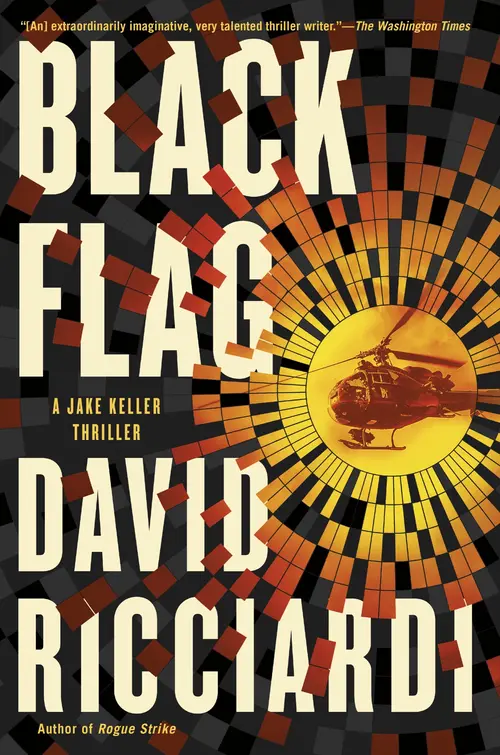
Black Flag
Cover
Berkley titles by David Ricciardi
WARNING LIGHT
ROGUE STRIKE
BLACK FLAG
Dedication
To Henry and Claudia, my inspiration for the second half.
Epigraph
In the era of square-rigged sailing ships, a black flag was flown by pirates to warn other vessels that an attack was imminent, but mercy would be shown if the crew surrendered without a fight. However, if the target refused to comply, the pirates would then hoist a red flag. The “bloody flag,” as it was known, was a signal that no mercy would be shown and no quarter would be given.
CHARACTER LIST
Badeed (“Shark Food”), Hawiye clan warlord
Cawar (“One Eye”), largest arms dealer in Africa, Isaaq clan
Clap, CIA Special Activities Center, Ground Branch team leader
Peter Clements, CIA, associate deputy director, intelligence
Farida, director of the Hawiye clinic
Gadhka Cas (“Red Beard”), boss of the Bakaara Market
Ted Graves, CIA Special Activities Center, chief
Jake Keller, CIA Special Activities Center, paramilitary operations officer
Masaska (“Snake”), disfigured Darood enforcer
Nacay (“Detestable”), son of Yaxaas
John Pickens, CIA, operations officer
Robleh, Hawiye clan elder, owner of Caafi water company
Athena Romanos, Greek shipowner (daughter)
Giánnis Romanos, Greek shipowner (father)
Steve, major, U.S. Army Special Forces
Saahid and Mahad, in INTERPOL’s Global Maritime Piracy Database
Yaxaas (“Crocodile”), Darood clan warlord
PROLOGUE
IT WAS A bad week for peace on earth.
Born the scion of a Greek shipping dynasty, the young man was said to have seawater running through his veins, but he cared not for the wheeling and dealing of the industry or the megayachts and private jets that came with it. His relationship with his family was strong, but its enormous wealth brought him neither pride nor shame—it simply did not define his existence. When he graduated from high school and the time came for him to choose between college and the family business, he decided instead—as he would for the rest of his life—to chart his own course.
The young man ventured 1,400 miles northwest, to the Dutch port city of Rotterdam, where he found work as an ordinary seaman at a competing line. He signed on under an alias—eager to prove to himself that he had earned his position—and was soon scraping paint, cleaning heads, and scrubbing decks. He worked hard, learned quickly, and moved rapidly through the ranks on everything from 150-foot tramp freighters to 1,200-foot oil tankers. Soon there wasn’t a crewman’s job aboard any ship, anywhere, that he couldn’t handle.
So he left the industry.
But he wasn’t finished.
He was just getting started.
The young man moved to Belgium and attended maritime college, where he spent four years studying navigation, load handling, and engineering before returning to the sea as a ship’s officer.
Strikingly handsome, with a square jaw and wavy dark hair, his resemblance to his father grew as he aged until, by his late twenties, even strangers would comment on the similarity. Once he’d attained the rank of ship’s master, he resumed using the family name. No one he’d served with would dispute that he knew his ships and the sea as well as anyone who’d ever commanded a merchant vessel.
In short order he was hired by the largest shipping company in the world to drive supertankers across the seas, taking 1,400-foot-long behemoths through storms that would frighten a statue and across oceans so vast that the crew would often go days without sighting another ship.
But as the years passed and the ships became more automated, the crews became smaller and satellite telemetry made him feel less like a master and commander and more like a bus driver. By the time he was in his late thirties, he’d moved back to his family’s shipping line, where he could once again manage the voyage and not simply optimize fuel consumption based on computer models and satellite predictions of weather and current.
—
WITH ASIA TO his north and Africa to his south, Captain Romanos was at the helm of the 860-foot M/V Lindos as it steamed east through the turquoise waters of the Gulf of Aden.
Sixty feet wide and with walls of glass, the oil tanker’s bridge offered a spectacular 360-degree view of the world as the sun fell through scattered clouds and disappeared below the horizon. The ship’s officers watched the sky and sea meld into blackness, interrupted only by the stars above and their reflections on the water below. Though they’d seen it happen a thousand times before, its mystical beauty never failed to reinforce their calling to the sea.
It was five past midnight when the captain prepared to retire to his stateroom and turn the bridge over to his second-in-command. Romanos was halfway to the door when the navigator spoke up.
“I’ve never seen that before,” he said, mostly to himself.
The captain stopped short.
The navigator and most of the other officers had come with him from the larger shipping company where they’d worked together for nearly a decade. They’d become like brothers, spending more time with one another than they did with their own families, and they’d learned to trust one another’s judgment and anticipate one another’s thoughts. Together they’d survived typhoons, been boarded by unfriendly navies, and had more barroom fistfights than anyone could count.
As far as the captain was concerned, the navigator had seen everything.
Romanos turned around.
“All three radars are full of static,” said the navigator. “Lost the GPS too.”
“Radio?” said the captain, nodding toward the single-sideband.
The communications officer turned up the volume.
“Nothing but noise. Same with the VHF.”
The captain looked at the chief engineer. “It could be electrical interference, but—”
The doors on both sides of the bridge burst open.
Six men in black and gray uniforms stormed in, three on each side, with rifles snugged in tight against their shoulders.
For as long as anyone could remember, ships’ crews had been instructed to cooperate when boarded. They would be threatened, they might even be abused, but their value as hostages decreased by 100 percent if they were dead. It had been the same with the airlines. Pilots had been told to appease hijackers because most were looking only to make political statements or maybe catch a ride to a forbidden destination. More often than not, all of the hostages were released safe and sound.
Cooperate and live. It had worked for most of modern history.
But piracy was experiencing its 9/11 moment.
The captain faced the gunman closest to him. The tall man’s blue eyes locked on like a hawk tracking its prey, but the captain stared right back.
“What do you—”
The pirate fired three rounds into his heart.
Captain Romanos was dead before he hit the ground.
—
TWO DAYS LATER, and a thousand miles to the north, a security guard met three trucks covered in dust from their long journey through the desert. The guard escorted the small convoy through the seaport’s high-security gate to a darkened warehouse and parked outside by the door while the trucks drove inside.
A lieutenant colonel from Iran’s Revolutionary Guards stepped down from the lead vehicle and began issuing orders to the forklift operator who’d been collecting overtime for the past four hours, waiting for the trucks to arrive. The lift operator had just finished unloading a dozen crates of rifles and rocket-propelled grenades from the first truck and was on his way to the second truck when two soldiers grabbed the warehouse’s metal doors and slid them shut in the security guard’s face.
Four soldiers climbed into the truck bed. Though it was midsummer in the Persian Gulf, the men shivered as they raised the plastic case by its handles. Roughly the size of a footlocker, the case wasn’t heavy, but the men moved it slowly and deliberately as they lowered it from the truck and placed it inside a slightly larger wooden crate.
Another soldier packed the empty space with blocks of dry ice and placed the wooden lid on top. A bead of sweat formed on his brow as the colonel handed him a hammer and a dozen nails. The soldier had seen the biohazard symbols painted on the plastic container and had no desire to disturb whatever was inside, but the colonel’s stare was unyielding. The soldier carefully aligned the hammer and tapped each nail into place with the minimum amount of force required to complete the task.
An hour after they’d arrived, the three trucks emerged from the warehouse and were escorted back to the main gate by the guard who’d been waiting outside. The entire operation had been shrouded in secrecy, from the civilian trucks to the late hour, and the guard’s name had been deleted from the roster—with explicit instructions from his supervisor to forget everything he’d seen.
The guard turned in the keys for his pickup and went to the employee locker room to change out of his uniform. He sat on a worn wooden bench and rubbed his eyes. It had been a long day and his shift was finally over. But he still had a phone call to make before his work was finished.
ONE
SIX MONTHS LATER . . .
JAKE KELLER FELT the blade of the machete against his throat.
The Somalis had gotten the jump on them.
“We’re with the United Nations,” Jake said in English. “We’re here to help.”
“You want to help? You give us money,” said Dameer. The nickname meant “donkey,” and he bared his teeth as he burst out laughing. His henchmen laughed too, as if he’d said the funniest thing they’d ever heard.
Dameer slammed his fist down on the table and the laughter stopped. His eyes were bulging and bloodshot.
“Pay us!”
He folded his arms across his chest while two of his cohorts brandished AK-47s. They were even more doped up than their leader.
“We just want to talk,” Jake said calmly. He’d been in worse spots before.
The Middle East, Europe, North Africa. Trouble had followed Jake like a hungry dog for the last two years—ever since he’d gone into the field for CIA.
“No money, no talk,” said Dameer.
Jake could smell the rancid breath of the man holding the knife to his throat.
“Maybe we take you hostage,” Dameer said. “Then UN pay us!”
He put his hands on the table. He was missing two fingers on his left hand. They looked as if they’d been cauterized with a rusty piece of iron. Punishment for something, no doubt.
“We’ll pay for protection,” said Pickens. “We just need to know who we’re paying.”
Dameer glared at him. Though Pickens was black, he looked nothing like the wiry Somalis. He’d been an outside linebacker at Northwestern University before joining the Agency. Beads of sweat glistened on his thick biceps and shaved head. He was built like an oak tree.
“Money, now!” Dameer shouted, slamming his fist against the table.
Pickens retrieved four fifty-dollar bills from his pocket and placed them on the table. Each one was a month’s wages for an honest Somali.
But there wasn’t an honest Somali in sight.
Dameer scooped up the cash and stuffed it in his pocket.
“More money, gaal.” It meant “infidel” in Somali, but the locals used it for any foreigner.
“There will be a lot of money,” Jake said, “once we talk to your boss.”
“You pay me,” said Dameer. “Then you go to Kitadra.”
It was the pirate capital of the world.
With no prospects on land, young Somali men with nothing to lose had taken to the sea to kidnap their way to riches, but aggressive countermeasures by ships’ crews and the world’s navies ensured that by 2015, the era of the Somali pirates was dead.
But it had made a comeback.
A new type of piracy had emerged in the last six months, and it was far more profitable and far more lethal than the old one. With each attack, twenty men disappeared and twenty million dollars’ worth of stolen cargo vanished—neither the crew nor the ships were ever seen again.
And it was a lot of money—enough to exert enormous influence over the broken nation of Somalia. It backed private armies and bribed corrupt politicians. It supported terrorism and funded human trafficking. For the country’s citizens, it meant a lifetime of living in fear: extortion, rape, murder.
The new wave of piracy was about to put the struggling country down for good.
And Jake and Pickens had been ordered to stop it.
“Who do you work for?” Jake asked.
Dameer said something in Arabic to his accomplices.
Jake didn’t know the Somali dialect well, but he understood enough of what Dameer had said to know what was coming next.
And it wasn’t good.
Pickens spoke Arabic and Somali, but he stuck to English around the locals. He learned a lot more when they thought he didn’t understand.
Like now.
It was going to be four-on-two. Dameer and the man with the machete, plus the two men with the Kalashnikovs, but they were so doped up that they probably couldn’t hit the air in front of them. The biggest risk from those idiots was a ricochet.
But it was a real risk.
The small room was made of concrete with a corrugated steel roof. Each bullet would have a couple of chances to find a target and if the gunmen went full Somali-style—rifle held at the waist and trigger held down until the gun was empty—there was a better-than-even chance that no one on either side would walk out alive.
The two Americans made eye contact. Pickens nodded almost imperceptibly.
Jake snapped his head back, shattering the nose of the man with the machete, then grabbed the hand with the knife and pushed the blade away.
The man staggered backward with tears in his eyes and blood streaming down his face.
Jake turned and punched him in the throat, then kneed him in the groin. The Somali crumpled to the ground, out of the fight.
Dameer stepped out from behind the table and squared off against Pickens. The Somali was tall and lanky, with a sweat-stained shirt, crazy eyes, and a knife of his own. It was rusty and dull, except for the edge, which was shiny and sharp.
Pickens brought his forearms up to protect his face and chest, like a boxer.
Old school.
The Somali waved the knife back and forth like he was trying to sell it. He took half a step forward.
Pickens faked right, then rotated his two-hundred-forty-pound body and launched a left into Dameer’s face. The blow lifted the man off his feet and hurled him into the back wall.
His sandals were still on the floor where he’d been standing.
It was a hell of a punch.
But the goons with the AK-47s had finally discovered that something was amiss. They were shouting and yelling and gesturing wildly—and pointing their rifles at Pickens.
TWO
THE TWO MEN with the Kalashnikovs were shaking.
It might have been from the drugs, or maybe they were nervous, but Jake wasn’t looking to make a diagnosis.
He was trying to keep his partner alive.
“Drop the weapons!” he shouted.
He had a 9mm pistol up and was shifting his aim between the two gunmen, making sure they each had a chance to look straight into the muzzle before he switched targets.
They could shoot Pickens, but it would cost them their lives.
It should have been an easy decision, even in a drug-induced haze, but the gunmen didn’t react.
Jake yelled again, this time in Arabic, and the men literally dropped their rifles onto the concrete floor.
Pickens scooped up the weapons and the two Americans backed through the door to a beige Daihatsu hatchback—a car so generic that it was like a third-world cloak of invisibility. With Pickens behind the wheel, they quickly disappeared into the low-rise streets of Mogadishu. Voted “the most dangerous city in the world” for twenty years running, it was a place where machine gun fire punctuated conversations and truck bombs ended them.
Though the thugs who’d tried to ambush them probably couldn’t walk a straight line, much less tail them through city streets, the two CIA officers didn’t take any chances. Pickens drove a full surveillance detection route over the narrow roads. The routes were designed not only to spot a tail but to do so without making it obvious, because acting like a trained intelligence operative was the surest way to confirm that someone was a trained intelligence operative.
Pickens spotted an accident blocking the road ahead and turned down a narrow side street to avoid a potential ambush. Lined on both sides with crumbling stucco buildings, it was impossible to tell where the blown sand ended and the cracked pavement began. He steered carefully around a man sleeping in the shade of a parked car and back onto a larger road where the two men could relax—somewhat.
“I’ve never seen a man knocked out of his shoes before,” Jake said.
Pickens grinned.
“The key,” he said, “is to rotate your hips and follow through on the swing.”
Jake checked the side-view mirror. “Too bad those idiots didn’t know anything.”
It was the third meeting they’d had in the four days since Jake had arrived, and each one had nearly cost him his life.
“We’ve got to start somewhere,” said Pickens.
John Pickens had been with the Agency for twenty years and working the Mogadishu account for the last eight. It was a medium-sized CIA station, but most of his fellow officers in the Directorate of Operations were working with their counterparts in the Somali National Intelligence and Security Agency or deployed in Counterterrorism Center teams. The CTC pursuit teams were the sexier side of CIA and, for the past twenty years, counterterrorism had been the fast track to advancement.
Pickens was in a career backwater.
“Everyone knows you’re understaffed here, John, but this is a new threat and we need a new response. Seven tankers have disappeared without a single distress call or ransom demand.”
Pickens snaked around the site of a recent IED attack. Two days prior, al-Shabaab terrorists had daisy-chained together half a dozen 122mm Russian artillery shells and detonated them in the back of a delivery truck. One hundred forty-six people had died. The air still smelled of diesel fuel and gunpowder, burnt plastic and seared flesh. An African Union soldier was in the blast pit, searching the twisted chassis for a vehicle identification number while children played nearby on piles of concrete rubble that had been their homes just forty-eight hours earlier.
“I told Ted this should be a joint op with FBI,” Jake said, “and he told me to shut up and find out who’s in charge of the pirates.”
“Is that what Black Flag is about?” Pickens looked over. “Is Graves looking to put people in the ground?”
Ted Graves was chief of the Agency’s Special Activities Center. The paramilitary officers under his command operated in the field with little oversight and were known for using their considerable autonomy wisely and ethically.
The same could not be said for their boss.
“Phase one is to identify who’s behind it,” Jake said. “I’m guessing phase two is rolling him up, but Ted hasn’t shared his long-term strategy with me.”
Pickens laughed and fist-bumped his new partner. “With you or with anyone, brother. I’m just trying to figure out why the Seventh Floor brass suddenly care. Piracy has been a way of life down here for twenty years.”
“It’s about oil.”
Pickens shrugged. “Always is.”
“But not the way it used to be,” Jake said. “Now that the U.S. isn’t importing as much from the Middle East, we’re reducing the military presence we’ve had there for the past fifty years.”
“The ‘Pivot to Asia’?”
“Exactly. Our forces are moving east to deal with national and regional threats, but whoever is stealing these oil tankers is clearing close to twenty million dollars each time they sell the cargo on the black market. That kind of money can fund terror networks and weapons of mass destruction.”
Pickens turned down a side street. “Then why aren’t the pirates ransoming the crews? That’s where they used to make their money.”
“Anonymity,” Jake said. “Headquarters doesn’t have a clue who is behind this: not an email, not a text message, nothing. You start making ransom demands and you leave a trail. Whoever is behind the hijackings understands operational security. This isn’t six-skinnies-in-a-skiff anymore. We’re up against professionals with training and resources, probably ex-military.”
Pickens scowled. “I don’t know, Jake. We take out this pirate and somebody will take his place before the body is cold. There’s no rule of law down here. People have gotten used to taking what they can today because they might not be alive tomorrow.”
“Economic opportunity is the long-term solution, but that’s never going to happen unless we find the pirate leader and put him out of business.”
The two men were stopped behind a line of cars and Pickens was tapping his hand against the steering wheel. Jake couldn’t tell if the anxiety was from the traffic, the narrow escape, or something else.
“I’m on board with the mission,” said Pickens eventually, “because that’s my job, but Somalia is a lost cause.”
THREE
JAKE AND PICKENS drove past Villa Somalia. Built by Italian colonialists, the whitewashed Art Deco building was the official residence of the Somali president, but with the country embroiled in a civil war since 1991, the villa changed tenants like a hot-sheet motel. The current government had been in place for less than a year, and though it didn’t control much territory outside Mogadishu, the new president took his personal security very seriously. He’d paid a lot of bribes and made a great many promises to secure his election, and he wasn’t going to waste the opportunity to grow rich off it. Armored personnel carriers staked out the compound’s corners and drop-down Delta barriers blocked the entrance.
The Story Continues on BooksBarbecue!
Enjoyed this preview? ❤️ Do not stop here!
Read the complete book free online → 🔗
Continue reading now on BooksBarbecue and discover every page!
Love reading? Bookmark BooksBarbecue.com for more amazing books!
Happy Reading!