Being Muslim
Cover Page
Praise for Being Muslim
“The book is strong on dealing clearly and directly with current contentious issues involving Islam. Siddiqui is unequivocal and effective in exposing double standards and inconsistencies in contemporary media coverage of news stories in which Islam plays a part.” — Canadian Materials Magazine
“Haroon Siddiqui does a careful job showing how many different points of view there can be within a shared religion.” — Chicago Tribune
“Siddiqui’s book isn’t polemical, nor is his style argumentative. On the contrary, he painstakingly addresses all those familiar ‘charges’ that have been routinely laid at the door of the Muslims of the world, and which encompass distorted interpretations of their faith and practices.” — Dawn News, Pakistan
“...this basic knowledge will help non-Islamic readers to make sense of what they see on the news, and to sort out the truth from the propaganda.” — Globe and Mail, Toronto
“This book would benefit not only the ill-informed non-Muslim, but serve as an excellent reference for the lapsed or culturally estranged Muslim.” — Gazette, Montreal
“Extremely challenging and thought-provoking, this book would be an excellent resource for senior high school students interested in politics and debate.” — Resource Links
“This balanced, concise book is an excellent resource for social studies or debate class.” — School Library Journal
“A wise and informative book.” — Eric Margolis, Toronto Sun
“Siddiqui writes cogently and clearly, wasting no words. This is an introduction to Islamic history and practice, but it also makes larger social and political points... In the end, he emerges as a calm, determined voice for a more modern Islam and for a society in which it plays a fuller, more constructive role.” — United Church Observer
“[Siddiqui’s] confrontation of the difficult issues whether in terms of ‘psychological internment,’ multiple identities, or the challenges that Muslims themselves must confront, is both rare and refreshing.” — Prince El Hassan bin Talal, Jordan

Slavery Today
Kevin Bales & Becky Cornell
The Betrayal of Africa
Gerald Caplan
Sex for Guys
Manne Forssberg
Technology
Wayne Grady
Hip Hop World
Dalton Higgins
Democracy
James Laxer
Empire
James Laxer
Oil
James Laxer
Cities
John Lorinc
Pornography
Debbie Nathan
Being Muslim
Haroon Siddiqui
Genocide
Jane Springer
The News
Peter Steven
Gangs
Richard Swift
Climate Change
Shelley Tanaka
The Force of Law
Mariana Valverde
Series Editor
Jane Springer
For my parents, the late Hafiz Mohammed Moosa Kandhlawi and the late Hafiza Amtul Baseer, for their endless love and indulgences that gave me the confidence to go anywhere, try anything.
My uncle, the late Hafiz Syed Sarwar Hussain, my first teacher and mentor, whose values continue to guide me.
My siblings, Maryam, Suleman and Hafiz Yousuf, for their enduring affection.
My wife, Yasmeen, whose animating presence lights up our household and whose judgment often saves me from mine.
Our sons, Fahad and Faisal, for whom and whose generation this book was written.
Muslims by Region / Language*
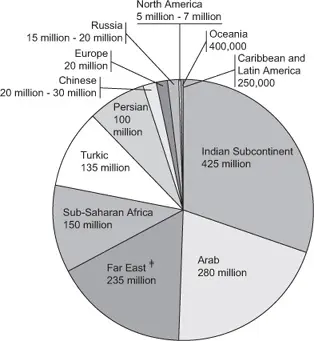
*The total Muslim population ranges between 1.3 billion and 1.6 billion. The uncertainty emanates mostly from three factors: outdated census in many nations, especially those embroiled in conflicts, such as Afghanistan, Iraq and Sudan; countries such as the US and France not recording their citizens’ religion; and Muslims in some countries, such as China, hiding their identity for fear of persecution. I have relied on estimates as listed in The World Factbook, www.cia.gov/cia/publications/factbook/index.xhtml.
‡The Far East includes Indonesia, Malaysia, Brunei, Singapore and adjacent areas.
Chapter 1
The Politics
UNDER SIEGE
Contrary to the popular belief that the West is under siege from Muslim terrorists, it is Muslims who have become the biggest victims of the attacks of September 11, 2001, as inconceivable as that would have seemed in the aftermath of the murder of 2,900 people. Tens of thousands of civilians have been killed since in Iraq and Afghanistan. General Tommy Franks, the American commander who oversaw the invasions of both countries as part of the “war on terror,” famously said: “We don’t do body counts.” But some civic-minded groups and institutions have.
In Afghanistan, the civilian death toll, as of September 20, 2007, was at least double that of 9/11 — “between 5,700 and 6,500,” according to the Afghan Victim Memorial Project, run by Professor Marc Herold of the University of New Hampshire. 1But these figures are clearly too low, considering that the Associated Press news agency was reporting more than 5,000 deaths in the first nine months of 2007 alone.2
In Iraq, where the American military presence has lasted longer than American participation in World War II, the scale of civilian deaths has been staggering. Iraq Body Count, a group of British academics and peace activists, tally between 82,772 and 90,305 reported civilian deaths to April 2008.3 This figure is also too low, considering that in zones of conflict, governments and media are generally able to report only about a tenth of casualties. Johns Hopkins University’s Bloomberg School of Public Health, therefore, opted for a different methodology of mortality count, one that had been used in the Congo, Kosovo and Sudan. Its team of researchers knocked on the doors of a representative sample of Iraqi households and asked if they had suffered any casualties. Projecting the results of the survey to the 4 million Iraqi households, it estimated the death toll across the country at 654,965 as of October 2006.4 Using a similar method, a British polling firm, Opinion Research Business, pegged the death toll at a shocking 1.22 million as of August 2007.5
Professor Les Roberts, co-author of the Johns Hopkins study, told me he agreed with the updated figure: “The toll stands at perhaps over a million,” more than 300 times the toll on 9/11.
Whatever the exact toll, there’s no denying the carnage in the killing fields of Iraq. Yet there has been little outrage, let alone official acknowledgment, in the US or among its allies. “We are communicating to the (Muslim) people of the Middle East and beyond that we don’t care for their lives,” said Professor Roberts. “We are sowing the seeds of terrorism that could dwarf 9/11.”
Not all the casualties were caused by US and other coalition forces. In Iraq, an increasing number of deaths were attributable to Sunni-Shiite sectarianism; to collateral damage from raging battles between various militias; and to criminal gangs taking advantage of the breakdown of law and order. But the mayhem was born of the collapse of the social order under the US-led occupation, prior to which Shiites and Sunnis had lived in peace for generations, dating back to the formation of Iraq in the 1920s. There is, therefore, no escaping the moral responsibility for what transpired in Iraq after the 2003 invasion.
As for the number of Iraqis injured, the estimate ranged from a confirmed figure of 125,0006 to between 1 million and 2 million.
More than 4 million Iraqis have been displaced — 1.2 million to Syria, 800,000 to Jordan and the rest internally, according to the UNHCR, the United Nations refugee agency, which called it one of the worst humanitarian disasters of modern times.
Even in the spots hit by terrorists — from London and Madrid to Amman, Istanbul, Riyadh and Jeddah, through Karachi to Bali and Jakarta — more Muslims have been killed and injured than non-Muslims.
The approximately 25 million Muslims living in Western nations have been targeted in other ways.
They have been victims of racial profiling and frequent identity mix-ups at airports and border crossings, where they have been harassed and sometimes detained.
Monitored by both the secret services and the media, Muslims must be careful about what they say in emails, phone
Muslims in the World7
There are 1.3 billion Muslims, who constitute one-fifth of the world’s population.
Islam is the fastest-growing religion in the world, including in Europe, the US and Canada.
Islam is the second-largest religion after Christianity, which has 1.9 billion adherents.
There are more Muslims than there are Catholics (1.1 billion).
Muslims constitute the religious majority in 54 countries.
There are as many Muslims as there are Chinese people.
There are as many Muslims in China (33 million) as there are Canadians in Canada.
conversations and in public. They must think twice about keeping a beard or wearing overtly Muslim clothing and be mindful of how they behave in public. They must keep proving that neither they nor their faith fits the caricature of Muslims and Islam drilled into the public consciousness.
They feel under siege, living through what the Canadian Arab Federation has called “psychological internment,” referring to the internment of thousands of Japanese Americans and Japanese Canadians during World War II. For American Muslims, the post-9/11 period has parallels with the infamous McCarthy era of the 1950s, when Senator Joseph McCarthy led a witch-hunt of suspected Communists and ruined the reputation and lives of many innocent Americans.
Muslims, therefore, had good reasons to be angry at George W. Bush, as polls have shown.8 But their quarrel with the US predated him, emanating from several policies:
• American support for Israel’s occupation of Palestinian lands, Israel’s suppression of Palestinian resistance and its 1982 invasion of Lebanon, which left 15,000 Lebanese and Palestinians dead;
• American alliances with undemocratic and oppressive Muslim, particularly Arab, regimes;
• The 1991-2003 US-led economic sanctions on Iraq, which caused the slow death of about 1 million Iraqis, half of them children under the age of five.9 In 1996, Madeleine Albright, US secretary of state, was asked if so high a price was worth the American goal of “regime change” in Baghdad. Her chilling reply: “We think the price is worth it.”10
• Washington’s silence over Russia’s two wars on Chechnya (1994-96 and 1999-2005), which killed between 100,000 and 200,000 Muslims.11
The US did garner goodwill among Muslims for its humanitarian interventions in Indonesia following the tsunami disaster (2004), and in Bosnia (1995) and Kosovo (1999) in the former Yugoslavia, where 250,000 Muslims were killed under Serb ethnic cleansing.
The September 11 terrorist attack engendered as much sympathy for the US and Americans in the Muslim world as elsewhere; there was a candlelight vigil even in Tehran. The United Nations-approved war on Afghanistan, the base of Osama bin Laden and the al Qaeda terrorist network, was supported by several Muslim states. What turned the tide of Muslim public opinion were Bush’s policies, starting with his strong backing of Israel’s brutal crackdown of the second Palestinian intifadah(uprising), from 2000 to 2003, and the 2006 Israeli invasion and indiscriminate bombing of Lebanon that killed more than 1,000 people and destroyed much of the civilian infrastructure, including residential buildings.
Then there was Iraq.
The War on Muslims
As most of the world feared then and knows now, Bush — enthusiastically supported by then British and Italian prime ministers Tony Blair and Silvio Berlusconi — ignored the United Nations and invaded and occupied oil-rich Iraq under false pretenses by exploiting public fears over Muslim terrorism. When every one of the reasons cited for the war was proven wrong — Saddam was not responsible for 9/11; had no connections to al Qaeda; and had neither nuclear, chemical or biological weapons nor the Scud missiles and pilotless planes to hit anyone — Bush and Blair changed their tune. They had gone to war to get rid of a dictator and bring democracy to Iraq and the Middle East.
It is said that Saddam killed at least 500,000 Iraqis during his nearly thirty-year gulag. The US, Britain and their allies have killed more than double that many in half the time, dating back to the economic sanctions. Whatever else his shortcomings, Saddam built a modern, secular state that provided decent health care and a range of public services. The US and its allies destroyed Iraq’s infrastructure as well as the symbols of its 3,000year-old civilization, and presided over the social disintegration of society. Iraqis got a new constitution and held elections, but they didn’t get clean drinking water and electricity, and they couldn’t venture out of their homes for fear of being shot dead by anti-American insurgents or by American soldiers in “friendly fire” or by American private security contractors, an army of more than 30,000, acting with impunity.12 In the absence of the most basic security, scared Iraqi citizens retreated into the safety of sects, tribes and Shiite or Sunni neighborhoods.
In Afghanistan, years after the ouster of the Taliban, relief and reconstruction work by the US and its allies, including Canada, remained mired in either incompetence or widespread corruption, or both. The promised rebuilding of the economy proved a mirage, and the most lucrative jobs were either in the service of the warlords or in cultivating poppies, as the country went back to being the world’s largest exporter of heroin.
The abused and the tortured at the Abu Ghraib prison in Baghdad, at the detention center at Guantanamo Bay (on the US-controlled part of Cuba) and in secret American-run prisons around the globe were Muslims. Some of the detainees were forced to watch the desecration of their sacred book, the Qur’an, or force-fed pork and alcohol or coerced into nudity, masturbation and other transgressions of Muslim religious and cultural norms. These were not isolated incidents carried out by a handful of undisciplined soldiers, as claimed by the Bush administration, but part of a program to break down the inmates by violating their deeply held religious precepts. Yet only eleven low-ranking soldiers were court-martialed for the Abu Ghraib scandal, and not a single officer was punished beyond a reprimand.13
Then there was “extraordinary rendition” — the American policy of subcontracting torture abroad. In about 1,000 secret flights, chartered Central Intelligence Agency planes, often flying illegally through Canadian and European air space and using their airports, ferried Muslim suspects to Egypt, Saudi Arabia, Pakistan, Syria, Morocco and Uzbekistan — states long condemned by the US State Department for human rights violations.14 From Malawi to Bosnia, the CIA also carried out “cross-border arrests that verged on kidnappings,” according to Human Rights Watch,15 and whisked away the captives to foreign jails or Guantanamo Bay or secret CIA-run detention facilities in Afghanistan, Thailand and Eastern Europe. The CIA reportedly captured 3,000 people worldwide, and its “black sites” held 100 desaparecidos, as the disappeared of Latin America used to be called. “We invoke the term very decidedly,” Carroll Bogert, associate director of Human Rights Watch told me in 2005.
Washington also provided overt or tacit support for allies who invoked the war on terrorism as a cover to crack down on Muslim dissidents and Muslim resistance to occupation or repressive rule. Waving the anti-terrorism banner, Russia, Israel, China, Uzbekistan and the Philippines intensified repression in Chechnya, the West Bank and Gaza, Zinjiang, the Ferghana Valley and Mindanao Island, respectively.
At Home in America
Within weeks of 9/11, the Bush administration arrested about 1,200 Muslims. The Justice Department’s own internal watchdog would later catalog the harsh treatment meted out in the 762 cases that he examined: verbal and physical abuse of the detainees, including slamming them against the wall, confining them to their cells for 23 hours a day, restricting them to one legal phone call a week and one social phone call a month, and denying them legal counsel for long periods. They were not told for weeks why they were held — for an average of 80 days each. In the end, not one was charged with terrorism-related offenses.16
The administration introduced a plan to register non-citizen and non-green cardholders from certain Muslim countries. More than 80,000 responded, including many who had been in the US illegally. About 14,000 were picked out for deportation.17 Rather than risk arrest, thousands left the country. These people were “not terrorists,” said Anthony Romero, executive director of the American Civil Liberties Union, but “had come to the United States for the same reason previous generations of immigrants had, for a better life and for freedom.18 That is not to say that illegal immigrants should have been allowed to stay, but rather that the government conducted a selective prosecution. There were, after all, nearly 11 million illegal immigrants in the US and 305,000 outstanding deportation orders at that time.
The administration also finger-printed and questioned 50,000 Muslims from or associated with Syria, Libya, Iran, Iraq and Sudan. About 8,000 were identified by the FBI for “voluntary” interviews that turned out to be “highly coercive,” according to Romero; they were questioned about their “bank accounts, mosque attendance and opinion about the US, in violation of their constitutional rights to freedom of speech and religion.” Few, if any, were found to have any terrorist connection.
Of the reported 83,000 people detained in the United States and abroad, only 335 were prosecuted as terrorists, of whom only 213 were convicted and only 123 were found to have committed a crime serious enough to be jailed.19
Among those arrested was James Yee, a 1990 West Point military academy graduate and a Christian convert to Islam who was appointed the Muslim chaplain at Guantanamo Bay. He was hounded because he had warned against the mistreatment of Muslim prisoners there. In September 2003, he was thrown into solitary confinement and charged with mutiny, sedition, espionage and aiding the enemy. When all those charges had to be abandoned for lack of evidence, he was slapped with lesser, still trumped-up charges of having porn on his computer and committing adultery. By March 2004, those charges, too, were dropped.20
Jingoism, Not Journalisn
Throughout all this, many in the American media kept echoing the steady drumbeat of the Bush propaganda, producing more jingoism than journalism. Little wonder, then, that even as late as December 2004, when most of the abuses against Muslims were well known, 44 percent of Americans believed in restricting the civil rights of Muslim Americans, according to a nationwide survey by Cornell University.21
American democracy, however, does work, albeit slowly. Thanks to the diligence of human rights activists, including academics and some investigative journalists, a clearer picture has emerged of how the Bush administration, operating mostly in secret, violated both international and American law, in four broad areas:
• Indiscriminate detentions, suspension of the most basic rights of the detainees and a denial of access to them by such agencies as the International Red Cross;
• Coercive interrogations, including torture, redefined so expansively by the administration — it is torture only if it leads to “organ failure, impairment of bodily function or even death”22 — that Bush could claim that “we don’t do torture.” This is while detainees were being subjected to harrowing punishments, including slapping them on the head; depriving them of food; keeping them manacled in stress positions for prolonged periods; forcing them to stay naked for hours in a frigid cell or having them stand in the 50°C (122°F) heat of Iraqi summers; depriving them of sleep for days by battering them with thundering music; or subjecting them to “waterboarding,” simulated drowning.23
• Delayed trials or no trials for the detainees or, in the case of those held at Guantanamo Bay, military commissions that were derided as kangaroo courts, and that were so fraught with problems that only one case was completed in the first five years.
• Secret surveillance, including wiretapping, of suspected (Muslim) residents of the US and all those they associated with.
The Canadian Case
Canada, which takes pride in being the world’s only constitutionally multicultural nation, was not immune from post-9/11 excesses. Five long-time residents of Arab origin languished in jail without charge for years. Two of them went on hunger strikes to protest their living conditions — in one case to get winter clothing and slippers for his cold cell and in the other to get medical treatment. As Alexandre Trudeau, son of the late prime minister, told me in 2005 while making a documentary about the five, “It is one thing to say we need to hold them because they are a threat to national security; it is another to be punitive with them. The logic may well be that such harsh conditions are an encouragement for them to voluntarily agree to deportation” — to their native nations of Syria, Egypt, Algeria and Morocco, which all practice torture.
“Voluntary deportation” was what twenty-two Pakistani and Indian Muslim men agreed to after being rounded up in Toronto in 2002 amid sensational accusations of being an al Qaeda sleeper cell that was going to blow up a nuclear facility and the CN Tower, then the tallest free-standing structure in the world. But in the end they were only charged with petty immigration violations, not terrorism offenses, and they simply left the country.
Meanwhile, an independent judicial commission in Canada— the only one of its kind in the post-9/11 world — probed American and Canadian complicity in the torture of Ottawa software engineer Maher Arar in a Syrian jail. He was passing through New York airport in the fall of 2001 when American security officials, after consulting their Canadian counterparts, put him on a special CIA flight to Damascus, where he was held for 374 days. He was released only after a spirited campaign in Canada by his indefatigable wife, Monia Mazigh, with the help of human rights groups and the opposition New Democratic Party in Parliament. “I never heard of a Canadian being deported to Ireland because of his Irish descent,” she told me in 2003. “A Canadian citizen traveling on a Canadian passport must be treated according to Canadian values. If he has done something wrong, charge him.”
Arar was never charged. In fact, the judicial commission concluded that he was innocent and had been wrongly labeled an “Islamic terrorist” by the Royal Canadian Mounted Police, which had casually passed on the unproven allegation to the US. Canadian officials then tried to cover up their complicity through a smear campaign of media leaks and misleading memos designed to prevent Arar’s return to Canada.24 Ottawa was forced to formally apologize to Arar and settle with him for $10 million.
While no compensation could ever right the wrong done to him, other Muslims falsely accused of terrorism, in any jurisdiction, are rarely vindicated. “Once you are labeled a terrorism suspect, you are stuck with that label for the rest of your life — worse than being called a Communist in the McCarthy era,” Paul Cavaluzzo, the lead lawyer for the commission, told me.
The Story Continues on BooksBarbecue!
Enjoyed this preview? ❤️ Do not stop here!
Read the complete book free online → 🔗
Continue reading now on BooksBarbecue and discover every page!
Love reading? Bookmark BooksBarbecue.com for more amazing books!
Happy Reading!