Chapters (11)
Historic European prejudices against Muslims have been exacerbated by the 2001 attacks on the US, the 2004 train bombing in Madrid and the 2005 subway bombings in London. The twin European pathologies of xenophobia and Islamophobia have come together in a toxic mix. Even when Muslims are not immigrants — two in five have been born in Europe — they are treated as foreigners. Muslims in France and Germany face the most systemic discrimination — in citizenship laws, employment and politics, at school and in day-to-day social contacts.
Unemployment among French Muslims is nearly double the national average of 9 percent. It is more than 30 percent in the banlieues, the crowded social housing projects that were the scene of riots in 2005 and 2007. The jobless rate for French Muslim university graduates is 26.5 percent, compared to the national average of 5 percent.3 Unemployment and underemployment extends to the second- and third-generation offspring of post-World War I immigrants, mostly the harkis (Muslims welcomed into France because they had fought alongside the French in colonial wars), or guest workers from North Africa (who were invited because of labor shortages). That soccer star Zinedine Zidane rose from their ranks does not mask the mass poverty of millions or the racism that they encounter.
In Germany, the jobless rate for Muslims (mostly Turks) is twice the national average of 11 percent. It is as high as 50 percent for younger Muslims in some cities. Schoolchildren of Turkish origin are routinely channeled into dead-end non-academic streams, the way Muslim children are in France.4 Job discrimination against Muslims is rampant even in Sweden, despite its liberal views toward immigrants. In Italy and Spain, the gravity of the situation can only be guessed at because most Muslims there do not have citizenship.
The irony is that Europe, with an aging population and a low birthrate, faces a population drop, from 450 million now to 400 million by 2050, unless it attracts new immigrants.5 There will not be enough working-age people to pay for health care, pensions and other benefits. The young that Europe does have in abundance are the urban Muslim underclass, whose working years are being wasted. Germany, with the lowest birthrate in Europe, despite a recent uptick in births, and France, with the largest number of Muslims on the continent, will find it particularly difficult to fix their ailing economies without making their Muslim youth more productive. More ominously, Europe risks losing some of its angry alienated youth to the certainty and the instant identity of Islamic militancy.
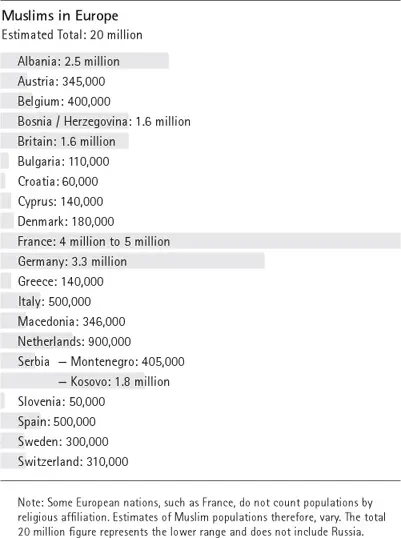
Jytte Klausen, professor of political science at Brandeis University, sees a direct relationship between restrictive citizenship laws and the economic, social and political isolation of Muslims. She studied Muslims in six nations (France, Germany, Britain, the Netherlands, Sweden and Denmark) and found that the higher the hurdles to citizenship, the worse the Muslim plight and the slower their integration.6