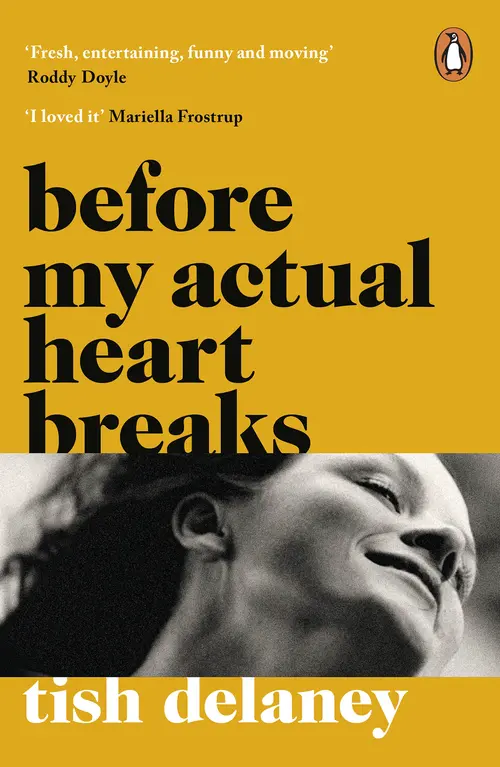
Before My Actual Heart Breaks
Cover

About the Author
Tish Delaney was born and brought up in Northern Ireland at the height of the Troubles. Like a lot of people of her generation, she left the sectarian violence behind by moving to England. After graduating from Manchester University, she moved to London and worked on various magazines and broadsheets as a reporter, reviewer and sub-editor. She left the Financial Times in 2014 to live in the Channel Islands to pursue her career as a writer.
Dedication
For Neil Paterson, artist poet.
And for Madge, 1922–2016. Much missed.
Epigraph
May the road rise up to meet you.
May the wind be always at your back.
May the sun shine warm upon your face;
the rains fall soft upon your fields and, until we meet again,
may God hold you in the palm of His hand.
Traditional Gaelic blessing

2007
THE ROAD RISES UP
1
People drown because they have to breathe in, they can’t not. Granda Ban told me that at the wake of a fisherman over thirty years ago. His voice tickles my ear and I’m back in that room with him and my Auntie Eileen and the fascinating remains of the blue-lipped Bart Macroom. I’ve never forgotten those words. When that night floats close, I hold my arms out and hug it to me, and I am once again that eleven-year-old girl, a girl who was out of reach of her mammy for the first time ever, a girl who thought the local fortune-teller would finally confirm her wildest dream – one day, maybe that very day, she would grow wings and fly.
– Poor auld Macroom! He’d worked that river his whole life dreaming of landing the perfect fish and now he’ll never know there was a fine salmon on his line when he was found. Isn’t that the saddest thing you’ve ever heard, wee Mary?
I put on my best pious face and sighed. I wanted Granda to be in no doubt that I was all grown up, but my chance to shine was ruined by Auntie Eileen who tutted and phutted at him before she hustled me away. She didn’t want anyone, including her father, egging me on. Even then I had a reputation for whimsy.
I was not supposed to be in with the big men puffing on pipes and telling tales. They were enjoying the respite of a nearly natural death in 1970s Northern Ireland. The Troubles rumbled constantly overhead like a thunderstorm, only tonight there would be no visits from the RUC or the British Army because it wasn’t a wake for anyone involved in the IRA. There was every chance one of the big men would have one whiskey too many and lift me up to kiss Macroom’s dead cheek, just for the craic.
I had been designated to help the ladyfolk with the tea because Auntie Eileen only had her daughter Bernie, and Bernie was not well enough to navigate kitchens or corpses. There was no shortage of help, kettles were boiling, big steel teapots were being filled, a production line of bread butterers, fillers and slicers were arranged around the table, knives and tongues moving at speed. A lot of good, strong tea is drunk over Northern Irish remains. The mourners are sorry for your trouble while they eye up the quantity and quality of the ham sandwiches flying round on the fine-china wheels of borrowed cake stands. It was already past nine o’clock but the wake wouldn’t thin out until after midnight.
I was employed to cut up a heavily laden fruitcake that someone had baked and brought to feed the mourners. For some reason – kindness or madness – they had fashioned a fish out of candied orange peel on the top with an alarmingly large glacé-cherry eye. It looked up at me, succulent and pink, and begging questions.
– Auntie Eileen, what happened the salmon?
– What salmon?
– Dead Macroom’s salmon! The one he caught?
– For God’s sake, Mary! You wee spook! You’re worse than Granny Moo! Get that cake on to a plate and get round the wans in the front room. Tell them fresh tea’s comin’!
I’d run on, laughing at the swipe of the tea towel on my backside. Auntie Eileen had never hit me in her life; she was the reason I knew it was possible to spare the rod and not spoil the child. She was the reason I knew I wasn’t nothing though Mammy had told me I was in every way, every day.
I remember watching her as I have a hundred times since. She was a fair beauty with her wild black hair in a high knot and our famous Ban Rattigan clan ‘white’ eyes which are in fact a pale grey-green. She moved from one person to the next with a sunshine smile at every step.
She put her arms around my neck when the fortune-teller, Decker McHugh, blew in, stinking of pigs and drink. He always pitched up at a wake for the free fire and free food, and later the free whiskey. His services were in demand at the height of the Troubles when most people didn’t make it through a week without a threat to body or soul. He read the leaves, and all the tea drinkers crowded around him because he only ever allowed one lucky person the chance to know what dangers or delights lay ahead.
With a light tap of his middle finger on my forehead I was picked. I was the one! He sat back to settle himself for the task ahead. Oh, I was made up! A special girl at last.
I supped up my milky tea and watched Decker swirl the cup in his big hand. I knew what I wanted to hear – that my bony shoulder blades would break through my skin, covered in feathers – long white feathers sweeping the floor like all the best angels from St Bede’s. I would take off as soon as I’d shook them dry. I’d leave the muck of The Hill behind. I’d be away in a matter of minutes, over our hill, over the next hill and the next, across the border, along the steely grey stripe of the Cloon River, the green grass shivering below me as I swooped through the valleys. I’d be out of Mammy’s reach for good.
I chewed my fingernails down to the nub in pure excitement. Decker spun my cup dry and looked into the brown leaves, his bushy eyebrows drawing together in a frown. Auntie Eileen pulled me closer, I could feel the rosary beads in her apron pocket and the smell of the Coty talc Bernie was always doused in. We both leaned in for the big news.
– There’s naught but rough seas for this wan, said the sorrowful showman.
– You could say that for any woman young or auld, Decker McHugh, you buck eejit, snorted Mrs Johns who lived down the back lane.
– What else would you expect in the Six Counties? roared somebody else.
It took Eileen a long while to settle me that night. I thought of the white waves rolling over the sand at Bundoran on our one-Sunday-a-summer seaside outing. How cold the water was off the coast of Donegal, how easy it was to get a lungful of salt and burny eyes, how the waves dragged you back even when you were running as fast as you could to get to the beach, the watery fists wrapped tight around your ankles, your mammy not caring, your daddy too far away to notice. Was that the rough seas he meant?
– You’ll travel, said Auntie Eileen to placate me. That’s all it is!
– Do you really think so?
– Sure, you have to take to the sea rough or not if you want to get as far away as America one day?
Auntie Eileen was a big fan of America. She was a big fan of anywhere that wasn’t Carncloon. She’d already been to New York – that’s where she’d got married and where Bernie had been born. I feasted on her tales of true love, of adventure. I was right by her side as she walked down Fifth Avenue describing the dresses she saw in the windows, imagined the coffee places where she tasted her first proper cup (‘it’s not even a bastard cousin of that Camp shite, don’t ever forget that, Mary’), watched her learn to eat spaghetti by twirling it on a spoon.
Her stories were the best boiled sweets ever invented, changing colour and getting sweeter every time I rolled one round my tongue. They tasted of freedom. My head fairly bloomed with its possibilities. If she could do it, so could I, we were the same blood. It was Mammy who first called us two rotten peas podded thirty years apart.
The hum of Macroom’s wake had carried on below us. Decker, safe in the knowledge that there would be no unnerving British Army Saracens on the street, took a fit of singing ‘The Boys of the Old Brigade’ and Eileen went back downstairs to see if she could hide the whiskey. I lay listening to Bernie choking on her wet snuffles and wondered if I could take her with me, back to her own country where she could breathe in without drowning.
The stormy seas first hit when I was a green girl of sixteen, but they did not carry me off. My life has been landlocked except for the times the Cloon burst its banks and the water let itself in like an old friend. The five children I reared looked forward to the floods like a day out, splashing through the kitchen like ducks. They are all gone now, grown up too fast, and my silly dreams of sleeping in, of being left alone for just ten straight minutes, have been realised.
When I think my voice is going to crack on the phone to them, I remember those days of wanting to be up, up and away from here, so I smile and laugh as they check again and again that I’m alright, that I’m coping, that I’m keeping busy. It’s because I’ve lost their father.
I lost him three hundred and seventy-two days ago, so many sunrises and sunsets with not much light for me in between. He isn’t hiding behind the barn or fallen down a bog hole. He’s not dead, just taking a break, and I feel a white-hot poker of regret from my womb to my throat when I recall that it’s me he’s taking a break from. He did well to last as long as he did. Not many men would have survived a mother-in-law like his, never mind a marriage like ours.
I blamed him when I failed to fly because it was him who clipped my wings. That’s the lie I told myself at sixteen and I repeated it so often that it came to be true. I fashioned a cage out of self-pity and slipped it over my head like a boned corset to hold myself together and to keep him out.
Wouldn’t it have been great altogether if Decker McHugh or anyone else at Macroom’s wake had been sensible or sober enough to tell me that rough seas make the best sailors? Wouldn’t it have been even better if I’d figured it out for myself before it was too late?
2
I have travelled – two bumpy miles from The Hill where I was born to where I live now. If you had to crawl with a pig on your back it would seem like a big journey, says Auntie Eileen. She has an eye for the bright side.
The Hill is my father Frank Rattigan’s place, known as that because it sits on Dergmoy, the highest of the five pudding-bowl hills of the Cloon Valley. The other four are Muckle, Sessiagh, Aghabovey and Glebe, each with its own patchwork quilt of greens, brown and purple. The house is a big square pebble-dashed, two-storey affair with many barns and sheds at its back. It’s also a landmark. Strangers looking to cross over the border into the Republic of Ireland are often advised to turn right at the Ban Rattigans’, which makes it sound like a mighty mountain range when it’s only a farm.
I had sixteen years at The Hill. I learned to pray there and I learned to give up on prayers there. I learned how to keep my mouth shut, to not let a single thing show on my face though my insides churned and burned. I learned that I was nothing. I learned how to take a slap and to never forget that it was no one’s fault but mine that I’d needed it.
I only have to close my eyes to see the way the light caught the corner of the sofa in the Good Room and eventually bleached a pink triangle on the red material. The way Daddy always left his wellies with the toes pointing towards the back door as if he couldn’t wait to be outside again. The way the kitchen always smelt of fresh scone on a wire that was not to be touched. The way there was nowhere to hide. The way my dream of leaving it came true so quickly that it took my breath away for years.
There are pictures of all seven of us Rattigan children, nailed to the wall in Baptism, Communion and Confirmation clothes. Mammy only framed the sacraments. There are no memories of seaside smiles or weddings. There’s not a single photograph of Frank Rattigan in The Hill, though images of God hang in every room. He was the man of the house, not Daddy. He was firmly on the kitchen wall with His Sacred Heart all ablaze outside His body, reassuring her with His big sad eyes that she was doing just fine. He was in the kept-for-best Good Room suffering the little children to come unto Him. He was in the back scullery in a lovely pink robe shepherding sheep. He was in her and Daddy’s bedroom with moonbeams bouncing off His head as He’s borne aloft by doves to keep His toes out of a powerful waterfall.
Upstairs He’s peppered about the place on crucifixes and in pictures which shimmer and shine and are lit up by electric bulbs in the shape of candles. When Mammy says, ‘Good Holy God is watching you,’ you cannot doubt her. He will condemn you on her behalf.
Alongside Him she has my particular favourite, No Siree Bob, the firebrand. On her scale of fury, 0 being mild rage, 10 apoplectic, No Siree Bob sat at around number 7. Good Holy God was a 9 and then it was straight to the perfect 10, the Virgin Mother herself, the Bo Derek of Catholic retribution. It was a busy house, though we rarely had visitors.
The weather in West Tyrone doesn’t help any mood, melancholy or otherwise. The wind and the rain batter us all day and all night for what feels like weeks on end and that’s just the summer. The Hill fairly rattled through every season. The tiny gaps at the windows sang like saws when the gales flew at us from the Blue Stacks on Donegal. The width of the block walls was all that stood between us and death by exposure – and not because Mammy cared about us freezing in our beds – she cared only for the health of our souls.
To help us get ahead in the race to Heaven, she made time to clean the chapel. It was a privilege, we were a chore. When she had scrubbed us, every room in The Hill and the doorstep clean and cooked three decent meals, she cycled off with a light heart to do it all again for God.
She polished the brass plaques, she mopped the marble under the altar, she swept the wooden floors and dusted the pews and she fed the priest whatever titbits he had a fancy for. She ripped the flowers from our garden and put them in vases under the dead-eyed statues. She looked like the perfect Catholic woman with her big family, her immaculate house, her devotion to the Church.
When peace broke out in Northern Ireland on Good Friday 1998, she was far from happy. She missed the daily battles and being duty-bound to sneer at any Protestants who crossed her path. Her and the Troubles have been on the back foot now for nearly a decade. The government of us and them – depending on what side of the barbed wire you were on – had bounced back to London for a while, but now we are power sharing! And surely anything is possible when the Chuckle Brothers – the Democratic Unionist Party’s Reverend Ian Paisley (hate preacher) and Sinn Féin’s Mr Martin McGuinness (former IRA commander) – still haven’t kicked ten bags of shite out of each other?
– There was a photo of those two fuckers in the Tyrone Constitution the other day, says Auntie Eileen, smiling at each other. Smiling! At each other! Imagine it, Mary? The fuckers!
It was nice that Auntie Eileen was more engaged with current affairs these days. When poor Mo Mowlam, God rest her resolute soul, was battling with both of those wonderfully dedicated public servants in the 1990s, Eileen only had one eye, one ear and evidently only half a brain on events unfolding on the BBC’s Inside Ulster programme.
– That poor woman has to fairly tear her hair out to be heard.
– Eileen, she has cancer.
– Who?
– Mo Mowlam!
– Mo Mowlam has cancer? No! Mother of God, what is she doing here wastin’ her time on those dickheads? She should be at home lookin’ after herself. She’ll understand the benefit of rest one day!
Ah, Auntie Eileen and her one day, one day! If she has one fault, it’s her one day, one day! ‘One day’ has been hanging over my head like a noose for as long as I can remember and even now I can’t outrun it. She kept me so firmly focused on all the good things that would happen one day because so many bad things happened every day. But that meant I missed out on a thousand gems that were right under my nose. High on the list is him, the missing husband.
The September sun is dipping and the chill that it will leave reaches me where I sit outside the house that I long to call my own. I must check my hens, I must check the gates, I must check some rat traps that I have set in the barn. A lonely woman’s work is never done. When I stand, my cat stretches himself, ready for the plod around the perimeter. His creaky yawn tells me that he doesn’t have a care in the world except his supper – lucky little rascal.
I wake up every morning to the deafening noise of a deserted hearth. I turn in every night with the ghosts of a life not well lived. If I could go back to being sixteen again, I’d do things differently. Everyone over the age of forty feels like that, you total gom, says my best friend Lizzie Magee. Auntie Eileen advises me to up my intake of sweets. When I was small, she often saved me with barley twists and chocolate limes because there was nothing she could do about the welts on my body.
I never could protect myself. I didn’t even open my mouth when my father gave me away. I thought it was the worst thing by far to befall me until I was taken by force. Those thoughts can drown me faster than black clouds.
To settle the heart banging painfully in my chest, I list the things I do know. I know my father loves me, I know my mother does not. I know that I have to reap what I have sown, it’s only fair. I am the mother to five children grown and gone in the blink of an eye. I am the sitting tenant of one farm, the wife to one husband, the fool to one lover. I have an empty nest, an empty lap, empty arms, a hollow heart.
The wind suddenly barges through the big sycamores at the bottom of my street. The crows rise up in a rage and a flurry of seed parachutes twirl to the ground, God’s confetti. I can see myself walking beneath them when we were all a lot smaller but equally green. They mark the entrance to the river field where the Cloon bends to make its journey to the town ten miles away. If I run, can I catch the little girl that was me and press my face to hers? You’ll be alright, I’ll say, one day. I could point out the holes in the road ahead where she might fall. She fell a lot. Even in this moment of seeing her again she has scabby knees. She’s too thin by far. It’s the week before her First Confession; she has a terrible thing to tell the priest. Stay away from the water, I whisper but she can’t hear me. If I’m quick I can at least hold her hand.
1973
THE WIND AT YOUR BACK
3
My big sister Kathleen is leaving me here soon. I will have to sleep alone in the dark at The Hill. Lights cannot be left on to burn perfectly good electricity for stupid little girls who should know that there is only one thing to fear and that is losing the love of Good Holy God and His Virgin Mother. I am seven but she is seventeen so it’s past time she had a proper job and stopped getting under people’s feet, way past time.
The Story Continues on BooksBarbecue!
Enjoyed this preview? ❤️ Do not stop here!
Read the complete book free online → 🔗
Continue reading now on BooksBarbecue and discover every page!
Love reading? Bookmark BooksBarbecue.com for more amazing books!
Happy Reading!