Bad Art Mother
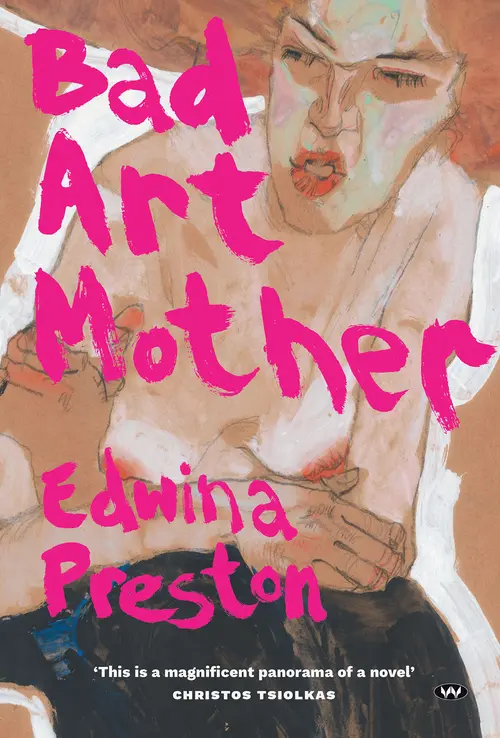
Cover
About the author
BAD ART MOTHER
Edwina Preston is a Melbourne-based writer and musician. Preston is the author of a biography of Australian artist Howard Arkley, Not Just a Suburban Boy (Duffy & Snellgrove, 2002), and the novel The Inheritance of Ivorie Hammer (University of Queensland Press, 2012). Her writing and reviews have appeared in The Age, The Australian, The Sydney Morning Herald, Heat, Island and Griffith Review.
† † †
‘I adore Edwina Preston’s Bad Art Mother. This is a magnificent panorama of a novel, written with an assured verve, that encompasses art and feminism, love and marriage, and makes us believe we are right there, at the very heart of a transformative moment in culture when everything is about to change. There is anger here, as there must be when telling the story of how women have been silenced in the world—but there is also a scrupulous empathy for every character: this is a humane and tender work. The conception is daring, yet Preston has the confidence and talent and assuredness as a writer to never stumble in the storytelling. I was never less than enthralled.’
—CHRISTOS TSIOLKAS
‘With commanding prose, imaginative energy and fierce wit, Preston tells the lives of women artists. The focus is Veda Gray whose confronting presence, desperate stratagems and passionate engagement with her creativity offers an intense and memorable portrait.’
—JANINE BURKE
Title page
Dedications
Dedicated to the feminists of my mother’s generation, the mothers of my friends, for paving the way, getting the laws changed, and making possible the conversations we are having today.
Helen Myles, for her work in women-centric healthcare and childbirth education in Melbourne in the 1980s, and for first alerting me to the word ‘feminism’;
Carolyn Lloyd, one of the original pram-pushing front-bar-stormers of the Graham Hotel public bar in Melbourne CBD and the Manhattan Hotel in Ringwood, 1972;
Liz Preston, upon whose bookshelf I first discovered A Room of One’s Own.
BOOK LAUNCH
I don’t remember much of Mother’s book launch, just the flash of the newspaperman’s camera. Flash! it went, fixing us in time. Flash! Flash!
I’ve still got the photograph the Age used. I keep it in my Cartridges box. Mother’s got a big glass of wine in her hand and she’s blinking and talking at the same time. Her eyes are closed and her mouth is open and the combination isn’t flattering. The Australian found a worse picture, in which she looks like a crazy Picasso woman, with bits of her face in the wrong places. No one, looking at her in those photos, would like her or feel sympathy for her.
I don’t remember Mr Parish’s speech. My subconscious must’ve deliberately erased the words he used to put Mother’s book to death. There was the picked-over head of a pig in front of him, I remember that. A lump of dead pork on the cover of someone’s Veda Gray.
He cleared his throat and drank a gulp of wine and then he read Mother’s sonnet, spelling out the first letter of the first word of every line, making sure no one could fail to understand.
It was 1970.
Germaine Greer had yet to publish The Female Eunuch.
Mother wasn’t a respectable woman.
PART 1 FOOD IS A SOLID FACT
MILK
In the beginning, I thought my mother was a book. A paperback, with a cream and orange jacket, and a picture of a small milk-bottle-shaped bird. The book just happened to have a mass of golden, wavy hair. It ate packets and packets of chocolate digestive biscuits. It regularly heaved and shifted and made low rumbling sounds, and sometimes sharp high barks.
But I was happy: I was getting all the milk I needed, I wasn’t cold, I wasn’t hungry.
Sunlight came through my eyelids. The book had a comforting heartbeat. Its pages turned with a papery whoosh, whoosh.
And then Mother yawned and the book fell from her face.
I broke off from the breast and wailed. Mother was not a book at all and she was enormous. Her colours weren’t orange and cream and black; they were pink and gold and grey. She had a big mouth and small, sharp teeth. Her face contained nothing that was familiar, nothing I could get a purchase on. She was utterly, utterly strange.
And I never got used to her strangeness. Mother never settled into a reliable shape. She’s always been unfathomable: woods I can’t see on account of all the trees.
You won’t believe any of this, Ornella. You don’t think it’s possible to recall things from such an early age. But it pays for the brain to be forgetful, or maybe we wouldn’t recover from the trauma of being born.
And I remember that too: being born is unbearable. It’s terrifying, the worst thing that ever happens to us. The weight, the terrible squeezing weight, and then, just when you think you can’t take it anymore, the sudden paralysing weightlessness. The massiveness of space and air. And the cold, it’s so cold!
Better to be a marsupial, born into a pouch, always able to climb back into a warm pocket of fur. Humans just get spat out into cold white nothingness and can’t ever go back.
But you’ve never imagined being a marsupial, Ornella. You’ve never imagined inhabiting anything except your own brain and body, plain and simple. Your first memory, you say, is of your mother yanking a pair of tights over your nappy, propelling you across the floor on your backside. From then, there is nothing in your memory banks until a Grade Three skipping contest. Before you knew it, you were an adult. In between, I imagine lots of grey bitumen, greaseproof paper and orange peel.
When it comes to my earliest memories, the only one I concede to you is the one about Mother being enormous.
‘Owen,’ you say, shaking your head. ‘Your mother was not a large woman. She was peteet. Pe-teet.’ When you say this, you bring your thumb and forefinger together, like you’re pinching out a lateral from a tomato plant.
Yes, you’re right about her size, I give you that. In the one photo I’ve got of her from this time, she’s small and compact and wearing a chequered dress with buttons down the middle. I’m in a carry-cot but Mother isn’t holding the carry-cot, she’s holding a tiny leather suitcase. She isn’t going anywhere—not yet—and the suitcase is not full of clothes, it’s full of her poems. Unfinished mostly, but lots of them, on scraps of paper and half-filled notebooks. Her legs look long for a pe-teet person. But her hands are little paws; the fingers don’t properly wrap around the suitcase handle. They’re an embarrassment, those hands, those fingers. It makes me sad to see them now, even in a photo. She was supposed to have a piano-player’s fingers. ‘It doesn’t matter,’ said Papa, ‘it’s what they write that needs to be elegant.’
Soon after this photo was taken, Mother says I became her enemy. I didn’t mean to be her enemy. It was not something I planned on or decided. But I had discovered my arms and legs and I climbed onto couches and ripped pages out of books that were lying there. I did the same to those on the bottom shelves of the bookcase, chewing their corners til they were moist and soft. When Mother settled down to a quiet afternoon read, the only thing I wanted to do was eat her book.
Which leads me to Papa.
My early interest in eating, and the iron constitution that allowed me to digest, unharmed, seventeen pages of Balzac’s Cousin Bette (a book that goes on too long anyway, Mother always said), was a source of great pride to my Papa. He boasted of how he’d opened my mouth one day and pulled out a lump of orange rind, a three-inch-long piece of hessian, and a £2 note. After that, he removed the washing powder from the laundry floor, and put all his penny pieces up high on a shelf.
Papa kept my very first baby romper suit too. I don’t know why. It’s very dirty and not really worth preserving. It’s in a trunk with his father’s war medals and a miniature silver-plated soup-ladle he was given for charitable services ‘undertaken under the auspices of the Salvation Army, Bourke Street, Melbourne, December 1966,’ says the soup-ladle.
I’ve got a million memories of the kitchen where he cooked this charity meal. These are bigger and more colourful memories than the ones about Mother. They feature what seem to be vats of olives and anchovies (though surely they’re only large tins); slabs of bacon and orange freckled ham hocks that look like orthopaedic shoes.
There I sit, pinning olive eyes to a potato with toothpicks.
I loved the smells in that kitchen, the height of the ceiling, the way the steam covered people up when the lids came off pots. No one took any notice of me when I was in there. I got to do just what I liked, just be a person among other people, everyone doing jobs of their own. The kitchen was my invisibility cloak.
There were actual spaces you could disappear into in the kitchen. There was a gap between an oven and a fridge that I discovered when a marble rolled in there and I crawled in after it. In that gap, puddles formed and dried and formed again, and a curious cottony mould grew on the lino. Once in there, I didn’t want to come out again. There was cold steel on one side of me, humming gently, and warm steel on the other, still. And I remember how secret and safe I felt, pressed in between those two contraptions. I unrolled the curious cottony mould from the lino and made it into a ball and wedged it between the bottom of the fridge and the floor. I peeled off another and did the same. But then, prodding and wedging and blowing my breath against the metal, I suddenly felt the fridge begin to move. I caught a glimpse of white shoes and felt the wheels grating on the floor. There was a slow clamping pressure against my stomach and my ribs, a great squeezing that grew more and more intense. I had to suck in my breath and jam up my shoulders, and I suppose I must’ve made a squealing sound, for suddenly the fridge lurched violently away, and the white shoes were upon me. I had light again, and I had space, and I was lifted into arms that smelled of oranges. And the person who belonged to those arms rocked me and pressed me into her neck and said, ‘My God, Oh my God!’ and that was you, Ornella. My first memory of you.
MILK PIE
Garlic was just an exotic word before 1956, says Papa. Sausages were fat and bread and offal scraps, wound through Grandma Blanche’s mincer and stuffed into intestines. Milk pie is the way Papa describes the culinary world he grew up in: spongy, creamy, white.
Starting out in life, Papa knew the following dishes off by heart:
Boiled Rabbit, which required 1 rabbit, 2 onions, 1 carrot and half a turnip, and could be served with a parsley or white sauce;
Brown Stew, which had a similar list of ingredients, but also stewing steak, and dripping;
Marmalade Pudding, which he still cooks in wintertime;
and Roly Poly, which involves something called Suet.
These four dishes came from a book of Grandma Blanche’s called Teach Yourself to Cook, published by The English Universities Press. Also in the series were Teach Yourself Household Electricity, Teach Yourself Astro-Navigation, Teach Yourself German and Teach Yourself More German, and last, but not least, Teach Yourself To Fly.
Papa possessed none of the more applied and manly volumes, but with Teach Yourself to Cook in his swag, he lurched around the countryside after Grandma Blanche’s death, laying bricks, killing rabbits and stealing vegetables from gardens. He got too much creek-water in his system and was so skinny you could hook your hands up under his ribs.
When he came to Melbourne, the city was getting ready for the Olympic Games. There were going to be fencing competitions in St Kilda Town Hall and weightlifting at the Royal Exhibition Building. On Swanston Street all the street-stalls had been vacated, or relocated, or put out of business via fines. It was a time of flags and gloves. Queen Elizabeth was everywhere: in profile on penny pieces, in touched-up photos in Women’s Weekly. No one could say she wasn’t lovely: the hint of blue in her eyes; her pale, smooth English skin.
On St Kilda Road, the plane trees spewed out their spores and made the commuters sneeze. Papa went for a walk and saw little inscrutable changes afoot in Melbourne. Places that looked suspiciously like art galleries (Papa was not sure) were popping up in buildings that had been haberdashers or dental surgeries. A woman in a black skivvy and green-and-red peasant skirt swished past on ballet slippers. A door banged open in the side of a wall and three men came laughing down some stairs, carrying musical instruments.
One day in late October, at the ripe old age of nineteen, Papa approached a restaurant called la Coccinella, having haltingly translated the half-English, half-Italian advertisement for a kitchenhand taped to the glass. He had applied a large quantity of hair oil. He had borrowed a suit from the Salvation Army. He knocked. A tram clattered past like a centipede in lead boots. The door opened. ‘Then my real life began,’ says Papa.
You were fifteen, Ornella, and you didn’t like the new kitchenhand; you hated it when Nonno promoted him to first courses and desserts; you hated it even more when your parents decided to ‘adopt’ him. Papa says this like a fact, but surely a nineteen-year-old boy’s too old to be adopted! In 1956, a nineteen-year-old boy was a man. They must’ve felt sorry for him. He was small, and a little bit dirty, and he looked like he needed caring for.
The whole situation made you miserable, Ornella. Papa even got his name changed by deed poll and he called your parents Nonno and Nonna, which were your words for them—because they were so old, so grey, their English was so bad, (so embarrassing).
But what kind of Italian family has no son? Papa was a prime specimen of native Australian-ness rolled up in unfulfilled filial longings.
Papa didn’t forget his other life though. He didn’t forget camping under Princes Bridge: the sound of water lapping at the pylons, the smells of brick-dust and clay and possum droppings, the violent rattle of traffic overhead. There was a scar on his wrist from a piece of glass or a razor blade. He was always, at heart, a small man, hoping for the best, never quite despairing.
WEST BRUNSWICK PROGRESS ASSOCIATION HALL
It was you, Ornella, who begged Papa to attend that fateful dance of 1958. Nonno wouldn’t let you go on your own. A girl had to be chaperoned. Once through the door of the West Brunswick Progress Association Hall, you abandoned Papa. Naturally. (Who could blame you? He was not your keeper. And Carlito was waiting for you, with his full repertoire of masculine wiles.)
Papa made his way to the refreshments table. He took a fruit punch and rolled a cigarette one-handed, which he proceeded to suck on, propped up by a wall. I imagine him like Humphrey Bogart, with his top button done up and the waist too high on his trousers.
Mother, sitting a few feet away, also smoked. But while she smoked, she scribbled in a small book in her lap. In between attacks of writing, she sat almost entirely still, inhaling and exhaling cigarette smoke.
Papa had never seen a woman writing so publicly, in a notebook. It shocked him.
Mother didn’t notice him until her cigarette went out. Then she looked up, waved her dead cigarette at him and he obliged. The flame went poof! between them like a French movie, and his metal lighter made a click as the apparatus fell back into place. In that moment of illumination, Papa saw Mother’s eyes, a bit yellow in the reflection of the flame—‘tiger’s eyes,’ he says—which always embarrassed me, for in reality Mother’s eyes were a very boring grey.
‘What are you writing?’ Papa asked.
Mother glared at him and stashed her notebook back into her purse.
‘Do you like to dance?’ he persisted.
‘No,’ said Mother. ‘I’m here with my friend.’ She brushed away some ash that had fallen into her skirt and pointed to a plump woman in a green dress, whirling on the dance floor. ‘That is Esmeralda,’ my mother said. ‘She’s a pharmacist’s assistant.’
‘And what are you?’ Papa didn’t mean it rudely. He didn’t really know how to talk to girls, let alone women. And Mother was definitely a woman.
Mother puffed her smoke in a different direction to let him know she wasn’t impressed. ‘I’m a girl at a dance. Talking to a very short man who is dripping his fruit cup all over his shirt.’
And then she got up and left, and Papa discovered she was right and went immediately to the Gents to clean himself up.
That might’ve been the end of it, but later in the evening, outside, Papa saw her again and this time she and her friend were having an argument.
Esmeralda was yelling something at Mother about a ‘blue fox’. She was shaking a decrepit-looking wet fur article in one hand, and angrily smoking a cigarette with the other. What Mother had done to her blue fox stole—for that’s what it was—Papa was never sure, but he had to intervene, he says. He had been taken in by those yellow ‘tiger’s eyes’. He needed to be gallant and valiant or, at least, memorable. He stepped in front of Mother just at the moment when Esmeralda threw her cigarette at her. It missed Mother but it got Papa in the chest, then fell to the ground. Papa put it out with his foot, glared at Esmeralda, and took Mother’s arm.
The two of them proceeded haughtily up Sydney Road, not looking back, Esmeralda shouting out behind them.
‘I didn’t put her stole down the toilet,’ Mother finally said. ‘I dropped it in. Accidentally. I was trying to wash it.’
Papa said nothing, so Mother took a silver decanter out of her purse and offered him some whisky. ‘My name’s Veda. What’s yours?’
They walked together for hours that night, Veda and Jo. It was not a cold night, so there was no good reason to huddle together, but at last Papa got his arm around Mother’s waist. ‘What were you writing, back there at the dance?’ he asked.
She took out her last cigarette and lit it. ‘A poem,’ she said.
Papa had never read a poem in his life. Even at school (he left at the age of twelve) he had apparently missed the classes where poetry got read.
When Mother said she was writing a poem, Papa’s mouth made the shape of an ‘O’. He didn’t quite take his arm from around her waist, but he was suddenly too nervous to kiss her.
Some days later, Papa attended Mother’s first poetry reading.
The venue was a private apartment at the Aquarius Hotel. It wasn’t a grand hotel, but it had been once: little flakes of gilt came off the plaster and there was a marble entrance hall. Now the third-floor rooms were rented out for dubious purposes, and the second-floor rooms for such curious events as poetry readings.
Mother had to learn her poems off by heart because her hands shook too much to hold the paper. When she finally stood up to read, she reeled slightly. But then she cleared her voice and looked straight out at the audience. ‘This first poem,’ she said, ‘is called “Just My Type”.’
Do you remember her voice, Ornella? It wasn’t like anyone else’s—not like you imagine a poet’s, that’s for sure. It wasn’t like cream, or honey, or liquid gold. It was like a high-quality rasp—it filed away your defences. And her poem, when she began reciting, was all on the ascent—a crescendo of feeling, and rhythm, and momentum, and then a sudden capsizing that dropped the audience and left them momentarily hanging, all those fluttering, hapless poets Papa immediately resented for their educations and vocabularies. When she finished, Mother made a mock-bow, and the audience clapped, and, after several more drinks and congratulations and offers of other reading opportunities, Papa steered her to a taxicab.
He took her home that night to her flat in East Melbourne and put her under the covers of her unmade bed. She reached out to undo his trousers, but he avoided her and went instead to inspect her kitchen. There was half a pint of off milk in her refrigerator and a can of baked beans in the cupboard. Mousetraps littered the floor. Papa poured the milk down the sink and washed out the bottle. Then he walked the five miles back to Coburg.
REAL ESTATE
Papa had been part of your family for two years and you’d got used to him. He had become the quintessential Italian son, and he’d started bringing Veda to family lunches. Veda had a skinny chest like a griddle pan. She lived on custard and butter-beans and cigarettes, Papa says; she ate her peas one by one. Nonna must’ve desperately wanted to feed her.
Nonno wiped his big grey moustache with his napkin and nodded. You could see his singlet through his shirt. Mother smoked and wasn’t paying attention. Nonna pursed her lips and ladled seconds onto plates.
They were very boring. They were talking real estate.
‘Where exactly is it, this place, Joseph?’ said Nonno.
‘Acland Street. St Kilda. Right near the seaside. Luna Park.’
Nonna poured an inch of grappa into her husband’s black coffee. ‘You cook Italian food, Joseph?’ she said.
Papa nodded again and shrugged his shoulders as if to say, what else? Nonna beamed. Ornella scowled. Mother looked wistfully into the deepening dark of the garden.
123 ACLAND STREET
The Story Continues on BooksBarbecue!
Enjoyed this preview? ❤️ Do not stop here!
Read the complete book free online → 🔗
Continue reading now on BooksBarbecue and discover every page!
Love reading? Bookmark BooksBarbecue.com for more amazing books!
Happy Reading!