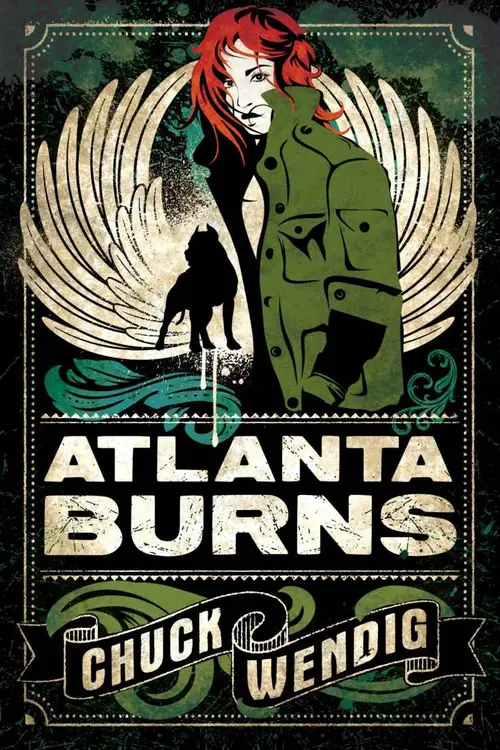
Atlanta Burns
Praise for Atlanta Burns:
“[Atlanta Burns] is like Veronica Mars on Adderall. Chuck Wendig knocks this one out of the park as he so often does.” —Stephen Blackmoore, author of City of the Lost and Dead Things
“Give Nancy Drew a shotgun and a kick-ass attitude and you get Atlanta Burns. Packed with action and fascinating characters, [Atlanta Burns] is a story that will captivate both teens and adults and have them clamoring for the next installment.” —Joelle Charbonneau, author of The Testing
Praise for Under the Empyrean Sky, Book One in the Heartland Trilogy:
“This strong first installment rises above the usual dystopian fare thanks to Wendig’s knack for disturbing imagery and scorching prose.” —Publishers Weekly
“Wendig brilliantly tackles the big stuff—class, economics, identity, love, and social change—in a fast-paced tale that never once loses its grip on pure storytelling excitement. Well-played, Wendig. Well-played.” —Libba Bray, author of the Gemma Doyle Trilogy, Going Bovine, and The Diviners
“A tense dystopian tale made more strange and terrifying by its present-day implications.” —Booklist
“Under the Empyrean Sky is like a super-charged, genetically modified hybrid of The Grapes of Wrath and Star Wars. Wendig delivers a thrilling, fast-paced adventure set in a future agri-dystopia. Fascinating world building, engaging and deep characters, smooth, electric prose.” —John Hornor Jacobs, author of The Twelve-Fingered Boy
“A thoroughly imagined environmental nightmare with taut pacing and compelling characters that will leave readers eager for more.” —Kirkus Reviews
“A lunatic, gene-spliced, biofueled thriller. Fear the corn.” —Tom Pollock, author of The City’s Son
“An imaginative, page-turning adventure that will delight science fiction fans and have them impatiently waiting for the next installment.” —Joelle Charbonneau, author of The Testing

Title Page
Other Skyscape titles by Chuck Wendig:
The Heartland Trilogy:
Book 1, Under the Empyrean Sky
Book 2, Blightborn
Book 3, The Harvest – Coming in July 2015
Short story based on the world of the Heartland:
The Wind Has Teeth Tonight: A Gwennie Story
The Atlanta Burns Series:
Book 1, Atlanta Burns
Book 2 – Coming in February 2016
Copyright Page

This is a work of fiction. Names, characters, organizations, places, events, and incidents are either products of the author’s imagination or are used fictitiously.
Text copyright © 2015 Chuck Wendig
No part of this book may be reproduced, or stored in a retrieval system, or transmitted in any form or by any means, electronic, mechanical, photocopying, recording, or otherwise, without express written permission of the publisher.
Part One of Atlanta Burns was first published in 2011 by Chuck Wendig as the novella Shotgun Gravy. Parts Two through Five of Atlanta Burns were first published in 2012 by Chuck Wendig as the novel Bait Dog. Published by Skyscape in 2015.
The quote on pages 70, 92, and 114 are from A.E. Housman’s poem “To an Athlete Dying Young.” In Modern British Poetry, edited by Louis Untermeyer. New York: Harcourt, Brace and Howe, 1920.
Published by Skyscape, New York
Amazon, the Amazon logo, and Skyscape are trademarks of Amazon.com, Inc., or its affiliates.
ISBN-13: 9781477827109
ISBN-10: 1477827102
Cover design by Cyanotype Book Architects
Library of Congress Control Number: 2014912061
Dedication Page
This book is for the bullied.
CONTENTS
CONTENTS
PART ONE: SHOTGUN GRAVY
Sometimes she wakes…
CHAPTER ONE
CHAPTER TWO
CHAPTER THREE
CHAPTER FOUR
CHAPTER FIVE
CHAPTER SIX
CHAPTER SEVEN
CHAPTER EIGHT
CHAPTER NINE
CHAPTER TEN
CHAPTER ELEVEN
PART TWO: BAIT DOG
CHAPTER TWELVE
CHAPTER THIRTEEN
CHAPTER FOURTEEN
CHAPTER FIFTEEN
CHAPTER SIXTEEN
CHAPTER SEVENTEEN
CHAPTER EIGHTEEN
CHAPTER NINETEEN
CHAPTER TWENTY
PART THREE: THE FARM
CHAPTER TWENTY-ONE
CHAPTER TWENTY-TWO
CHAPTER TWENTY-THREE
CHAPTER TWENTY-FOUR
CHAPTER TWENTY-FIVE
CHAPTER TWENTY-SIX
CHAPTER TWENTY-SEVEN
CHAPTER TWENTY-EIGHT
PART FOUR: KISSING FIRE
CHAPTER TWENTY-NINE
CHAPTER THIRTY
CHAPTER THIRTY-ONE
CHAPTER THIRTY-TWO
CHAPTER THIRTY-THREE
PART FIVE: BAIT GIRL
CHAPTER THIRTY-FOUR
CHAPTER THIRTY-FIVE
CHAPTER THIRTY-SIX
CHAPTER THIRTY-SEVEN
EPILOGUE: THE MESSAGE
ACKNOWLEDGMENTS
ABOUT THE AUTHOR
PART ONE: SHOTGUN GRAVY
PART ONE: SHOTGUN GRAVY
Sometimes she wakes…
Sometimes she wakes up at night, smelling that gunpowder smell. Ears ringing. A whimpering there in the darkness. Doesn’t always hit her at night. Might be in the middle of the day. She should be smelling pizza, or garbage, or cat shit wafting from the house next door, but instead what she smells is that acrid tang of gun smoke. All up in her nose. Clinging there like a tick.
CHAPTER ONE
CHAPTER ONE
She hears the clanging, the echoing reverb of an open-palm slap on the side of a dumpster. Voices carry across the empty parking lot near Bogner’s Produce: a mean cackle, a goofy haw-haw, the murmur of threats culminating in some pleading bleat. Atlanta Burns is on the way home from school, walking the five-mile stretch from town to country, for the burg of Maker’s Bell lives on that line between rural and suburban, between farmland and white picket fences (with a crooked zigzag of trailer parks smack in the middle). She thinks, Fuck it, fuck this, no, no, just keep walking, do not pass Go, do not collect two hundred dollars, do not go kicking over logs to see what worms squirm beneath.
A few folks mill around. They ignore the sounds from the parking lot in favor of watching her. Ever since she got back, the eyes are always on her. As if she makes people uncomfortable now.
Whatever. They don’t care about the noise. Neither does she.
But then she hears the laughs again. Crass and cruel. And the sound that follows: the sound of someone—a boy or a girl, she can’t tell—scared shitless, maybe in pain.
Atlanta sighs. She pulls her tie-dyed bag—bought at a flea market some years ago when she was thirteen or fourteen and didn’t know just how bad things could be—and crosses the street.
The sound’s coming from behind the old garage. An abandoned husk of gray concrete.
Her mouth’s dry. All the moisture gone to her hands: palms slick and sweaty.
Atlanta sees a rusted can of motor oil. Before she rounds the corner and heads behind the garage, she kicks that can—it clangs and skips across the blistery, cracked asphalt—just to let them know someone’s coming.
Not that they’ll probably give much of a shit. She heads out back, finds three boys from her school standing around the far end of a big green dumpster, its sides pocked with cankers of rust.
She knows them. Rather, she knows of them.
The tall one with the smashed-flat nose, that’s Jonesy—a.k.a. Gordon Jones. The prick next to him is Virgil. Virgil’s a juicer, the muscles of his upper torso looking like bulging balloon animals lashed together with ropy tendons. She’s not real sure of his last name. Erlenmeyer. Erlenbacher. Something. The one hanging back behind the other two is Chomp-Chomp, his first and last name lost to her. He’s average in every way. His hair is so sandy brown it blends in with the dirt lot behind the garage. One exception is his teeth: kid’s got a wall of horse teeth shoved unceremoniously in his mouth. Big, flat biters in a too-small jaw.
They’re not alone.
They’ve got a pudgy Latino kid held in the dumpster. Dressed well, this kid. Blue shirt buttoned tight to the neck. Hair slicked back like he’s a gangster or a preacher’s son. Jonesy’s hemming him in with a flat-bladed shovel like the one Atlanta’s mother uses to edge out her flower beds. Atlanta can see something sitting at the edge of the shovel.
A turd-curl of dog shit, by the looks of it.
The three boys—not boys, not really, given that they’re all seventeen or eighteen years old, but boys because they’re acting like mean little shits—stand and give her a real hard look.
“Hey,” Jonesy says. He nods. Grins. Shrugs as if to say, Yeah, what of it?
The Latino kid—she thinks she’s seen him at school, too. She figures him to be a sophomore, maybe a year below her. He gives her a look like he’s not sure if she’s friend or foe. He’s got a cut across his brow, a line of blood running down the margins of his round, mocha-colored Charlie Brown head.
Virgil gives Jonesy a sharp elbow in the ribs. Jonesy waves him off and says, “Like the police say, nothing to see here. Move along.”
“That kid okay?” she asks, lifting an eyebrow.
Jonesy nods a vigorous, almost comical nod. “He’s great. We’re just playing a game.”
She looks to the kid in the dumpster. “Are you okay?” The gentlest shake of a head. No.
Again Virgil elbows Jonesy, but Jonesy retorts: “Fuckin’ quit it.”
“Looks to me like you’re trying to make that kid eat a shovel of crap,” she says.
“It’s chocolate,” Jonesy says, stifling a laugh. “It’s, ahhh, you know. Wetback chocolate. Made special. Just for him. Unless you want some?”
The third miscreant in the trio, the one she thinks of as Chomp-Chomp, is watching everything with a deliberate stare. Arms folded, hands tucked tight into his armpits. He’s mule-kicked, she thinks. Or a sociopath. Or just scared of what he’s gotten himself into.
She slides her hand into her tie-dyed bag. Leaves it there.
Virgil blurts in what he thinks is a whisper but what is instead just a really loud hiss: “Dude. Don’t you know who that is?”
“What?” Jonesy asks. Then he takes a long look at her.
She knows what they see. On the surface, at least. Tangled red hair, a little too long, too frizzy, hasn’t been cut. A patch of freckles across the bridge of her nose in the shape of a small Band-Aid. Old, ratty bomber jacket.
They don’t all recognize her. Not yet. But Virgil does. He’s got a wary look like he’s watching a rattlesnake at a distance. And the kid in the dumpster looks like someone’s been beating him up and trying to force-feed him a pile of dog shit. No telling if he’s figured her out yet.
But then she sees the light come on behind Jonesy’s eyes.
Now he gets it.
“Right,” Jonesy finally says. “Riiiiight. Burns, yeah. Atlanta Burns. That’s a name.”
“Sure is,” she says. “So, listen. Why don’t you boys go home?”
“Is that like a Southern accent?” Jonesy asks Virgil. Virgil nods, but it’s not like it’s a secret. Up here, middle of Pennsylvania, her accent sticks out like a bent and broken toe. “Cool. My dad’s got a rebel flag on his pickup.”
“Then your daddy’s a jackass.” She says it before she means to say it, but that’s how she is: it’s like the bouncers who are supposed to be guarding the door to her mouth are on an eternal smoke break. Even still, she continues: “That flag’s not just the emblem of being a racist asshole, a club to which your daddy probably belongs happily. But it’s also the Confederate flag. The one carried by Southerners to say to the Yankees—that’s your daddy, a Yankee—‘Don’t tread on me or I’ll pop a musket ball up your ass.’ Northerners driving around with the Dixie flag is like a Jew wearing a ‘Go Hitler!’ baseball cap.”
Jonesy’s smile has fallen off his face. He squirts a jet of spit from between his two front teeth, then hands the shovel to Chomp-Chomp, who takes it, shell-shocked. The ringleader then gives a look to Virgil and nods at Atlanta. It isn’t subtle.
They both take a step toward her.
“You sure you wanna do this?” she asks.
Virgil doesn’t retreat, but she sees him recoil. His body language is clear. He’s not sure. He might be afraid of her. Now that’s interesting. Jonesy, though, he doesn’t give a shit. He licks his lips, comes another step closer.
There it is again: the smell of gun smoke. Damn near makes her sick. It’s not real, she thinks. Not a smell, but the ghost of a smell.
“Last chance,” she says. Her heartbeat is drumming in her neck. Every part of her brain is screaming for her to take those getaway-sticks she calls legs and run as far and fast as she can. But her body stays rooted. Her hand tightens in her bag. It’s got other plans. “We can all just play nice. Go our separate ways. You can leave that nice Mexican boy alone—”
“Venezuelan,” he peeps up from inside the dumpster.
“Sorry. You can leave that nice Venezuelan boy alone, and he won’t tell anybody, and nobody will get hurt worse than he already has. Square?”
“I like her,” Jonesy says to Virgil. “She’s feisty. I bet the three of us could have a fun time together. Virgil at the front. Me at the back. Shaking hands in the middle.”
Her stomach roils. She goes elbow-deep in her bag.
“I see you reaching in that hippie purse,” Jonesy says, pulling Virgil along next to him. “What’s in there? I don’t think you can fit a shotgun in there.”
Way he says shotgun, he knows. It doesn’t scare him. And that scares her. You’re going to get hurt, she thinks. Maybe you do this to yourself.
You go poking rattlesnakes, maybe you get bit.
But she bears down. Doesn’t move.
“Nope, no shotgun,” she says. “Hey, you ever been attacked by a bear?”
Jonesy pauses. “What?”
“A bear. Like, a grizzly. As I hear it, you get attacked by a bear, not much you can do. They run faster. They got teeth and claws like knives. You play dead, that might work, but not before the bear bats your body around like a cat with a dead mouse. You’d think a gun would do the trick, but that ain’t necessarily true, either. A bear will take a round to the head and keep coming. And a scattergun mostly just pisses them off. What you need is a can of bear mace.”
“Bear what?”
“Bear mace.” She shows him. From her purse she pulls a tall, lean canister with a pull tab and a black nozzle. Atlanta points the pull tab at the three assholes and rips that tab off.
Bear mace isn’t like other pepper spray. A can of dog deterrent sprays maybe five, ten feet. More a cloud than anything. But bear mace is a concerted blast—a geyser of pepper spray that shoots in a thirty-foot jet. Powerful enough that it doesn’t blow back unless the wind’s bad—and today, the air is still as a chair in an empty room.
The can empties in about five seconds.
For those five seconds, Atlanta can’t see much. She knows that the Mexic—er, Venezuelan kid hit the deck inside the dumpster. Heard the thump of his body. The other three, well, she can see their shapes thrashing around—first standing up, then down on the ground—but that’s all they are. Shapes. Screaming, howling shapes.
When the can is done, Atlanta wings it past the margins of the lot into the bushes.
The smoke clears, revealing the trio of assholes writhing on the ground. Faces red. Crying. Even from here she can see the blood vessels showing bright in the whites of their eyes. Jonesy’s clawing at his face like he’s got a rat chewing its way out of his sinuses. Virgil is blubbering, with dog crap on his face. He pounds the ground with a fist. The mute, toothy third, Chomp-Chomp, lies curled up like a baby. He whimpers like one, too.
She lets out a long breath.
A little voice inside her asks, Is this who you are now?
She doesn’t want to find the answer.
So she turns and runs. Bag flopping at her hip.

She tries to cry, but it just isn’t coming. She wants to. It’s in there somewhere. But like a stubborn sneeze, she just can’t make it happen, and that’s somehow worse.
Up the long driveway, shoes crunching on gravel. Past the fallow fields on either side. Green starting to poke up, with spring trying to get sprung. In the distance is the Cat Lady’s house. Atlanta doesn’t know her name. Woman’s old and frail, like a bundle of sticks bound up in a moth-bitten bedsheet. Her cats look that way, too: starving, rangy, half-mad.
Atlanta gets closer to the old farmhouse in which she and her mother live. Passes a dead brown Buick that sits off to the side, the car draped in the choking vines and soon-to-be-purple clusters of wisteria. It’s not her mama’s, that car. Was here when they bought the place.
Atlanta takes a moment. Her right hand is shaking. Her index finger in particular.
Then she goes in through the garage.
Mama’s in there. Setting up the cot, pulling sheets over it, fluf-fing some pillow that looks about as soft and comfortable as a sack of grain. A long, lean cigarette is pinched between her lips.
Seeing Atlanta, she quickly puts it out. I’m quitting, she told her daughter a few days ago. Like that somehow mattered.
“You want dinner?” Mama asks finally.
“I don’t,” Atlanta says. “I got it covered.” Which means some generic frozen entrée from the Amish store where they sell grocery goods that are either off-brand, out of date, or both. Froot Loops from two years ago, or Fruit Scoops only a month old.
Probably best her mother isn’t cooking dinner. Mama can make a hell of a breakfast, but her dinners are at the end of the culinary spectrum reserved for roofing shingles.
Just to be a bitch, Atlanta walks over to where her mother is setting up the cot, opens the garage fridge, and pulls out a beer. Coors Light. Tastes like watered-down cat piss, she thinks, but part of her just wants to see how far she gets to push.
Mama sees but pretends not to see, and that’s all Atlanta needs to know.
Atlanta goes inside while her mother sets up a cot on the oil-stained concrete.
The age of the house shows in all the doorways—each tilted off-kilter like something out of a carnival fun house. Floors aren’t level, either. Atlanta one time put a cat’s-eye marble on the floor and it rolled away, down the hall and into an old iron floor grate. She never got that marble back.
Knock knock knock.
He about scares the spit out of her. Standing by the kitchen window like that. Atlanta goes and opens the back door and pokes her head out.
“What?” she barks.
The Venezuelan kid practically jumps out of his skin. Then he steeples his hands in front of him, looking nervous. “I just wanted to, uhh, ahh, say thank you.”
“So say thank you.”
“What? Oh. Thank you.”
She nods. “Uh-huh.” Then she slams the door.
But as she rips the cardboard zipper off the frozen dinner, she sees him still out there. He’s no longer looking in the window, but he’s on the back lawn by the rusted patio furniture. Pacing.
Fuck it. She ignores him. Perforates the plastic with a fork. Dinner in the microwave. She cracks the beer and takes a sip and makes a face, then dumps it in the sink. It’s not skunked, but it might as well be.
The kid knocks at the back door. Moon face peering past floral curtains.
“Don’t want any,” she says. “Already have plenty. You’re welcome. Scram.”
When next she looks to the door and window, the kid is gone.
Five minutes later she’s eating bad General Tso’s chicken, each nugget so nasty it’s like eating fried homeless people dipped in ketchup.
Door to the garage opens up. Mama comes in.
“Hon?” she asks. Atlanta’s about to tell her mother, No, thanks, I said I got dinner covered, so you go on back to your garage now, but instead her mom beats her to the punch with: “I think a friend’s here to see you.”
Atlanta’s about to protest, but it’s too late. Mama’s already letting the Latino kid with the oil-slick hair and the round acorn-storing cheeks in the door.
Mama waves like she did something nice, like this earns her credit or karma or something, and then she vanishes quicker than a lake monster.
Latino Charlie Brown doesn’t say anything. They stare at each other in the cramped kitchen. Finally: “You want a TV dinner or something?”
He nods. “Okay.”
She gets him something that looks (but probably doesn’t taste) like lasagna.
CHAPTER TWO
CHAPTER TWO
They’re watching one of those gavel-banging shows on cable. Blah blah blah. Dog bit my leg. Bitch dinged my car. Deadbeat won’t pay for a paternity test.
The couch has as much give in the cushions as a body with rigor mortis, but what’s even less comfortable is the space between her and the boy.
She hands him the remote. “You want to watch something else?”
“Nah.” He pauses. “Well, I do like the Food Network.”
“This is basic cable. We don’t get the Food Network.” She blinks. “You watch the Food Network?”
“Yes.”
“Do you like to cook?”
“Yes.”
“Then that lasagna you’re eating probably tastes pretty bad. Like tomato paste pressed between layers of shoe leather or something.”
He puckers his lips. “I wasn’t going to say anything.”
“Let’s go back to the kitchen. You’re going to cook me dinner for saving your tail today.”
She can’t lie. It’s the best grilled-cheese sandwich she’s ever had. Has a good crunch but isn’t burned. Soft in the middle. A little sweet, too. She tells him so as they sit at the rickety card table that serves as a dinner table.
“The secret is to cook it low and slow in an iron skillet,” he says as if he’s been practicing this line for his own food show. He even waves his hands around, gesturing like he’s on camera. “If you had Brie cheese, I’d make it with that. That’s the best way.”
“Brie. Sounds French.”
“It is French.”
“So, not cheap?”
“Not cheap.”
“Your family can afford Brie?”
“Well. Uh. No.”
Her eyes narrow. “You ever eaten Brie cheese?”
He hesitates. “Not exactly.”
“Whatever. This is a good sandwich whether it has cheese made by French surrender monkeys or not.”
“You know, that’s a myth. That the French were all cowards. The French Resistance was instrumental in helping America win the war.”
She just shrugs, keeps eating her sandwich.
“I put a thin layer of mustard in the middle,” he says.
“Ish sho good.” They sit and chew. She says finally, “I figured you’d make, y’know, Mexican food or something. A chalupa.”
“A chalupa.” Blink, blink.
“Yeah. Why? Is that racist or something?”
The Story Continues on BooksBarbecue!
Enjoyed this preview? ❤️ Do not stop here!
Read the complete book free online → 🔗
Continue reading now on BooksBarbecue and discover every page!
Love reading? Bookmark BooksBarbecue.com for more amazing books!
Happy Reading!