Ask No Questions
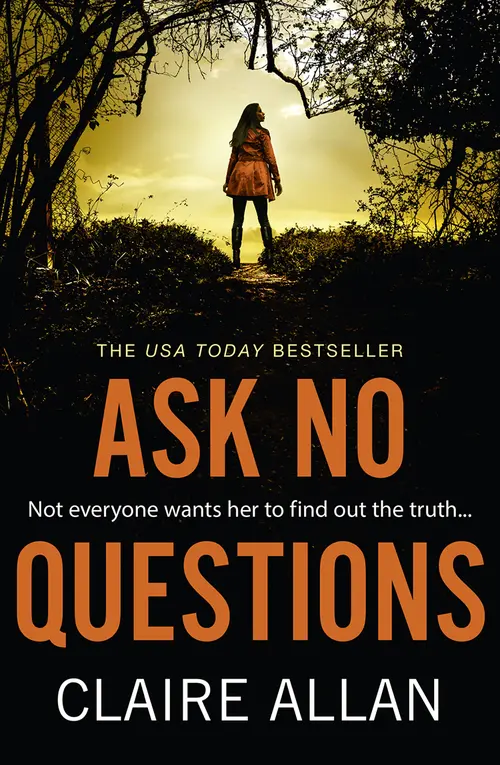
Cover
Dedication
For my agent, Ger Nichol,
who was the first to take a chance on me
Epigraph
Who’s at the window, who?
Who’s at the window, who?
It’s the wee bogey man
With a sack on his back
Come to take you away.
Where will he take you to?
Where will he take you to?
To a wee dark shed
Over the hill
Far, far away.
Traditional song, sung to the children of Northern Ireland, source unknown.
Prologue
Ingrid
I was ten years old when I found out that monsters are real and they walk among us. I can pinpoint the exact day that everything changed, when the world I’d found to be fun and innocent and good turned into something dark and frightening.
Looking back, I pity my mother having to find the words to tell my brothers and me what had happened. I pitied all the mothers and fathers who were forced to have that same conversation with their children at the dinner table that evening.
There’d be no playing out in the street any more. Not on these dark nights. There’d be no nipping in and out of neighbours’ houses, or knocking on doors looking for a glass of water when we were parched from playing tig or Red Rover, or riding our bicycles all over the estate in and out of the dark alleyways.
We were never to go out on our own. Nor walk back from school on our own. Even though it would still be light then. We absolutely were not allowed to take the short cut through the overgrown fields at the back of the school, either.
And we were never, ever, ever to go into anyone’s house on our own. No matter how well we knew them. No matter how many times we’d been there before.
Because Kelly Doherty had been found and she was dead. And someone, some bad man or bad woman, had hurt her and killed her and our mothers didn’t know ‘how they would ever be able to cope’ if something like that happened to us.
I didn’t sleep that night. I couldn’t. For the first time, I hated that I had a room all to myself and my brothers got to share. They got to keep each other company. I curled into as tight a ball as I could manage, hugged Daisy, my tatty stuffed puppy, to me and squeezed my eyes tight shut. But every noise, every creak, every sound from the street had my imagination running wild.
I was scared to move. Scared to breathe. I prayed over and over again, channelling my earnest childhood belief in prayer and a greater good, for Jesus himself to protect me.
‘Oh, Sacred Heart of Jesus, I place all my trust in you,’ I muttered over and over and over again until I was stumbling over the words and trying to shake the image of Kelly, dead – like actually dead – from my head.
What did dead people look like? I wondered.
Had she been scared?
Had she been alone?
Who was the bad man?
Or the bad woman?
At some stage during the long, dark night I heard voices on the street. Whispers. I couldn’t make out the words, but I guessed they could only be talking about one thing. One person. It was all everyone was talking about. It was all everyone was thinking about.
I wondered if I crept to the window, if I ducked my head through the curtains, would I be able to hear more? I slipped out from under my duvet, still grasping Daisy tightly, and tiptoed to the window. My breath was loud, heavy, misting against the cold glass. My heart thumping so fast I wondered was it possible for a ten-year-old to have an actual heart attack and die.
I almost, almost, didn’t look out of the window, but I steeled myself, took a deep breath and opened my eyes.
There was a man, dressed in black, a woollen hat pulled down over his forehead, a scarf, or jumper or something high on his neck. But I saw him, and he saw me.
He looked straight up at me, raised a gloved hand to gesture to me, to bid me to come to him, and I fell to my knees, then curled into a ball, squeezing my eyes as tightly as I could. Because monsters were real.
The bogeyman we had always been told was just make-believe stalked our streets.
Chapter One
Declan
Thursday, 3 November 1994
Declan and Niall Heaney had gone against their mother’s express wishes and had not come home straight after school. They had been on their best behaviour all day in their stuffy classroom and now all the energy they had managed to control for six long hours needed to be expended.
And they had a den to visit, one they went to every day. Little more than a hole in the large bushes and trees that ran along the side of the reservoir at the Creggan Country Park (or ‘the rezzie’ as they called it), it was the Heaney twins’ favourite place on earth.
One day it could be headquarters for the Power Rangers. The next a soldier’s dugout. Or a ninja training camp. Most of all, though, it was theirs. It had just the right amount of foliage cover to provide a shelter of sorts in the rain and shade in the summer. And the old lunch box they had buried, telling the long-suffering Mrs Heaney it had been lost, held a trove of treasures fit for any ten-year-old boy. Chewing gum. Match Attax trading cards. A box of matches. Two cigarettes they’d secreted from their daddy’s stash but hadn’t dared smoke yet, half a packet of bourbon creams, fifty-six pence exactly in loose change, a pair of dice, a knife that had been blunted a long time ago and a folded page from one of their school jotters in which they gave the girls in their class marks out of ten.
They didn’t need much more. They had their imaginations, after all, and they used whatever they could get their hands on as props for whatever world they created that day.
They knew that Kelly Doherty was missing. Of course they did. Everyone in the estate did. They imagined that probably everyone in Derry, maybe even all of Northern Ireland knew about Kelly. She’d gone out collecting for Halloween with her friends and had become separated from them at some stage. It was now a whole three days later and she still hadn’t come home, so the search had shifted to the land surrounding the reservoir.
Kevin McCay had told them that he heard his mammy and daddy say that poor Kelly was probably dead now and it was probably better for her that she was. Neither Kevin nor the Heaney twins understood what that meant, but they were happy to parrot it anyway.
‘We have to go and maybe help look for her,’ Niall had said. ‘This is like something off the TV or a movie.’
Declan had resisted at first, but his brother had a point. It was a big deal and besides, if they went home, their mammy would just make them do their homework straight away like she always did. It would be more interesting to see the search in full swing, but he didn’t actually want to look for her, especially if Kevin McCay’s mammy and daddy were right.
They’d watched as a group of maybe a hundred grown-ups had set off walking around the country park at the top of the reservoir. They were wearing bright yellow jackets, carrying torches and sticks, which they used to poke around in the grass. From where Niall and Declan sat in their den, close to the water’s edge, they could hear the repeated shouts of Kelly’s name.
‘They’ve a van up there with tea and soup and biscuits and stuff,’ Niall said. ‘For all them people searching. Do you think they would give us some?’
Declan had considered this for a moment and had shaken his head. ‘Nah. I bet it’s only the grown-ups that get that.’ He sniffed, drawing the sleeve of his duffel coat under his nose. It was cold and the sky looked like it could open and dump buckets of rain on them at any time.
‘Da says he’s going to go out and look with them later,’ Niall said, digging out the old lunch box from its bed of leaves and dirt and taking out two bourbon creams.
He bit into one and handed the other to his brother. They didn’t need those free biscuits or the soup anyway. They had their own supplies.
‘Do you think he’ll want us to go, too?’ Declan had asked. He’d shuddered at the thought of searching in the dark.
Niall shook his head. ‘Not a chance. Even if Da wanted us to go, Ma wouldn’t. Besides, we’ve homework to do tonight.’
‘Bloody sums. I hate the seven times tables,’ Declan had said dejectedly, finishing his biscuit. Declan lifted the stick he had been using as a sword earlier and started to poke at the leaves and mud, sending a fat black beetle scurrying for cover. ‘There’s no craic here today at all,’ Declan added. ‘And I’m freezing. Shall we just go home?’
Reluctantly Niall, the younger of the two by seventeen minutes, agreed and stood up, hefting his school bag onto his back.
‘C’mon, then,’ he said to his older brother and the pair started their walk along the banks of the reservoir, Declan still dragging his stick, leaving a line in the dirt as they went.
It was Declan who saw her first. Not that he knew what it was he saw when he first looked. He thought it was a piece of rubbish. Discarded carrier bags, floating on the water, lapping towards the shore. Dirty white plastic. He didn’t think anything of it at first glance. Then, as he bowed his head against the squally shower that had started, he spotted what looked like a black school shoe, patent leather, mired in the mud at the water’s edge, and he glanced up again.
The dirty white plastic had morphed into a white dress – lace and satin. A mottled hand, bloated and grey, had floated to the surface. He knew that Kelly Doherty was dressed as Glinda the Good Witch of the North from The Wizard of Oz when she disappeared. Recycling her first communion dress from the year before. And still, he couldn’t make sense of what he was seeing. It couldn’t be … His vivid imagination was playing tricks on him. This was just rubbish. The hand, it looked so unreal, so fake, it was probably a discarded Halloween prop. It couldn’t belong to a person.
It, this shape that refused to make sense, floated closer to him. The edges started to become more defined.
He put his hand out to block Niall, to stop him from coming closer. He had to protect his more sensitive brother. But he’d not been quick enough.
‘Is that …’ Niall’s voice faded out.
Declan was stuck somewhere between horror and morbid fascination. Imagine if he, just ten years old, could be the person to find Kelly Doherty. If it was Kelly. The body in the water, now just a few feet from the boys, was face down. Dark strands of hair floated like weeds to the surface. Kelly had blonde hair. He knew that. He used to see her running around the playground with all of her friends. Screaming in that annoying high-pitched way wee girls do. This hair was dark, though, splayed in fronds on the top of the water. Maybe it was the water that was dark, he thought.
He wanted to step closer. To look more closely. But his legs didn’t want to move. The noise around him faded out, replaced with a buzzing in his ears.
He felt Niall take the stick from him. Watched as his brother stepped closer to the bank, his shoes sinking into the mud. Mammy would be raging, Declan thought, but Niall was undeterred. He waded into the water, gasping at the cold as the water covered his feet, his ankles, up to his knees. He reached out with the stick, caught it on the dress and pulled. The shape – the body – moved a little towards them and Niall turned back towards Declan. ‘C’mere and help me!’ he shouted, but Declan was frozen to the spot. He couldn’t even shake his head.
Niall swore and took another step towards the shape, getting a better hold of the dress. Then he heaved it towards him until it was close enough that he could grab the material with his hands and pull it to shore.
As her legs, her arms, her hands all became visible, Declan knew it had to be Kelly – it had to be – but she was face down, her features hidden.
He watched as Niall gently prodded at her prone body. He tried to tell Niall to step back, but his voice wouldn’t work, either. He knew they should get a grown-up. Niall turned and gestured to Declan to follow, but he didn’t, shaking his head. He still couldn’t move, afraid if he even tried, he might wet himself with fear. He knew Niall would say he was being a baby, and maybe he was, but right at that moment, he didn’t care.
His stomach clenched as he watched his brother poke some more. He didn’t expect there to be any give. He watched in horror as the stick pushed through an already shattered skull into the soft matter of Kelly Doherty’s brain.
He doesn’t remember much from after that, except that was the point he did wet himself, and he threw up, undigested brown Bourbon biscuit splattering on the muddy ground.
Chapter Two
Ingrid
Wednesday, 16 October 2019
The archive room in The Chronicle isn’t anywhere near as grand as it sounds. It’s not a fancy library, lined with mahogany shelves housing every copy of The Chronicle’s 200-year-old history. I don’t select the bound copies I need and carry them to a leather-topped desk to pore over them under the gentle glow of a reading lamp.
Instead, I shiver as I try to make sense of a long-ignored filing system to find the papers from 1994. Twenty-five years before. When I was ten and Kelly Doherty was eight.
I got to grow up, though. Kelly didn’t.
I’d been nervous about digging out these files. Uncharacteristically so. Normally, the grittier the story or more gruesome the crime, the more eager I am to be assigned to cover it. But this was different. This was the anniversary of a murder that had shocked to the core the community in which I grew up. We’d been used to violence, of course, in Northern Ireland. Bombs and guns and masked men were something we were almost, but not quite, immune to. But murder, like that? Of a child? That didn’t happen. That changed everything. Changed everyone. I never really understood fear or grief until then. I’ve never forgotten them since.
I wish I’d lifted my grey cardigan from the back of my chair before I came down here. It’s ugly and not at all my usual style, but it comes in very useful during long hours in the archive room. I suppose I could walk back to my desk and get it, but I’m happy to hide out away from everyone.
I had a couple of glasses of wine last night and my head is the worse for it. I should know by now never to drink on a school night, and certainly never to drink cheap wine. The combination of the two is lethal, especially when faced with working my way through pages and pages of minute typeface, blurring against yellowing newsprint.
Sighing, I rub my eyes and wish the lighting in the archive room was better. I stop flipping over pages when I see her face. Angelic. Gap-toothed. The picture is black and white, but I can see her hair was blonde, ringleted. Just as I remember it. There’s a clip holding it back from one side of her face. She’s in school uniform – the same school colours I wore myself – and it looks like it was taken by one of those official school photographers who charge an arm and a leg.
The headline is stark: ‘Bring her Home.’ The subhead speaks of the hell the family of missing schoolgirl Kelly Doherty are going through. The byline is Ryan Murray’s. He’s since climbed the ranks to editor, but must have been only a junior reporter then. This would’ve been a huge story for him to cover.
The Chronicle was published just twice a week in 1994, instead of daily like today. It was an era when local journalism bloomed. Circulation was high. Advertising was healthy. Competition was almost non-existent. The Chronicle was a flagship paper. Not like now, I think. The Internet has almost wiped us out. Why pay for news when you can get it for free?
Looking at the date on the front page, I see that by the time this paper hit the counters in the newsagents, it would only have been a matter of hours before Kelly’s body was found. I shudder, an icy coldness running through me. I blink and it’s like I’m there again, on Halloween night.
We were all dressed in our fairly basic costumes, throwing together whatever our parents could find to make us into a bunch of amateur monsters, vampires, witches and fairies. We were armed with plastic shopping bags, which we carried from door to door. This was before Halloween was Americanised. We didn’t say trick or treat – we would parrot in sing-song voices ‘Anything for Halloween?’ to our neighbours, and we would be rewarded with nuts and apples and grapes; if we were exceptionally lucky, we might get a lollipop.
Then, bundled in our duffel coats, we’d move on to the next house and the process would begin again. We didn’t need parents to chaperone us then. It was a different time. We watched out for each other. Our neighbours looked out for us. The only thing to fear was the thought that our bags of loot could be ‘raided’ by the bigger boys from the next street – taking our collections and leaving us to go home empty-handed.
That night, it was cold and wet. I remember my breath curling in soft white in front of me and the nip of the cold at the tips of my fingers, the strength of the wind catching the hood of my coat and pushing me backwards. I wished I’d worn my gloves and a hat – not that I would’ve admitted that to my mother. The smell of smoke from the coal fires in each home hung thick in the air.
I remember, or at least I think I remember, seeing Kelly. Those curls. Her white dress. A star on a stick covered with tin foil to give it the appearance of a magic wand. She was running down the street, following her friends, laughing. Jumping in puddles as she went. I remember her waving at me. And I waved back. Or I think I did. Memory is a funny thing.
I didn’t see her again after that until the day of her funeral, when I saw a little white coffin being carried into the chapel.
I spend an hour making notes, snapping photos of the relevant pages on my phone and searching through boxes of negatives for the relevant original images from the time. By then the chill in the archive room has become too much and I need a coffee.
I’m walking back to my desk, when the door to the editor’s office opens and I hear my name being called.
‘Ingrid,’ Ryan says from behind his desk as I walk in. ‘Sit down.’
I take a seat for a minute or two while Ryan taps at his computer, sending emails or proofing pages or possibly just scanning Twitter. Anything to keep me waiting, to remind me that he is my boss. Eventually, he looks up.
‘You’ve been researching the Kelly Doherty anniversary story?’ he says.
I nod. ‘I have. And I’ve put the feelers out to see if Jamesy Harte will talk to us. He’s not come back to Derry, by all accounts, but I’ve been able to track down one of his cousins, who made positive noises. I’m sure as his campaign to clear his name grows, Harte’ll want to talk. Something about him … well, it never added up to me. It would be interesting to hear his side of things.’
Ryan sits back and steeples his fingers together in an exaggerated ‘I’m thinking’ pose. ‘The thing is, Ingrid, I don’t think we want to be seen to be backing Jamesy Harte in any way. He was convicted and he served his time. The law says he was guilty and I think digging too deep into that … well, it won’t make us popular.’
‘It’s not like you to shy away from a big story,’ I tell him, and it’s true. It’s one of the reasons I have stayed at The Chronicle for so long – Ryan’s willingness to push for answers, no matter how uncomfortable the questions.
‘I’m not shying away from anything, Ingrid,’ he says, his tone harsh. ‘Cover the story by all means. A measured anniversary piece. But I don’t think we should be coming down on the side of a convicted child killer.’
‘Even if he claims he’s innocent? There’s a growing body of evidence …’ I begin. ‘I’ve only started to look into it, but there seems to be something in what Jamesy is saying. This could be huge. What if there has been a huge miscarriage of justice here, Ryan? Don’t we want to be on the right side of championing that?’
The Story Continues on BooksBarbecue!
Enjoyed this preview? ❤️ Do not stop here!
Read the complete book free online → 🔗
Continue reading now on BooksBarbecue and discover every page!
Love reading? Bookmark BooksBarbecue.com for more amazing books!
Happy Reading!