Arctic Drift
Table of Contents
Title Page
Copyright Page
Dedication
PART I - DEVIL’S BREATH
Chapter 1 - APRIL 2011 THE INSIDE PASSAGE BRITISH COLUMBIA
Chapter 2
Chapter 3
Chapter 4
Chapter 5
Chapter 6
Chapter 7
Chapter 8
Chapter 9
Chapter 10
Chapter 11
Chapter 12
Chapter 13
Chapter 14
Chapter 15
Chapter 16
Chapter 17
Chapter 18
Chapter 19
Chapter 20
Chapter 21
Chapter 22
Chapter 23
Chapter 24
Chapter 25
Chapter 26
Chapter 27
Chapter 28
Chapter 29
Chapter 30
Chapter 31
Chapter 32
Chapter 33
Chapter 34
PART II - BLACK KOBLUNA
Chapter 35
Chapter 36
Chapter 37
Chapter 38
Chapter 39
Chapter 40
Chapter 41
Chapter 42
Chapter 43
Chapter 44
Chapter 45
Chapter 46
Chapter 47
Chapter 48
Chapter 49
Chapter 50
Chapter 51
Chapter 52
Chapter 53
Chapter 54
Chapter 55
Chapter 56
PART III - NORTHERN PURSUIT
Chapter 57
Chapter 58
Chapter 59
Chapter 60
Chapter 61
Chapter 62
Chapter 63
Chapter 64
Chapter 65
Chapter 66
Chapter 67
Chapter 68
Chapter 69
Chapter 70
Chapter 71
Chapter 72
Chapter 73
Chapter 74
Chapter 75
Chapter 76
Chapter 77
Chapter 78
Chapter 79
Chapter 80
Chapter 81
Chapter 82
Chapter 83
Chapter 84
Chapter 85
Chapter 86
Chapter 87
Chapter 88
Chapter 89
EPILOGUE - THE ROCK
Chapter 90
Chapter 91
Chapter 92
Chapter 93
Chapter 94
Chapter 95
“When the going gets tough, I read Clive Cussler, for no one can spin a yarn that’s so thoroughly spellbinding and entertaining as he can.”—Harold Coyle
ARCTIC DRIFT
Clive Cussler’s previous Dirk Pitt® novel, Treasure of Khan, satisfied readers’ appetites for action with “a big fat juicy cheeseburger of a novel” (Los Angeles Times). Now, Cussler once again brings to life the heroism and guts that have made Dirk Pitt a legend in the world of adventure. . . .
A potential breakthrough discovery to reverse global warming . . . a series of unexplained deaths in British Columbia . . . a rash of international incidents between the United States and a longtime ally that threatens to erupt into a shooting war. NUMA Director Dirk Pitt and his children, Dirk, Jr., and Summer, know there’s a connection—but they also know they have very little time to find it.
Their only real clue might just be a mysterious silvery mineral traced to a long-ago expedition in search of the fabled Northwest Passage. But no one survived that doomed mission. And if Pitt and his buddy Al Giordino aren’t careful, the very same fate may await them . . . and the world.
Praise
“Cussler is a master at building suspense and tension.”
—Richmond-Times Dispatch
“Dirk Pitt is a combination of James Bond and Jacques Cousteau.”
—New York Daily News
PRAISE FOR
CLIVE CUSSLER
“Pure entertainment . . . as reliable as Pitt’s trusty Colt .45.”
—People
“Pure Cussler, pure fun. The action just keeps accelerating.”
—The San Francisco Examiner
“Full of action, intrigue, and beautiful women.”
—San Antonio Express-News
“Nobody does it better than Clive Cussler. NOBODY!”
—Stephen Coonts
PRAISE FOR
CLIVE CUSSLER’S DIRK PITT®SERIES
TREASURE OF KHAN
“Dirk Pitt’s nineteenth adventure . . . offers a plot as credible as it is monstrous, and the kind of exotic aquatic detail that amazes, informs, and entertains.”
—Publishers Weekly
“The quality fans expect from a Clive Cussler novel is in abundance.”
—Library Journal
“Fast-paced adventure fans of the long-running series will hungrily gobble this dish.”
—Booklist
BLACK WIND
“[A] ripsnorting adventure thriller . . . Fans will revel in this action-packed yarn of land- and sea-based derring-do . . . Major entertainment.”
—Publishers Weekly
“Harrowing encounters, close calls, daring exploits . . . another Cussler epic . . . Another win for NUMA.”
—Booklist
“A father-son action thriller penned by a father-son team that more than maintains the supercharged Cusslerian danger.”
—Kirkus Reviews
TROJAN ODYSSEY
“Continuous action, thrills galore, and lots of fun.”
—The Oklahoman
“The story is an extravaganza, a blur of bravado and close calls above and below the waves . . . Impossible to resist . . . [A] wildly imaginative thriller.”
—New York Daily News
“Just about the best storyteller in the business.”
—New York Post
VALHALLA RISING
“[A] nonstop thriller . . . Cussler speeds and twists through the complex plot and hairbreadth escapes [with] the intensity and suspense of a NASCAR race.”
—Publishers Weekly
“Action-filled adventure . . . great fun.”
—Library Journal
“Clive Cussler . . . is at top form here.”
—Kirkus Reviews
PRAISE FOR
CLIVE CUSSLER’S NUMA®SERIES
“Marvelous . . . simply terrific fun.”
—Kirkus Reviews
“You can’t get much more satisfying.”
—The Cleveland Plain Dealer
“A great story.”
—Tulsa World
“Audacious and wildly entertaining.”
—New York Daily News
TITLES BY CLIVE CUSSLER
The Chase
DIRK PITT® ADVENTURES BY CLIVE CUSSLER
DIRK PITT® ADVENTURES BY CLIVE CUSSLER
AND DIRK CUSSLER

FARGO ADVENTURES BY CLIVE CUSSLER
WITH GRANT BLACKWOOD
Spartan Gold
KURT AUSTIN ADVENTURES BY CLIVE CUSSLER
WITH PAUL KEMPRECOS
OREGON FILES ADVENTURES BY CLIVE CUSSLER
NONFICTION BY CLIVE CUSSLER AND CRAIG DIRGO
The Sea Hunters II
The Sea Hunters
Clive Cussler and Dirk Pitt Revealed
CHILDREN’S BOOKS BY CLIVE CUSSLER
The Adventures of Vin Fiz

Copyright Page
THE BERKLEY PUBLISHING GROUP
Published by the Penguin Group
Penguin Group (USA) Inc.
375 Hudson Street, New York, New York 10014, USA
Penguin Group (Canada), 90 Eglinton Avenue East, Suite 700, Toronto, Ontario M4P 2Y3, Canada
(a division of Pearson Penguin Canada Inc.)
Penguin Books Ltd., 80 Strand, London WC2R 0RL, England
Penguin Group Ireland, 25 St. Stephen’s Green, Dublin 2, Ireland (a division of Penguin Books Ltd.)
Penguin Group (Australia), 250 Camberwell Road, Camberwell, Victoria 3124, Australia
(a division of Pearson Australia Group Pty. Ltd.)
Penguin Books India Pvt. Ltd., 11 Community Centre, Panchsheel Park, New Delhi—110 017, India
Penguin Group (NZ), 67 Apollo Drive, Rosedale, North Shore 0632, New Zealand
(a division of Pearson New Zealand Ltd.)
Penguin Books (South Africa) (Pty.) Ltd., 24 Sturdee Avenue, Rosebank, Johannesburg 2196,
South Africa
Penguin Books Ltd., Registered Offic es: 80 Strand, London WC2R 0RL, England
This is a work of fiction. Names, characters, places, and incidents either are the product of the authors’ imagination or are used fic titiously, and any resemblance to actual persons, living or dead, business establishments, events, or locales is entirely coincidental. The publisher does not have any control over and does not assume any responsibility for author or third-party websites or their content.
ARCTIC DRIFT
A Berkley Book / published by arrangement with Sandecker, RLLLP
Copyright © 2008 by Sandecker, RLLLP.
No part of this book may be reproduced, scanned, or distributed in any printed or electronic form
without permission. Please do not participate in or encourage piracy of copyrighted materials in
violation of the authors’ rights. Purchase only authorized editions.
For information, address: The Berkley Publishing Group,
a division of Penguin Group (USA) Inc.,
375 Hudson Street, New York, New York 10014.
eISBN : 978-1-101-15150-1
BERKLEY®
Berkley Books are published by The Berkley Publishing Group,
a division of Penguin Group (USA) Inc.,
375 Hudson Street, New York, New York 10014.
BERKLEY® is a registered trademark of Penguin Group (USA) Inc.
The “B” design is a trademark of Penguin Group (USA) Inc.
Dedication
In memory of Leigh Hunt.
And yes, there really was a Leigh Hunt.
A dear friend, bon vivant, wit, and madcap Don Juan who had a way with women that made him the envy of every man in town.
I killed him off in the prologues of ten Dirk Pitt books. He always wanted to play a bigger role in the stories but didn’t complain because he enjoyed the fame.
So long, old pal, you are sorely missed.
PROLOGUE
PASSAGE TO DEATH
APRIL 1848
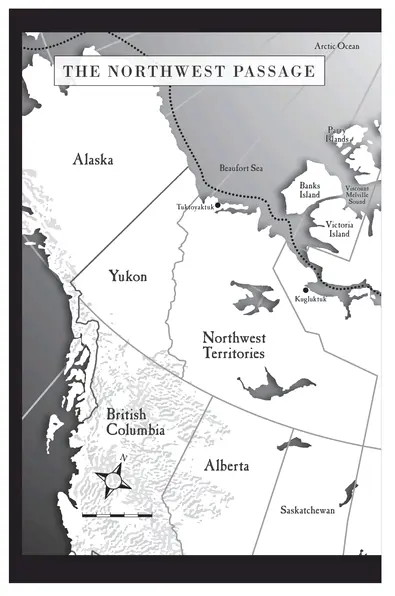
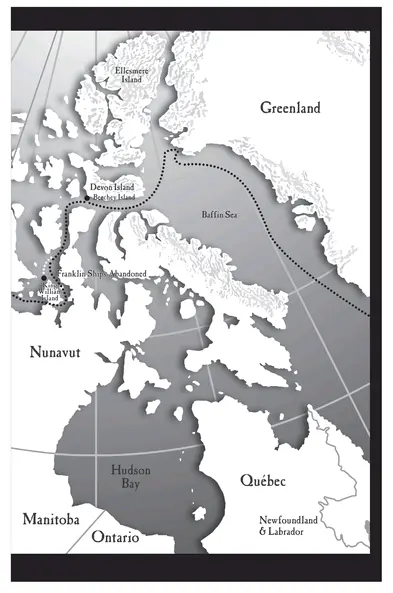
VICTORIA STRAIT
THE ARCTIC OCEAN
THE CRY RATTLED THROUGH THE SHIP LIKE THE howl of a wounded jungle beast, a mournful wail that sounded like a plea for death. The moan incited a second voice, and then a third, until a ghoulish chorus echoed through the darkness. When the morbid cries ran their course, a few moments of uneasy silence prevailed until the tortured soul initiated the sequence again. A few sequestered crewmen, those with their senses still intact, listened to the sounds while praying that their own death would arrive more easily.
In his cabin, Commander James Fitzjames listened as he squeezed a clump of silver rock in his hand. Holding the cold shiny mineral to his eye, he swore at its luster. Whatever the composite was, it seemed to have cursed his ship. Even before it had been brought aboard, the mineral carried with it an essence of death. Two crewmen in a whaleboat had fallen overboard while transporting the first sample rocks, quickly freezing to death in the icy Arctic waters. Another sailor had died in a knife fight, after trying to barter some of the rocks for tobacco with a demented carpenter’s mate. Now in the last few weeks, more than half his crew had gone slowly and inexorably mad. The winter confinement was no doubt to blame, he mused, but the rocks somehow played a role as well.
His thoughts were interrupted by a harsh banging on the cabin door. Conserving the energy needed to stand and answer, he simply responded with a raspy, “Yes?”
The door swung open to reveal a short man in a soiled sweater, his ruddy face lean and dirty.
“Cap’n, one or two of ’em are trying to breach the barricade again,” the ship’s quartermaster stated in a thick Scottish accent.
“Call Lieutenant Fairholme,” Fitzjames replied, rising slowly to his feet. “Have him assemble the men.”
Fitzjames tossed the rock onto his bunk and followed the quartermaster out the door. They stepped down a dark and musty passageway, illuminated by a few small candle lanterns. Passing the main hatchway, the quartermaster disappeared as Fitzjames continued forward. He soon stopped at the base of a tall pile of debris that blocked his path. A mass of barrels, crates, and casks had been strategically wedged into the passageway, piled to the overhead deck and creating a temporary barricade to the forward compartments. Somewhere on the opposite side of the mound, the sound of shifting crates and human grunts resonated through the mass.
“They’re at it again, sir,” spoke a sleepy-eyed marine who stood watch over the pile with a Brown Bess musket. Barely nineteen, the guard had a dirty growth of beard that sprouted off his jaw like a patch of briar.
“We’ll be leaving the ship to them soon enough,” Fitzjames replied in a tired voice.
Behind them a wooden ladder creaked as three men climbed up the main hatchway from the orlop deck below. A cold blast of frigid air surged through the passageway until one of the men tugged a canvas hatch cover in place, sealing it shut. A gaunt man in a heavy wool officer’s jacket emerged from the shadows and addressed Fitzjames.
“Sir, the arms locker is still secure,” Lieutenant Fairholme reported, a frozen cloud of vapor rising from his mouth as he spoke. “Quartermaster McDonald is assembling the men in the officers’ Great Cabin.” Holding up a small percussion-cap pistol, he added, “We retrieved three weapons for ourselves.”
Fitzjames nodded as he surveyed the other two men, haggard-looking Royal Marines who each clutched a musket.
“Thank you, Lieutenant. There shall be no firing except by direct order,” the commander said quietly.
A shrill cry erupted from behind the barrier, followed by a loud clanging of pots and pans. The sounds were becoming more manic, Fitzjames thought. Whatever abominations were taking place on the other side of the barricade, he could only imagine.
“They’re turning increasingly violent,” the lieutenant said in a hushed tone.
Fitzjames nodded grimly. Subduing a crew gone mad was a prospect he could never have imagined when he first signed on for the Arctic Discovery Service. A bright and affable man, he had quickly risen through the ranks of the Royal Navy, attaining command of a sloop of war by age thirty. Now thirty-six and in a fight for survival, the officer once referred to as “the best-looking man in the Navy” faced his toughest ordeal.
Perhaps it was no surprise that part of the crew had become deranged. Surviving an Arctic winter aboard an icebound ship was a frightful challenge. Bound for months in darkness and unrelenting cold, the men were trapped in the cramped confines of the ship’s lower deck. There they battled rats, claustrophobia, and isolation, in addition to the physical ravages of scurvy and frostbite. Passing a single winter was difficult enough, but Fitzjames’s crew was coming off a third consecutive Arctic winter, their ills compounded by short rations of food and fuel. The death of their expedition leader, Sir John Franklin, earlier only added to the fading sense of optimism.
Yet Fitzjames knew there was something more sinister at work. When a bosun’s mate tore off his clothes, climbed topside, and ran screaming across the ice floes, it could have been marked down as a single case of dementia. But when three-fourths of the crew began yelling in their sleep, staggering around listlessly, mumbling in confused speech patterns, and hallucinating, there was clearly something else at play. When the behaviors gradually turned violent, Fitzjames had the afflicted quietly moved to the forward deck and sequestered.
“It’s something on the ship driving them mad,” Fairholme said quietly, as if reading Fitzjames’s mind.
Fitzjames started to nod in reply when a small crate came hurtling off the upper reaches of the barrier, nearly striking him in the head. The pale face of an emaciated man burst through the opening, his eyes glowing red under the flickering candlelight. He quickly squeezed himself through the opening and then tumbled down the face of the barrier. As the man staggered to his feet, Fitzjames recognized him as one of the stokers for the ship’s coal-fi red steam engine. The stoker was shirtless despite the freezing temperatures inside the ship, and in his hand he wielded a heavy butcher knife taken from the ship’s galley.
“Where be the lambs for slaughter?” he cried, holding up the knife.
Before he could start slashing, one of the Royal Marines countered with a musket stock, striking the stoker on the side of the face. The knife clanged against a crate as the man crumpled to the deck, a trickle of blood running down his face.
Fitzjames turned from the unconscious stoker to the crewmen around him. Tired, haggard, and gaunt from an inadequate diet, they all looked to him for direction.
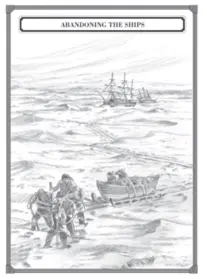
“We abandon ship at once. There is still more than an hour of daylight left. We will make for the Terror. Lieutenant, bring the cold-weather gear up to the Great Cabin.”
“How many sledges shall I prepare?”
“None. Pack what provisions each man can carry but no extra equipment.”
“Yes, sir,” Fairholme replied, taking two men with him and disappearing down the main hatch. Buried in the ship’s hold were the parkas, boots, and gloves worn by the crew when working on deck or while exploring away from the ship on sledging parties. Fairholme and his men quickly hauled up sets of foul-weather gear and dragged them to the large officers’ lounge at the stern of the ship.
Fitzjames made his way to his stateroom, retrieving a compass, a gold watch, and some letters written to his family. He opened the ship’s log to the last entry and wrote a final notation in a shaky hand, then squeezed his eyes shut in defeat as he closed the leather-bound book. Tradition would dictate that he take the logbook with him, but instead he locked it in his desk atop a portfolio of daguerreotypes.
Eleven crewmen, the sane remnants of the ship’s original complement of sixty-eight men, were waiting for him in the Great Cabin. The captain slipped into a parka and boots alongside his crew, then led them up the main hatchway. Shoving aside the top hatch, they climbed onto the main deck and into the elements. It was like stepping through the gates of a frozen hell.
From the dark, dank interior of the ship, they entered a blistering world of bone white. Howling winds hurled a trillion specks of crystalline ice at the men, peppering their bodies with the force of a hundred-degrees-below-zero windchill. The sky could not be distinguished from the ground, nor up from down, in the dizzying vortex of white. Fighting the gusts, Fitzjames felt his way across the snowbound deck and down a stepladder to the frozen ice pack below.
Unseen a half mile away, the expedition’s sister ship, HMS Terror, sat locked in the same ice sheet. But the relentless winds reduced visibility to just a few yards. If they should miss locating the Terror in the ravaging winds, they would wander around the ice pack and die. Wooden marker posts had been planted every hundred feet between the two ships for just such a contingency, but the blinding conditions made finding the next marker post a deadly challenge.
Fitzjames pulled out his compass and took a bearing at twelve degrees, which he knew to be the direction of the Terror. The sister ship was actually due east of his position, but her nearness to the magnetic north pole produced a deviated compass reading. Silently praying that the ice pack had not materially moved since the last bearings were taken, he hunched over the compass and began trudging across the ice in the targeted direction. A rope line was passed back to all the crewmen, and the party proceeded across the ice field like a giant centipede.
The young commander shuffled along, head down and eyes glued to the compass, as the frigid wind and blowing snow stung his face. Counting a hundred paces, he stopped and peered about. With an initial sense of relief, he spotted the first marker post through the cottony swirls. Moving alongside the post, he took another bearing and proceeded to the next marker. The string of men leapfrogged from marker to marker, clambering over uneven mounds of snow that often rose thirty or forty feet high. Fitzjames focused all his energy on the journey, shaking off the disappointment of abandoning his ship to a contingent of madmen. Deep down, he knew it was a matter of survival. After three years in the Arctic, nothing else now mattered.
Then a deep boom shook his hopes. The sound was deafening, even over the howling winds. It sounded like the report of a large cannon, but the captain knew better. It was the ice beneath his feet, layered in massive sheets that moved in a rhythmic cycle of contraction and expansion.
Since the two expedition ships had become trapped in the ice in September 1846, they had been propelled over twenty miles, pushed by the massive blanket of ice called the Beaufort ice stream. An unusually frigid summer kept them icebound through 1847, while the current year’s spring thaw had materialized only briefly. The ravages of another cold spell again made it doubtful that the ships would break free over the coming summer. In the meantime, a shift in the ice could be fatal, crushing a stout wooden ship like it was a box of matches. In another sixty-seven years, Ernest Shackleton would watch helplessly as his ship the Endurance was crushed by an expanding ice pack in the Antarctic.
With his heart racing, Fitzjames increased his pace as another thunderous crack echoed in the distance. The rope in his hands grew taut as the men behind struggled to keep up, but he refused to slow. Reaching what he knew was the last marker pole, he squinted into the tempest. Through the blasting swirls of white, he caught a brief glimpse of a dark object ahead.
“She’s just before us,” he shouted to the men behind him. “Step lively, we’re nearly there.”
Moving as one, the group surged toward the target. Climbing over a rugged mound of ice, they at last saw the Terror before them. At one hundred and two feet, the vessel was nearly identical in size and appearance to their own ship, down to the black-painted hull with a wide gold band. The Terror barely resembled a ship now, however, with its sails and yardarms stowed away, and a large canvas awning covering her stern deck. Snow had been shoveled up in mounds nearly to the rails for insulation, while the mast and rigging were coated in a thick layer of ice. The stout bomb ship, as she was originally designated, now looked more like a giant spilled carton of milk.
Fitzjames boarded the ship, where he was surprised to see several crewmen scurrying about the ice-covered deck. A midshipman approached and led Fitzjames and his men down the main hatch and into the galley. A steward passed around shots of brandy while the men shook the ice from their clothes and warmed their hands by the cookstove. Savoring the liquor as it warmed his belly, the captain noticed a beehive of activity in the dim confines, with crewmen shouting and shoving stores about the main passageway. Like his own men, the crew of the Terror were frightful souls to look at. Pallid and emaciated, most of the men fought the advanced ravages of scurvy. Fitzjames had already lost two of his own teeth to the disease, a vitamin C deficiency that causes spongy gums and bleeding scalp. Though casks of lemon juice had been carried aboard and rationed regularly to all the crew, the juice had lost its efficacy over time. Combined with a shortage of fresh meat, the disease had left no man untouched. And as the sailors all knew, left unchecked, scurvy could eventually prove fatal.
The captain of the Terror presently appeared, a tough Irishman named Francis Crozier. An Arctic veteran, Crozier had spent the better part of his life at sea. Like many before him, he had been drawn to the search for a passage between the Atlantic and the Pacific through the unexplored regions of the Arctic. The discovery of the Northwest Passage was perhaps the last great feat of seaborne exploration left to conquer. Dozens had tried and failed, but this expedition was different. Armed with two Arctic-ready ships under the command of an enigmatic leader in Sir John Franklin, success had been all but guaranteed. But Franklin had died the year before, after attempting a dash for the North American coastline too late in the summer. Unprotected in the open sea, the ships became trapped when the ice closed in around them. The strong-willed Crozier was determined to lead his remaining men to safety and salvage glory from the failure that was lying before them.
“You’ve abandoned the Erebus?” he asked Fitzjames pointedly.
The younger captain nodded in reply. “ The remaining crew members have gone out of their heads.”
The Story Continues on BooksBarbecue!
Enjoyed this preview? ❤️ Do not stop here!
Read the complete book free online → 🔗
Continue reading now on BooksBarbecue and discover every page!
Love reading? Bookmark BooksBarbecue.com for more amazing books!
Happy Reading!