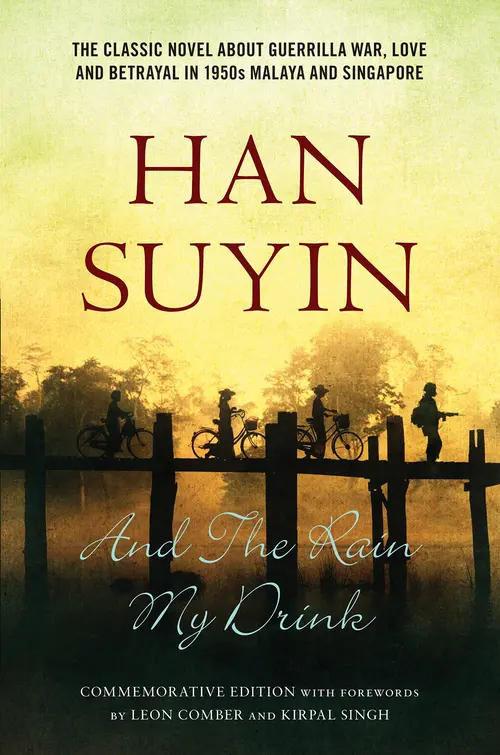
And the Rain My Drink
Cover
1
I will go to the forest for justice
The wind for my garment I wear.
… and the rain my drink.
(Old Chinese Ballad)
2
Praise for And The Rain My Drink
“Moving and beautifully described” Times Literary Supplement, UK
“Considerable sensibility and penetration” The Sunday Times, UK
“An important book … a book of great richness … profoundly moving” The Daily Telegraph, UK
“Han Suyin can convey the heat, the squalor, and flux of Asiatic life with expert touches” TIME magazine, USA
3
Foreword by Leon Comber
As Han Suyin’s former husband, I have often been asked about the genesis of her Malaysian novel And The Rain My Drink and how it came to be written. It was first published by Jonathan Cape Ltd., London, in the 1950s, while we were living in Johore Bahru. I was then a Special Branch (SB) officer in the Johore State SB headquarters.
My wife created something of a furore when we first arrived at Johore Bahru. We had been married not long before that in a small Catholic church in Pokfulam, Hong Kong, and in the absence of her father in China, she had been given away by the then Governor of Hong Kong, Sir Alexander Grantham. She did not fit in easily with the accepted pattern of an Asian woman in those days and especially one married to an angmoh (‘foreign devil’). She was an attractive woman, nearly always wearing a cheung sam (Chinese slit gown), articulate in English and Mandarin (but not in any of the southern Chinese dialects), self-opinionated and yet charming, unique, and professionally qualified as a medical doctor with a MBBS from the University of London. She was streets ahead intellectually of most of the people we met in those days.
Not long after we arrived at JB, her first novel A Many Spendoured Thing had been published in London, and the film rights had been taken up by Hollywood. It was made into a successful movie, though the Hollywood moguls added the word ‘Love’ to its title to make it more marketable, and to this day many people still remember its moving theme song. Although it was a ‘novel’, it was autobiographical, and it was a poignant and tragic love story of her romance before we married, with Ian Morrison, the Australian, Cambridge University-educated, Far East foreign correspondent of The London Times, who was tragically killed covering the Korean War. Ian Morrison was the son of the famous ‘Morrison of Peking’ who had been an advisor to the Chinese government in the early 20th century, and he was one of the many foreign correspondents covering the Korean War from the comparative safety of Hong Kong, which was then a British colony.
Morrison was given the name of Mark Elliott in the book, though his real identity was known to everyone who lived in Hong Kong, and Han Suyin appeared as herself as an Eurasian doctor working in the Casualty Department of the Queen Mary Hospital in Hong Kong.
The book, however, had its tragic consequences as it was not until it appeared in print that Morrison’s wife, who had remained behind in Singapore while her husband was in Hong Kong covering the Korean War, was greatly distressed when she came to know about his affair, and steps were taken to have the book withdrawn from circulation. However, the publishers said that it would not be possible to do so as the book had already been widely circulated in the book trade and the film rights sold. Unusually for a novel, it had a long Foreword contributed by Malcolm MacDonald, then the British Commissioner General for South East Asia, living in Bukit Serene, Johore Bahru, one of the Sultan of Johore’s palaces, not far from where we lived, although I do not think he knew of the consequences brought about by the publishing of the novel.
To revert to the writing of And The Rain My Drink, most of the background information used for it was provided from information that the author had picked up in casual social conversations with police and SB officers in Johore Bahru, although they were not aware she was writing a novel or that it would be used in this way. Many of the characters that appeared in it, too, could be identified without too much trouble with actual persons who were ‘fictionalized’ in the story although their real names were not used but as many of them were given traits which they did not have, they were not very happy about it.
When the book, which was considered to be critical in many ways of the British colonial government in Malaya, especially the hardships caused by the large-scale resettlement programme into New Villages that had been carried out by the colonial authorities during the Malayan Emergency to separate the Chinese squatters and farmers from the communist terrorists, came to the attention of General Templer, who was then the High Commissioner and Director of Operations in Malaya, he took up the matter with the Colonial Office on one of his visits to London in 1953 in an attempt to have the book suppressed on account of its anti-British bias. However, he was not successful in having the book withdrawn although a senior Colonial Office mandarin promised to see what could be done to provide a more balanced picture of the circumstances by sending out Vernon Bartlett, a MP and a journalist of the London News Chronicle, to Singapore to provide a more favourable account of the situation.
At the same time, General Templer complained to the Colonial Office about what he considered to be the biased reporting about the Malayan Emergency by Louis Heren, the Singapore correspondent of the London Times, who had pointed out in one of his articles that the improvement in the security situation following General Templer’s arrival at Malaya in February 1952 was not entirely due to Templer’s efforts and had largely come about because of a change of policy by the Communist Party of Malaya which had been decided on before Templer’s arrival. Although Templer pressed for Heren’s removal from Singapore by the London Times, the Editor of the London Times, Sir William Haley, refused to do so and Heren remained
where he was.
As it happens, my own career was affected by the publishing of And The Rain My Drink, and in 1953, although I did not agree with the views expressed in the book, I decided to resign from the Malayan Police Special Branch as a matter of principle at what I considered the undemocratic way in which the British colonial government tried to have it withdrawn by the publishers, especially as in the Malayan Emergency we were fighting for democracy against Communism which stifled free speech. When I submitted my resignation, G.C. Madoc, then Director of the Malayan Special Branch, and W. Carbonell, the Commissioner of Police, flew down from Kuala Lumpur to see me in Johore Bahru in an attempt to get me to change my mind but I said I intended to stand by my principles.
This is the untold story of the background to the writing of And The Rain My Drink.
(Dr) Leon Comber
4
Foreword by Kirpal Singh
As most readers of this remarkable novel (the categorization is difficult given the nature of this extraordinary narration of events that actually took place, with ‘real’ people being thinly disguised as leading characters and with the author herself appearing as herself!) point out, its title is intriguing and right from the start hints at larger-than-life evocations and profundities. The title comes, from a poem which has, as its basis, a fundamental commitment to seeing ‘justice’ and ‘equality’ being established as a way of life, as normative rather than just remaining remote ideals, talked about by many, truly aspired by a few and really only pursued by those very few individuals prepared to sacrifice themselves in the process.
This is a difficult, convoluted and oftentimes tragic story of what has been broadly termed the Malayan Emergency—the in-between years after the surrender of the Japanese following World War II when there was chaos, and order, as most people know it, was not restored till at least ten to fifteen years later. Historians, of course, will tell the same story in different ways, as will those who were directly involved and engaged—men such as the Chin Peng, whose own book My Side Of History, is well worth reading to better understand what our own author is trying so sensitively, yet boldly and robustly, to share. I was still a young boy, growing in the Kinta valley, surrounded by the Kampar hills in Perak, when much of what is narrated in And The Rain My Drink took place. I do remember, though, that as young kids we were often given baskets laden with vegetables, fruits, meat and cooked food to carry to the cave temples built within the limestone hills to hand-over to the temple-keepers. What we didn’t know then was that these baskets we dutifully carried and gave to the men and women fronting the hill temples were actually meant for those known as ‘communists’ who were hiding in the dense, thick jungles around the hills! Often, as I came to know later, buried beneath the contents of these innocent-looking baskets were notes that conveyed news to those fighting for justice and equality under the banner of the MCP (Malayan Communist Party; mostly led by Chin Peng). We were then living in small villages collectively known as New Villages (described in Han Suyin’s book) where the authorities had settled displaced citizens and those perceived to be ‘troublesome’. These New Villages were like our present-day ‘gated’ communities and no one could get in or out without express permission from the security guards who patrolled them and had their posts in box-like structures specially built at various entry/exit points. I remember passing through these ‘points’ quite easily when carrying the baskets; however, it was often harder to do the same when returning with our allotted provisions of rice and sugar which were given out on a weekly basis by the ruling powers. Altogether it was a confusing, confused period with very few knowing what really was going on. I remember hearing my elders speaking in whispers (we kids were told to go away and do our own thing!) and often people we knew who lived in the community left and never returned. Later in life, I discovered that my late Uncle Bill was actually one of those who sometimes sat as a ‘judge’ in the jungles and there were stories that Bill did send a few to their death. This uncle had, in his time, been gruesomely tortured by the Japanese when they learnt that he was in cahoots with the MCP (the MCP was composed chiefly of Chinese, though many Indians and Malays and some Eurasians were also members, even ‘inner’ members) and it would be almost natural to expect that when he sat as a judge he took revenge on those exposed to be spies.
Leon Comber has shared the background of Han Suyin’s work and I want to add that Han Suyin herself was unafraid to articulate her own views and perceptions of what she both heard and saw first hand. As a medical doctor, all kinds of injured and sick came to see her—both from the communists and the establishment. With her sad passing recently, I am sure more and more direct evidence by way of notes, diaries and letters will surface to both augment and dispute some of the interpretations of her book. We do know, of course, that in the main, the establishment was not happy with the way Han Suyin portrayed the treatment and handling of difficult issues such as justice and equality. It is clear that she tended to side with the underdogs—in this case those fighting on behalf of the people; i.e. mainly the communists). My Uncle Bill later worked at a seaman’s mission known as Connell House. Situated on Anson Road in Singapore, Connell House was where members of the merchant navy (mostly British and Australian) stayed when in transit or on leave. At the house bar much went on by way of gossip and rumour. Indeed, Leon Comber chatted there to my uncle a few times, exchanging memories of an era gone by. I know that when Mr Comber and I first met we did have occasion to talk about my late Uncle Bill (who also knew Han Suyin and had met her several times when she operated her Singapore clinic). Han Suyin did not endear herself either to the British or for that matter any of the ruling powers because she firmly believed in democracy and resented any attempt at coercion or suppression. At one point, given her wide-reading public (for she had one, especially after the grand success of the Hollywood movie Love Is A Many SplendoredThing, with Nat King Cole singing the theme song), even the Americans were very unhappy with her political views and positioning and did, for some time, ban her from entering the country. Such is the enormous power of the pen when it is mighty, and given Han Suyin’s no-nonsense and yet charming style (and there is much awaiting any scholar who needs a good title for literary research: The Style of Han Suyin’s Fiction) her pen is mighty. She writes in the kind of nonchalant manner that entices and then seduces to make complete the bond between writer and reader—a bond that most readers carry through life. This is quite an astonishing achievement; most readers of her books remain devoted and passionately speak about how reading her books made them rethink their own lives. I was in Dumaguete in the Philippines at a resort and lo and behold the owners of this resort had named their only child Suyin, in their adoration of our gifted author.
I will go to the forest for justice,
For justice and righteousness,
And become a green-clad man.
The rulers pursue me with soldiers,
With riders, chariots and spears.
I will go to the forest for justice,
The people will flock to me.
I right their wrongs from the green shade,
And kill the rulers with arrows.
The horsemen stumble with fear.
I will go to the forest for justice.
The wind for my garment I wear.
Together with my many companions,
The wind for my garment and the rain my drink,
We build a new heaven and earth.
It is necessary to quote the poem from which the title comes in full because it sets the tone, the stage and the tapestry for what the book tries passionately to communicate. The character Evangeline who sings this song, the author tells us, sang in a harsh, unmelodic voice pitched higher than normal, off-key and haunted with the old longing and grievance, old as the world of man. Old as the world of man: yes, because the lyrics, the words of the poem sung as song, serve as incantation, both demanding a keen listening and also providing a rich, ancient evocation through the use of allusion. Han Suyin, was more than a medical doctor; her keen eye and ear and no doubt the detailed discipline of the medical training all come to her aid when she is narrating an incident, describing a scene, crafting a character, dramatising a plot. Repeatedly, interspersed throughout And The Rain My Drink are allusions, giveaways, references to numerous ‘others’: historic events, writers, poems, novels, stories, songs. When I was young the song Han Suyin mentions in her novel—‘Rose, Rose I Love You’—used to be very popular. Rose was a real person though the name was a pseudonym. I remember meeting her when she was performing at the old Happy World Stadium in Singapore—a world frequented by the likes of my late Uncle Bill where life became like a dream …
And, yes, this is, to my mind, one of the leading leitmotifs of And The Rain My Drink. Dream. Dreams. Dreaming. All over the world we witness conflict: people willing to die to see their dreams realized to give hope for a better world for their children and their children’s children. Han Suyin spares no horrific details of the ways in which many hundreds died, on all sides, the physicality of the tortures, the terrible manner by which many saw their own end, the enormity of the entire jungle existence, the strict codes which all were expected to abide by and for breach of which many found themselves dead, the love stories of yearning young men and women who otherwise gave their all to the cause. We are confronted by all these issues as we read the book. How do we respond? How do we react? How do we read and interpret them? These and several other questions bog the mind as we put the book down and turn to our other chores. Pitted against the backdrop of the book, most of what we get preoccupied with seems puny, meager, small. The book’s theme is large, its pages full of pain and real suffering, and though the main platform for the book is now history, its vividness and capacity to move us beyond ourselves is telling. Like the great novels of a similar genre, And The Rain My Drink, is a tragic reminder of what humans do to one another and with one another when times are not good. Yes, there are glimpses into a humanity that is giving, caring, generous; but for the major part, human conduct and behavior leaves much to be desired when the tide turns against us. Is this book the proof or reproof? A warning, a prophecy or just one person’s rendition of a phase now fossilized? One simple sub-theme of the book is racism, at many different levels: is such a theme no longer relevant? Then there are the roles of women, young brides, old mothers, the kids … what roles do they play in the narrative? What roles do they play now?
In the vast field of Malayan Literature in English—or in the other main languages for that matter—And The Rain My Drink stands out as a towering testimony of a hellish period lived through and experienced by the writer herself. Very few books come close to the wrenching narrative of this book as it unravels and exposes the truths behind the realities of what went on during this time of confused values and even more confused judgments. In the years to come, given the author’s recent demise, as more come forward to offer their own personal testimonies, I am sure the book’s validity and claim to be the major account of jungle warfare and terrorist tactics used by different parties for very different ends, will be of paramount interest and concern to, and for, literary scholars. The writing is unaffected, the backdrop unpleasant for the most part, and the characterization brutally honest and clear. These are qualities we admire in the best of writers and here Han Suyin excels even herself. For more than any other of her books, And The Rain My Drink speaks of history and to history; presenting an articulate and uncompromising view and laying bare the quintessence of what individuals and families had to endure during these tough times in the Malayan jungles because of the absence of real leadership. It is important that young people—and particularly so the young of Singapore and Malaysia (which were one country then, known as the Federation)—read this book and process the many perspectives it offers, for Han Suyin writes not so much for the people in power who made a mess (and therefore are judged by the might of her pen) but for those common human beings who lost so much even though they gave so much. Another Malaysian writer, the late Ee Tiang Hong, has stated in one of his most moving poems that ‘the common man/is history’s poor left-over’ (‘The Common Man’ in Myths For A Wilderness). What we witness in And The Rain My Drink is this common man, ordinary humanity, pitted against ruthless greed for power and tragically miscalculated emphases on the ends at the expense of means. Our young need to experience the disastrous consequences when ends take over means with scant regard for human pain and suffering and while the history books will state this, it is fiction that will bring the enormity home! For this I strongly advocate that And The Rain My Drink be read in schools and colleges because there is a persistent danger that the pursuit of ideals, no matter how worthy, should not be undertaken without due regard to the costs involved. Yes it is honourable to court ideals and even die for these, but where and when the ideals are themselves originating from confused mindsets and set-in-stone paradigms, then it is advisable to be cautious, circumspect and rational. Passions aside, at the end of the day, we are talking about real lives being lost in the wilderness of uncertain commitments, goals and values. While And The Rain My Drink does not pretend to be exhaustive, its coverage and rendering of human plight is comprehensive enough for all to be aware of the terrors that lurk behind uneasy compromises and simplistic solutions to complex issues.
The Story Continues on BooksBarbecue!
Enjoyed this preview? ❤️ Do not stop here!
Read the complete book free online → 🔗
Continue reading now on BooksBarbecue and discover every page!
Love reading? Bookmark BooksBarbecue.com for more amazing books!
Happy Reading!