All the Way Happy
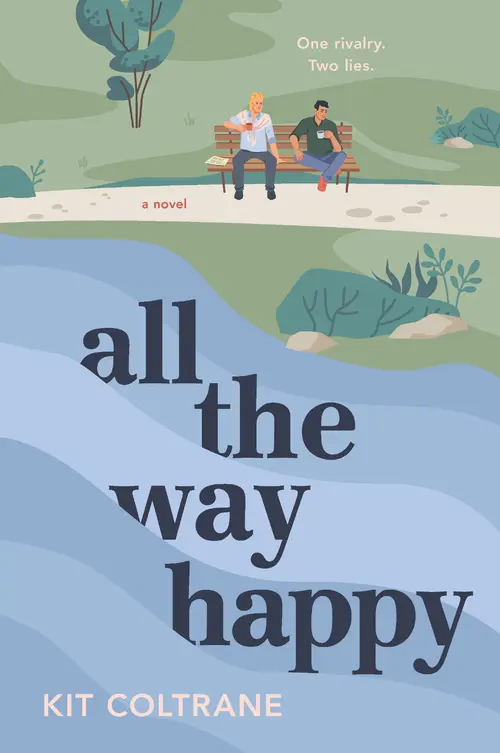
Cover
Content Warning
Content Warning
This novel includes some descriptions of neglect and abuse, and healing from childhood trauma is a crucial theme of the text. There are also mentions of drug use and suicidality. Jack and Theo are navigating love, loss, and adulthood as they cope with foundational trauma. If this is challenging to read, be gentle with yourself. The words will be here if and when you are ready.
Dedication
To that child in the cold bedroom,
the window stuck open,
the rain coming down—this is for you.
You made it out.
Prologue
He was thirty-seven. Fuck. He was thirty-seven.
When he ran away from everything—from Baltimore, from his family, from blue eyes and guilt and casual schoolboy violence—he ran far. He got his first shitty apartment in Cork, Ireland, and he tried to live on the razor edge of a knife, in the dangerous dance of his own self-destruction.
He had a dodgy upstairs neighbor, Cathal, and windows which didn’t shut all the way, and the water wasn’t ever quite warm enough, but it was—it was his.
He’d cashed out the small trust fund that hadn’t been impacted by what his father—what had happened, and the first thing he bought was an old record player and a stack of LPs. Music was what kept him going. The kind of music that his parents had never let him listen to, ugly and wailing and wild, soft and heartbreaking, stupid and silly and utterly perfect.
Led Zeppelin blared out when he smoked his first spliff (courtesy of that same upstairs neighbor, who was quite sketchy indeed, but with an apartment full of exotic birds and a too-kind heart). Tiffany sang about being alone, and he danced in front of the bathroom’s cracked mirror while he cut his own hair. Long locks shorn, revealing an angular, violent beauty.
He listened to the Clash and thought about his father, about imposing his own brand of anarchy on his stilted and tightfisted childhood, that man he had worshipped and the man who had hated him. He threw things and threw up at two in the morning, the fast food he’d grabbed after a night at the clubs coming up looking not all that dissimilar from the way it went down.
Stevie Wonder sang about falling in love and he tried, he really did, not to think about sky blue eyes and black hair.
And then there was David Bowie.
The feeling of sunrise in Cork—the way the air was damp and fresh, shaking, all too aware of the panic of nighttime, liminal and lined with edges of gold—went best with Bowie. Some mornings he listened to “Heroes,” and he thought about what he had never been. On other mornings, he put on “Let’s Dance” and drank cup after cup of shitty instant coffee before heading down across Saint Patrick Street to scrub the sticky floors of the club he’d been writhing in four hours before.
Rainy days and it was “Bring Me the Disco King,” and he thought about taking a knife to the inside of his arm. When the flat was freezing with cold in a wet way which felt like falling into the sea, he played “My Death,” which was Jacques Brel, but Bowie lived and died it. And “Wild Eyed Boy From Freecloud” was what he played when he first took another man into himself and wanted to scream out to his father and his past and those blue eyes.
He’d had enough of silence.
But most of all, that first year was marked by an almost orgiastic adherence to Bowie’s sepulchral warning—the desired brevity of his life, an anticipated early end by twenty-five.
He didn’t think he would make it, not even that far. He figured there was nothing much to live for at eighteen, anyway, other than one more drink, one more fuck, a few more cups of coffee, trad nights with American exchange students grinding in the corners, balancing on the rock wall across from The Thirsty Scholar at three in the morning and itching, always, to jump into the water and melt the fuck away.
And now, at thirty-seven, he was still very much alive—his blood pumped through him, and his brain was sparking in manic fury and discontent, and his skin felt like ice. He had a job, a respectable one, and he had a smooth face which no one could read. He had an ex-wife and a child, an aging mother who had never really loved him but who was maybe trying her best now. He was usually sober. He played music at an acceptable volume.
He was back in his childhood home. Managing it, and his money, and making it all look good.
As the Beaumonts had always done. At least until his father had fleeced half of Baltimore. But he was reclaiming that name, that heritage, even as he hated it.
And every little part of him, the broken bits, the whole bits—every breath which reminded him of cigarettes at midnight—every time his mother looked at him with a vague, muted disappointment—every time he saw blue eyes in the street or in a bar or the Gwynns Academy alumni newsletter—every morning when he didn’t wake up in that shitty flat with Cathal and the parakeets upstairs and the old record player and the LPs which skipped—
Every single cell in his body longed, desperately.
Silently.
He was thirty-seven.
He wanted to burn the world down.
Chapter One
The first time Jack Gardner met Theodore Beaumont, he was staring at a rack of blue blazers, knowing that his mother could never afford them, and doubting every decision which had led him here, to Gwynns Academy, the most exclusive—and expensive—preparatory school in Baltimore.
All Jack had ever worn were hand-me-downs, clothing used by others, and the crisp lines of the Gwynns uniforms were foreign to him, nearly strange. The stitching was impeccable, the cloth a deep navy blue, and the school’s crest was in gold and red embroidery, and he had never had anything so fine, so costly, so clean. Starched white shirts and pleated trousers and striped gold ties were the other elements of his soon-to-be school’s uniform, and he wondered if this—this outfit, this costume, this mask—could ever hide the little boy who’d never really had enough to eat.
The school shop bustled with other students and their perfect families—ice-blonde mothers with pearls, and fathers with platinum tie tacks, and kids who looked like their copies, utterly at ease, expectant of nothing other than this, the chore, the way the world was, spending money without a thought. Jack was already out of place—school hadn’t even started yet.
He caught a glimpse of himself in the full-length mirror and wanted to look away, but he couldn’t. He saw his skinny frame, knobby knees covered by too-large shorts, a collarbone as thin and delicate as a bird’s wing exposed by the stretched-out neck of his black T-shirt. His hair was thick and messy, impossible to tame. The only feature which might have been attractive were his blue eyes, piercing. He tried not to worry so much about how he looked. That wasn’t why he was here.
He could see the rest of the school shop behind him in the mirror, crammed tight with the uniforms and notebooks, lacrosse gear, Shakespeare and Yeats and mathematical texts, the smell of fresh paper and glue, and all of those shining people. At the register, one of the other children stood with a stack of clothes, seeming bored, elegant, casually stunning, and cold. His mother was next to him, chatting with another mother with rich black hair, and his father typed away on his cell phone. Jack couldn’t help but imagine the sort of life they must have—galas and fundraisers and meals out, clothing and jewelry and shoes without holes.
He held a blue jacket under his chin, trying to imagine the next four years, what he would look like. Who he might be. His fingers delighted in the soft material, but—
“For fuck’s sake, Jack. We can’t—go look at the used pile.” His mother’s face was pinched and still somehow disinterested. She had tucked herself in a corner, maybe in an attempt to go unnoticed, but she stood out here just as much as he did. She didn’t fit.
He’d learned not to blush, not to show shame. He turned away from the mirror and dug through the pile of used uniforms.
The blond boy at the counter slanted his eyes over, looked at Jack from his scuffed sneakers to his frayed collar, and Jack could feel his eyes like glaciers on his neck. The boy smirked. “This school’s really been lowering its standards, Mother.”
His mother turned from her conversation, glanced at Jack and his mom, and pursed her lips. Half an unkind smile, and then her tanned skin smoothed out into a blank haughtiness. “Be nice, Theo.” She turned back toward the other parents, unbothered. Dismissing Jack—and maybe her own son—as if he were of no consequence.
A sigh from the boy, unnoticed. “If I must.”
Everything that Jack had ever hated about himself was visible on the other boy’s face. An unpleasant face, a jeering face. That child had seen right through him, right down to the root, and he had found him wanting.
And that boy—Theo—was everything that Jack yearned to be. His skin was pale, clear, white enough to show the blue tracery of his veins, and his hair was perfectly coiffed, and he wore a five-thousand-dollar watch, and he could afford to be cruel. Could afford to go to Gwynns without a scholarship, without working himself down to the nub, competing and scrapping and begging, Please, see me.
Jack gathered up two jackets, two pairs of trousers, three shirts, one tie. His mother dug in her handbag and looked at him as if he were a terrible burden. This was a big day, an important day—he didn’t want to admit his mother’s resentments. He could look at that later; his mother’s attitude wouldn’t go away.
Jack got in line, keeping a significant distance between himself and that boy, Theo, who was tall and lithe and perfect, who smelled like vanilla and gin, who was sparkling. Who belonged here, effortlessly.
No one could ever miss Theo Beaumont.
Jack hated him at once.
“For fuck’s sake, Will.”
Jack, if pressed, would admit with a sheepish grin and a tilt of his head that Gwilim Linwood Alistair—Will, now, since all of his kids were determined to have normal names, despite his best efforts—was his favorite child. He was quiet, a dreamer, with all of his father’s sarcasm but none of his insecurity, and Jack maybe felt a bit bad about the name, but it was too late now.
He looked exactly like his dad. But he was better.
Though, admittedly, just as absentminded. Christ.
Johnny, of course, had set herself up in her room with little fanfare and a careless hug for each of her parents—a very clear “go away” signal—and was already prepared for her junior year. She’d been through the routine before. And she was never quite as—distractible as Will.
Jack looked at Will’s Gwynns Academy blazer, forgotten in the back of the car. Meg, as pretty as ever but twice as worn out, strapped Amy into her seat belt, and gave Jack a that’s your kid, you idiot stare.
He sighed. “I’ll run it in, all right? Maybe check in with Charlie, catch a cab home.”
“Mm.”
He handed over the keys and leaned down to press a kiss to his wife’s freckled cheek, and then they had that moment which many soon-to-be divorced people must have—oh, shit.
Not his wife. Not anymore.
Jack turned away, walked out of the parking lot and back to the mica-flecked granite of the school gates, school uniform in hand, and he tried not to think about what was coming next. The signing of the papers. Finding a new place to live. Splitting up the hours, the days—Will and Johnny at school, for now, but where would Amy live, and would he get to see her enough, and would they all hate him, maybe, for tearing down a marriage which must have looked, from the outside, unbreakable?
They’d settled Will into his dorm room, posters on the walls, bookshelves jammed with science fiction paperbacks and thick textbooks and all that literature they were paying a ridiculous amount for teachers to shove into his head. Jack jogged back through campus, passing the old Japanese maple he’d climbed and hid in for so many hours as a teenager, and the running stream he’d fallen into while skipping study hall, and the lacrosse field where he’d shed so much blood. Parents and their children were still milling about, and despite the long years between his youth and adulthood, Jack was full of excitement and dread and that old longing, a kid at the candy store, a child without a home. He barely looked around him, eager to get into the dorms and out without being noticed, and he ran right into the back of another parent.
Juniper. Sandalwood. Vanilla.
Fine, combed wool. Ice-blond hair.
Oh, shit.
He was going to throttle Will.
Theo Beaumont turned, elegant, still. He was wearing a perfectly tailored suit, tie loosened around his neck and top button undone, a gold watch, shined shoes. Jack suddenly felt underdressed and unfashionable, just as he had twenty years ago.
He’d spotted him in the distance—of course he had—while getting Will into his dorm, though he’d tried not to think about it; he had a son, too, in Will’s year, with the same chilly looks but a big toothy grin. They’d been filling out forms at the reception desk, designer luggage handed over to be carried up by school staff, and Jack had turned away, face hot. He didn’t want—he had really tried not to look—he forced himself not to even though, God, he needed—
Now Jack couldn’t look away. Theo’s hair was long again, no longer asymmetrical and uneven, and his skin was still flawless, enriched by the few fine lines showing the decades between that summer after their senior year and today. His eyes held a hint of warmth—maybe he’d been softened by fatherhood, by marriage—but they were gray and frosted as he regarded Jack. Despite the subtle differences, he looked—it was still him, unequivocally. Still Theo—still so beautiful.
Nothing had changed.
Jack hadn’t talked to Theo in nineteen years.
And everything had changed since then.
“Gardner.”
“Um, hi. Sorry, I—” Jack felt like he’d been hit with a blast of ice. He was frozen to his spot, here on the red brick lane, in the shade of pear blossom trees, the thick wet scent of Baltimore in September.
He looked so much the same. He even smelled the same.
Jack was, very quickly, losing the plot.
Theo rolled his eyes. “Is there a reason you’re holding a Gwynns jacket?”
Jack looked down at his hand, eyes catching on gold stitching. Looked over at the dormitory building. Looked at Theo. He opened his mouth, but nothing came out.
“Oh, for God’s sake.” Theo rolled his eyes again, somehow more dramatic, and waved a hand. “Just go in, would you?”
“I—”
“The dorms are quite nice, now.” His casual tone was forced in a way that only Jack would be able to notice.
“Yeah, I—”
“I think they have your picture up there, somewhere. Sure to be a thrill.”
Still kind of a bastard, it seemed. Jack grimaced, embarrassed. “I wish they hadn’t done that.”
Theo scoffed. He was unbelievably good at scoffing. “You’re the only person I know who could be ashamed of such a...significant donation.”
“Yeah, well...” He trailed off, uncertain. He really was uncomfortable with people—people thinking about—“I hate that they—”
“I remember.” Theo looked him over, eyes just as sharp and critical as ever, and then his face softened, just a little. “Always so ashamed to be noticed.”
Jack’s face colored. He glanced away, staring at the brick pathway.
“It’s been a long time.” Theo’s voice was hollow but gentle.
“Yeah.” Jack rubbed the back of his neck, tried to smile. “We’re old men now.”
“Not that old.” A lifted eyebrow.
“God.” Jack felt the burden of too many years, so many joys and too many stupid decisions. “I feel old.”
They both paused, silent. Jack felt the distance between them as if it were a physical thing, a solid thing, and he wanted to reach out, smell that place where Theo’s shoulder met his neck—and he remembered those few months, the stone wall next to the River Lee, Cork at sunrise, cigarettes laced with hash, and the most beautiful and fucked-up time in his entire life.
And he thought about his three children, whom he loved more than anything. Meg, the girl who’d cared for him, and their family, and their failed marriage. And the rumor he’d heard, back in January, about Theo’s divorce.
The moment he realized he couldn’t lie anymore.
“Yes, well...” Theo breathed out, shaky, and ran a hand through his still-perfect hair. “Right, so this has been...awful, yeah. Absolutely terrible.” A shrug. “Good luck with the jacket, Gardner.”
“Theo, I—”
But he was already walking away.
Jack had watched him go so many times.
Above him, hopping from branch to branch in the pear blossom tree, a blue jay yelled out its sharp call, and a damp breeze ruffled its feathers, and Jack remembered the apartment above, filled with exotic birds, and the skipping of old records, and the way the air felt at two o’clock in the morning when they’d had too much to drink and the rain came down, mizzling, and lamplight refracted in the spider silk strands of Theo’s hair.
Something twisted inside him and he made a sound like spitting up concrete.
He gripped the jacket, too tight, in his left hand.
Fuck.
Chapter Two
Theo told himself he never doubted that this was where he was meant to be, even though he could remember a time when all he wanted was to be anywhere but here.
That little boy who had wanted—
He shrugged. He was too old for dreams.
Father had gone to Gwynns and started dating Mother here, and all of his childhood friends were going—of course they were. And it was just the way it was, for his circle and his parents’, old families which grew up together and lived well together and ruled the city together, and there was no question of the money.
Theo never thought about money at all.
Unless he was noticing who didn’t have any.
And then he was merciless.
First day in the dorms, and Theo was fully arranged, with the best of everything, and he was going door to door as the unofficial welcome and fuck-you committee. The building smelled like fresh pencil shavings and lined paper and too many clashing perfumes; it was a heady smell, the beginning of things. Fourteen years old, away from home, a monitored independence.
Tom followed him with his significant bulk the way he had since they were children, and his other childhood friends were comfortable in their rooms. Genni had waved him off, perfecting her eyeliner and gossiping with her roommate, and Phillippe was already dug in to one of their textbooks, classical music playing on his stereo, the geek. But Theo—he was unsettled. Restless.
Theo wasn’t nervous—not exactly—but he wanted everyone to know who he was and that he would always be at the top of the pile. Most of the other students saw, immediately, that it was Theo they’d need to compete with—and that they would never really measure up.
There were certain...expectations which came with being a Beaumont. His father made that clear in the car on their way to Gwynns, and he had made it clear his whole life. And his mother’s entire elegant existence was the manifestation of these expectations; she played her role as a Beaumont perfectly. She could charm an entire ballroom with a glance and she was beautifully, stunningly silent when his father...
Well. Theo knew he needed to be like them, to earn the best grades and make lucrative connections; he was valuable as long as he proved—
He thought that, if he were enough like his father, powerful and respected and a tiny bit feared, his mother might take more notice of him. And his father might leave him al—
Might be proud enough to let him breathe.
The Story Continues on BooksBarbecue!
Enjoyed this preview? ❤️ Do not stop here!
Read the complete book free online → 🔗
Continue reading now on BooksBarbecue and discover every page!
Love reading? Bookmark BooksBarbecue.com for more amazing books!
Happy Reading!