All of Me
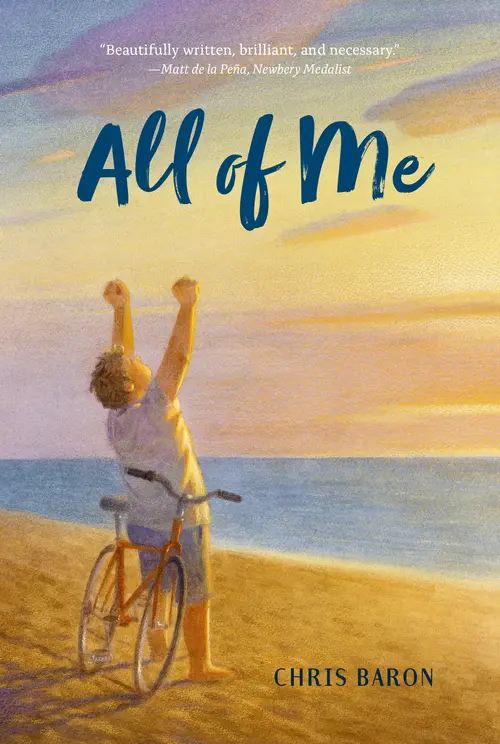
Title Page
Copyright Notice
The author and publisher have provided this e-book to you for your personal use only. You may not make this e-book publicly available in any way. Copyright infringement is against the law. If you believe the copy of this e-book you are reading infringes on the author’s copyright, please notify the publisher at: us.macmillanusa.com/piracy.
Dedication
For my dear family, Ella, Asa, Samaria, and Caylao, and for anyone doing their best to be all of who they are.
Before Summer
Who Am I?
The life in my head seems
so different from the life outside,
where I am so big
that everyone stares,
but no one sees the real me.
My name is Ari Rosensweig.
This year, I am the newest seventh grader
at Mill Valley Middle School.
I have sandy-brown hair
and green eyes like my father’s.
I’m average height, but
I am a fat kid, and I hate it when
people call me names.
Even though I’m overweight,
I can still do everything
everyone else can—
ride my bike, play video games—
but people just see me as different,
only notice who I am
on the outside.
My mother is an artist
who sculpts giants in clay
and paints the world
on canvas, on murals,
and even on clothes;
my father sells what she paints.
I’m an only child.
Sometimes I get lonely,
wish for a brother or sister,
but I get so much time to myself
to do what I like to do,
and no one interferes.
I make role-playing games.
I’m going to be a cryptozoologist.
I want to find the creatures out there,
like Bigfoot, that might seem so different
but that belong to this world too.
My mother says we are going
to spend the summer at the beach;
Out in nature, she says.
I like the beach, but I don’t like
taking off my shirt.
I always have to hike up my pants,
and I worry that there isn’t enough food,
because I’m always hungry.
More than anything, I think,
I want to lose weight,
and I don’t know how.
Why Are You So Fat?
people always ask (not always out loud)
I’m not fat.
I sit up straighter,
feel the rolls on my body unbuckle.
I just have big bones. That’s what my mom says.
I have big bones and bigger spaces in between them.
Why are you so fat?
Well, they say my grandfather, from eastern Europe
had a mysterious disease that made him big;
he carried it with him,
and he gave it to my mother
and my mom had it and now I have it.
Why are you so fat?
Because my grandmother made me eat every bite,
told me to never leave anything on my plate.
Why are you so fat?
It’s a gland problem.
I’ve got bad glands.
Someone told me about glands,
so I think I have bad ones.
Why are you so fat?
The doctor says I can’t help it.
He says I may not look normal,
but I’m healthy enough to carry the stars,
and this fat keeps me safe.
Why are you so fat?
Because I love school lunches: meat pies and yogurt cups
and a giant cookie, and then after school
I take the five dollars my parents give me
and buy slices of pizza from Mario’s and play the old Pac-Man machine until dark,
stack quarters along the edge
until I pass the second apple.
Why are you so fat?
My parents are never really home anyway.
They’re busy,
and I fill myself up with food and watching TV,
comic books, and going to the park, and hot dogs with ketchup and onions.
Why are you so fat?
Sometimes I get home to an empty apartment
and the echo of the cars going by on the street outside.
Why are you so fat?
Because if someone asks enough times,
then the question becomes the answer.
Moving
When your mother is an artist,
you move a lot.
We stretched ourselves
across the whole country
from New York to San Francisco,
far from our family
and everything we knew.
For the artist,
making a new life
is as simple
as scraping off a palette,
setting up a new studio.
For me
the studio means
quiet corners
with slabs of clay,
sketch pads
and universes,
hands and face chalked
with pastels, potato chip grease,
and Pepsi.
Spider-Man comics,
The Hobbit, and Bridge to Terabithia.
For me it means waiting.
It means space,
suspended in time
between the mother
who is the Artist,
the father who is too busy,
and a son
whose story is about being
the new kid in seventh grade,
awkward, big, different
from everyone else.
Since Leaving New York
we haven’t celebrated
the high holidays like we used to,
with the rest of the family.
It’s like things that used to matter
suddenly don’t anymore.
I didn’t know I cared.
I thought of it as something we just did,
who we are, but now that it’s gone,
I think about those long tables
back in New York,
overflowing with food
and candles at Shabbat,
and the grown-ups
talking long into the night,
the cousins playing ring-a-levio
outside, or capture the flag.
When we left,
they stopped talking to us,
or we stopped talking to them,
like we were all suddenly
not in the same story anymore.
When I tell this to my father
on the way to the rabbi’s office,
his eyes get wet,
so I don’t say anything else.
Rabbi’s Office
Right away I am nervous
because we are already
a year late in the process
of my bar mitzvah because my parents
just didn’t make the time.
My father waits outside,
and I go in.
The first thing I notice
is a little glass globe.
Inside is a blue river
and green trees in the center,
a whole world, so peaceful,
a storybook inside glass.
If I could, I would sleep
next to the trunk of the tree
closest to the rock,
where words are etched
in delicate precision:
“I will pour water on the thirsty land,
and streams on the dry ground.”
The rabbi tells me that his grandson
brought the globe back from Israel.
He lets me hold it.
He gives me saltwater taffy.
He’s calm,
and everything he says
sounds like a story
I might be a part of.
I make promises to practice,
and he writes down some dates
for when to come back,
all the way through the summer.
It’s a good meeting. A start at least.
It won’t be the worst thing
to come here.
Grown-Up Talk
In my room, I watch
The Greatest American Hero.
It’s an old show
I watch with my dad about these aliens who
give a suit to some guy
and it makes him a superhero.
I think about what I would do
if I had the suit.
How I would fight for good.
How I would streak across the sky.
How I might look in that skintight suit.
I would have to get in shape and exercise,
or maybe the suit would change me
just by my putting it on.
I hear my parents
talking in a low hum
in the dining room,
a gentle
stream of words
flowing through the house.
It’s comfort,
the uncomplicated vibration
of grown-up talk,
the sound, not the words.
But then, in the middle of the second commercial,
I hear a crashing sound,
the dining room table, the pewter cup,
the dinner dishes falling.
The bass of my father’s yell vibrates
through the wall.
I hear the shriek
of my mother’s angriest voice.
I hear
crashing,
bumps,
door slams.
I hide in my room and wait.
The Greatest American Hero
slides under a car
to stop it from crashing
into a school bus.
My parents yell,
but it’s when I hear crying
that I try to be brave.
I open my door,
sneak down the very short hallway
until the sound burns like fire.
My father sits on top of my mother,
holds her head down,
screaming, Fatso, you’re killing me!
She screams back
every word
I have been told
not to say.
Other words too,
about traveling,
about lying again,
another woman’s name,
about businesses. About money.
Words in spit and terrible angles.
His body hangs over her,
his weight over hers, trying to maneuver
their awkward, swollen adult bodies.
I want to rush in and knock him over.
I want her to stop screaming.
I’ve heard yelling before,
always shouting at each other
as if this pitch and fury
is just a part of who they are,
but I’ve never seen them like this before.
When my father finally notices me, his eyes are broken,
pleading, guilty, hopeless.
She’s driving me crazy, he says.
He stops, stand ups, grabs his cigarettes,
walks out of the apartment.
My mother gets off the floor too,
stops crying,
tries to pull herself together,
takes a drink of whatever is on the table,
stares at the door, left slightly open.
Grown-up talk, Ari, she says,
and sits down in her chair.
Just grown-up talk.
School over the Bridge
I should be going
to school in San Francisco,
where we live,
but my parents
send me over the Golden Gate,
to Mill Valley Middle School.
They say they want to send me to the best school.
It’s won all the awards, my mother tells me.
I ask her if she’ll get me a phone now
since I will be going so far every day,
but she tells me, No!
Under no circumstances, she says.
Those things stifle creativity!
You can always reach me on the school phone.
At first, my father drove me every day,
and we laughed and talked about school
or the family in New York
or the best ways to talk to girls,
but after doing it for a while,
I could tell he didn’t like
driving over the bridge every day.
One day he got really quiet,
played the music a little louder,
and we didn’t talk at all.
This drive is too long, he said.
There’s got to be another way.
I Will Fight You
Words are the source of misunderstandings.
—Antoine de Saint-Exupéry, The Little Prince
When you are fat,
you get picked on.
It’s just how it is,
especially if you’re the new kid.
I don’t know what to say
most of the time.
I just want them to like me.
I want to fit in.
At the Ping-Pong table
before school,
Frank tells me
that he is afraid of Mark,
that he made him mad somehow.
Frank’s one of the people
I see before school,
because his parents drop him early
for the breakfast program,
and sometimes I get there early too.
We eat doughnuts between games,
and I eat way too many.
Powdered sugar
wafts onto the table,
white flecks
on a green field.
I want Frank to be my friend
but usually he is mean to me,
picks me last at PE,
makes fat jokes,
even pushes me.
Sometimes, on bad
days, he chases
me on the bike path after school.
One time he called me “Jewboy.”
When I told my parents,
they said to stay away,
but there is
nowhere else
to go.
For now, we are
battling on the table,
and for once I am winning.
You’re pretty good, he says.
I used to have a table at home, I reply.
I didn’t. I try not to lie,
but I’m scared to tell him
that I learned to play
with my parents, in New York,
on vacation in the Catskills
and at Camp Shalom.
I don’t want him
to ask me questions
about being Jewish.
Mark is weak, I say between serves.
Mark is not weak. Not at all.
The mini-doughnut wrapper blows across
the table. Powdered sugar
covers the green field, the paddles, our hands.
You are way tougher, I insist.
Frank is strong, but not the toughest,
maybe in the bottom of the top ten,
behind the obvious choices,
mixed in with the dark-horse contenders,
strong kids, good athletes,
kids who do karate and kung fu.
I tell Frank that he can kick
Mark’s ass, that he shouldn’t worry.
The bell rings.
Frank smiles and grabs his bag.
Later, he says.
I feel the pride of helping,
and soon, in my mind,
I am standing on the far field,
across from the basketball courts,
right alongside him and the other cool kids.
I see Frank later in PE.
He stands next to Mark.
They are looking at me and laughing.
Mark is the tallest in the class.
In the mile run,
he glides past us
like some action hero.
Crushes baseballs,
spirals footballs.
After lunch, in the bathroom,
Brian Yee whispers to me,
I hear Mark and Frank are going to kick your butt.
Why did I open my big mouth?
I meant well.
I just didn’t think past that moment,
that I was the outsider,
but I can’t go through people
to get inside.
I don’t fit into those spaces,
no matter how much I lie to myself.
I am too big,
even in theory,
to hide,
too slow
to run.
I shouldn’t have said anything.
We’re gonna get you, Fatboy, they say.
How long do I have?
First Friend
On one of my first days
in this new school,
the counselor ducks me into class,
unannounced, sits me near the back,
close to a wiry, brown-haired kid
with bright eyes and a square jaw.
I’m John, he says.
Ari, I reply.
His desk is filled with notebook pages
of robots and mechs from Transformers,
Robotech, Voltron, and Battle of the Planets
drawn in blue pen and scratched eraser marks.
I watch him smear ChapStick on his lips every ten minutes,
even digging out the last bits of lip balm with a toothpick.
One day, John drops the toothpick
on the floor and mumbles, My pick …
And that’s where it really starts.
For a while, I try to call him ChapStick,
or Chap, Bot, or anything else he might like better,
but it always becomes the nickname
Pick.
Finding the nickname
finally made me feel like I lived here,
like we shared something just between us.
Pretty soon it’s me and Pick all the time,
watching cartoons together on long Saturday mornings,
Spider-Man, The Transformers, Avatar,
and Pick’s favorite,
an old anime called G-Force.
I love 7-Zark-7, he says,
a round, trash-can-looking robot
who is always afraid
but who helps protect Earth
from nine hundred fathoms below the sea.
Dolan Avenue House
Halfway through the year,
my father starts to spend
his days and nights
in the garment district,
selling the hand-painted
clothes my mother designs.
He tells me once,
on his way to work,
This is how we survive.
I hardly see him.
They let me
take the bus now,
over the Golden Gate
on Sunday nights
to stay with Pick’s
family on Dolan Avenue
off Shoreline Highway
a few days a week.
They even bought
me a bike to keep
at Pick’s house.
Every day, from the house,
we ride our bikes
to school along
the bike path,
through the marsh.
At first,
it feels like
long sleepovers,
whispering stories
in the dark,
learning not
to be alone.
This family, so kind to me,
even though they pack
mostly gross vegetables for lunch,
eat salads every day,
eat nearly invisible
portions at dinner,
even though I am
always starving.
The First Time I Meet Lisa
I spin the combo
on my bike lock,
but it won’t open.
I breathe heavy
and groan in frustration.
The first bell is about to ring.
Frank laughs as he walks by.
What’s the matter—
are your fingers too fat
for the lock?
I don’t look.
Why don’t you just shut up.
I hear her voice
like a bolt of lightning.
The lock pops open.
Her long blond hair
shines against her green
military jacket,
her arms filled with books.
She puts out her hand
with a thousand silver bracelets.
I’m Lisa.
But I know this.
I saw her my very first day,
the rebel girl
who misses school sometimes,
who looks like she’s in high school.
I’m Ari, and we shake,
walk toward the bike racks.
How is it being the new kid?
Oh, it’s great, I lie.
She looks at me
like she’s waiting for the joke to end.
Where did you move from?
New York, I say.
Wow, she says. I wanna go there one day.
You know, I say, it’s a grid.
What? She looks at me.
A grid.
You know, the way the city is built,
like on a big sheet of graph paper.
Like this? Lisa opens a journal
filled with blue-and-white graph paper
with drawings of dragons, and daggers,
and castles against dark skies.
Wow, those are amazing.
Thanks. She smiles,
turns to walk toward class.
I blurt out,
Hey, we are making a game
about giant robots!
Cool, she says.
Maybe you can show me some time?
She waves with her notebook,
so comfortable
in her own body,
curves and all.
I can tell because
I’m an expert
in uncomfortable.
Bye, Ari!
and she runs
toward her homeroom.
Pencil Space
I am box-shaped.
I waddle when I walk.
When I sit down,
my sides
squirt out from my pants
and create a ridge.
The skin on the surface of that ridge
must aggravate the nerve endings,
because it can feel the metal
part of the school chair.
In class, I take my pencil,
lay it between the edge of the desk
and my stomach and measure
in a T-shape
the distance in between,
how many pencils of space
between my stomach and the desk.
For Mark, two at least,
For Diana, at least two and a half.
For me, less than one,
even when I suck it in,
even when I push my jacket into my body,
less than one pencil space.
Carlos, no pencil space at all,
gets stuck when he tries to stand up too fast.
Other kids say he’s been like that since first grade.
They leave him alone now,
like they don’t even see him anymore,
like he doesn’t exist,
but that seems worse.
In the mornings,
kids sit sideways in their desks.
Pick is talking to Abra,
and Noah is laughing at something
that Grace just told him,
moving his body freely up and down,
his legs crossed, comfortable;
I see the angles of his body
with space all around.
When Skye talks to me,
I wish so badly I could
sit sideways in my chair.
I want to turn around
and see her eyes.
She always smells like candy.
I turn as much as I can,
my stomach pressed against
the wood lip of the desk,
my neck aching.
I want this one simple thing
to open up more space
between my desk and my body,
to stop seeing
life in pencil lengths.
Shadow Father
By the end of seventh grade,
my father becomes a shadow,
tired, distant,
weighted down,
the business swollen,
sculptures,
paintings,
and prints,
and hand-painted dresses,
my mom’s designs
arcing across
silk and cotton,
a life fleeced
with fabric,
the world puffed up
in San Francisco showrooms
and design expos,
important meetings
way past my bedtime.
One weekend day before summer,
I go with my mom to the giant warehouse
where they make everything.
I have something to tell everyone,
she says, and I want you with me, Ari.
I love the warehouse,
acrylic paints and oil slicks,
messy palettes, blue jeans,
bundled fabric, stacked canvases
like bright packages
waiting to be ripped open,
and jars of brushes
in water pots planted on
gesso-stained coffee tables
and wooden supermarket crates.
The sinks in the back,
swirled into muddy rainbows.
She floats inside
like she has wings for real.
Her paintbrush poised as always
for correction and for instruction,
forever the mentor
where artists work
to repeat her designs now on shower curtains,
pillowcases, sweatshirts, and blankets,
each one original, each one
poured out from the well
of a single imagination.
I run ahead of her
into my father’s office,
a goliath door
in the center of the work space,
I unhitch the latch, push.
This is the first time I see her,
his assistant, on the leather couch,
her legs crossed,
my father pacing.
Ari? he says, surprised, and pulls me in,
sits me in his desk chair,
gives me the name of the woman on the couch,
who smiles as if she knows me.
Look at all these orders!
Bright-white paper scratched with squid ink,
some numbers and names unrecognizable,
stacked and folded in uncertain order.
The Artist ignores him,
moves from table to table
in an unbreakable orbit.
This will be her last day
of showing everyone
how to paint her designs,
of overseeing other artists,
of meetings and questions
and business that she doesn’t understand.
Spirits beg for her to release them
into terra-cotta and canvas.
I’m going to work on my collection,
she announces. The other artists gasp.
Somewhere near the beach.
Artists all over the showroom
clap and cheer for her.
My father stands at the edge of the room,
claps his enormous hands
in rhythmic exhalation,
relief.
I want this relief to find me too,
but all I can think about
is how much change is about to happen,
and I might not ever see the warehouse again.
Her Hands
On Thursday afternoons
after school,
my mom teaches drawing classes
at the Marin County Rec Center.
The best part is that Lisa
and her mom both go.
Lisa’s the youngest student,
but my mom says she has a real gift.
She paints the entire canvas
without any fear. She just lets
the colors explode wherever she wants,
unafraid to get her hands dirty.
Sometimes we all get dinner after class,
and soon our moms become friends,
drink wine and talk
while me and Lisa write stories
and build worlds together.
She loves vintage music,
and I tell her about
the old TV shows and movies
I like to watch.
Once after the drawing class,
Lisa, with her long, wild blond hair,
her hands full of charcoal and paint,
in her torn jeans, her Def Leppard T-shirt,
and her tall white boots,
took my hand and walked me outside.
What’s it like having a mom like yours? she asked.
My mom drinks all the time, Ari.
All. The. Time. Even more after the divorce.
But all I could feel was her hand,
like it had stretched itself
over my whole body.
I didn’t know how to answer
right away. I thought
about telling her what
I imagined she wanted to hear,
about art and studios
and books everywhere,
but being with her
made the truth just come out:
She smokes too much,
yells all the time,
and I never know
what will happen next.
I could see in her eyes
she was looking for something,
squeezing my hand tighter now,
like she might squeeze even more truth
out of me, a key to something.
I didn’t know what to do.
but
this hand
in my hand
would unravel me.
Marzipan Potato
Sometimes after school, I skip
the first bus,
take the two-mile walk
home with Lisa.
The Story Continues on BooksBarbecue!
Enjoyed this preview? ❤️ Do not stop here!
Read the complete book free online → 🔗
Continue reading now on BooksBarbecue and discover every page!
Love reading? Bookmark BooksBarbecue.com for more amazing books!
Happy Reading!