All Is Burning
Cover
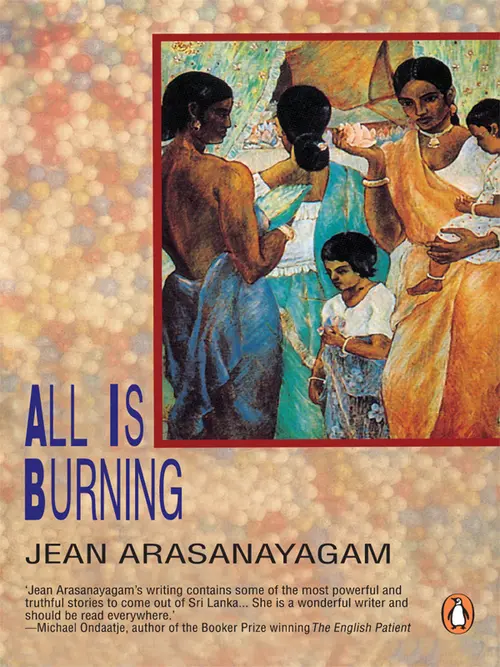

JEAN ARASANAYAGAM
All is Burning

PENGUIN BOOKS
PENGUIN BOOKS
ALL IS BURNING
Jean Arasanayagam is a Sri Lankan writer of Dutch Burgher origin. She attended a private Methodist Missionary School, is a graduate of the University of Ceylon and obtained an M.Litt in Literary Linguistics from the University of Stratchlyde, Glasgow. She was an Hon. Fellow in the Creative Activities of the International Writing Programme at the University of Iowa in 1990. In 1994 she was International Writer-in-Residence in the South West (U.K.) and was Visiting Fellow at Exeter University in the Faculty of Arts. Her work has been published widely in Sri Lanka and abroad.
She is married to Thiagarajah Arasanayagam, writer, painter and playwright, and has two daughters who are themselves writers. She lives in Kandy but has travelled extensively in the United Kingdom, the United States, Europe and India.
Dedication
To my daughters
Parvathi and Dewasundari
Continuing sources of inspiration and support
Thus have I heard, The Blessed One was once living at Gayastsa in Gaya with a thousand bhikkus. There he addressed the bhikkhus.
‘Bhikkhus, all is burning. And what is the all that is burning?
‘Bhikkhus, the eye is burning, visible forms are burning, visual consciousness is burning, visual impression is burning, also whatever sensation, pleasant or painful or neither-painful-nor-pleasant, arises on account of the visual impression, that too is burning. Burning with what? Burning with the fire of lust, with the fire of hate, with the fire of delusion; I say it is burning with birth, ageing and death, with sorrows, with lamentations, with pains, with griefs, with despairs.
The Fire Sermon of the Buddha
(Adittapariyaya—sutta)Here too, the night is dark, thunder-black, as the fire
In the village spreads, it’s best to escape while you can,
Take to the forest, mats rolled up on the head,
Children tucked under the arms, no time to cook
The evening meal, just milk in the breast, the morning’s
Rice wrapped up in a plantain leaf, to lie awake
Watching alert for the sound of gunshot and wailing
Cries, the moon wounded, the clouds bleeding …Excerpt from Fire in the Village
The Journey
Oneself is one’s own protector (refuge); what other protector (refuge) can there be? With oneself fully controlled, one obtains a protection (refuge) which is hard to gain
—The Dhammapada
TWO … THREE … FIVE … eight … twelve … sixteen …. Always the counting. Numbers. Under the breath. In soft, sibilant whispers. There must be no slip in their precise numbering. But we had names. Must we forget them now? Names that were known among friends. Parents. Loved ones. In which country? One that seems so distant now. The one we have left behind. Home: hills, fields, valleys; rivers, jungles, habitations; trees, flowers and fruit. They pass through my mind like those Jataka tales unfolding in the temple murals of my country. Tales of the several lives of the Bodhisattvas. The striving of The One to reach Enlightenment, become a Buddha. But first to reach the highest state of perfection. Until then he is on the road to Enlightenment and on that road which he travels through successive births, he will live and speak with all beings—animals, birds, humans. That journey of his, that Road to Perfection …. And ours? We are travelling on many unknown roads. Taking unfamiliar routes through alien terrain, crossing frontiers and borders. On and on we travel. To reach what destination and why?
The guide knows where we are being taken. We must trust him absolutely. We are walking through a forest. There are no tracks. The trees are silent and watchful sentinels. Yet they offer us protection too. Oak. Birch. Beech. Pines. The snow piles up silently. Our boots sink deep as we step cautiously through it. We cannot afford to flounder. Or delay. In the darkness we have to keep together. By instinct. Animal instinct. If we veer off the track we will be lost. Losing our way will mean that we can never make it to our destination. There’s a woman among us, with her young son. That makes sixteen of us altogether (asylum seekers, refugees—call us what you like). Seventeen with the guide. The guides change from time to time and place to place. No names. Just gestures to follow them. Trust. Absolute trust.
The woman doesn’t ask to be treated in any special way. Bears everything silently. But she is always watchful and alert where the boy is concerned. She’s prepared for any hardship. Tough woman. Only tender towards the child, but doesn’t cosset him too much. I’m the only Sinhala male in this group. The others are Tamils, from the North of the country which we have left. And the guides? Who knows? They change. German? Russian? Swiss? Jewish? No one questions. No one asks with easy and casual familiarity, ‘Hey, what’s your name? Where are you from? A family? Children? Have you ever travelled before? Visited my country?’ No, no. No time for questions, for entry through the slightest aperture into any life other than one’s own. Danger lies in too much knowledge. We do not share information about each others lives. We have learned to store away all facts that are useful to us. When the time comes we will unearth that store. Moreover, identity isn’t important here, at this juncture. Identity is still the burning question of the day in our part of the world; identity that separates and divides. But here we are one, because we share this journey and all its travails. We eat the same food. Bread, cheese, apples. We quench our thirst from the same flask of water. No one makes me feel that I am not one of them. It would have been easy for them to have done so.
We maintain silence most of the time. I have no one to talk to in my own language at any rate. Nor can we speak in each other’s language. We use signs to communicate with each other when the necessity arises. What keeps us together, keeps us going in a landscape that has no recognizable signpost or landmark is just one purpose and that is to reach Berlin. To disappear there or to seek, through legal means, political asylum. The question of maintaining an individual identity will come later.
Two routes lead to Berlin. One through France, the other through Russia. We have taken the route through Russia.
We continue to move stealthily. Fear. It is perpetually with us. We need physical and mental stamina too. We must be strong in body, mind and will. No sign of weakness must be shown, or we might be left behind. We must not impede the rest of the group. We must move together. I am reminded of the stories about the plantation workers who were brought to our island two hundred years or more ago. Brought from south India in their hundreds in ships. Disembarking at Talaimannar, they made the long trek from the north, through thick, animal-infested jungles, to the central highlands to work on the tea estates. So many died on the way of cholera, dysentery, malaria. Many were left behind to be attacked by wild bear and leopards or to grow weaker and weaker and die, leaving their skeletons as new landmarks on that terrifying journey. And of those who reached the central highlands, many hundreds died of fever, chills, pneumonia in those mist-veiled mountains. Always the weak have had to succumb …. No, we must keep up our strength. There is no letting go even for a moment. And always to remember that we are a group. Numbers. Each of us is a number. The numerals reverberate in our minds: sixteen of us, seventeen with the guide. No one should go missing.
Our dependence on the guide is total. This is unknown country to us. We are not human beings to them. With names. Personal lives. Habits. Feelings or emotions. When we are handed over at the border for the next stage of the journey to the next guide or agent, we are ‘dollars’. We bear with the irony. We’re not people, we’re money to them. We provide employment to them. They take risks too. We understand that. Dollars. Money. What do they care about the politics of our individual countries? About war and violence. Conflict. Ethnicity. Massacres and assassinations. Revolutions. Human rights violations. Disappearances, torture, death. Though it’s nothing new to anyone, really. The soldier justifies his rape of women in war. He asserts the triumph of the victor. He has to let off the tensions and the horrors of the battlefield, has to have his booty. The map of Europe has been changed often enough and is still changing. People are reclaiming the territory that once belonged to them before the invasions and conquests of historical eras and epochs. The changing of borders and frontiers leads to extensions of power. And now, ethnic cleansing, so that the reclaimed territory rests on a foundation of skeletal remains: bones that branch out like a subterranean forest, the flesh nourishing the soil yet its poisons creeping through the still veins to create a monstrous foliage. We know the histories of all these worlds. They haven’t had time to learn ours. Our wars, our revolutions, our conflicts, our displacements, are important only to ourselves. We become refugees, asylum seekers. Their laws restrict our entry into their countries. Yet there are people who help us to bend these laws. They’ve got to eat too, haven’t they? We serve their purpose. They serve ours. When we reach a destination, the desired one, we can’t expect a friendly welcome. Although looking back on our own history, didn’t we open our doors to the invader? Didn’t we even adopt the colonizers’ way of life? Change our language, our religion, our culture? Didn’t Kuveni herself take Vijaya for a lover?
To reach Europe we had to pay thousands of dollars. Somehow we made it. To Russia. We reached there by Aeroflot. Not as tourists, of course! No one questioned our identities. We had passports and visas we had purchased at a price. And hard currency in our pockets. That would help us through part of the journey. In Moscow we were all put in one room. It was winter. There was no heating. We were grateful for the warmth of each other’s bodies. The comfort of each others breath. Our being together. We had glimpsed streets white with snow piled high, snow crisp like mounds of freshly laundered linen. We still did not have the freedom to tread those streets.
The woman and child were cold. I saw her remove her fur-lined jerkin and wrap it about his shoulders. I had a warm woollen muffler. I unwound it from my neck and held it out to her. ‘For him,’ I gestured wordlessly. She looked at me, uncertainly, almost unbelievingly, took it, gave me a tentative smile. Why had I done this? I was thinking of my malli, my youngest brother, I suppose …. It wasn’t gratitude I wanted, or even friendship. Just a little human feeling. We weren’t divided in this country according to our racial or ethnic groups. We hadn’t brought our weapons, our arms to this country. We didn’t bear labels here—terrorists, militants, subversives, misguided youths …. Those identities had been left behind. We had a different mission here. The journey. The pilgrimage. We weren’t a warring people here.
The others talk to each other. In whispers. But in very few words, and in their own language. I wish I could join in. I feel lonely sometimes but most of the time I am not. I think of the next stage of the journey. I’ve reached so far, but then, what happens next? I count the dollars in my wallet, open my travelling bag, touch my warm clothes. I have my passport with me and a photograph or two of my family. No letters; I have no address as yet. It is best this way. I don’t want to reveal my whereabouts to anyone. We travel incognito. No longer in touch with the outer world.
I wonder what’s happening at home. When I was there I sometimes felt I would like to join the Security Forces. Ideas of courage, of patriotism spurred me on but I had seen too many young friends missing in action, or blinded or crippled for life … when they had hardly begun their journey. Landmines. Ambushes. Dying in action. Dying for the Motherland. Too few people caring anyway. Each in his own way dividing the country further. And would any of us want to return? But this is no place to talk politics. Though why should I, who has not suffered in any way through displacement, loss, bereavement want to leave my comfortable home? Why should I be with this group that I would have had nothing to do with in my own country, with whom I have nothing in common, neither language nor culture nor tradition?
I have my own reasons for making this decision to leave home. I’m not like these people. They have other reasons; so many things to escape from. The long and protracted war that has been going on for ten years and more. Armies of occupation in their soil. Their sons, and daughters too, martial women who have their own regiments, have gone against all the traditions of their society, joining the militant movements. Fighting for a cause. Families broken up. For them, seeking political asylum is often a matter of life and death. Am I, belonging to another ethnic group, the majority group in the country, am I too responsible for making them refugees? No. I’m not guilty. I’m really a peaceful kind of person. I have been more or less privileged all my life. I’ve had a good life. My father is a businessman, he has wealth. So I’ve always had what I’ve wanted. I was educated in a good private school too. Maybe life was too easy for me. I didn’t join the revolution like many of my friends did. I had no interest in destabilizing the State. I was not one of those who were socially deprived by caste, a feudal power structure, or lack of wealth. I had no social conscience either. I didn’t rave and rant against the exploitation of my own people by multinational and vested interests. I had no purpose in life. So many of my friends had disappeared, died or been detained in camps during the revolution that my father was only too happy to give his consent for me to go abroad. He had enough money to give my sisters in marriage. Besides, I didn’t have a profession or a career. I wanted a change, some adventure. I wanted to make a journey that would change my life. I wanted to venture into an unknown country; make my own predictions and decisions, question the revelations that would confront me at the end of this long saga.
I was as yet unenlightened in many ways. For one thing, in my own land would I ever have undertaken a journey with people who were not of my own kind? We had looked upon each other as strangers, even enemies, dangerous to the unity of our motherland. To me they were people who were trying to divide the country, claim territory for themselves. We too had moved into their traditional homelands, changed the demographic map. Each ethnic group had accused the other of untold crimes. Was I joining a band of pilgrims disguised as asylum seekers? Was I innocent enough to think that in the new country I would find enlightenment which would release me from all suffering, dukkha? I …? Taking the path of the Bodhisattva, is it also the route of the asylum seeker, the refugee? Is the shedding of an identity also the path to enlightenment, if that identity is part of an existence that entails hatred, enmity, violence? With these people that I am travelling with, there are no such feelings. We do not look upon each other as brothers, nor do we look upon each other as enemies. We can learn a lot about survival from each other. Even without a shared language. The guide knows the route, that’s all we need to know.
And yet sometimes I feel unsure and afraid. Who will meet me at the end of this journey? One thing, however, we are well fed here. They bring us plenty of food. Pans of steaming hot, boiled vegetables and soup. Cabbage. Cauliflower. Rye bread. Black bread. Borscht. Nothing spicy, but the food fills that pit in the stomach. We eat, then sit on our haunches, stand around, smoke cigarettes, wait. Wait until it is time to get the OK to move on. To leave this temporary shelter, take the lorry or truck or container to the next assignment.
In Moscow too we had waited. We could see nothing of the city. We were not there for sightseeing anyway. No strolling along the streets or sitting in restaurants drinking vodka. I would have liked to see the Kremlin or shop in their markets. Taste caviar perhaps. All we heard was news of the White House being under siege, of the deaths, the surrender, the trials and imprisonment of the leaders. The epochs we moved through were historical. We were part of it all, caught up in that turbulent stream of events.
The Story Continues on BooksBarbecue!
Enjoyed this preview? ❤️ Do not stop here!
Read the complete book free online → 🔗
Continue reading now on BooksBarbecue and discover every page!
Love reading? Bookmark BooksBarbecue.com for more amazing books!
Happy Reading!