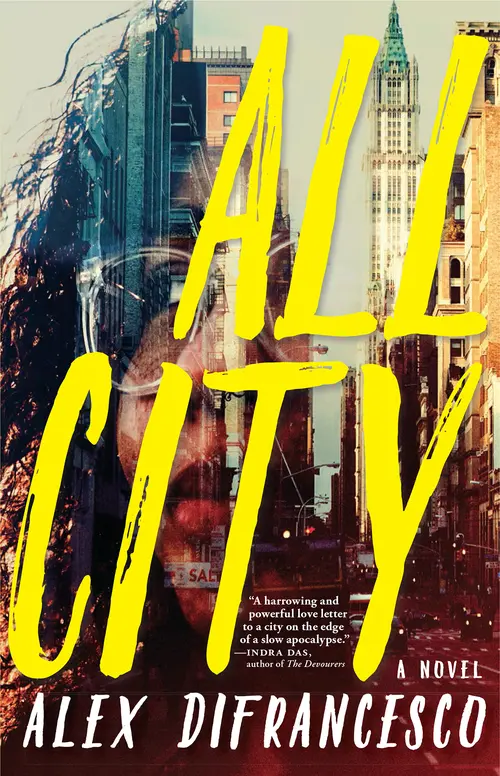
All City
Cover
Title Page
This book was informed and made more vibrant by the work of several visual artists. To that end, I’d like to dedicate it to:
BANKSY,
whose NYC residency coincided with the writing of the first draft
JEAN-MICHEL BASQUIAT,
whose ghost whispers in Green-Wood
JOHN LURIE,
on an island somewhere where nobody will find him
The wind came first, and with it brought the clouds that came between the city and the sky. The clouds were heavy and low, the color of a sinister night; more steel than sky. The steel slammed down into the skyline and turned off all its light. The wind whipped the clouds, it tore at street signs, it lofted the garbage cans, and it gave wings to anything that wasn’t nailed down, and to some things that were. The bridges swayed and broke, their cables popping like gunshots, huge chunks of concrete and metal falling down and down, splashing into the water and disappearing to the bottom of the river.
The rain came down in sheets. It was a wall, impenetrable, hitting all it reached with a sting of weight and gravity. The rain came sideways and down as it swirled in gusts of the feverish wind.
The sea, turbulent in the storm, began to surge into the New York Bight, filling it with the millions of tons of seawater the storm had brought along to the city like an unwelcome guest. As the bight filled, the water began to spill over. Tiles popped off of the Holland Tunnel as water forced its way through. The subway tunnels filled with salt water that corroded their already weakened tracks and pipes. The water surged up over the streets, over the tires of the cars parked there, into the basements of buildings, into the buildings’ lower floors, then up into the higher floors. The people left behind scrambled to carry their possessions higher and higher, up stairs, down hallways, up stairs again, until finally it became obvious that there would be no place high enough, that the waters would keep coming, unrelenting. A force.
Part One Makayla—November
PART ONE
MAKAYLA—NOVEMBER
1 A week before Superstorm Bernice, I was walking home from the 24/7 when I saw it. It was in the spot where the old bodega had been for ten years, years in which I’d gotten to know the owner, Abdul, and in which he’d always let me know when the oussies had come in. Abdul had told me a while back he’d be closing up, that he couldn’t afford the rent anymore, not now, not since the neighborhood had gotten a new name from the chum slingers that made it sound more like an extension of the nearby, more fashionable neighborhood. It was sinking more smash in to make it the kind of place that the new neighborhood residents (the kind of people who never knew to ask about the oussies, or even needed them) wanted, or pack up and leave. And he’d decided to pack up.
The it I saw that night was another store. But when you’ve slagged all day for smash enough to barely pay your rent and not do much else, there’s the bodegas like Abdul ran, where you can maybe go and get little bits of something, a cup of noodles or a dollar bag of chips, and then there’s places that make you feel like you’re too poor to walk inside. And feeling very poor, being very poor is like going down a street and realizing that all the beautiful places you walk by, places that have wine and good food and music, are locked when you try to walk through their doors. And so, after a while, you stop looking at them and start looking down at your feet, hoping maybe to find a hundred-dollar bill that will act as a key to one of those doors, or a drug or a dream that will make you forget those doors are there at all.
The store I saw that night was not open to me, I could tell you that. I could tell, looking in, seeing the dim lights, seeing the woman who looked like she’d just come off some decorating magazine cover, looking dap even in her slag clothes, that it was not a bodega. I saw a little sign inside. I saw it next to a little bowl of dog treats that the sign told me were made of traveled ingredients from the finest places in the world, the cost of getting them there be damned. And my head started feeling squeezed together like my brain was expanding and taking up too much space. In all the years I’d lived in this neighborhood, in all the times my family had helped organize block parties, in all the times my dad had volunteered to talk to kids in school about street violence as someone who barely got out if it alive himself, in all the times my mother cooked food for the old lady who lived down the hall and struggled to get by on her piddly-shit sienty disability check and whose kids never came to see her, no one ever, ever, offered us a damn thing that could be called “traveled.”
I reached into my bag then. And from all the things that slipped through my fingers, my keys, my wallet, my sunglasses, I grabbed one thing. A combination lock that I kept on my locker in the break room of the 24/7 and took home with me at night. The metal weighed heavy in my hand there inside my bag, but only for a moment before I whipped it up and back behind me, then over my shoulder and through the dimly lit window.
The glass broke and fell like bells. I heard the woman in her slag clothes scream, and I ran.
2 I’ve heard that years ago they didn’t know just where a storm would hit. Now they know. There’s no maybe paths, no loose science. There’s no “somewhere along the Eastern seaboard.” There is: Duluth will be hit by 100 mph winds. There is: Sarasota will face torrential downpours. There is: New York City will have pieces of it knocked into the ocean.
So we all knew Bernice was coming and where she was coming. She wasn’t the first storm, and I didn’t think she would be the last, not then—New York didn’t seem like a place that could have an end. We would all wake up to our coffee in Greek paper cups and be furious about the train delays no matter what happened.
It had gotten bad, though, even I had to admit. After the last one, there had barely been time to rebuild the worst hit coastal areas like Gravesend and Sheepshead Bay. Of course, all the smash had been poured into Manhattan and the wealthiest parts of Brooklyn, as it was every time. They had things back up and running there in a few weeks, but even then you could see people getting restless. How many more times? Why hadn’t more been done to prepare? There was jaw on the news of Hesco bastions and better power grid protection, and they were building a buffer and a barrier that kept getting destroyed every time a new storm hit. They couldn’t build fast enough. The subways still had those sienty sandbags protecting them, and the lines at the gas stations were blocks long.
My grandma was living out in public housing on the edge of Gravesend, and last time her twelfth-floor apartment was fine but she didn’t have heat or lights for weeks. I went over there to try to get her out before the storm came, but she just sat there in the dark with the TV on and say, “Makayla, where’m I gonna go?” And I said, come back home with me, back to the neighborhood, back where she lived all those years before my mother and father checked, before she had to live on what the government gives her, before I had to live in some ’trosh basement that I still can’t afford. I kept jawing. Come with me, Granny, the water almost never gets in that far, it’s better than being out here alone. And she said, “No, Makayla. I stay here.” And she did.
She said the same thing before Bernice. But then I didn’t fight her, because then my sienty basement apartment was all packed up in boxes. I didn’t want to move. But the rent had gone from $2,000 to $2,500, and I couldn’t make that extra five hundred dollars come from anywhere. Same old story that anybody who’d lived on my block ten years ago could tell you. I knew that the minute I was out, my rentboss would have the chum slingers showing the place before he could even slap a new coat of paint on it. Then he’d make promises, gut everything, make it the sort of place he could charge three or four grand for. But there was nothing I could do. There was no such thing as security in the city anymore, not for people like me.
So I didn’t fight my grandmother’s decision. I just made sure she had a shit-ton of gallons of water, food that didn’t need to be cooked and wouldn’t go bad, and a case of slurree. As soon as the subways were back up, I’d go back out there and take care of her.
I got up the morning of the day of Bernice and went to slag at the 24/7. I stood on my feet all day, moving boxes of shit from one place to another, ringing up coffees, donuts, bags of chips. I worried about what I was going to do if Bernice was real bad and the 24/7 closed for the day. I couldn’t afford lose a fifth of my smash for the week. I started to worry and bite my nails. I went outside and smoked one of my oussies, even though if I finished my pack before work was over, I’d have to buy the full-priced cigarettes we sell upswing at the 24/7.
After work, I went back to my place. I sat there in the boxes with my television on as they began calling for evacuation. I thought about my grandmother, and the hallways that smelled like piss and shit the last time I’d had to go over there and make sure she was okay. I thought about my sister who nobody’d heard from in months, who, last I did hear, was living in the streets, scoring drag any way she could. And I thought, Where would I go?
As I was sitting there in the middle of all those boxes, my phone rang. I looked down at the screen and saw that it was Jaden, a guy who I’d pretty much grown up with, who still lived a few blocks away.
“Where are you?” he asked me.
“Where do you think I am? I’m in my apartment waiting to start floating to the ceiling,” I replied. I guess I sounded short, but I don’t like jawing on the phone very much, and I was in the middle of having a crisis.
“Well, get your ass over here,” he said. “I’ll sleep on the couch and you can take my room.”
“What about your roommates?”
“Gone. I could use the company.”
Jaden, he’s practical. He’s hung on to the apartment his family lived in long after they didn’t live there anymore, long after the landlord stopped doing repairs, hoping he’d leave. Jaden started doing them himself. He found three guys who wanted to live in the new, hot neighborhood and charged them what they could pay (and what he couldn’t) to live there. Sometimes I get jealous of how well he gets along in the world in ways I can’t bring myself to.
I hadn’t yet packed up my toiletries for the move, so I went into the bathroom and began tossing them in this dissat backpack I still have from when I was in high school. I packed up my glasses and my contact solution and my toothbrush and toothpaste and all the things I might need. I even packed some of the things I probably wouldn’t get to use if the power went out, like my straightening iron and my Mixplayer. I grabbed all the beer out of my refrigerator and threw it in there, too.
The wind had picked up outside, and people were walking down the street with their clothes pulled back tight against their bodies and billowing out behind them like sails. Some people looked worried, some looked like they were having a good time, drinking out of paper bags. But there were a lot fewer people on the street than there usually were. Cars were rolling by, nice-looking ones, and it was clear they were getting out. I noticed lots of people were going down into the subway, but nobody was coming out the other set of stairs, even when the train rumbled by beneath the street.
The front entrance of Jaden’s building has been all redone for the people like his new roommates that live there, so where there used to be a busted lock and a broken security camera, there’s now two locked doors and an intercom that rings up to each apartment. I’m just waiting for them to bust down the walls of the downstairs apartment and make a lobby out of it, with a doorman just standing there smiling as you go in and out, greeting everybody by name. I don’t know if they’d lose smash by taking out that apartment, or make more by raising everybody’s rent because now it was a doorman building. Figuring out ways to make smash has never been my strong suit. Just ask the people who sign my checks at the 24/7.
I pushed the button under Jaden’s apartment number. He’s the only one who doesn’t have his name up there. It’s like the rentbosses at that place are hoping that if they just will him out, he’ll go. But Jaden’s not going anywhere, not with the kind of rent he pays, and the laws in place that limit how much they can raise it. What’s he going to do, I always ask, when those laws go away, like they’re always threatening to? He doesn’t know, just like me. But for now, he’s okay.
Jaden answered right away, buzzing me in without even calling down to see who it was. Who else was crazy enough to be out there? The wind was blowing a little harder now, I felt it pushing into my face, drawing my skin back just a bit. The cans of beer in my book bag jangled and sloshed together as I went through the double door and ran up the stairs.
The door to Jaden’s apartment was open partway when I got up to the third floor. I pushed it open farther and saw his bike hanging up from the hook in the front hallway. Jaden loves that bike, has had it since he was a kid and takes care of it like a baby. He learned how to fix it, he oils it and replaces parts himself. His first slag was as a bike messenger when he was just a teenager because he could ride faster and better than any of the people older than him. I walked by the bike then, pushing one of the pedals in a slow circle with my hand. Jaden was still a bike messenger, for this company in Manhattan that caters to rich people who can’t be bothered going somewhere to pick it up and can’t wait for things to be shipped. They do it from anywhere to anywhere, so he ends up delivering the craziest things sometimes. Once he delivered a kitten to a five-year-old who lived on Central Park West. Turned out the kid had just had a play date with a friend who had one, and couldn’t wait to get his own. So Jaden had ridden from a pet store to this kid’s house with this scared little kitten in a box in the basket attached to his bike. Other times, he didn’t know what he was carrying at all; there were simply locked boxes. Jaden didn’t ask too many questions about those.
Because of all that biking, Jaden’s in amazing shape. He’s got these legs that I bet could kick through a brick wall, like in those old kung fu movies. He’s always got girls around him and some of the guys on the block flirt with him, too. Even though Jaden’s straight, he flirts right back with everybody. He’s good-natured and dap, and a lot of people love him. Sometimes standing next to him I feel like an angry ogre from a fairy tale.
“Hello?” I called, walking past his bike. The hallway I was in had a room off to either side, and led out into a living room with another bedroom on the far side of it. That bedroom was Jaden’s. It had a big window that faced the street and a huge tree with speckled bark stood outside it.
“Hey,” Jaden said, emerging from his bedroom. He already had a drink in his hand, and as he got close and hugged me hello, I could smell that it was a whisky drink. Likely there would be no slag tomorrow for either of us, so before we started worrying about the smash we’d lose because of that fact, we might as well enjoy our night off.
I pulled the beer out of my backpack and took it over to the refrigerator. It was full of the typical stuff you’d imagine for three single guys living together—frozen foods, loads of cans of slurree, an outdated carton of milk that I didn’t want to go near. I looked around and looked at Jaden.
“What were you planning on eating if the power goes out?” I asked.
“Don’t worry, I got us supplies,” he said. He opened up one of the cabinets above the sink and showed me boxes of things. More slurree, granola and breakfast bars, macaroni and cheese, noodles. It wasn’t exactly gourmet fare, but it would be enough to keep us going if we needed it.
“And check this out,” he said. He motioned over to the living room where he had a small generator plugged in and juicing up. Near it was a camping stove with little propane tanks attached to it. Jaden was ready.
“Great,” I said. “Better than I would have done. Who knows how long we’ll be without power after this bitch hits.”
I popped open a can of beer and started sipping it. Jaden and I sat down in the living room, on the couch, and started jawing about the neighborhood, about people we knew, about people who had moved or checked. By the bottom of my first can of beer, I began to feel a warmth in my stomach and a lightness in my head. It was such a pleasant feeling, a real escape from the heaviness and the pressure that I always feel like I’ve got inside me. The sun started slipping down over the Manhattan side of the city, and the winds picked up. The door of Jaden’s bedroom was open, and we could hear the branches of the tree outside it slapping against the panes. I was supposed to sleep in there, and I kept picturing the tree smashing through the window, through the wall. Jaden slept on a mattress on the floor, and I asked him if we couldn’t pull it out into the living room, where there were no windows. It took us some effort, and I kicked over my half-full second can of beer in the process, but we managed it.
“Hey, let’s go to the corner store and get a sandwich before we have to eat noodles and drink slurree for days,” Jaden said.
“Okay,” I said. I was starting to feel hungry, and a sandwich sounded great.
The Story Continues on BooksBarbecue!
Enjoyed this preview? ❤️ Do not stop here!
Read the complete book free online → 🔗
Continue reading now on BooksBarbecue and discover every page!
Love reading? Bookmark BooksBarbecue.com for more amazing books!
Happy Reading!