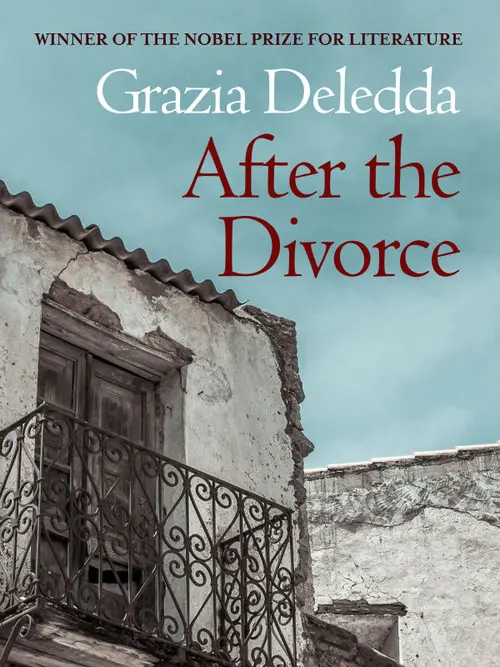
After the Divorce
Cover
In the Wilds of Sardinia
Some years ago, Piers Plowright of the BBC, my partner Norman Thomas di Giovanni, and I were in Rome waiting to board a plane for Sassari, in the north of Sardinia. We were making a programme for Radio 3 about the island’s 1927 Nobel Prize winner, the novelist Grazia Deledda, and were on our way to her birthplace, in Nuoro.
While we chatted away waiting for our flight to be announced, a barely-audible or barely-heard announcement came out of the blue. Sure I had caught the ominous word sciopero – strike, the bane of Italy in those days – I scurried to the counter for verification. Sure enough, there was a wildcat strike affecting our flight. When I explained our predicament, the woman at the airline counter merely shrugged and asked why we didn’t take the flight to Cagliari instead, which was leaving shortly. Sassari was in northern Sardinia; Cagliari in the south. It amazed me that the strike covered only that one flight and no other part of the airline’s operation. To us, it hardly made any difference whether we made our way to Nuoro from Cagliari rather than from Sassari.
Our taxi driver dropped us off at a Cagliari hotel, we enquired about where to eat dinner and were pointed to a restaurant across the street. It was too early, so we booked a table for three and returned an hour or two later. We told everyone why we were in Sardinia, and the proprietor of our eating establishment, charmed to have the BBC there, and interested in Grazia Deledda to boot, served us a feast of at least six very different pastas, each in abundance, and would not hear of our paying for any of it.
More, he introduced us to a friend, one of his regulars, who owned a new resort hotel not far from Nuoro. The man gave us his card, asked where we planned to stay in Deledda country, and said that in a few days’ time he would send a van to pick us up. We, the BBC, simply had to see his place. Of course, we never gave it another thought until, a few days later, a stylish van drove up and whisked us off up winding roads into the mountains. As it was dusk, we had no idea even in which direction we were headed though I gathered we were somewhere in the wilds of Gennargentu, Sardinia’s highest range of mountains.
It was a long drive, and we knew we were in bandit country – we knew, at least, that it was in this general area that kidnappers operated, holding their victims, especially foreigners, for ransom. We got to the hotel, a great pile, a place of several stars, but we were the only guests. There was a complete staff, but the place itself was empty. Not even the proprietor was there.
Our driver, a local, a rough peasant character, informed us that he was there to look after our every wish. It was all too good to be true. We were shepherded to a boutique and encouraged to buy some coral jewellery. I think, out of a sense of obligation, I bought a necklace. We were served a stupendous dinner. Piers began to panic. He didn’t think the BBC would pay for all this. I was thinking cavalleria rusticana, rustic chivalry and all that, and tried to make myself believe everything was going to be all right.
After dinner, we were led to a dimly-lit pavilion of tables out back, where our guide had herded six or eight of the hotel’s chambermaids, all young girls, and produced the largest bottle of grappa any of us had ever seen. So we sipped grappa while he chased the girls round the tables, trying to goose them, as they laughed and screamed with joy. Then suddenly the girls broke out into song. It was some strange melancholy wail or keening, something primitive and archaic. It seemed to express exactly what we admired in Deledda and what D.H. Lawrence had admired in the Sardinians. Piers dashed to his room for a tape-recorder. The girls sang or keened or wailed. We all got tipsy. Sufficient unto the day. The three of us eventually retired and left any worries about the bill until the morrow.
In the morning light it was obvious that we were in the Gennargentu all right and a considerable distance from Nuoro. Our guide and driver, despite the late night and the grappa, was up early, all bright-eyed, bushy-tailed, cleanly shaven, and ready to look after us.
We had mentioned that we wanted to see some nuraghi, the prehistoric round stone towers that dot the island’s landscape. And so that’s where we were headed on a fine June morning. But first our escort thought we needed coffee, so he took us to a village that seemed to materialize out of nowhere and a well-frequented bar. We drank coffee, and when we went to pay the bill the barman serving us shook his head. We did not understand why he refused our money and turned to our driver, who stood far back in the doorway shaking his head, instructing the bar that we were his guests and therefore were not to pay. Rustic chivalry.
And once again we wound our way over the hills for some miles until we stopped at a place where in the middle of a field with grass three or more feet high rose a nuraghe. There had been a heavy dewfall in the night and the grass bent under the weight of it. The stone tower was some distance off. It looked like we would be soaked and maybe even half drowned before we reached it.
Our driver was far quicker off the mark than we were. ‘Follow me,’ he said. And he scooped me up and with me riding piggy-back he set off trampling down a swath of grass, thereby creating a relatively dry wake for Piers and Norman to follow in.
Safe and sound later that day back in Nuoro, I traced the hotel owner and phoned to thank him for his hospitality and for his driver’s kind attention. I mentioned the visit to the nuraghe and my piggy-back ride.
Yes, our benefactor told me, his driver was a treasure. The man had been with him a year or more now, ever since he had finished his stint in prison for kidnapping.
Grazia Deledda was born in Nuoro, Sardinia, in 1871. She wrote many novels and collections of short stories. D.H. Lawrence admired her for reproducing ‘the temporary psychological condition of her period … she creates the passionate complex of a primitive populace.’ After her marriage in 1900, she moved to Rome, where she lived the rest of her life. Awarded the Nobel Prize for Literature in 1926, she died in 1936.
Susan Ashe
Lymington, Hampshire
July 2016
I
On the floor by the bed in the Porrus’ guest room a woman sat weeping. She crouched, rocking her head on her arms, sobbing in utter despair. Her shapely figure, tightly laced into a yellow cotton bodice, rose and sank like a wave on the sea.
It was almost dark in the windowless room. Through the open door, which gave on to a bricked balcony, a stretch of ash-grey sky could be seen, gradually darkening. In it, a single yellow star shone. From the courtyard below a cricket chirped, and now and then a horse’s hoof stamped against the paving stones.
A stout old woman in the peasant dress of Nuoro appeared in the doorway carrying an iron lamp in one of whose four sockets burned a wick swimming in oil. ‘Giovanna Era, what are you doing in the dark?’ she called out in a gruff voice. ‘It sounds to me as if you’re crying.’
The sobbing went on. The old woman drew closer and went on indignantly, ‘Your mother’s downstairs waiting for you, and here you are wailing like a madwoman.’ Hooking the lamp to a nail in the wall, she crossed to the weeping girl, trying to find words of comfort. But all that came to her was, ‘You’re crazy, Giovanna.’
The guest room, traditionally reserved for friends from neighbouring villages, was large, whitewashed, and unplastered. It contained a big wooden bedstead and a table covered with a fine cotton cloth. On the table were little glass cups and saucers. A number of pictures adorned the walls, close under the rough wooden ceiling. Bunches of wrinkled grapes and yellow pears hung from the rafters, filling the room with a delicate fragrance. Sacks stuffed with wool stood about the floor.
The old woman, who was mistress of the house, took hold of one of the sacks, dragged it to the centre of the room and then back to where she had found it. ‘Stop that at once,’ she told the girl, panting from her efforts. ‘You mustn’t give up yet. Even if the prosecutor asks for hard labour, it doesn’t mean the jury will follow him like a pack of mad dogs.’
Still the desperate sobbing continued.
‘Get up or I’ll call your mother,’ ordered the woman, seizing the girl by the hair and forcing her head up.
She had a lovely face, round, rosy and ringed by a tangle of black hair. From beneath thick brows her dark, tear-stained eyes glistened. ‘Leave me alone to my fate, Porredda,’ she screamed. ‘Thirty years. That’s what they’ll give him!’
‘Fate or no fate, get up. What’s thirty years? You’re carrying on like a wildcat.’
‘What’s thirty years?’ Giovanna cried out, tearing her hair in her frenzy. ‘A man’s whole life, Porredda. You don’t understand a thing. Go away and leave me alone, for the love of God.’
‘Get up, damn you, and stop all this,’ Porredda said. ‘There’ll be plenty of time to tear your hair out tomorrow. Your husband hasn’t been sentenced yet.’
Giovanna bowed her head and again began to cry. ‘Costantino, Costantino,’ she wailed, heart-broken. ‘I’ll never see you again, never again. Those mad dogs have taken you and shackled you, and they’ll never let you go. Our house will be empty, our bed cold, our family torn apart.’
Giovanna’s grief moved Porredda. Not knowing what else to do, the old woman went out on to the balcony. ‘Bachisia, come up here,’ she called. ‘Your daughter’s losing her mind.’
There was a footstep on the outer staircase. Porredda came back in, followed by a tall, tragic-looking woman dressed in black. Her yellow, hawklike face and gleaming green eyes were framed by a black scarf. Her mere presence seemed to have a calming effect on the girl.
‘Get up!’ the tall woman commanded in a harsh voice.
Giovanna rose. She was tall, well-built, yet slim. Her short woollen skirt had a purple stripe that swelled over muscular thighs and a green hem that revealed small feet and shapely legs.
‘Why are you being so troublesome?’ her mother said. ‘Stop it at once and come down to dinner. Don’t frighten the children or spoil these good people’s happiness.’
‘These good people’s happiness’ referred to the arrival that same evening of the son of the house, a law student home for the holidays.
Giovanna obeyed, calming down. She took the woollen kerchief off her head, revealing a cap of old brocade, from which tumbled torrents of jet black hair, and went to wash in a basin of water placed on a chair. Porredda looked at Bachisia, pressed her finger to her lips, and left without a sound.
Bachisia said nothing. She waited until Giovanna had bathed her face and tidied her hair, then both women silently descended the outside staircase. It was a warm, still night. The first small yellow star had been followed by thousands of silver stars, and the Milky Way lay across the sky like a huge veil embroidered with twinkling jewels. A smell of new-mown hay permeated the air. Concealed in the courtyard trellis, crickets still chirped, and the horse munched, stamping its iron-shod hooves. From some way off came the sound of a mournful song.
The kitchen door and that of a ground-floor room occasionally used as a dining-room stood open onto the courtyard. In the kitchen, beside the kindled hearth, Porredda was busy preparing macaroni. A fair-haired girl, barefoot and dishevelled, squabbled with a boy as fat and florid as his grandmother.
‘Stop that you wicked children or I’ll thrash you with this ladle,’ Porredda said, chasing them off. Escaping into the courtyard they collided with Giovanna and her mother.
‘What’s happened? What’s going on?’
‘They drive me to distraction,’ said old Porredda from the kitchen door.
All at once the dark figure of a young girl moved away from the half-open street door. ‘They’re coming, Grandmother!’ she called excitedly. They’re here!’
‘Let them in, Grazia, and try to control your brother and sister.’
Grazia did not reply. She took the lamp from Bachisia, snuffed it out, and hid it behind a bench in the kitchen. ‘Grandmother, now that Uncle Paolo’s coming, you ought to be ashamed of this lamp.’
‘Why? Do you think Paolo was brought up on gold?’
‘He’s been to Rome.’
‘So what? They don’t have lamps like this in Rome. They have to buy their oil by the pennyworth, while we here can use as much oil as we like.’
‘You’ll soon get into difficulty if you believe that,’ said the girl, and, hearing the voices of her uncle and her grandfather, she turned to the courtyard in a flutter.
‘Hello, Giovanna … Bachisia, how are you?’ came the student’s hearty voice. ‘I’m well, thank the Lord. I was so sorry to hear about your troubles. Bear up. We don’t yet know what will happen. They’re pronouncing sentence tomorrow, aren’t they?’
He led the way into the room where the table was laid, followed by the women and the children, who were intimidated but also delighted by their uncle’s presence. He limped slightly for one of his feet was smaller and the leg shorter than the other. Because of this he was known as Dr Littlefoot, which he did not mind, saying it was better to have one foot smaller than the other than a head smaller than other people’s. He was short too. His round pink face with its blondish moustache smiled shyly from under a soft floppy hat.
Sitting on the bed, his legs dangling, he pressed his nephew and niece to him, one on each side. They stared at him open-mouthed as he hugged them absentmindedly, his attention riveted on the tale Bachisia was telling him. From time to time he glanced at Grazia, whose angular girlish figure was accentuated by a black dress that was too small for her. Her steel-grey eyes held her uncle in an eager, unrelenting gaze.
‘It was like this,’ Bachisia began in her harsh voice. ‘Costantino had an uncle, his father’s brother. His name was Basile Ledda, but he was known as the Vulture because he was so grasping. God rest his soul if he’s not already in the devil’s clutches. He was a moody man, a bitter old miser. They say his wife died of starvation. As a boy, Costantino was put in his charge. The child had some money of his own but his uncle devoured every penny of it. Then he beat Costantino, bound him between two rocks in a field, and left him to the mercy of the sun and the bees, which almost stung his eyes out. One day when he was sixteen, Costantino ran away. He was gone for three years. He said he’d been working in the mines. I don’t know, but that’s what he said.’
‘Yes, yes,’ Giovanna broke in. ‘He was working in the mines.’
‘I don’t know about that,’ her mother said, pursing her lips dubiously. ‘Anyway, the fact remains that one day while Costantino was away someone fired a shot at the Vulture when he was out in the fields. So he must have had enemies. When Costantino came back he admitted that he hated his uncle and had run away to keep from killing him. However, Costantino made his peace with the old man. Now listen to this, Paolo Porru.’
‘Dr Porru! Dr Littlefoot!’ squealed the grandson, correcting the guest. Bachisia glared at the boy and made as if to strike him. Giovanna burst out laughing. Seeing their ‘heartbroken guest’ – who until then had been surrounded by a halo of romance and tragedy – laughing, Grazia too broke into a nervous giggle. Her younger sister, Minnia, also giggled and after that the boy and the student started to laugh. Bachisia looked round in fury. What were they laughing at? She raised a thin yellow hand to slap someone. But whom? Her daughter? The boy? Then Porredda came in with the steaming macaroni.
Behind her came Efes Maria Porru, her husband, thickset and dignified, in a tight-fitting blue velvet jerkin. Though a peasant, he was said to be well-read, and his sallow face with its short curly beard and bright eyes indicated a certain intelligence.
‘Come quickly, supper’s ready,’ Porredda said, placing the dish on the table. ‘I see you’re all giggling. Is it the lawyer who’s making you laugh?’
‘I was about to slap your grandson,’ said Bachisia.
‘Why, my dear? Come and eat now. Giovanna here, Dr Littlefoot over there.’
Paolo threw himself flat backwards on the bed. Stretching out his arms, he lifted his legs in the air, dropped them again, jumped down on to his feet and yawned. Giovanna and the children again burst out laughing.
‘A little gymnastics does you good,’ Paolo said. ‘God, how I’ll sleep tonight. All my bones are dislocated. You’re so tall, Grazia. You’re like a beanpole.’
The girl blushed and lowered her eyes. Bachisia scowled, offended because the student’s mind was on something other than her story and because everyone was making light of Costantino’s calamity. Even Giovanna seemed to have forgotten, and only when Porredda put in front of her a big helping of macaroni, pink and fragrant with sauce, did the young woman’s face go dark again and she refuse to eat.
‘What did I tell you?’ exclaimed Porredda. ‘She’s out of her mind. Why don’t you eat? What does eating today have to do with the sentence tomorrow?’
‘Come on now,’ Bachisia said, somewhat crossly. ‘Don’t be foolish. Don’t spoil these good people’s happiness.’
Tying his napkin under his chin, Efes Maria spat out a literary epigram. ‘“A brave heart defies fate,” as Dante puts it. Come now, Giovanna. Show us you’re a mountain flower, and you can endure more than the stones themselves. Time heals all.’
Giovanna began to eat, but with a lump in her throat. Bent over his food, Paolo said nothing. By the time Giovanna had managed to swallow her first mouthful, his plate was already empty.
‘You’re a whirlwind, my son,’ said Porredda. ‘Hungry as a wolf. Do you want some more? There’s plenty.’
‘It looks as though you didn’t get enough to eat in the Eternal City,’ Efes commented.
‘That’s what I say,’ agreed Porredda. ‘It may be a fine place, but everything there has to be paid for in hard cash. I’ve heard all about it. They don’t keep food in the house the way we do, and, as everyone knows, when there’s no food in the larder no one gets enough to eat.’
Bachisia nodded. She knew only too well what a house without food was like.
‘Is it true or isn’t it, Dr Littlefoot?’
‘It’s true,’ he said, eating and laughing and waving his white hands with their over-long nails.
‘Maybe that’s why he’s become such a leech. A vampire,’ Efes Maria remarked, turning to his guests. ‘He won’t leave a drop of blood in my veins. By God, how they eat up money in Rome!’
‘If you only knew,’ sighed Paolo. ‘Everything is so expensive. A peach costs twenty pence. There, now I feel better.’
‘Twenty pence!’ they all echoed.
‘Well, Bachisia,’ Paolo said. ‘What happened after Costantino came back?’
‘As I said, he was away for three years.’
‘So he was working in the mines. Then he came back and made peace with his uncle.’
‘And then he met my Giovanna here and they fell in love. His uncle was against it because we were poor. So uncle and nephew started to hate each other again. Costantino worked for the Vulture but was never paid a penny. One day Costantino came to me and said, ‘I’m poor. I haven’t enough money to buy a wedding-ring or food for guests, and you’re poor too, so this is what we’ll do. For the time being we’ll just have a civil wedding. We’ll all work hard and save up enough money to have guests and then Giovanna and I will marry in church. Nowadays lots of people do this. We’ve decided we will too.’ So, the civil wedding took place quietly and afterwards we all lived together. The Vulture went into a rage. He took to shouting and swearing right outside our own front door, and he provoked Costantino everywhere he went. But we kept on working. After the grape harvest last year, while we were baking cakes for the wedding, the uncle was found murdered in his own house. Costantino had been seen going in to the house the evening before. He had gone to tell his uncle about the wedding and to try to make peace with him. Poor boy! I advised him to run away but he didn’t even try.’
‘Because he was innocent, heaven help him,’ Giovanna broke in.
The Story Continues on BooksBarbecue!
Enjoyed this preview? ❤️ Do not stop here!
Read the complete book free online → 🔗
Continue reading now on BooksBarbecue and discover every page!
Love reading? Bookmark BooksBarbecue.com for more amazing books!
Happy Reading!