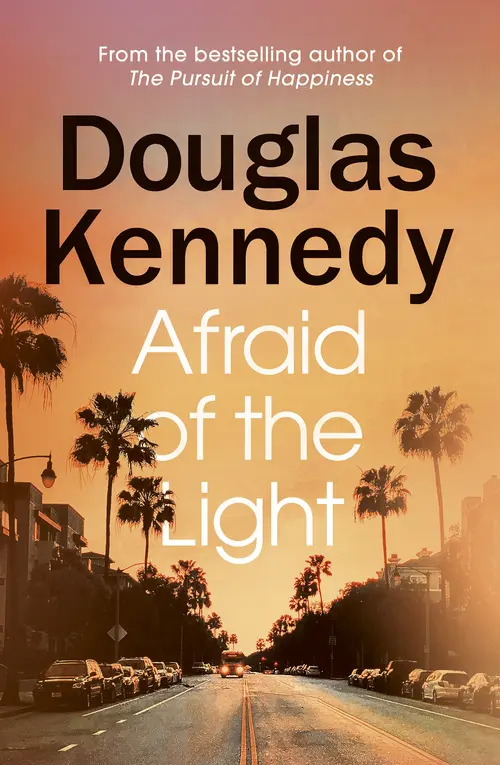
Afraid of the Light
Cover

About the Author
Douglas Kennedy’s previous twelve novels include the critically acclaimed bestsellers The Big Picture, The Pursuit of Happiness, A Special Relationship and The Moment. He is also the author of three highly-praised travel books. The Big Picture was filmed with Romain Duris and Catherine Deneuve; The Woman in the Fifth with Ethan Hawke and Kristin Scott Thomas.
His work has been translated into twenty-two languages. In 2007 he was awarded the French decoration of Chevalier de l’Ordre des Arts et des Lettres, and in 2009 the inaugural Grand Prix de Figaro. Born in Manhattan in 1955, he has two children and currently divides his time between London, Paris, Berlin, Maine and New York.
Also by Douglas Kennedy
ALSO BY DOUGLAS KENNEDY
Fiction
The Dead Heart
The Big Picture
The Job
The Pursuit of Happiness
A Special Relationship
State of the Union
Temptation
The Woman in the Fifth
Leaving the World
The Moment
Five Days
The Heat of Betrayal
The Great Wide Open
Isabelle in the Afternoon
Non-fiction
Beyond the Pyramids
In God’s Country
Chasing Mammon
Dedication
for Antony Harwood my agent and friend for a mere twenty-eight years
Epigraph
‘We can easily forgive a child who is afraid of the dark; the real tragedy of life is when men are afraid of the light.’
– Plato

one
‘WHERE WE GOIN’?’
The voice belonged to my first fare of the afternoon. I’d picked him up at one of those big nothing office buildings on Wilshire, just on the edge of Westwood. A fast ride, two miles, to another faceless office building in Century City. I looked him over in my rearview. The guy was around fifty. Bad tan suit. Bulky – around two sixty and, like me, not happy about all the fleshiness he was carrying around with him. A sweaty guy – and not just because the mercury was punching three figures with killer humidity.
‘I asked you: where we goin’?’
His tone was low-level aggressive, a time-is-money type who believes that the loudest voice in the room wins.
‘We’re going to the address you gave me,’ I said, thinking: one of the rules of this game is that you frequently pick up people who hate the lives they’re living.
‘But surely you fucking well know that going east on Wilshire at this time on a Friday –’
‘According to my GPS Wilshire Boulevard was supposed to be clear right up to West Pico,’ I said, wondering if an accident had just leapt into our path. ‘Let me see if the GPS is showing me another way out of this.’
‘Fuck your GPS. Don’t you know the city? Have you never read a fucking map? Or did you just recently show up in this town and land this loser job?’
My instinct was to tell Mr Nasty to go have sex with himself. I knew that making such a statement might result in an email against me … and one which could end my only possible source of income right now. So I sucked down my fury and maintained a polite conversational tone. Saying:
‘I was actually born here, sir. A true Angeleno. I’ve spent much of my life stuck in traffic.’
‘But you still steered us into some serious shithole constipation …’
‘The reason why there has been this sudden build-up of traffic –’
‘– is because you don’t know how to do your job and because, like every loser behind the wheel, you only listen to where your fucking GPS tells you to go.’
Silence. I found myself tensing after that second ‘loser’ slap across the face; his immediate sense of superiority being his way of telling me: I may be nowhere in this world, but I am at least three ladder rungs higher from nowhere than you.
Count to ten.
It’s a strategy I use every day – to keep my own quiet rage in check as I do a job that I don’t want to be doing. But as my career options have flatlined – and the only other work possibilities are minimum-wage nightmares (like stacking shelves at Walmart or doing an eight-hour buried-alive shift in an Amazon warehouse) – sitting behind the wheel of this car still strikes me as less of a mind-fuck option. Even with a guy like this one in the back seat.
‘Now as you will see on the right, sir, the reason we’ve run into such traffic is because that Triumph chopper went under the wheels of that Jeep Cherokee … and the driver of the bike looks kind of dead to me.’
Big Boy looked up from his phone and stared out at the body beneath those Detroit-made wheels. He finally said:
‘He’s not getting to wherever he was going.’
‘Time is never on our side,’ I said.
‘So now you’re not just an Uber sad sack, but a philosopher.’
‘What kind of work do you do?’
‘What business is that of yours?’
‘Just making conversation,’ I said.
‘Say I don’t want conversation?’
Silence again. We were crawling by the scene of the crime. Cops everywhere. Two ambulance guys covering the dead biker with a sheet while a third colleague came out with a fold-up metal stretcher. Meanwhile the driver of that new-model Cherokee – I figured him around twenty, all skinny and tanned with Daddy money behind him – had just finished blowing into the breathalyser held for him by a woman cop. The kid looked like he knew that his future was cooked.
‘Sales,’ the big guy said. ‘I’m in sales.’
Just as I figured.
‘What kind of sales?’
‘Fiber optics.’
‘No kidding,’ I said.
‘No kidding what?’
‘You into optical transport? Baseband video?’
‘How do you know that shit?’
‘Ever heard of Auerbach?’
‘They’re our competitors,’ the guy said, aggression gone from his voice. ‘You know them?’
‘Yeah, I knew them … for twenty-seven years. Regional sales director for SoCal. Petrochemical production and distribution was my game. Flames sensors. Transducers and transmitters. Custom-engineered electro thermocouples.’
‘That’s fucking weird. ’Cause I cover just about the same territory – only my beat is Nevada, Idaho, Wyoming, Montana.’
‘Who with?’
‘Crandall Industries.’
‘Yeah, you were chasing the same client base as us.’
‘Twenty-seven years you tell me?’ he asked.
‘Twenty-seven years.’
‘Then what happened?’
‘A downturn,’ I said. ‘A bad streak. Three big strikeouts.’
‘And they just let you go?’
I glanced in the rearview. Saw the way that his lips were all scrunched up. I wanted to ask: is the reason you play the obnoxious shithead because, like me seventeen months ago, you too are having a losing streak? But I have a ‘never step out of line’ face that I show to the world; a face that parents and priests forced me to wear from a young age. I still wear it for all public transactions. Especially those that take place in my seven-year-old cream-colored Prius. In Uber World once a complaint is made against you then you are in the wrong. Which means: when dark thoughts show up at a moment like this I’ve to keep them locked down inside my throat. Instead saying: ‘Yeah, they just let me go.’
‘I’m sorry,’ he said.
Well, how about that? A moment of shared humanity. A moment that arose not from any kind of actual compassion, but his own fear that he too might end up behind the wheel like me.
The traffic began to move.
‘You gonna get me there on time?’ he asked.
‘According to the GPS … two minutes before your appointment.’
‘You said four minutes before.’
‘Things change,’ I said.
‘Tell me about it.’
He said nothing during those final minutes in my back seat. When he got out he also said nothing. When I later looked back on my app to see if the guy had tipped me … zilch, zip.
A rule of thumb in my game:
Guys who hate their lives never tip.
two
PICKUP NUMBER TWO of the afternoon was all talk. She got into the car in mid-conversation. Her telephone spiel was super-clipped, super-fast. An exchange finished within the ten seconds it took her to close the passenger door and me to pull out into traffic. Machine-gun talk: ‘We don’t make a habit of losing.’ End of call. She hit another number. On she went: ‘We don’t got a gun to our head … you do.’
A check in the rearview. The talker was in her mid-forties. With a hard face. Jet-black hair with gray streaks. No warmth in the immediate vicinity. Fatigued, disappointed by so much – but still up for a fight. And for saying things like ‘Don’t got’.
My dad talked that way. ‘I don’t got the time for this, sonny boy.’ Never the name he gave me: Brendan. Never the ‘Brennie’ that my mom called me. Sonny boy. That was Dad. Always keeping me at an emotional distance. Always letting me know: I ain’t there.
Dad. No formal education … but he prided himself on reading the LA Times cover to cover every day. ‘Don’t got the smarts to do Electrical Engineering like sonny boy here.’ But Dad still had smarts – even if his grammar was a little left field from time to time. The woman in my back seat also had smarts and a far higher degree of education than my father. But the ‘don’t got’ was a hint of origins as no-frills and basic as my own. We’ve all got our way of making it through the day. Hers was ‘no mercy’ repartee.
‘You expect compassion? Really? That’s the word you want to use here: compassion? You? Asking for lenience, commiseration? You? Maybe you’d like me to throw in “grace” and “benevolence” as part of the package … which, I got to tell you, is going to land on your doorstep on the 12th of Never.’
Did I see in the rearview a flash of a killer smile behind the killer patter? Did that ‘I crush ants like you’ instinct keep down all the loneliness going on inside her?
We were now hitting the intersection of Beverly and Wilshire. Pulling up in front of a big-deal building with about eight high-end law firms occupying all its square footage. I stopped outside its chrome-and-glass frontage. Ms Machine Gun Talk kept doing just that: talking. Rat-tat-tat. I braked. I shifted into park. She slid across the seat, her menace monologue still carrying on. She opened the door. She put her legs onto the pavement. She volted herself up, forward motion propelling her toward the corporate doors facing her.
‘Have a nice …’ I said just as her left hand remembered to slam the door behind her.
But Ms Machine Gun Talk was gone from the car, gone from my story.
Pickup number three was coming out of the same building. A bookish guy, late thirties. Black jeans. A black T-shirt. Black Adidas sneakers. Too cool for school black glasses. A black leather backpack over one shoulder, an Apple Book under his arm.
‘How’s it going?’ he asked.
A guy doing nice. A climate change from my last two fares.
‘Going okay,’ I said. ‘Just ending my first hour.’
‘With how many more to go?’
But his phone rang. He actually said ‘Excuse me’ and was into a conversation straightaway.
You do my sort of work you eavesdrop. You pick up the details and clues that, put together, start to form a picture of all that is going on in a life outside of this car. You try to work out their story. From what I was hearing, this was a dude under pressure. An agent asking for a rewrite on four episodes. A kid not sleeping. Cash-flow fears. I knew the address that popped up on my screen. Dropped someone off there before. It was a street right off Vermont in Los Feliz. Full of little cottages which went for the low seven figures.
‘It’s going to be okay,’ he was saying. ‘I’m calling UTA right after and Lucy will get me … Yeah, yeah, I know all about the car payment …’
Oh man, not just money worries. Badass debt. He’d bought into the system as most of us had done: the mortgaged house, a family, the leased car, the credit card liabilities … while simultaneously telling himself that he was going to sidestep all the compromises and limitations that big grown-up responsibilities bring to the table. Whereas the truth of the matter was: we buy in because we tell ourselves that not to buy in is not to do what we were raised to do – which is to buy in. My story like so many others.
I liked this guy. Someone with the smarts to be paid for writing … but vulnerable. Especially as, from what I heard, he was a new dad. And when you have kids … man, are you endlessly vulnerable.
His phone call ended. I heard him do a few breathing exercises – something to calm down the worry within. Then he was dialing another number.
‘Lucy Zimmerman, please … Zach Godfrey here … Yeah, I very much am her client … Sure I can hold …’
His face scrunched up. Being told to wait showed his lower status on the totem pole. The fact that the receptionist didn’t recognize his name … not good. He kept the phone to his ear, he shut his eyes, he sank back into the seat. Asking me:
‘Could you please put on a little music? KUSC?’
‘You got it, sir.’
I clicked the radio into life. KUSC was number 4 on my presets. The classical station. Something old and violin-heavy came on.
‘Thank you,’ he said. ‘Are you always so decent?’
‘Try to be, sir.’
‘You like the work?’
‘It’s … work,’ I said.
‘I hear you. Working for Uber is working for The Man, right? But don’t think that’s a reproach. We all, on some level, work for The Man these days.’
‘I appreciate your point of view,’ I said, ‘and agree with it. But I need to explain something to you. When it comes to “working for Uber” …’
Someone was now back in his ear.
‘Hold that thought,’ he told me, then started his phone call.
‘Lucy? … Yeah, yeah … So listen … You know all about that already? And do you think …?’
I wanted to tune further into his talk but I noticed a big long swathe of red on the GPS – a hint of traffic trouble up ahead on Melrose. Should I leave this jam and zigzag around a lot of twisty back streets – heading down to Beverly, eventually getting to S Western Avenue, then turning north? Following that route would give us the appearance of moving forward and getting somewhere but which would end up taking as much time as driving into the slowdown up ahead on Melrose – one of the big old-school boulevards that are the real arteries of the city. The guy didn’t seem to be in a hurry. I was hoping that he’d finish up his call before we reached his address. Because there was something I wanted to tell him before we parted company in front of 179 Melbourne Ave.
You don’t work for Uber.
Nobody works for Uber.
But you do drive for Uber.
You might not be their actual employee …
But you are their captive.
Because they hold all the cards – and you have to abide by all their rules. You also have to be driving about seventy hours a week to earn some modestly acceptable money – which is about thirty hours too many. Mathematically that works out to an extra six hours on a normal workday to keep yourself just about afloat.
So, again, I don’t work for Uber. But I still have to pay lip service to their rules and restrictions. Just as I know: if I didn’t take an interest in everyone I pick up, if I didn’t play surface detective and try to figure them out in the few minutes that they are with me, the job would be beyond punishing. My life for many hours a day is letting a screen on a smartphone direct me around this crazy sprawl that I call home. Wanting to put together a storyline, a police dossier, on each of my pickups … well, it chews up the clock, right?
Mr Writer finished his call with:
‘Surely you can convince them to come up with a little more. What they’re offering now … Okay, you don’t have to remind me that my stock out here isn’t the highest right now. Still, they can look at that series of mine … So what if it was back in 2014? … Fine, fine, understood, other clients … Yeah, sure, and yeah, know you’ll do your best, and sorry if I … Right, right … You too.’
I heard him doing another long intake/outtake of breath, then muttering ‘shit, shit, shit’ to himself. The delay on Melrose still had us only a mile east along the route.
‘Looks like we might be here for a while.’
‘Home is going nowhere. Home can wait for me.’
To which I wanted to say:
‘Don’t I know that one.’
But I said nothing.
three
IT WASN’T ALWAYS like this.
I have a degree in Electrical Engineering. And a career in sales.
Did I ever like the work?
It was a living. It was, for a while, not a bad living.
But did I ever really like the work?
There was a moment … a summer thirty-four years ago … when just out of Cal State I spent three months climbing electrical poles in that high country near Sequoia. All those crazy tall redwoods and being at an altitude of 8,000 feet and watching snow white out the horizon in May. Then there was this discovery of oxygen. Pure uncorrupted oxygen. After my twenty-two previous years in Los Angeles – where several hundred thousand internal combustion engines define the daily air quality – I was having my first proper encounter with ozone. And I was out in the wild, far away from city and family: that bungalow-bland corner of North Hollywood which hasn’t changed much over the past thirty years. Dad himself grew up in South Central LA. A couple of streets of prole Irish America right near some badass ghettos. Hispanic, black ghettos. A place where being a white guy was decidedly no-go. And where – as Dad never tired of telling me – if you kept to certain rules you could also sidestep trouble.
Dad liked to play the Paddy card. Though he also loved singing the ‘I was born on Mean Streets’ blues the fact is: no one in his family was ever busted by the cops. All of his three sisters – one of whom became a Carmelite in Nevada (yes, they actually have a convent near Vegas) – were classic ‘good girls’ … blue-collar shorthand for not getting caught peddling themselves down a dark alleyway. And to the best of my knowledge there were no gang warfare moments where the tough Irish boys got into a rumble – in pure 1950s teen movie style – with the local Hispanic gang on some dirty boulevard.
My parents grew up three streets away from each other. Florence Riordan met Patrick Sheehan at the local high school. They were both the kids of emigrant parents. Their families had arrived from County Limerick and County Louth respectively at the kick-off of the last century. Their grandparents started out on the East Coast, then their parents headed west to the alleged golden land. Mother and Father were both born in Good Samaritan Hospital in South Central. Neither of them ever left this corner of the city. Dad trained as an electrician and got a job as a ‘cable and lights guy’ (his turn of phrase) at Paramount. He stayed in the same job for forty-one years. Mom stayed at home with her three children. I was the last in the pecking order. We all did what was expected of us. We pushed ourselves into the middle class. There was a brother who was an accountant. He died of cancer ten years back. A quiet, decent man. We were close – even if Sean steered far away from any displays of emotion. But at life’s darker moments we were always in each other’s corner. Our sister, Helen, became a senior ER nurse. She went east for work and now lives in a retirement community on the Delaware shore. Like Sean, like everyone in our family, she too was raised to be respectful, reserved. She has a retired cop husband and no kids. We talk a few times a year on the phone. It’s always a reasonable chat – even if, truth be told, we don’t have much to say to each other.
And then there’s me: the electrical engineer turned salesman.
The Story Continues on BooksBarbecue!
Enjoyed this preview? ❤️ Do not stop here!
Read the complete book free online → 🔗
Continue reading now on BooksBarbecue and discover every page!
Love reading? Bookmark BooksBarbecue.com for more amazing books!
Happy Reading!