Adventures in the Skin Trade
Chapters (25)
- Title Page
- INTRODUCTION
- ADVENTURES IN THE SKIN TRADE
- AFTER THE FAIR
- THE ENEMIES
- THE TREE
- THE VISITOR
- THE LEMON
- THE BURNING BABY
- THE ORCHARDS
- THE MOUSE AND THE WOMAN
- THE HORSE’S HA
- A PROSPECT OF THE SEA
- THE HOLY SIX
- PROLOGUE TO AN ADVENTURE
- THE MAP OF LOVE
- IN THE DIRECTION OF THE BEGINNING
- AN ADVENTURE FROM A WORK IN PROGRESS
- THE SCHOOL FOR WITCHES
- THE DRESS
- THE VEST
- THE TRUE STORY
- THE FOLLOWERS
- Other Titles
- Copyright
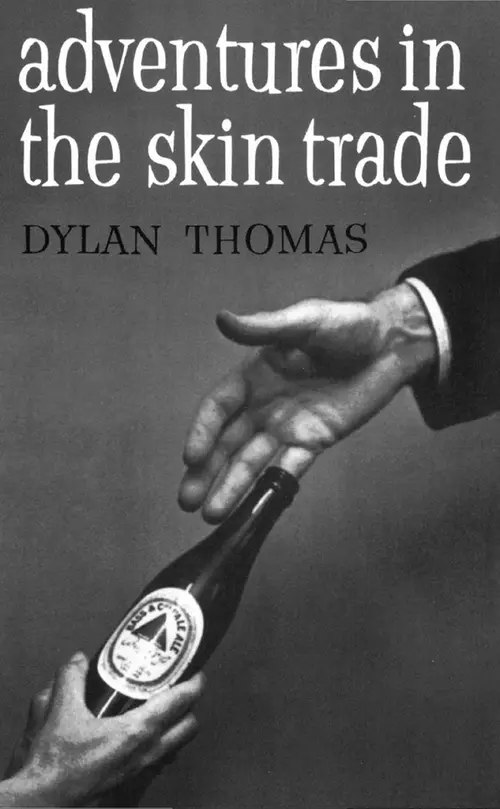
Title Page
INTRODUCTION
In a writer of great originality there is sometimes a heckler closer to him than his admirers, a dissenter who will not keep step with his fame, a spur which contradicts progress. Such a writer was Dylan Thomas. He began as a single performer. He created his own audience. Being very intelligent and witty, he could judge their reactions several years before the applause came. When it came he had already lost interest in his self-created audience, and found his true audience outside, in a sceptical world. His imagination kept a perverse integrity, resisting all favours. A religious poet, he sought the company of unbelievers. His ivory tower existed in the act of writing itself. Before and after the act, he challenged it with every hostile and contradictory element, and it remained untouched.
To Dylan Thomas, the writing of poetry was the most exacting and, potentially, the most rewarding work in the world. He was, when I first met him at the age of twenty, completely absorbed in the mystery of language, in the latent power of words and the magic of their substitution. He had no political interest, no programme of social reform. It was the power of language itself which obsessed him, its ability to restate the great themes which haunted his imagination—the Book of Genesis, the creation of man, the Garden of Eden, the opening eyes of the suckling, the unfolding universe, and the closing eyes of the witness of the reciprocal vision of heaven and of this world. With his first book, 18 Poems, he had astonished the public by the use of an idiom which recurred throughout the poems and controlled these themes, as from a battery, by a concise and suggestive force. The idiom, new to English poetry, was unmistakable:
I see the boys of summer in their ruin …1
The force that through the green fuse drives the flower
Drives my green age….2
I sit and watch the worm beneath my nail
Wearing the quick away.3
A candle in the thighs
Warms youth and seed and burns the seeds of age;…4