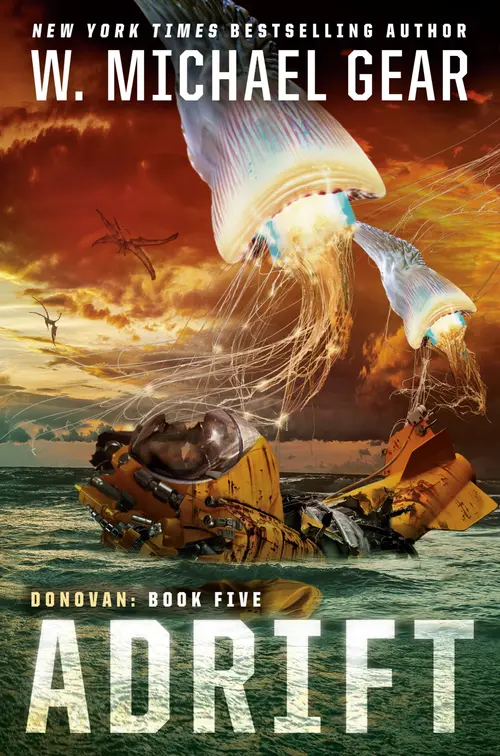
Adrift
Cover
DAW BOOKS PROUDLY PRESENTS THE SCIENCE FICTION NOVELS OF W. MICHAEL GEAR:
The Donovan Series
Outpost
Abandoned
Pariah
Unreconciled
The Team Psi Series
The Alpha Enigma
Implacable Alpha*
The Spider Trilogy
The Warriors of Spider
The Way of Spider
The Web of Spider
The Forbidden Borders Trilogy
Requiem for the Conqueror
Relic of Empire
Countermeasures

Starstrike
The Artifact
*Coming soon from DAW
Dedication
TO BRIAN AND LEXIE YARRINGTON
FOR ALL THE YEARS OF BEER, FOOD, AND FELLOWSHIP.
ACKNOWLEDGMENTS
Special appreciation goes to my old and dear friend, Sheila Gilbert, for standing by me through the insanity of a changing literary world. By the time this is published, we can only hope that political censors are a thing of the past and authors can write from their hearts without fear of reprisal. To better days and a return to freedom of speech. Thanks, Sheila, for helping to weather the storm and for your continued faith in the Donovan books.
As always, my beloved Kathleen—center of my heart and the axis of my universe—has supported, been critical of, and kept the creative blood flowing through the Donovan universe. All that I am is because of her. You wouldn’t be reading this if Kathleen hadn’t been willing to seize the dream all those years ago when we were eating pizza on our first date. I owe her so much.
1
The long ocean swells might have been on Earth. Physics are physics after all. The same on Donovan as in the Pacific, Atlantic, or Indian Oceans; though the water here was a deeper blue—a sort of royal turquoise. These waves were running about a meter and a half, occasionally cresting into whitecaps as the foam was wicked off in streamers.
The warm wind, too, could have been on Earth; it carried odors of salt and spray. It blew in from the northeast, gusting against the curved walls of the Maritime Research Unit’s Pod. The Pod was essentially a two-story sialon tube set north-south on pilings. With a small landing pad on the roof, a deck that could be raised or lowered to sea level on the northeast, and the Underwater Bay, a submerged submarine hanger and ocean access, the wind-blown tube now functioned as humanity’s lonely base for the exploration of Donovan’s oceans.
If Scientific Director Michaela Hailwood was any judge of the weathervane atop the station’s high mast, it was blowing from about forty degrees and pushing close to ten knots. Overhead, low puffy bits of cloud rode the zephyr. Torn and twisted by turbulence, they seemed to dance against a background of higher cirrus in Donovan’s deeper-blue sky.
Born on Apogee Station, Michaela had taken an improbable path to scientific director. Her African and European ancestors had come from industrial and urban stock, not to mention that station-born folk were rarely drawn to such fields as oceanography. She had reached the ripe age of forty-eight, stood right at six feet, and her build remained rail-thin—as did the rest of her team’s—after the years of privation during the ten-year-long transit from Solar System aboard Ashanti.
Michaela centered her attention on the restless sea. Swells were all about friction: the interface of moving air on water. Donovan’s moon massed more than Luna did back in Solar System, so Donovanian tides could be fierce. But here, five hundred kilometers east of the nearest shoreline, and at this latitude, the effect was ameliorated.
More than a million years ago, a meteor strike had forever altered the continental landform. Blasted out the five-hundred-kilometer crater like taking a giant bite out of the coastline. Michaela’s research station had been situated on a narrow reef created by the ejecta. It was one of a line of shoals that ran like a string of beads around the Gulf’s eastern circumference. A million years of wave action and tides had worn down the land that had once protruded above the ocean’s surface.
Donovan was a living world. The triangular sails of what her people had named seaskimmers could be seen in the distance. To date, Michaela and her team were unsure what they were. The closest analogy was that the seaskimmers were a Donovanian equivalent to the terrestrial Portuguese man-of-war, the small bladder-topped siphonophore. But there the comparison stopped. Seaskimmers were nearly thirty meters tall and similar to a lateen-rigged sailboat. Unlike a man-of-war, they had no subsurface tentacles but seemed to use wind power to chase down prey. The sail itself appeared to be a membrane, stiffened by something analogous to cartilage ribs that trailed filaments at the tips. To date, Michaela’s team hadn’t managed to get a closeup image of the creature’s lower and buoyant body, but it was streamlined, reminiscent of a racing hull. From the single blurred visual they’d taken, the creature had three eyes and a triangular mouth. Based on morphology, at least three different species of seaskimmers could be distinguished.
And then, off in the distance, they’d also seen something that looked like a glowing cone with tentacles. The thing floated, apparently dangling its tentacles into the water, though what it might harvest outside of plankton was up for grabs.
Michaela rubbed her arms against the chill coming off the water. The distant seaskimmers flipped in the wind, tacking eastward in unison. Capella’s light shimmered in the iridescent colors that rippled over the sails. Brilliant reds, yellows, greens, and blues flowed across the membrane in complex patterns.
“Probably some form of communication,” she whispered, taken by the beauty of it. Communication by patterns and colors was one of the givens on Donovan. At least, that was the case on land where people now knew that quetzals and mobbers communicated by color and pattern. There was speculation that the invertebrates and perhaps even the plants did as well.
She heard the hatch cycle behind her and turned as her second-in-command, Lee Shinwua, Shin for short, stepped out into the wind. Still looking half-starved, the man’s clothes hung on his broad-shouldered body. The stiff gusts played with his spacer-short black hair, and he squinted his nut-brown eyes into the wind, which accented their Asian cast. He was thirty-six with a PhD from ScrippsCal University. As with her origins in Apogee Station, Shinwua’s Uyghur roots wouldn’t have predisposed him to a degree in oceanography. Somehow, however, he’d managed to navigate the Corporate system, aced the exams, and landed a coveted appointment to the SCU. That he’d graduated magna cum laude, published prodigiously on deep-water resources, and cultivated the right sponsorship on the Board had wrangled him a place on Michaela’s team.
Shin stepped up beside her, squinting into the wind’s bite. “Thought you might be here. Got a problem with the main refrigeration unit. Got Tobi Ruto working on it. Looks like it’s some sort of fried circuit. We don’t have a spare. Tobi’s not sure how to fix it.”
She glanced at him. “No spare? Again?” Seemed like half the equipment they tried to fix didn’t have a spare, or if it did, it was the wrong part. For the first maritime expedition on Donovan, they were off to a rocky start. They had only been in the Pod for a week, unpacking, setting up, testing equipment, and preparing to initiate the first study of Donovan’s oceans. They had suffered one malfunction after another.
Shin shrugged. “If we have one, it’s not in the listed inventory. I guess from what Tobi tells me, it’s a common sort of part that rarely fails, and if it does, you just order one. Dharman called Corporate Mine. They don’t have one. Not sure Port Authority does, either. But they’re asking around.”
She chuckled dryly, eyes on the endless swells that rolled toward them to vanish beneath the platform and slosh against the Pod’s pilings. In Capella’s harsh light and crystalline water, she could see the reef three meters beneath the surface. Patterns of vegetation—in a mosaic of green and blue—mottled the water-worn rock. Something big, torpedo-like, jetted from under the pod to vanish from sight. Who knew what it might be?
Michaela told him, “Have Tobi call Sheyela Smith, that electrician in Port Authority. If she doesn’t have the part, she’ll know how to jury rig something to make the refrigeration work.”
“Um, doesn’t Sheyela Smith need to be, like, paid? You know, part of this market economy they’re so proud of? We have some sort of deal worked out with them?”
“Supervisor Aguila said she’d dicker something until we could figure out a suitable method of compensation.” Michaela gave him a shrug. “It’s so weird. So different. Haphazard and chaotic. Back home everything was ordered. Even on Ashanti we knew where we fit, how it all worked.”
Shin stuffed his hands into his back pockets. “Scary, huh? This whole world. I don’t get it. After everything we’ve been through. All the hell we lived on Ashanti: knowing the Unreconciled were eating each other down in Deck Three; the starvation; the years of being locked in that little space. We should be prepared for anything. You know that everyone’s on the edge of panic, don’t you? That it’s sinking in that we’re here. All alone.”
She nodded, staring out at the waves. “It’s never been just us, Lee.”
“Not on Ashanti, that’s for sure. We were surrounded by crew. And back on Earth? The whole of Solar System was just a short shuttle’s ride away.” A pause. “You been sleeping? Well, I mean?”
Did she dare tell him?
Taking a breath, she said, “It’s a new environment. Takes getting used to. Different sounds, different smells. Hell, even the beds are different. Brand new . . . never slept in. Everything’s clean and fresh. Like this air. It doesn’t stink of ship and human. And then there was that briefing Aguila and that Perez woman gave us back at Port Authority. Watch out for this monster, watch for that monster. Be careful of the wildlife. Donovan will try to kill you. Give it a while for our people to adjust.”
He grunted, then said, “The kids are having nightmares. Lot of them wish they were back on the ship.” A beat. “And it’s not just the kids.”
“Back on the ship? We prayed for ten years, desperate to get the hell out of Ashanti.” She didn’t dare tell Shin that she, too, dreamed of being locked back in the limited confines of Ashanti’s Crew Deck. And she did have nightmares. A recurring theme was of water cascading into her cramped quarters, rising, and there was no way out. Which was absurd; there wasn’t that much water aboard Ashanti.
“It’s this.” Michaela waved an arm out at the endless waves marching their way. “The vast immensity of it. Nothing but water. In all directions. Endless water, endless sky, with no roof, no safe walls. And here we are, with just the Pod. Our little universe. Shouldn’t be any different than being locked in Ashanti, right? Or being out in the middle of the south Indian Ocean back on Earth.”
“But it is.” Shin’s gaze fixed on the swells. Gave the impression that the Pod was moving instead of the water. “Okay, so I know the specs. I know what kind of forces the Pod can endure. The thing’s essentially crush-proof, can withstand just about anything the ocean can throw at it. Solid sialon casing and floors.” He rapped a knuckle against the white wall behind him. “But it’s like this thin shell is the only thing between us and drowning.”
“You having nightmares of your own?”
The dull acquiescence in his brown eyes provided all the answer she needed. Played right in concert with her own tortured dreams of sinking into dark water, of holding her breath. Desperate. Then finally gasping, sucking in an endless rush of cold ocean. Even awake and aware, she could still feel the cold filling her lungs, the terror of drowning . . .
Michaela shivered. Shook it off. Appalled that Lee had seen, knew her weakness. All of which triggered her sense of frustration and fury. Damn it, she was the Director of Scientific Research, second-in-command only to Board Supervisor Kalico Aguila. The Board had appointed Michaela to the Directorship because of her iron will, her expertise in the field. To show any—
“It’s all right,” Shin interrupted her thoughts. “After all that time in Ashanti? There’re no secrets left. You can be human like the rest of us.”
“No secrets left,” she whispered in agreement. “Isn’t that the truth?”
They’d been packed together on Crew Deck after the Unreconciled had tried to seize the ship: twenty-three people jammed into four small cabins.
They’d had no privacy. Had to live cramped together—ass to armpit as the saying went. Had to endure all the trials humans inflicted upon each other in close proximity. They’d fought, formed alliances that shifted through time, hated each other, loved each other, swapped partners, squabbled and made up, and finally sorted themselves into a sort of extended family. One that tolerated each other despite the histories, jealousies, sexual complications, and remembered slights. Well, all but Dr. Anna Carrasco Gabarron. She was like the despised aunt that everyone stoically endured as a sort of cosmic punishment for his or her sins.
“You kept us sane, you know,” Shin told her. “Otherwise, we’d never have made it. You were the one who ordered us out of Deck Three. Sided with Captain Galluzzi before we could make any other choice.”
So, did that make her any less timid now that they were dirtside, alone on an empty and hostile planet in the middle of an uncharted and unknown ocean? An ocean that, if they could trust the briefings the Supervisor had given them, was full of creatures that would try to kill them?
A violent gust hit her, fluttering her coveralls, causing her to stagger. She ran a hand over the tight curls of her short black hair. “We’ll be fine. All of us, we’ve trained for this. We’re the best Solar System had to offer. Wind, waves, wildlife, we’re the experts. If anyone can make a go of it, it’s us.” A beat. “We just need to get out there, Shin. Get our hands dirty, start doing research, and everything will fall into place.”
Shin studied the waves with shining eyes. “You’re right. Once we start exploring, get the subs and UUVs out, I think the nightmares and fears will fade away. It’s just knowing that if anything goes wrong, there’s no Corporation a com call away. No Coast Guard. No other ships. No search and rescue.”
A large swell—one that almost reached the deck—swept beneath them, crashing on the Pod’s duraplast pilings. To Michaela’s relief, she didn’t even feel its impact. The Pod was solid. Dreams of drowning in the darkness were just plain silly.
Then, as if spiraling out of the back of her mind, the words of Wejee Tolland—who’d been on guard at the Mine Gate back in Port Authority—repeated in her head: “But if an old hand can give you any advice, Dr. Hailwood, you’ll live a lot longer if you’ll take for granted that everything on this planet is trying to kill you.”
Damn it, they had to get out there, start cataloging. Of course, it would be different than being on Earth, but if they couldn’t figure out Donovan’s oceans, no one could. They’d be careful; they’d been dealing with sharks, rays, eels, sea snakes; and they had the best technology available.
“What’s that look?” Shin asked, fixing on her expression.
“Nothing.” She pointed where the colorful seaskimmers were tacking against the stiffening wind. They’d passed over the horizon now, their triangular sails fading behind the line of rising and falling swells. “No matter what Supervisor Aguila tells us, how could something that beautiful be dangerous?”
“Michaela,” Shin chided, “the situation here, it’s not like life on the mainland. We’re in the Pod. Not directly exposed to the wildlife. In the sub—which is a pretty tough piece of equipment—we’ll be perfectly safe. It’s made to withstand pressures down to thirty thousand feet. Nothing on this planet could crush it. And most of our work is going to be with the UUVs.” UUV stood for unmanned underwater vehicle, the AI and remote-controlled drones that would be doing the majority of the underwater survey and exploration.
As her gaze fixed on the water, a gap in the high cirrus let Capella’s light fully illuminate the shallows. It could have been a trick, an illusion created by the pattern of the waves and the undulating vegetation beneath, but something large seemed to flit away with remarkable speed, as if it had suddenly determined she was looking at it.
“Now what’s wrong?” Shin asked.
“I keep thinking of something Wejee once told me. He works gate security in Port Authority. He said, ‘Nobody has ever died of old age on Donovan.’”
2
Water ran around Corporate Supervisor Kalico Aguila’s boots as she sloshed up the inclined adit. They called the sloping tunnel the Number Three. It had been driven into the base of the mountain three hundred meters below Corporate Mine’s fenced compound.
Her muscles ached. She still hurt from her frantic escape from the Unreconciled. Now, barely having time to catch her breath, her engineers had asked her to take a look at the Number Three. Damn it, she had too much to do. And Michaela Hailwood kept asking when she’d be out to inspect the Maritime Unit, said she had issues that needed to be dealt with.
Issues? Who the hell on Donovan didn’t have issues?
Around Kalico, the rock walls had been intricately shored with timbers that supported zones of shattered rock. In principle, the adit had been a good idea. Drive a tunnel at an inclined angle from the base of the mountain to just below the expanding stope in the Number One mine. In the stope, water had become an increasing problem, one that was rapidly overwhelming the Number One’s single-pump capacity. Better to use gravity as a drain than to keep building pumps, pipes, and hoses. Additionally, instead of hauling ore out in the skip, winching it to the surface, and transporting it by tram, her crew could dump ore into a hopper and drop it down a vertical shaft into a waiting ore car. The ore car would unload it into a tipple that would fill a hauler at the adit’s mouth, or portal. From there it could be driven to the smelter for processing. And finally, the adit would give her people another egress in the event of a disaster as well as improve ventilation now that they were working deeper and deeper into the mine.
A simple solution to a lot of problems, all of which had proved to be an incredible headache.
She and her engineers had understood that opening a haul road between the adit mouth and the smelter would be a battle. On Donovan, trees moved. And this was deep forest. Kalico and her people had barely won the fight to keep the relentless forest from overrunning her measly seven acres of farmland and its contiguous smelter. Fortunately, she had been able to secure enough terrestrial pine trees from Mundo Base to establish a line. Something about the chemistry in pines repelled Donovanian plant life. Her road would have to be lined with pines, which meant she was harvesting every cone that matured down at Mundo Base. Once sprouted, the seedlings were nurtured with extra care. Armed patrols planted the seedlings where aquajade, chabacho, and ironwood was cut for shoring. Meter by meter, the haul road was being established. Might be another three years before enough pines could be grown to line the entire route.
Next came the problem of the adit. Her engineers, Desch Ituri and Aurobindo Ghosh, had carefully surveyed the slope, determined the angle and distance, and begun driving the Number Three adit. What they hadn’t counted on was the zone of shattered rock they hit two hundred meters into the mountain. This was, after all, the edge of a crater. One caused by an asteroid impact powerful enough to penetrate the planet’s crust. Shattered rock wasn’t a big surprise. And it was remarkably rich in valuable metals, so it was profitable to extract. On the downside, it also crumbled the moment it was undercut. The technical term for the roof collapse was goafing. Problem was, once excavated, the tunnel roof just kept goafing its way up through the shattered rock zone. What Ghosh called “void migration.” Like hollow rot eating its way up through the mountain’s guts, or a bubble of empty space rising through ever-collapsing rock. Leave it go for long enough, and the whole volume above the adit would consist of loose fill that had to be supported.
The solution was that shoring had to be built bit by bit as the adit was drifted into the mountain. They fought a constant battle to keep the adit roof, or head rock, supported.
Structural stability wasn’t the only problem with shattered rock. Unlike higher in the Number One and Number Two mines, the shattered rock in the Number Three had the porosity of a sponge. Water trickled out of it by the bucketful. Because of the incline, Ituri had cut a ricket, or gutter, into the floor that now ran a full stream of toxic heavy-metal-rich water. What Ituri called the “water-make” was now just over one hundred and twenty gallons a minute.
The Story Continues on BooksBarbecue!
Enjoyed this preview? ❤️ Do not stop here!
Read the complete book free online → 🔗
Continue reading now on BooksBarbecue and discover every page!
Love reading? Bookmark BooksBarbecue.com for more amazing books!
Happy Reading!