Accident
Accident
ACCIDENT
. . . And I tell you this—it’s the same woman—not a doubt of it!”
Captain Haydock looked into the eager, vehement face of his friend and sighed. He wished Evans would not be so positive and so jubilant. In the course of a career spent at sea, the old sea captain had learned to leave things that did not concern him well alone. His friend, Evans, late C.I.D. Inspector, had a different philosophy of life. “Acting on information received—” had been his motto in early days, and he had improved upon it to the extent of finding out his own information. Inspector Evans had been a very smart, wide-awake officer, and had justly earned the promotion which had been his. Even now, when he had retired from the force, and had settled down in the country cottage of his dreams, his professional instinct was still active.
“Don’t often forget a face,” he reiterated complacently. “Mrs. Anthony—yes, it’s Mrs. Anthony right enough. When you said Mrs. Merrowdene—I knew her at once.”
Captain Haydock stirred uneasily. The Merrowdenes were his nearest neighbours, barring Evans himself, and this identifying of Mrs. Merrowdene with a former heroine of a cause célèbre distressed him.
“It’s a long time ago,” he said rather weakly.
“Nine years,” said Evans, accurately as ever. “Nine years and three months. You remember the case?”
“In a vague sort of way.”
“Anthony turned out to be an arsenic eater,” said Evans, “so they acquitted her.”
“Well, why shouldn’t they?”
“No reason in the world. Only verdict they could give on the evidence. Absolutely correct.”
“Then that’s all right,” said Haydock. “And I don’t see what we’re bothering about.”
“Who’s bothering?”
“I thought you were.”
“Not at all.”
“The thing’s over and done with,” summed up the captain. “If Mrs. Merrowdene at one time of her life was unfortunate enough to be tried and acquitted for murder—”
“It’s not usually considered unfortunate to be acquitted,” put in Evans.
“You know what I mean,” said Captain Haydock irritably. “If the poor lady has been through that harrowing experience, it’s no business of ours to rake it up, is it?”
Evans did not answer.
“Come now, Evans. The lady was innocent—you’ve just said so.”
“I didn’t say she was innocent. I said she was acquitted.”
“It’s the same thing.”
“Not always.”
Captain Haydock, who had commenced to tap his pipe out against the side of his chair, stopped, and sat up with a very alert expression.
“Hallo—allo—allo,” he said. “The wind’s in that quarter, is it? You think she wasn’t innocent?”
“I wouldn’t say that. I just—don’t know. Anthony was in the habit of taking arsenic. His wife got it for him. One day, by mistake, he takes far too much. Was the mistake his or his wife’s? Nobody could tell, and the jury very properly gave her the benefit of the doubt. That’s all quite right and I’m not finding fault with it. All the same—I’d like to know.”
Captain Haydock transferred his attention to his pipe once more.
“Well,” he said comfortably. “It’s none of our business.”
“I’m not so sure. . . .”
“But surely—”
“Listen to me a minute. This man, Merrowdene—in his laboratory this evening, fiddling round with tests—you remember—”
“Yes. He mentioned Marsh’s test for arsenic. Said you would know all about it—it was in your line—and chuckled. He wouldn’t have said that if he’d thought for one moment—”
Evans interrupted him.
“You mean he wouldn’t have said that if he knew. They’ve been married how long—six years you told me? I bet you anything he has no idea his wife is the once notorious Mrs. Anthony.”
“And he will certainly not know it from me,” said Captain Haydock stiffly.
Evans paid no attention, but went on:
“You interrupted me just now. After Marsh’s test, Merrowdene heated a substance in a test tube, the metallic residue he dissolved in water and then precipitated it by adding silver nitrate. That was a test for chlorates. A neat unassuming little test. But I chanced to read these words in a book that stood open on the table:
H2SO4 decomposes chlorates with evolution of CL4O2. If heated, violent explosions occur; the mixture ought therefore to be kept cool and only very small quantities used.”
Haydock stared at his friend.
“Well, what about it?”
“Just this. In my profession we’ve got tests too—tests for murder. There’s adding up the facts—weighing them, dissecting the residue when you’ve allowed for prejudice and the general inaccuracy of witnesses. But there’s another test of murder—one that is fairly accurate, but rather—dangerous! A murderer is seldom content with one crime. Give him time, and a lack of suspicion, and he’ll commit another. You catch a man—has he murdered his wife or hasn’t he?—perhaps the case isn’t very black against him. Look into his past—if you find that he’s had several wives—and that they’ve all died shall we say—rather curiously?—then you know! I’m not speaking legally, you understand. I’m speaking of moral certainty. Once you know, you can go ahead looking for evidence.”
“Well?”
“I’m coming to the point. That’s all right if there is a past to look into. But suppose you catch your murderer at his or her first crime? Then that test will be one from which you get no reaction. But suppose the prisoner acquitted—starting life under another name. Will or will not the murderer repeat the crime?”
“That’s a horrible idea!”
“Do you still say it’s none of our business?”
“Yes, I do. You’ve no reason to think that Mrs. Merrowdene is anything but a perfectly innocent woman.”
The ex-inspector was silent for a moment. Then he said slowly:
“I told you that we looked into her past and found nothing. That’s not quite true. There was a stepfather. As a girl of eighteen she had a fancy for some young man—and her stepfather exerted his authority to keep them apart. She and her stepfather went for a walk along a rather dangerous part of the cliff. There was an accident—the stepfather went too near the edge—it gave way, and he went over and was killed.”
“You don’t think—”
“It was an accident. Accident! Anthony’s overdose of arsenic was an accident. She’d never have been tried if it hadn’t transpired that there was another man—he sheered off, by the way. Looked as though he weren’t satisfied even if the jury were. I tell you, Haydock, where that woman is concerned I’m afraid of another—accident!”
The old captain shrugged his shoulders.
“It’s been nine years since that affair. Why should there be another ‘accident,’ as you call it, now?”
“I didn’t say now. I said some day or other. If the necessary motive arose.”
Captain Haydock shrugged his shoulders.
“Well, I don’t know how you’re going to guard against that.”
“Neither do I,” said Evans ruefully.
“I should leave well alone,” said Captain Haydock. “No good ever came of butting into other people’s affairs.”
But that advice was not palatable to the ex-inspector. He was a man of patience but determination. Taking leave of his friend, he sauntered down to the village, revolving in his mind the possibilities of some kind of successful action.
Turning into the post office to buy some stamps, he ran into the object of his solicitude, George Merrowdene. The ex-chemistry professor was a small dreamy-looking man, gentle and kindly in manner, and usually completely absentminded. He recognized the other and greeted him amicably, stooping to recover the letters that the impact had caused him to drop on the ground. Evans stooped also and, more rapid in his movements than the other, secured them first, handing them back to their owner with an apology.
He glanced down at them in doing so, and the address on the topmost suddenly awakened all his suspicions anew. It bore the name of a well-known insurance firm.
Instantly his mind was made up. The guileless George Merrowdene hardly realized how it came about that he and the ex-inspector were strolling down the village together, and still less could he have said how it came about that the conversation should come round to the subject of life insurance.
Evans had no difficulty in attaining his object. Merrowdene of his own accord volunteered the information that he had just insured his life for his wife’s benefit, and asked Evans’s opinion of the company in question.
“I made some rather unwise investments,” he explained. “As a result my income has diminished. If anything were to happen to me, my wife would be left very badly off. This insurance will put things right.”
“She didn’t object to the idea?” inquired Evans casually. “Some ladies do, you know. Feel it’s unlucky—that sort of thing.”
“Oh, Margaret is very practical,” said Merrowdene, smiling. “Not at all superstitious. In fact, I believe it was her idea originally. She didn’t like my being so worried.”
Evans had got the information he wanted. He left the other shortly afterwards, and his lips were set in a grim line. The late Mr. Anthony had insured his life in his wife’s favour a few weeks before his death.
Accustomed to rely on his instincts, he was perfectly sure in his own mind. But how to act was another matter. He wanted, not to arrest a criminal red-handed, but to prevent a crime being committed, and that was a very different and a very much more difficult thing.
All day he was very thoughtful. There was a Primrose League Fête that afternoon held in the grounds of the local squire, and he went to it, indulging in the penny dip, guessing the weight of a pig, and shying at coconuts all with the same look of abstracted concentration on his face. He even indulged in half a crown’s worth of Zara, the Crystal Gazer, smiling a little to himself as he did so, remembering his own activities against fortune-tellers in his official days.
He did not pay very much heed to her singsong droning voice—till the end of a sentence held his attention.
“. . . And you will very shortly—very shortly indeed—be engaged on a matter of life or death . . . Life or death to one person.”
“Eh—what’s that?” he asked abruptly.
“A decision—you have a decision to make. You must be very careful—very, very careful . . . If you were to make a mistake—the smallest mistake—”
“Yes?”
The fortune-teller shivered. Inspector Evans knew it was all nonsense, but he was nevertheless impressed.
“I warn you—you must not make a mistake. If you do, I see the result clearly—a death. . . .”
Odd, damned odd. A death. Fancy her lighting upon that!
“If I make a mistake a death will result? Is that it?”
“Yes.”
“In that case,” said Evans, rising to his feet and handing over half a crown, “I mustn’t make a mistake, eh?”
He spoke lightly enough, but as he went out of the tent, his jaw set determinedly. Easy to say—not so easy to be sure of doing. He mustn’t make a slip. A life, a vulnerable human life depended on it.
And there was no one to help him. He looked across at the figure of his friend Haydock in the distance. No help there. “Leave things alone,” was Haydock’s motto. And that wouldn’t do here.
Haydock was talking to a woman. She moved away from him and came towards Evans and the inspector recognized her. It was Mrs. Merrowdene. On an impulse he put himself deliberately in her path.
Mrs. Merrowdene was rather a fine-looking woman. She had a broad serene brow, very beautiful brown eyes, and a placid expression. She had the look of an Italian madonna which she heightened by parting her hair in the middle and looping it over her ears. She had a deep rather sleepy voice.
She smiled up at Evans, a contented welcoming smile.
“I thought it was you, Mrs. Anthony—I mean Mrs. Merrowdene,” he said glibly.
He made the slip deliberately, watching her without seeming to do so. He saw her eyes widen, heard the quick intake of her breath. But her eyes did not falter. She gazed at him steadily and proudly.
“I was looking for my husband,” she said quietly. “Have you seen him anywhere about?”
“He was over in that direction when I last saw him.”
They went side by side in the direction indicated, chatting quietly and pleasantly. The inspector felt his admiration mounting. What a woman! What self-command. What wonderful poise. A remarkable woman—and a very dangerous one. He felt sure—a very dangerous one.
He still felt very uneasy, though he was satisfied with his initial step. He had let her know that he recognized her. That would put her on her guard. She would not dare attempt anything rash. There was the question of Merrowdene. If he could be warned. . . .
They found the little man absently contemplating a china doll which had fallen to his share in the penny dip. His wife suggested going home and he agreed eagerly. Mrs. Merrowdene turned to the inspector:
“Won’t you come back with us and have a quiet cup of tea, Mr. Evans?”
Was there a faint note of challenge in her voice? He thought there was.
“Thank you, Mrs. Merrowdene. I should like to very much.”
They walked there, talking together of pleasant ordinary things. The sun shone, a breeze blew gently, everything around them was pleasant and ordinary.
Their maid was out at the fête, Mrs. Merrowdene explained, when they arrived at the charming old-world cottage. She went into her room to remove her hat, returning to set out tea and boil the kettle on a little silver lamp. From a shelf near the fireplace she took three small bowls and saucers.
“We have some very special Chinese tea,” she explained. “And we always drink it in the Chinese manner—out of bowls, not cups.”
She broke off, peered into a bowl and exchanged it for another with an exclamation of annoyance.
“George—it’s too bad of you. You’ve been taking these bowls again.”
“I’m sorry, dear,” said the professor apologetically. “They’re such a convenient size. The ones I ordered haven’t come.”
“One of these days you’ll poison us all,” said his wife with a half laugh. “Mary finds them in the laboratory and brings them back here, and never troubles to wash them out unless they’ve anything very noticeable in them. Why, you were using one of them for potassium cyanide the other day. Really, George, it’s frightfully dangerous.”
Merrowdene looked a little irritated.
“Mary’s no business to remove things from the laboratory. She’s not to touch anything there.”
“But we often leave our teacups there after tea. How is she to know? Be reasonable, dear.”
The professor went into his laboratory, murmuring to himself, and with a smile Mrs. Merrowdene poured boiling water on the tea and blew out the flame of the little silver lamp.
Evans was puzzled. Yet a glimmering of light penetrated to him. For some reason or other, Mrs. Merrowdene was showing her hand. Was this to be the “accident?” Was she speaking of all this so as deliberately to prepare her alibi beforehand? So that when, one day, the “accident” happened, he would be forced to give evidence in her favour. Stupid of her, if so, because before that—
Suddenly he drew in his breath. She had poured the tea into the three bowls. One she set before him, one before herself, the other she placed on a little table by the fire near the chair her husband usually sat in, and it was as she placed this last one on the table that a little strange smile curved round her lips. It was the smile that did it.
He knew!
A remarkable woman—a dangerous woman. No waiting—no preparation. This afternoon—this very afternoon—with him here as witness. The boldness of it took his breath away.
It was clever—it was damnably clever. He would be able to prove nothing. She counted on his not suspecting—simply because it was “so soon.” A woman of lightning rapidity of thought and action.
He drew a deep breath and leaned forward.
“Mrs. Merrowdene, I’m a man of queer whims. Will you be very kind and indulge me in one of them?”
She looked inquiring but unsuspicious.
He rose, took the bowl from in front of her and crossed to the little table where he substituted it for the other. This other he brought back and placed in front of her.
“I want to see you drink this.”
Her eyes met his. They were steady, unfathomable. The colour slowly drained from her face.
She stretched out her hand, raised the cup. He held his breath. Supposing all along he had made a mistake.
She raised it to her lips—at the last moment, with a shudder, she leant forward and quickly poured it into a pot containing a fern. Then she sat back and gazed at him defiantly.
He drew a long sigh of relief, and sat down again.
“Well?” she said.
Her voice had altered. It was slightly mocking—defiant.
He answered her soberly and quietly:
“You are a very clever woman, Mrs. Merrowdene. I think you understand me. There must be no—repetition. You know what I mean?”
“I know what you mean.”
Her voice was even, devoid of expression. He nodded his head, satisfied. She was a clever woman, and she didn’t want to be hanged.
“To your long life and to that of your husband,” he said significantly, and raised his tea to his lips.
Then his face changed. It contorted horribly . . . he tried to rise—to cry out . . . His body stiffened—his face went purple. He fell back sprawling over his chair—his limbs convulsed.
Mrs. Merrowdene leaned forward, watching him. A little smile crossed her lips. She spoke to him—very softly and gently.
“You made a mistake, Mr. Evans. You thought I wanted to kill George . . . How stupid of you—how very stupid.”
She sat there a minute longer looking at the dead man, the third man who had threatened to cross her path and separate her from the man she loved.
Her smile broadened. She looked more than ever like a madonna. Then she raised her voice and called:
“George, George! . . . Oh, do come here! I’m afraid there’s been the most dreadful accident . . . Poor Mr. Evans. . . .”
About the Author
About the Author
AGATHA CHRISTIE is the most widely published author of all time, outsold only by the Bible and Shakespeare. Her books have sold more than a billion copies in English and another billion in a hundred foreign languages. She died in 1976.
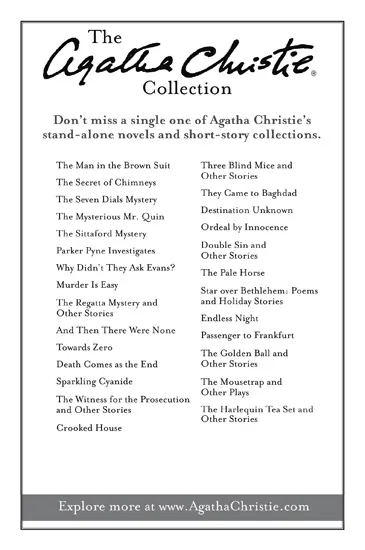
The Agatha Christie Collection
The Agatha Christie Collection
The Man in the Brown Suit
The Secret of Chimneys
The Seven Dials Mystery
The Mysterious Mr. Quin
The Sittaford Mystery
Parker Pyne Investigates
Why Didn’t They Ask Evans?
Murder Is Easy
The Regatta Mystery and Other Stories
And Then There Were None
Towards Zero
Death Comes as the End
Sparkling Cyanide
The Witness for the Prosecution and Other Stories
Crooked House
Three Blind Mice and Other Stories
They Came to Baghdad
Destination Unknown
Ordeal by Innocence
Double Sin and Other Stories
The Pale Horse
Star Over Bethlehem: Poems and Holiday Stories
Endless Night
Passenger to Frankfurt
The Golden Ball and Other Stories
The Mousetrap and Other Plays
The Harlequin Tea Set and Other Stories
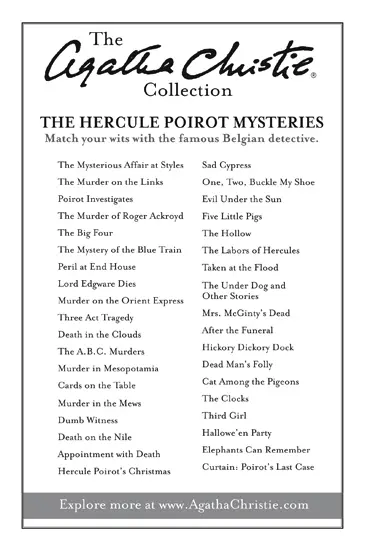
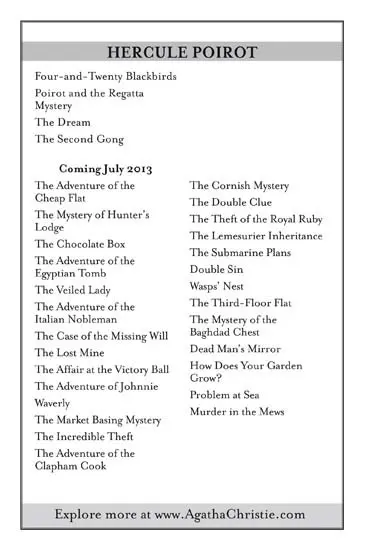
The Hercule Poirot Mysteries
The Mysterious Affair at Styles
The Murder on the Links
Poirot Investigates
The Murder of Roger Ackroyd
The Big Four
The Mystery of the Blue Train
Peril at End House
Lord Edgware Dies
Murder on the Orient Express
Three Act Tragedy
Death in the Clouds
The A.B.C. Murders
Murder in Mesopotamia
Cards on the Table
Murder in the Mews
Dumb Witness
Death on the Nile
Appointment with Death
Hercule Poirot’s Christmas
Sad Cypress
One, Two, Buckle My Shoe
Evil Under the Sun
Five Little Pigs
The Hollow
The Labors of Hercules
Taken at the Flood
The Under Dog and Other Stories
Mrs. McGinty’s Dead
After the Funeral
Hickory Dickory Dock
Dead Man’s Folly
Cat Among the Pigeons
The Clocks
Third Girl
Hallowe’en Party
Elephants Can Remember
Curtain: Poirot’s Last Case
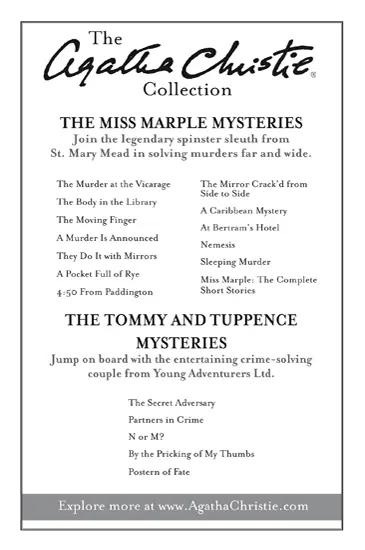
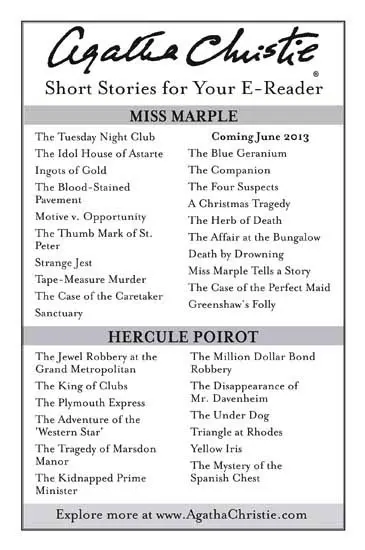
The Miss Marple Mysteries
The Murder at the Vicarage
The Body in the Library
The Moving Finger
A Murder Is Announced
They Do It with Mirrors
A Pocket Full of Rye
4:50 from Paddington
The Mirror Crack’d from Side to Side
A Caribbean Mystery
At Bertram’s Hotel
Nemesis
Sleeping Murder
Miss Marple: The Complete Short Stories
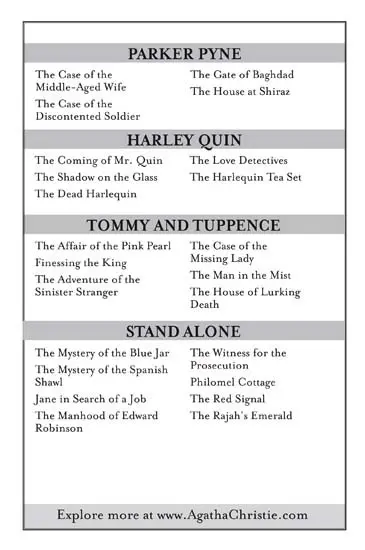
The Tommy and Tuppence Mysteries
The Secret Adversary
Partners in Crime
N or M?
By the Pricking of My Thumbs
Postern of Fate
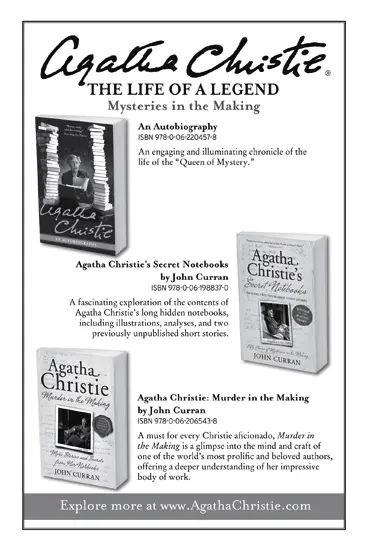
Memoirs
An Autobiography
Come, Tell Me How You Live

About the Publisher
About the Publisher
Australia
HarperCollins Publishers (Australia) Pty. Ltd.
Level 13, 201 Elizabeth Street
Sydney, NSW 2000, Australia
Canada
HarperCollins Canada
2 Bloor Street East - 20th Floor
Toronto, ON, M4W, 1A8, Canada
New Zealand
HarperCollins Publishers (New Zealand) Limited
P.O. Box 1
Auckland, New Zealand
United Kingdom
HarperCollins Publishers Ltd.
77-85 Fulham Palace Road
London, W6 8JB, UK
United States
HarperCollins Publishers Inc.
10 East 53rd Street
New York, NY 10022
The Story Continues on BooksBarbecue!
Enjoyed this preview? ❤️ Do not stop here!
Read the complete book free online → 🔗
Continue reading now on BooksBarbecue and discover every page!
Love reading? Bookmark BooksBarbecue.com for more amazing books!
Happy Reading!