Acastos
Cover Page
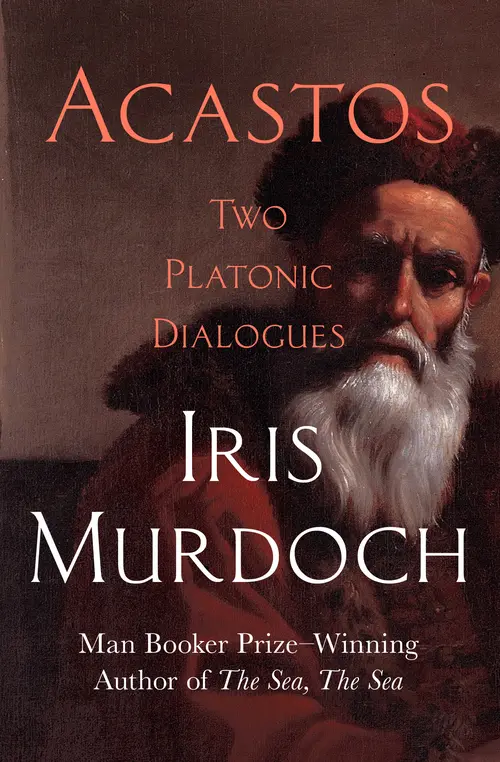

Title Page
ACASTOS
TWO PLATONIC DIALOGUES
Iris Murdoch

To Michael Kustow
ART AND EROS: A Dialogue about Art
ART AND EROS:
A Dialogue about Art
Characters in order of appearance
CALLISTOS a beautiful youth
ACASTOS a serious youth
MANTIAS a political man, in love with Callistos
DEXIMENES a cynical man
PLATO
SOCRATES
Athens in the late fifth century BC.
At the time of the dialogue, Plato is about twenty years old, Socrates about sixty.
Acastos, Callistos, Mantias and Deximenes are fictional characters.
The first performance of Art and Eros took place as a National Theatre Platform Performance in February 1980. The cast was as follows:
SOCRATES Andrew Cruikshank
PLATO Greg Hicks
ACASTOS Adam Norton
CALLISTOS Robin McDonald
MANTIAS Anthony Douse
DEXIMENES Michael Beint
The director was Michael Kustow
At the house of Deximenes.
Enter Callistos, Acastos, Mantias, Deximenes and Plato.
Callistos carries an actor’s mask.
Plato sits apart. They have just come from the theatre.
CALLISTOS
Oh wasn’t it great? That last scene was just–perfect– Oh I did enjoy the play! Didn’t you, Acastos?
ACASTOS
I’m not sure.
DEXIMENES
Acastos never knows what he feels.
CALLISTOS
You must know what you feel, who else could?
MANTIAS
Is Socrates coming?
CALLISTOS
Oh I do hope Socrates will come!
MANTIAS
Stop jumping around!
CALLISTOS
Did you like the play, Plato?
DEXIMENES
Did you like it?
MANTIAS
No, I never do.
DEXIMENES
Why do you go then?
MANTIAS
One must keep an eye on the theatre, it’s an influence.
CALLISTOS
I believe it all when it is happening.
ACASTOS
They say you shouldn’t do that, you should sort of realise that it’s a play, and –
MANTIAS
How can you not with actors speaking in those pretentious unnatural voices!
DEXIMENES
Plays aren’t serious. The theatre is cheap magic. Toys for conceited directors. A chance for half–educated people to think they’ve understood something. It’s unimportant.
MANTIAS
Nothing people like so much is unimportant.
CALLISTOS
Yes, everybody loves the theatre, not just us intellectuals.
Laughter
DEXIMENES
Art is all in the mind. It’s not in the play. We invent the art experience ourselves.
ACASTOS
So we all have different ones?
MANTIAS
I must say I think the theatre’s done everything now, after what we’ve had today. We’ve seen it all!
DEXIMENES
People always think their art is the end of art.
Callistos, who has been playing with his actor’s mask, suddenly puts it on and begins to declaim:
CALLISTOS
Zeus, whoever he may be, If he cares to bear this name –
MANTIAS
Oh shut up!
DEXIMENES
The theatre is humbug. But who wants it to be like life, it’s escape.
CALLISTOS
Yes, who wants it to be like horrid old life? It’s a dream world.
DEXIMENES
Monkey business on the stage and private fantasies in the audience!
MANTIAS
It’s magic all right. Did you see that audience? How many people? Ten thousand? All sitting absolutely silent and spellbound. Why should they? Why do they stay there? Theatre is a kind of miracle, it’s an influence. Magic can be very useful.
CALLISTOS
You want everything to be useful. Why don’t you just enjoy it?
DEXIMENES
He’s a politician!
Callistos starts eating some fruit.
MANTIAS
That isn’t just for you. Can’t you wait? Don’t play with it!
CALLISTOS
Oh, you’re so socially minded! I think politics should know its place.
MANTIAS
In our society its place is everywhere.
CALLISTOS
Sometimes I think a tyranny would be so relaxing, you wouldn’t have to think about politics at all.
ACASTOS
We’ll never have tyranny here, after all we invented democracy – Yes, I did enjoy the play, and it moved me – but I don’t know why.
MANTIAS
Precisely.
ACASTOS
But all sorts of things move us and we don’t know why.
MANTIAS
I think we should find out why people are moved.
DEXIMENES
You mean some of us should, so as to control the others!
CALLISTOS
All beauty is like that – it’s mysterious –
ACASTOS
Yes – And aren’t we forgetting that the plays are a religious festival?
DEXIMENES
Of course we are!
ACASTOS
I don’t like seeing the gods portrayed on the stage – after all, how do we know what the gods are like? It’s irreverent–
CALLISTOS
You are so old–fashioned. We know what we think about the gods.
ACASTOS
Do we? I don’t.
MANTIAS
Religion is important. We shouldn’t become too familiar with our gods.
CALLISTOS
There’s nothing wrong with irreverence, look at Aristophanes.
DEXIMENES
Well, look at him! [ gesture of disgust ]
MANTIAS
Satire can be influential, it matters what people laugh at.
ACASTOS
I don’t think people should laugh at religion, but I think it’s good if they can laugh at politicians!
MANTIAS
He who laughs at religion one day will despise his rulers the next. Democracies can perish because in the end people don’t believe in anything and don’t revere anything.
Enter Socrates. They all rise.
SOCRATES
Well, my dears, did you enjoy the play?
ACASTOS
We were just arguing about it, sir.
CALLISTOS
Bags I sit next to Socrates!
SOCRATES
It’s my lucky day!
DEXIMENES
Yes, I saw who you were sitting next to in the theatre.
SOCRATES
I have always worshipped beauty. Who’s over there?
CALLISTOS
Plato, he’s got one of his moods!
SOCRATES
What was your argument about?
DEXIMENES
Here we go!
CALLISTOS
Deximenes thinks the theatre is magic so it’s not important, and Mantias thinks the theatre is magic so it is important, and Acastos thinks we shouldn’t portray the gods, and Mantias thinks it’s bad to laugh at people and –
SOCRATES
And what do you think?
CALLISTOS
I think it’s fun!
MANTIAS
We were wondering what the theatre was for.
DEXIMENES
Need it be for anything?
CALLISTOS
Everything is for something, isn’t it, Socrates?
DEXIMENES
What are you for?
MANTIAS
Need you ask?
SOCRATES
He is young and will have many uses!
ACASTOS
Deximenes says the theatre is false. Can one say that art is true or false?
MANTIAS
I’d rather say good or bad, that is, good or bad for us.
ACASTOS
But you’re assuming –
SOCRATES
Wait, wait, not so fast. This is a difficult question. Shall we try to sort it out?
DEXIMENES
You sort it out, Socrates, we’ll listen.
SOCRATES
Shall I ask questions and get someone to answer?
DEXIMENES
Who is to stop you, my dear?
SOCRATES
Who shall answer? Let us have the youngest, then if he makes mistakes he need not blush.
DEXIMENES
Who is the youngest?
MANTIAS
Callistos is.
CALLISTOS alarmed
No, no, Plato is younger.
SOCRATES
I think Plato is communing with a god and we should not interrupt him. You shall answer.
CALLISTOS
Well, all right, but please don’t be cross if–
DEXIMENES
Socrates is never cross.
SOCRATES
Dear child! Perhaps we should start by considering art in general, and then move from the general to the particular. Do you agree?
MANTIAS
Yes, yes, yes.
SOCRATES
We speak, don’t we, of ‘the arts’ as a family. But isn’t it odd that we should classify them together when they are so unlike? It seems that we can see a common quality. Shall we attempt a definition of art?
ACASTOS
Oh yes!
SOCRATES
Then later we can see whether it can be called true or false, or good or bad, or whether it has a use. This won’t be easy, I think. Now since you are the victim today, how would you define art?
CALLISTOS
Well, art is the Odyssey and the Agamemnon and the Antigone and the statue of Athena in the Parthenon and music and –
SOCRATES
Wait a moment, this list could go on for ever! These are examples of art. But what is the ‘artiness’ which makes all these different things art?
CALLISTOS
You mean all art, any art?
SOCRATES
Yes.
CALLISTOS
Well – art is copying.
MANTIAS
Why do you suddenly say that?
SOCRATES
What do you mean by copying?
CALLISTOS
I mean like – like paintings – or like imitations of men and animals like you see on the Acropolis. Art tries to be like what things are really like.
SOCRATES
And the best art is the most like?
CALLISTOS
Yes.
MANTIAS
You’re contradicting what you said just now –
SOCRATES
So is sculpture a better art than painting?
CALLISTOS
Well – er –
SOCRATES
Painters represent men in two dimensions whereas sculptors represent them in three dimensions.
DEXIMENES
Be brave!
CALLISTOS
Yes, that’s better – and the theatre is the best of all because the actors are real men imitating real men.
ACASTOS very fast
That can’t be right, if you mean imitation like comparing a statue with a man. Old statues which don’t look like real people are often much better art – and if we just want to imitate real things why have art at all? Real men are more like men than marble men are. Or why not just put a cooking pot on a pedestal and call it art, or a few old bricks or – ?
DEXIMENES
If they were called art at least we’d look at them.
MANTIAS
What does music imitate?
SOCRATES
Don’t bully him. Perhaps you would like to restate your definition.
CALLISTOS
Yes, well music doesn’t seem to copy anything. A play tells a story of course, and that’s like life –
DEXIMENES
Is it?
SOCRATES
Go on, my child, try again.
CALLISTOS
Art is like a sort of form or diagram, it’s like life only sort of different, like summarised or simplified or –
SOCRATES
Do you want to give up your idea that art is copying, imitation of life?
CALLISTOS
No, but it’s copying into a world where everything looks different and clearer, and there’s no muddle and no horrid accidental things like in life.
ACASTOS
No horrid accidental things!
CALLISTOS
It’s like a map.
DEXIMENES
How dull.
SOCRATES
Art is a sort of formal copying into a medium where things look similar but clearer and simpler?
CALLISTOS
Yes!
MANTIAS
Before you came Callistos was saying art was fabulous and marvellous and beautiful and made him happy and so on! Why don’t you say that now? Why did you suddenly say that art is copying?
CALLISTOS smugly
Because I know Socrates likes a clear answer even if it’s wrong.
SOCRATES
Why did you start by talking about painting?
CALLISTOS
It seems most like what art’s really like, I mean here’s the thing and here’s the picture and you can sort of measure the one against the other.
MANTIAS
Do stop saying ‘sort of!
SOCRATES
Yes, and we often express ideas in visual images, as when we say of music that it’s high or low. I’m touched that you tried to please me by saying something clear. But perhaps your idea is still too simple. You spoke of an exact copy, then you spoke of a schematic copy, like a map. Don’t you want to add something? When you came out of the theatre you were excited and happy –
MANTIAS
I think we should start again –
Mantias is trying from now on to take over the argument. Acastos also wants to speak and keeps raising his hand. Socrates checks them with a gesture.
CALLISTOS
Yes, when I said about forms and maps that sounds dull, and art isn’t dull, it’s emotion and excitement and some art is thrilling like music or when you’re in the theatre and you don’t know what on earth it’s about but your heart beats and – of course painting isn’t exciting like that –
DEXIMENES
Oh come on – isn’t it – sometimes?
CALLISTOS puzzled for a moment
You mean like pictures, like those special pictures in Derkon’s house which show – ? Yes, but that’s sex.
DEXIMENES
Isn’t art about sex?
CALLISTOS
Well–
DEXIMENES
Don’t blush, you can’t shock Socrates.
SOCRATES
He looks charming.
ACASTOS
Of course we all have kinds of pictures of – But those horrible erotic scenes in Derkon’s house aren’t art at all, they’re just designed to –
DEXIMENES
Acastos is such a puritan, almost as bad as Plato.
ACASTOS
Well, what does Plato think?
He turns to Plato, but Plato ignores him.
MANTIAS
What’s the matter with him?
DEXIMENES
Jealousy. He wants Socrates all to himself.
MANTIAS
I see he’s taking notes again. Socrates told him not to.
SOCRATES
Go on, hold on to your idea, you’ve just discovered something you want to add, so perhaps you might now restate your definition.
CALLISTOS
You mean with sex in?
SOCRATES
Anything you like in.
DEXIMENES
You needn’t call it sex, call it passion.
SOCRATES
What does music do?
CALLISTOS
It expresses feelings and emotions and makes you feel as if the musical pattern went straight into your heart, into your body.
SOCRATES
Don’t you want to put something like that into your definition?
DEXIMENES
Oh come on!
CALLISTOS
Art is the expression of feeling, the communication of emotion. All art is like music really.
SOCRATES
You said it was like painting. Now you say it is like music. You used the word pattern. Now do you want to give up your idea that art imitates the world, in some way?
CALLISTOS
It won’t do for music – unless music copies something we can’t see or hear.
SOCRATES
Some say that the gods are always doing geometry. Perhaps they are always composing music too.
ACASTOS
I like that – and we sometimes overhear a little.
CALLISTOS
But art is about the world, how real things are changed into a sort of feeling – pattern, a feeling – thought or – sorry, I’m in a muddle –
SOCRATES
Go on, dear boy, don’t give up, try to catch something here. Remember, you are doing philosophy – and sometimes when you’ve been trying really hard to get a glimpse of an idea you can only talk about it in a kind of nonsense. So stop trying to be clear and just talk honest nonsense.
CALLISTOS trying hard
Art is a sort of copying or imitating, because it is about the real world somehow, though I’m not sure about music, and it has a pattern and form, so it does change things, it’s sort of neater and clearer than life, but it shows us real things with great – force – with emotion – and through seeing and hearing and imagining – and it’s not sort of analysed, it’s all condensed into one, like a thing – and it’s exciting and sexy and – oh dear –
SOCRATES
No, no, you’ve done very well. You’ve talked most excellent nonsense and helped our argument along splendidly. You said art was like a realistic picture, then you said it was like a map, then you said it was like music where an emotional pattern enters into the body. And just now you spoke of seeing and hearing and imagining. Are all arts something to do with the senses?
CALLISTOS
Yes, I think so –
ACASTOS
But–
SOCRATES
Acastos has been waving his hand at me for some time, let us hear what he has to say.
ACASTOS
I agree that art is to do with the senses – I mean poetry has rhythms and sounds and pictures have shapes and colours, and the body is involved, I don’t mean like sex –
DEXIMENES
Why not?
ACASTOS
But really art is thinking. I mean, good art is deep wise thinking. And bad art is bad because it’s stupid or depraved thinking. Callistos said something about a ‘feeling–thought’. I don’t know what that is. But I’m sure good art tells us something. It isn’t just a dose of emotion. It’s like vision – insight – knowledge –
SOCRATES
Good, good, you are continuing Callistos’s splendid nonsense! Copying, maps, feeling, thinking. Yes, we use all these ideas to help each other out, as each one by itself seems helpless. But still the ideas remain obscure, they stand as it were in a ring holding hands and each idea tries to support the next but cannot support itself. Do you want to keep Callistos’s idea that art is imitation of the world?
ACASTOS
Yes, but not simple like a real man and a marble man, it’s indirect.
CALLISTOS
I said it was different!
ACASTOS
The artist puts thoughts in, he’s a judge of reality.
SOCRATES
A judge suggests justice – truth –
ACASTOS
Yes, the idea of copying and judging means truth and morality. Art has got to be true. Deximenes said art is trickery and fantasy and perhaps bad art is, but good art is wisdom and truth. Art is looking at the world and explaining it in a deep way and when we understand the explanation or even half understand it we feel oh – such joy – and I think that’s what beauty is –
DEXIMENES
What about beauty in nature? Nature doesn’t explain!
Callistos, let off the hook, pats himself on the back, plays with the mask, tries to put it onto Mantias, who thrusts him away. Plato is listening attentively to what Acastos is saying.
ACASTOS
A man could copy cleverly, like in pornographic pictures, but if there’s no moral judgement and no thought the thing is dead and false. Callistos said art was sexy and I suppose it is sometimes, but I’d rather say it was to do with love, with really loving the world and seeing what it’s like. I think good art is passionate and holy.
SOCRATES
I like that, I like that–
ACASTOS
And it’s somehow true – I’m certain of that –
SOCRATES
Hold onto that certainty, my dear young friend.
Slight pause. Socrates glances at Plato, but Plato will not be drawn in. He drops his head sulkily.
I like your instincts. The good artist is wise, compassionate, just – but we’re in deep waters. You’ll have to think more carefully about what you mean by saying that good art is true.
DEXIMENES
Poetry isn’t true! This is getting too awfully high–minded for me.
ACASTOS increasingly excited by his ideas but confused
I mean, I think good art is good for us, it teaches us – great poetry is wise –
CALLISTOS he has donned the mask again and begins to declaim
Zeus, whoever he may be,
If he cares to bear this name –
MANTIAS
All this woolly talk has simply brought us to the obvious point which I wanted to make at the start! At last Acastos has quite accidentally said something sensible! He says good art is good for us! That’s the whole thing in a nutshell. It’s educational. Socrates said your ideas were standing in a circle holding hands and each trying to explain the next and couldn’t. My idea breaks the circle. If we think of art as education everything becomes clear, it answers all the questions – it’s clear why we classify the arts together, it makes sense of music, it clarifies this notion of morality which Acastos has introduced –
ACASTOS
I don’t mean that art is education.
MANTIAS
You said so!
ACASTOS
I said it was good for us.
MANTIAS
What’s the difference? I’m concerned with politics and social life, unlike some who are only interested in their own little messy private feelings. Politics is not self–centred, it’s to do with other people, with caring, with society. The essence of politics is explanation, that is persuasive explanation.
DEXIMENES
I thought the essence of politics was coercion.
MANTIAS
I said persuasive explanation, another name for this is rhetoric. And this explains the nature of art. Art is rhetoric. Not copying or music or thought. Rhetoric.
SOCRATES
You stun us with the simplicity of your idea.
MANTIAS
Well it’s so clear. And that’s how we distinguish between good and bad art. Good art makes good citizens, bad art makes bad citizens. It’s as simple as that.
SOCRATES
Do you define good art as art which benefits society?
MANTIAS after hesitation but firmly
Yes.
ACASTOS
Oh no!
CALLISTOS
Horrid!
MANTIAS
The really useful and valuable arts are the ones which make plain statements, stuff you can understand.
DEXIMENES
Lots of poetry is very obscure, or personal, or erotic.
MANTIAS
Art which is private and obsessive is bad, it distracts people from the real world, the public world. I should have thought that’s obvious and should be of interest to Acastos with his concern for truth! And erotic art makes people think that sex is the whole point of life!
CALLISTOS
Isn’t it?
DEXIMENES
All art can be used as pornography. Art happens in the mind. Even great art isn’t sacred. We all have obsessions.
MANTIAS
You have.
CALLISTOS
Sex is funny!
MANTIAS
An art which is solely concerned with sex and personal relations is selfish and untruthful. Wouldn’t you agree, Acastos?
Acastos is not sure
SOCRATES
Isn’t it the nature of art to explore the relation between the public and the private? Art turns us inside out, it exhibits what is secret. What goes on inwardly in the soul is the essence of each man, it’s what makes us individual people. The relation between that inwardness and public conduct is morality. How can art ignore it?
DEXIMENES
Mantias doesn’t believe in individual people.
MANTIAS
Yes, I do! That’s just what I do believe in and you don’t! Art must overcome the alienation of men from each other. It should try to make sense of society. [ To Acastos ] That’s better than private fantasy, isn’t it?
DEXIMENES
If you ban private personal relations you ban the whole of art.
MANTIAS
Our painting and our sculpture represent people who are physically healthy. I think our arts should represent people who are morally healthy!
SOCRATES
Who are these people?
MANTIAS
Good citizens.
DEXIMENES
I know, healthy handsome young men performing valuable social duties!
MANTIAS
All right, you jeer at the idea of the good citizen! What have you ever done with all that cleverness and idealism you had when we were their age?
Deximenes is hurt.
I’m sorry. This society is full of injustice and misery. Isn’t it, Acastos? Yes or no?
ACASTOS
Yes.
MANTIAS
Won’t the whole man, the decent man, try to change this, won’t he devote all he has to changing it? Why should artists be exempt? Why shouldn’t they use their talents to help their society? Art is a thought concealed in an emotional package, as Acastos said –
ACASTOS
I didn’t – I don’t think I did –
MANTIAS
Emotion is important but it must be simplified –
SOCRATES
The Story Continues on BooksBarbecue!
Enjoyed this preview? ❤️ Do not stop here!
Read the complete book free online → 🔗
Continue reading now on BooksBarbecue and discover every page!
Love reading? Bookmark BooksBarbecue.com for more amazing books!
Happy Reading!